


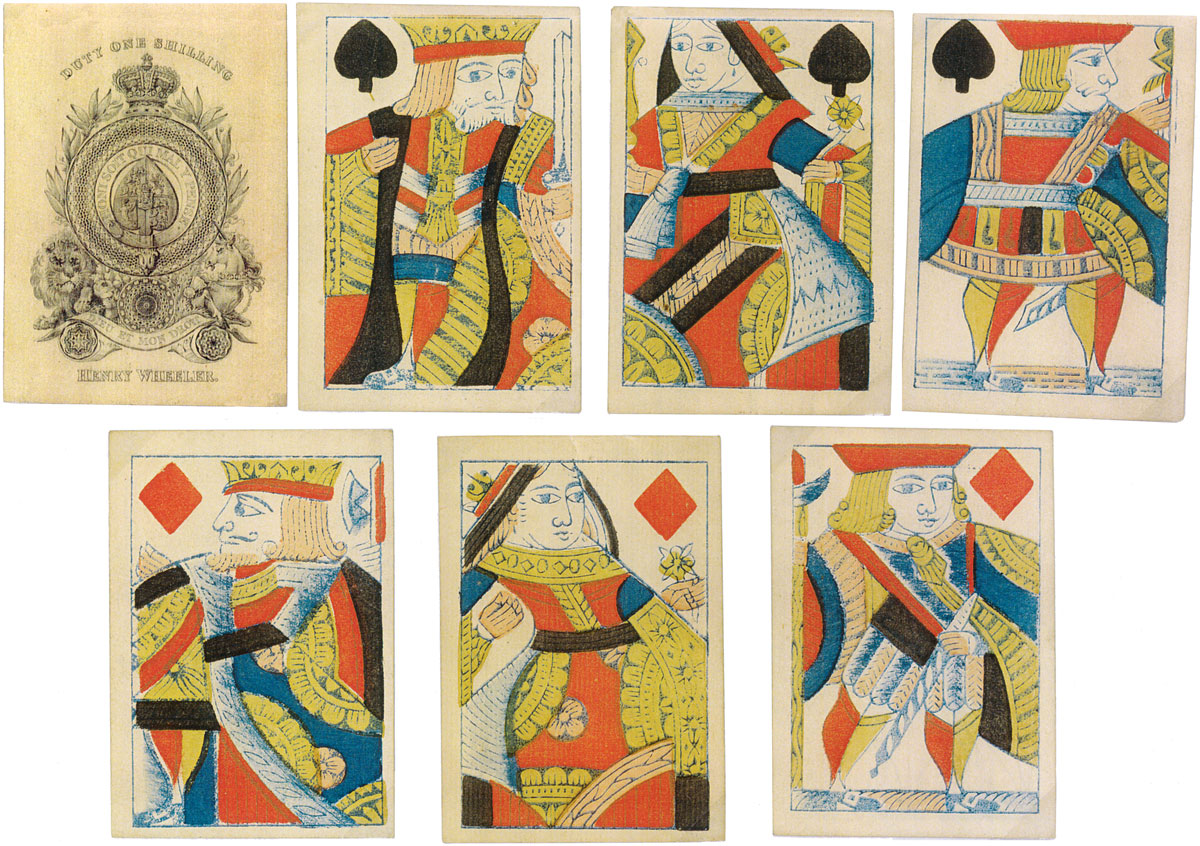
Henry Wheeler, manufacturer, c.1828
In 1836 Henry Wheeler was found guilty of using forged duty Aces of Spades.
In 1824 Henry Wheeler first appears at 4 Leather Lane, then at 93 Leather Lane in 1828 & 1829, then at 22 Greville St, Hatton Garden in 1830. By 1832 Henry has moved yet again to 25 Aldersgate, but by 1836 he’s at 122 St John Street, Smithfield, which is where he lived when indicted of owning Aces of Spades illegally. He is supposed to have been deported for this offence in 1836.
A Henry Wheeler appears at 3 Back Church Lane in 1839 and he is listed as a pasteboard-maker (not cards) from 1844-55 at 14 Coppice Row and in 1859 and 1860 at 16 Vineyard Walk, Clerkenwell. Whether this person was the deported Henry's son is not clear, but as he was born in 1817 he was clearly not the deported card-maker. In the 1871 census he is still listed as a card-maker (pasteboard) and his birth-place is given as Clerkenwell.
References:
Lodge, Ken: The Standard English Pattern (second revised and enlarged edition), Bungay, Suffolk, 2010.
All images and research courtesy Ken Lodge. Additional information obtained from census entries and Post Office directories in the London Metropolitan Archive.
• See also: Thomas Wheeler Ken Lodge's Blog►

By Donald Welsh
United Kingdom • Member since February 01, 1996

Activity for Henry Wheeler, manufacturer, c.1828
Sign in to comment or save this article.

Related Articles
Learning to play Cribbage
I learned to pay cribbage when I was very young, aged around six or seven.
77: The Standard English pattern - Part 1, the basics
A simple set of criteria for defining the standard English pattern
Marmite
Fifty-Four images celebrating a UK savoury spread, that has been around one hundred and twenty two y...
Hobby horse playing cards
Hobby horse playing cards produced by Michael Evans in a limited edition of 350 packs, 1986.
50: Joseph Reynolds
A presentation of my database of Reynolds cards.
Cribbage Board Collection part 3
A collection of antique and vintage Cribbage Boards by Tony Hall, part 3
Breedon Press Ltd
Playing cards advertising Sunspel underwear printed by the Breedon Press Ltd, Nottingham, c.1950
Watney’s Happy Families
A vintage Watney's Coombe Reid & Co Ltd promotional card game distributed by the brewery to their cu...
36: Minor Makers of the 19th Century
In 19th century England there were a number of makers who produced cards in relatively small quantit...
Suicide King
The King of Hearts, holding a sword behind his head, is sometimes nicknamed the “Suicide King”. He c...
Draughts League Medals
Arthur Charles Prince worked for De la Rue as a playing card cutter and later was promoted to superv...
Rider Waite Tarot early editions
Rider Waite Tarot early editions
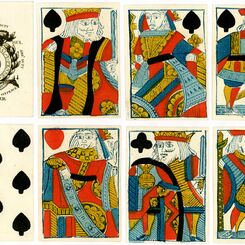
Thomas Wheeler
Thomas Wheeler appears in directories at 2 Richbell St (1799), 8 Middle Row, Holborn (1801), 118 Hol...
Animal Snap
The full set of this 'Snap' card game is believed to have 9 characters in sets of four, making a tot...
Berkshire Printing Co.
The company was founded in 1908 as the printing division of the Brooke Bond Tea Company in Reading. ...
Blanchard, c.1770
The style of these cards is descended from the earlier seventeenth century cards of makers such as H...
Waddington’s Playing Cards
John Waddington Limited was a leading producer of playing cards and card games in the UK during the ...
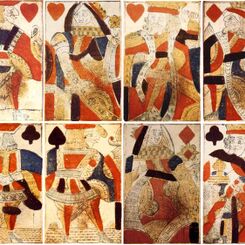
Hunt, c.1800
Standard English pattern playing cards manufactured by Hunt, c.1800.
Early English Playing Cards
Early examples of traditional, standard English playing cards of which the best known are those of H...
Collecting English Playing Cards & Games
The History of English Playing Cards dates probably from the mid 15th century, the first documentary...
Most Popular
Our top articles from the past 60 days


