


Tarock Cards by Antonín Kratochvíl
Excerpt from the catalog of a prominent Prague workshop.
One of the leading Prague card manufacturers of the late 19th and early 20th centuries was Antonín Kratochvíl (1842–1915). In 1879, he took over the management of the famous, well-established Prague firm Severa, which had been run in its final years (1875–1879) by Marie Severová, the widow of cardmaker Wenzel Sever. Kratochvíl then labeled his products “M. Severa, nasledník / W. Sewera’s Nachfolger” and listed the production address as Týnská St. 5 (German: Teingasse 5/I), where the Sever family’s workshop had also been located. Over time, before 1900, he moved his company to the address U Štupartů (German: Stupart). Antonín Kratochvíl’s workshop ceased operations in 1910, as announced in a newspaper advertisement dated January 15, 1910. The original firm was taken over by Ferd. Piatnik & Söhne.
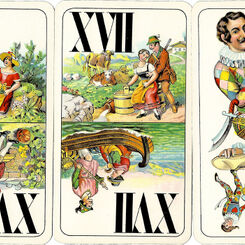
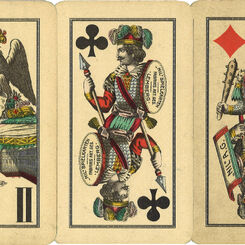
Tarock cards were a relatively common product among card manufacturers in 19th-century Austria-Hungary. The most common playing material was the Austrian Tarock, also known as Industrie und Glück, which has survived in Central Europe to the present day. From the perspective of the average user, the format and appearance of the cards are consistent; from the perspective of different manufacturers, the most significant variation lies primarily in the company logo, which is always placed on the Jack of Diamonds and the Jack of Clubs, and historically also on the Ace of Hearts. During development, changes were made to the genre-specific scenes, but these are easily interchangeable during normal gameplay.


One possible way to standardize the card design was the secondary use of printing plates from other manufacturers. This was a common solution at the time. Antonín Kratochvíl’s deck is a prime example of this.
The set of Genre scenes corresponds to the definition of Austrian Tarock Type B according to IPCS standards; Klaus Reisinger refers to this solution as Scheme V. A minor anomaly is the blue colour of the “Industrie und Glück” inscription on tarock II. It is usually yellow or ochre. The blue design is not unique to Kratochvíl; it appears on Austrian Tarock Type B decks produced around 1885. The tax stamp on the Ace of Hearts was used in Austria-Hungary between 1882 and 1899. This is also reflected in the manufacturer’s address, which is written in German here. The reverse side of the cards in the Vienna Lightning (ger. wienerblitz, a later developmental phase) design was popular at the time and is still in use today.


Above: Tarock Cards designed by Josef Neumayer and manufactured by Antonín Kratochvíl, Prague, 1899.
Closer inspection reveals that Kratochvíl used a secondary, older die created by engraver Josef Neumayer for his 68 x 126 mm cards. The design can be clearly identified by the preserved JN monogram on the buckle of the man’s belt in tarock card No. V. Neumayer’s monogram has been preserved in this location in many decks. The specific identification of the die is possible primarily from the date 1884 on tarock card No. II. Right at the edge, in the left corner of the image, there is also another JN signature, which is very illegible in Kratochvíl’s version.
In his book “Tarocke. Kulturgeschichte auf Kartenbildern” Klaus Reisinger identifies the company Ludwig Jäger in Vienna as the original commissioner of the matrix’s production. The same printing plates (or their transfers) were also used by the Viennese companies Ferd. Piatnik & Sons and Josef Glanz too.
Reisinger also presents other versions of Kratochvíl’s cards featuring these engravings—with different borders, set apart from the depicted motifs themselves. This modified version dates to the end of his workshop’s activity. The size of the image field and the appearance of the border frame typically followed the fashion trends of the time. The version with triple, narrow border lines (shown above) is, of course, older.

Sources and Acknowledgments
Klaus Reisinger : Tarocke. Kulturgeschichte auf Kartenbildern
Petr Kruml : “Výrobce karet Antonín Kratochvíl” (Card Maker Antonín Kratochvíl) in the 2020 Yearbook of the Card Game Collectors’ Club (Club sběratelů karetních her).
This article would not have been possible without the helpful assistance of Mr. Wolfgang Altfart and the use of his text “Makers of Playing Cards in Prague (Bohemia) From the 16th Century to 1918”.
IPCS : Austrian Tarock Type B ►
Open Call
Other Austrian Tarock cards from Antonín Kratochvíl’s workshop are also known, featuring different schemes of genre scenes (Scheme III and Scheme V/VI according to Reisinger). Over time, Kratochvíl updated the borders and company inscriptions (which he lists separately in the Czech and German versions).
I am attempting to map the full extent of the surviving Kratochvíl Tarock cards. I kindly ask readers for any additional information on this topic that they would like to share with me.
By Marek Brejcha
Czech Republic • Member since June 13, 2024
My relationship with cards grew from playing to collecting and transformed into publishing as well. I am part of the team at Counter Clockwise, a small company that publishes traditional card games.

Activity for Tarock Cards by Antonín Kratochvíl
Sign in to comment or save this article.

Related Articles
Luxury No. 2167
A Piatnik classic that lives up to its title.
Warrior from Cattaro
A typology of Austrian Tarock documented through the evolution of one of its motifs.
Julius Berndl and his Austrian tarock
Josef Glanz's Tarock: a classic deck with artistic innovation by Julius Berndl.
Tarock Nr. 71 by Ferd. Piatnik & Söhne
Special tarock deck for the Tyrolean game Droggn.
Tarock Cards by NIL Spielkartenfabrik
A deck of tarock cards from the eastern end of the ending Austro-Hungarian Empire.

Morgan-Greer Tarot
Based on the knowledge, wisdom and interpretation of Paul Foster Case and Arthur Edward Waite.
Bourgeois Tarot by Piatnik 1987
Piatnik’s ‘Bourgeois Tarot’ in a version published in 1987 with nice quality images, especially the ...
Piatnik No.97
Non-standard French-suited cards published by Ferd Piatnik & Sõhne, Vienna, c.1940s.
Vienna (ex-Lyon) pattern
‘Vienna pattern’ derived from archaic Lyon pattern by Ferd Piatnik & Söhne A.G., c.1926-1934.
48: Ferdinand Piatnik & Sons
Ferd. Piatnik produced a very large range of cards with many different standard and non-standard pat...
Popular No.257
Piatnik’s “Popular Playing Cards” No.257
Salzburger Pattern
Salzburger pattern by Ferd. Piatnik & Söhne, Vienna
Rococo No. 2130
Piatnik: Rococo No. 2130 playing cards designed by Prof. Kuno Hock, c.1975
Tarok c.1900
Piatnik & Söhne “Industrie und Glück” Tarock c.1905-1910.
Jugendstil Tarock
‘Jugendstil Tarock’ was designed by Ditha Moser and first published by Albert Berger and Josef Glanz...
Vienna Melange
“Vienna Melange” Playing Cards by Piatnik with a historical feel representing the four races that ma...
Soldaten Tarock
Piatnik was known for their magnificent quality of chromo-lithographic printing, and this facsimile,...
Ferd. Piatnik & Söhne
Ferdinand Piatnik was born in Ofen on October 14, 1819.
Piatnik Tarock
Deck of "Industrie und Glück" or "Rural Scenes" tarock cards manufactured by Ferd Piatnik & Söhne, V...
Tarock Cards
The earliest Tarot decks originated in Italy in the fifteenth century, with Italian suit symbols. Ho...
Most Popular
Our top articles from the past 60 days


