


Warrior from Cattaro
A typology of Austrian Tarock documented through the evolution of one of its motifs.
The current tarock deck used for playing in Central Europe (1) is known as Austrian Tarock. In addition to this name, recommended by The International Playing-Card Society, it is also sometimes referred to as Industrie und Glück Tarock (2) or Genre Scene Tarock.
The origin of the cards is now documented in the specialized literature. The oldest known deck of cards dates back to 1815 and was produced by the Viennese manufacturer Johann Norbert Hofmann (3). Initially, it sought its place in the market somewhere between Oriental, mythological, and animal tarock, but it soon established itself on the market. Hofmann’s successful product was subsequently copied by competing manufacturers and, through evolutionary development, surpassed all its competitors. It has survived to this day as an active playing material in the region of the former Austro-Hungarian Empire.
The original creator likely aimed to capitalize on the growing interest of urban society in folk culture and featured motifs on the tarock cards that referenced individual regions of the Austrian Empire. Over time, the genre scenes depicted on the tarock cards gradually evolved. From a collector’s perspective, in modern times, there has been an effort to catalog tarock cards specifically with regard to the transformations of these depictions. In the case of court cards, the evolution has been minimal; they remain more or less similar.
Mann A : 1859 - 1936
Mann B : 1860 -
Mann C : 1890 -
The International Playing-Card Society uses a classification system created by Sylvia Mann, which distinguishes three main established patterns now referred to as Mann A-C.
This relatively crude classification was insufficient for the Austrian expert Klaus Reisinger (4), who used a classification system comprising seven basic and two secondary types. However, he maintains consistency between these classification systems, such that Mann A = Reisinger III, Mann B = Reisinger V, and Mann C = Reisinger VI.
Proto-versions |
Reis. I |
Reis. II |
Reis. III |
Reis. IV |
Reis. V |
Reis. V/VI |
Reis. VI |
Reis. VII |
1815 (?) - 1828 |
1824 - 1870 |
1850 - 1880 |
Mann A |
1859 - 1914 |
Mann B |
1866 - 1890 |
Mann C |
1870 - 1912 |
Perhaps this solution is already too complex. During the formative period, particularly before 1850, various manufacturers used a multitude of their own variations; the Reisinger IV and VII schemes were predominantly produced by the Josef Glanz company. Reisinger’s transitional Scheme V/VI is also highly variable in terms of the positioning of individual genre scenes.
Reisinger identifies the publication “The Costume of The Hereditary states of The House of Austria,” published in London by William Miller in 1804 (5), as one of the sources of inspiration for the depicted scenes. Although the individual scenes on tarock cards have changed over time, some popular motifs remain and accompany the deck throughout its development. One such scene is the motif known as the Warrior from Kotor (German: Krieger aus Cattaro). The original source from which the motif’s name is derived cannot be found in the aforementioned book (5) on PLATE XXXVII.
A MAN AND WOMAN OF RISANO, IN THE COUNTRY OF CATTARO. RISANO is a small episcopal town in Dalmatia, situated on the Gulf of Cattaro. It has been nearly destroyed by the Turks. The inhabitants very much resemble the Zouppanese in their manners, person, countenance and dress. We again meet the red cap of the latter, the long whiskers, the shawl, girdle, long wide breeches, and the same arms ; there is only a little difference in the shape of the boots and of their cloak, which is much more open at the chest. But there is not the least resemblance between the dress of a lady of Risano and that of a Zouppanese. Her whole head-dress consists of a veil carelessly put on, the motions and folds of which she varies with great dexterity without appearing to touch it, but in such a manner as to display her charms, sometimes successively, and sometimes the whole of her beautiful face at once. 'The rest of her dress consists of a green petticoat, a small bodice shaped like a spenser, of a bright red with a yellow border, and a large white apron with a bib that reaches up to her neck. The young woman represented in this Plate is a vintner carrying a basket of grapes to her husband, who, tired no doubt with waiting, is scolding her for coming so late : his dissatisfied and jealous eye seems to discover more coquetry than innocence in the use she makes of her veil.
However, the scene of the Croatian warrior sitting with a rifle can also be found in a set of calligraphic playing cards published by the Nuremberg engraver Johann Christoph Albrecht as early as 1769.


Above: The motif of this man with a rifle has appeared on tarock cards since the Reisinger I variant. A very early depiction of the Warrior can be found in a deck by J.G. Steiger from 1837. In 1822, Steiger took over the Viennese business of J.N. Hofmann—which was already being run by his widow. Unlike the original scene, the warrior stands alone. He is apparently waiting again, but on his side of the card he will always be alone. Only the company on the other side of the card will change over time. The surroundings are complemented by prickly opuntia, and his face is adorned with a thick beard. An innovation in J.G. Steiger’s depiction is known as early as 1847. The warrior has grown younger, sporting only a mustache, and next to him, the remnant of an Ionic capital protrudes from the ground—a clear reference to the region’s ancient history. Alois Machaczek of České Budějovice (6), for example, also offered the same depiction. In the Reisinger's Schema II sets, we do not encounter our hero very often. In his work (7), Reisinger documents him in a late version by the prominent Viennese manufacturer C. Titze & Schinkay from around 1860.

Above: Since the Reisinger III (Mann A) version, this motif has always been present in standard Austrian tarock decks. Examples of this include the Piatnik Damen-tarock, which is now available again as an official reprint, and a sample from Pierwsza Gal. Fabr. Kart do Gry in Lviv. In 1860, Ferdinand Piatnik commissioned engraver Josef Sürch to create his own, more refined version of Scheme III. These matrices were also used by A. Eurich’s workshop in Linz. The treatment of the motifs is similar to that of C. Titz & Schinkay. At the same time, in 1859, Sürch created a new design of a tarock deck for Josef Glanz’s company. Reisinger classified it as Schema IV. This depiction of a warrior suggests a shift toward further development.

Above: In Reisinger’s Schema V (Mann B), the setting in which the warrior sits undergoes a transformation. On the right side, the base of the original column is visible. The sense of ancient ruins is further heightened here. The left horizon is filled, compositionally, by a massive fortification wall surrounding the bay—a feature that remains a hallmark of the port city of Cattaro to this day. The spread of this design is largely attributable to the engravings of Joseph Neumayer. He worked for leading Viennese playing card companies, and his matrices (or their transfers) were widely used throughout the Austro-Hungarian Empire. Here, they are presented on three decks produced by Czech manufacturers from the first half of the 20th century. The example from Piatnik’s production is a chromolithographic version of the motif.

Above: The Czechoslovak company Miracle also offered its own version of Schema V. The palm tree on the right side of the image indicates knowledge of a subsequent version of the design. Engraver Neumayer created a transitional typology for the Piatnik company, which Reisinger refers to as Schema V/VI. The motif undergoes further transformation. The seated figure moves to the riverbank; on the opposite bank stands a house of Oriental appearance (flat roof). Here is an example of a secondary use of the matrix by the Prague manufacturer A. Kratochvíl. An interesting variant of Schema V/VI is shown in an anonymous package in the British Museum collection, which follows the design line of the engraver Sürch. Reisinger documents (7) a similar design by Ferdinand Piatnik around 1867 as well.

Above: Neumayer's design has stood the test of time best in the evolution of Austrian tarock. It has been preserved as Schema Reisinger VI (Mann C) to this day. Among the selected examples, the company Hrací karty 1884 showcases the current state of affairs in the Czech Republic.
Today’s manufacturers primarily offer packages based on the Mann C typology, and exceptionally Mann B.

Above: The warrior motif also appears in Reisinger’s Schema VII, here in a version created for the Glanz company by Julius Berndl in 1870. The popularity of this warrior is further evidenced by its inclusion in Glanz’s Affen tarock deck, which combines genre scenes and vedute (engraver Sürch). It is also part of an atypical deck by the Viennese firm Johann Nejedly and a modern adaptation from the 1960s by the Austrian manufacturer Josef Schneider.
Acknowledgement
This article uses images of cards provided to me by Jiří Vaněk and Wolfgang Altfahrt.
Notes & References
This text was originally written for the 2025 Yearbook of the Playing Cards Collectors’ Club. It was adapted for publication on WoPC and supplemented with a general introduction.
- The use of this deck of cards still corresponds to the original territory of Austria-Hungary.
- according to the inscription on Tarock Card No. II, which has identified this type of card since its inception
- Hans-Joachim Alscher http://www.alscher-bruck.at/tarock/Hofmann_doc.pdf
- Klaus Reisinger / Die Herkunft von zwei Tarockbildern in Talon Nr. 4/1995
- The Costume of The Hereditary states of The House of Austria at archive.com https://archive.org/details/gri_33125012237570
- Today the Czech Republic; manufacturer active from 1850 to 1890
- Klaus Reisinger: Tarocke. Kulturgeschichte auf Kartenbildern
Additional Sources used:
British Museum: Johann Christoph Albrecht 1769
WCMPC Collection J.G. Steiger: Austrian Tarock 1837
British Museum J.G. Steiger: Austrian Tarock 1847
British Museum: Anonymous Austrian Tarock
WWPCM Josef Schneider Aussergewöhnliches Tarock
C. Titze & Schinkay and A. Eurich: Klaus Reisinger: Tarocke. Kulturgeschichte auf Kartenbildern
By Marek Brejcha
Czech Republic • Member since June 13, 2024
My relationship with cards grew from playing to collecting and transformed into publishing as well. I am part of the team at Counter Clockwise, a small company that publishes traditional card games.

Activity for Warrior from Cattaro
Sign in to comment or save this article.

Related Articles
Luxury No. 2167
A Piatnik classic that lives up to its title.
Tarock Cards by Antonín Kratochvíl
Excerpt from the catalog of a prominent Prague workshop.
Militar-Tarock No. 38
Non-standard tarock cards combining theatrical and military themes by Joseph Glanz.
Julius Berndl and his Austrian tarock
Josef Glanz's Tarock: a classic deck with artistic innovation by Julius Berndl.
Gigerl-Tarock by Joseph Glanz
Urban Dandy caricature deck from 19th century Vienna designed by Julius Berndl.
Tarock Nr. 71 by Ferd. Piatnik & Söhne
Special tarock deck for the Tyrolean game Droggn.
Johann Nejedly Tarok Cards
Johann Nejedly, a 19th-century Viennese card maker, produced Tarock cards featuring modern scenes th...
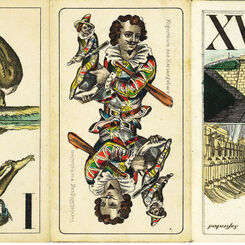
Joseph Sürch, Engraver
Joseph Sürch, a prominent Viennese engraver, made significant contributions to card sheet engraving ...
Jan Becher playing cards
Publicity pack for Jan Becher, a Czech liqueur company, with modified international courts.
Bohemia Moravia
Historical figures from Bohemia and Moravia in Piatnik’s traditional style.
Tarok c.1900
Piatnik & Söhne “Industrie und Glück” Tarock c.1905-1910.
Casino No.240
Piatnik-Ritter No.240 - Obchodní Tiskárny Casino No.240.
Jugendstil Tarock
‘Jugendstil Tarock’ was designed by Ditha Moser and first published by Albert Berger and Josef Glanz...
Austrian Cartomancy Cards
During the 19th century a system of fortune telling arose in Europe using unnumbered, pictorial card...
Bohemian Pattern
The Bohemian Pattern, sometimes called the Prager Pattern, has roots in the 16th century.
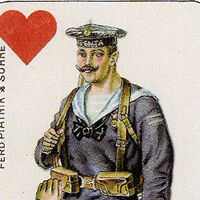
Soldaten Tarock
Piatnik was known for their magnificent quality of chromo-lithographic printing, and this facsimile,...
OTK Bridge-Rummy
OTK Bridge-Rummy by Obchodní Tiskărny, c.1990.
Wiener pattern
The Vienna pattern, or Wiener Bild, is a distant relative of the early Lyons pattern. The King of He...
Piatnik Tarock
Deck of "Industrie und Glück" or "Rural Scenes" tarock cards manufactured by Ferd Piatnik & Söhne, V...
Tarock Cards
The earliest Tarot decks originated in Italy in the fifteenth century, with Italian suit symbols. Ho...
Most Popular
Our top articles from the past 60 days


