


Julius Berndl and his Austrian tarock
Josef Glanz's Tarock: a classic deck with artistic innovation by Julius Berndl.
Julius Berndl was born in Vienna on 7 April, 1848. Although no records of his training are known, his documented work shows that he began working for Josef Glanz in around 1885. He often signs his work, which allows its identification. He followed the tradition of his predecessor Josef Sürch►
Sadly, in 1901 Julius Berndl was placed in an asylum due to mental illness; he died on 4 April, 1902. Around 1875, his son of the same name was born. Based on the decks produced by Josef Glanz that are dated 1900–1910 and bear the same signature, it's likely the son succeeded his father. It is debatable whether the version 2 below is not a joint work of father and son, or perhaps only the son.
Perhaps Berndl's best-known collaboration with the Glanz company is the Gigerl-Tarock. Another interesting atypical tarock deck is the similar “Tarock with scenes from leisure time” (Tarock mit Szenen aus den Mußestunden) created around 1890.
The Glanz company also commissioned Berndl to design its own Austrian tarock deck (Industrie und Glück). The court cards have the usual appearance, but the composition of rural scenes on the tarock cards is non-standard. Although it is close to the Type B scheme in the IPCS specification, sometimes the position of the scene does not correspond to a specific tarock. Some motifs are completely new. Leading tarock expert Klaus Reisinger, with his own classification series, refers to the deck as “Scheme VII”. Tarock cards with this composition of genre scenes were produced only by Josef Glanz.
Version 1. According to the contact addresses listed on Jack of Clubs, this deck could be dated to 1897-1898. The tax stamp used in 1882-1899 also corresponds to this date. Reisinger assumes that the original matrix was created around 1890. Berndl's signature can be seen on tarock card no. I. (See footnote regarding pencilled index numbers).
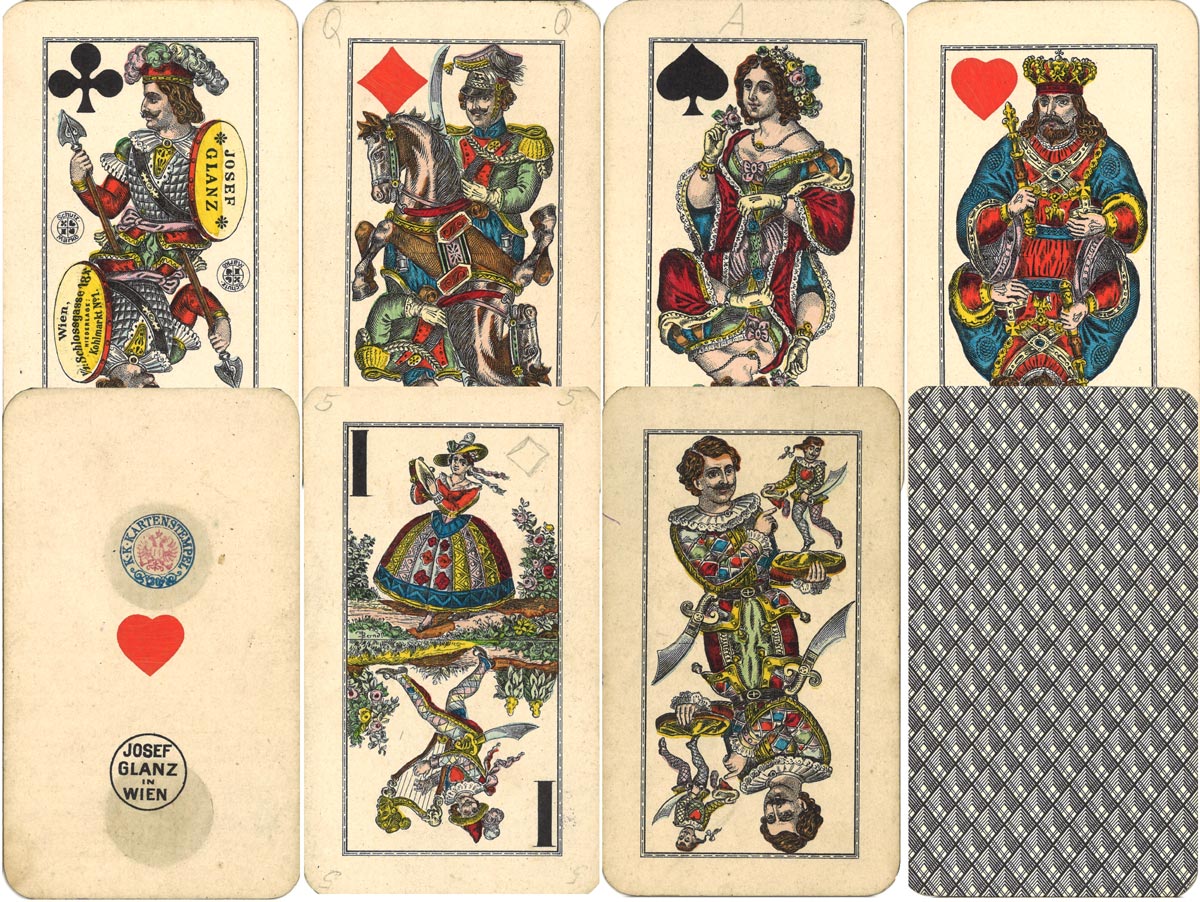
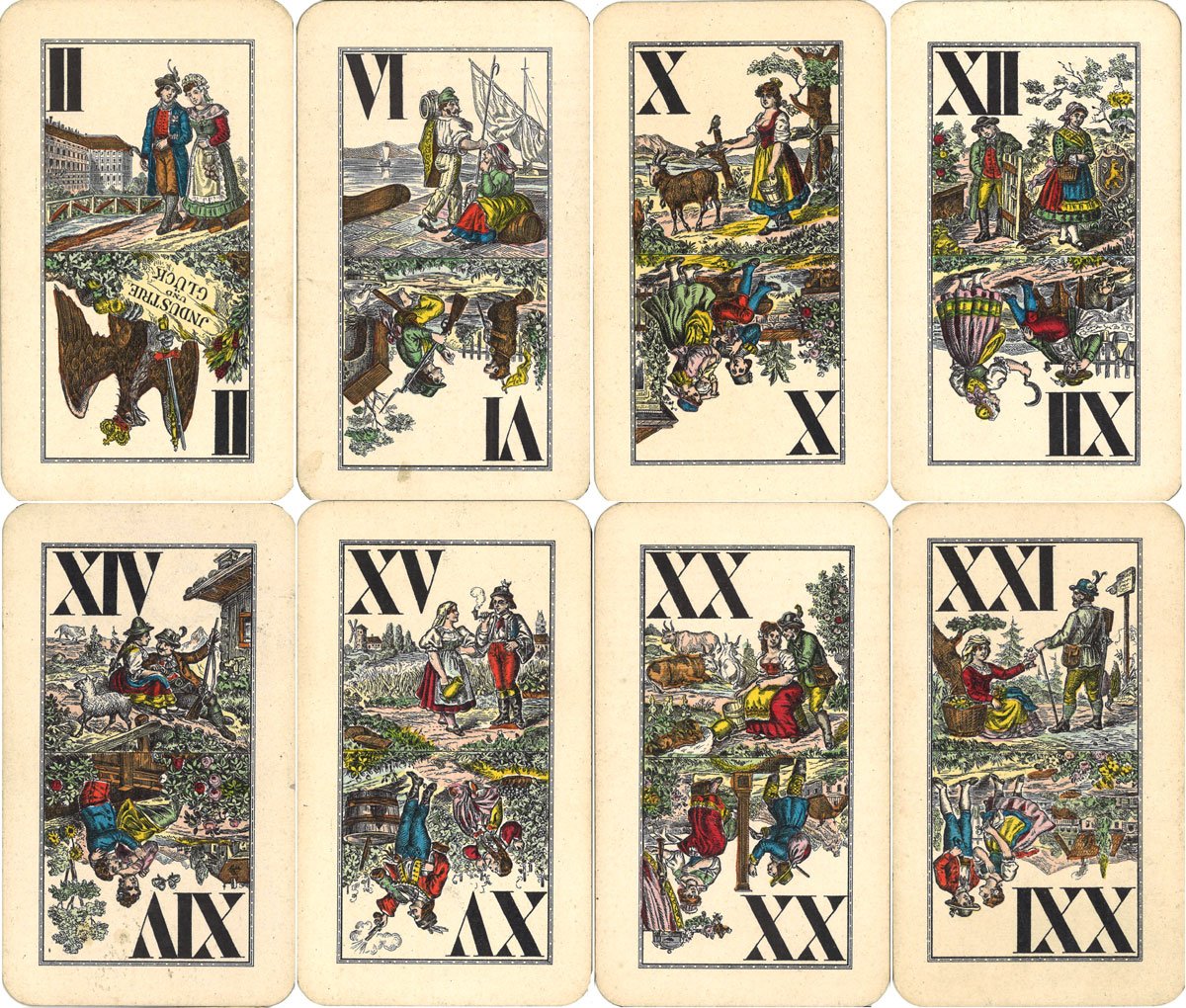
Some of the new images use motifs from another deck by Josef Glanz: Nationalitätentarock published around 1864. These include a hunter and a shepherdess on tarock card XIV (Tyrol), a man smoking with a woman on tarock card XV (Moravia) or a man entering a gate on tarock card XII (Bohemia). The walking couple on tarock card II in front of the period backdrop of the Hofburg (the Hofburg is common here when it serves as a background for the figure of the so-called Tyrolean clothier) is usually seen on card XII. Even in the case of using some traditional scenes, they are supplemented with new details (bird on the fence (X), frightened chicken (XII), butterflies (XIV)).
Version 2. Berndl also made another version for the Glanz company, which has a slightly simpler graphic design. The signature is again placed on the pagat card (tarock no. I), this time including the date 1895. The set of genre depictions on the tarock cards is identical to the previous version. The manufacturer's contact addresses on the Jack of Clubs are also the same, but this information was routinely updated on new editions. So even in the previous case, the product information may not correspond to the engraving design.
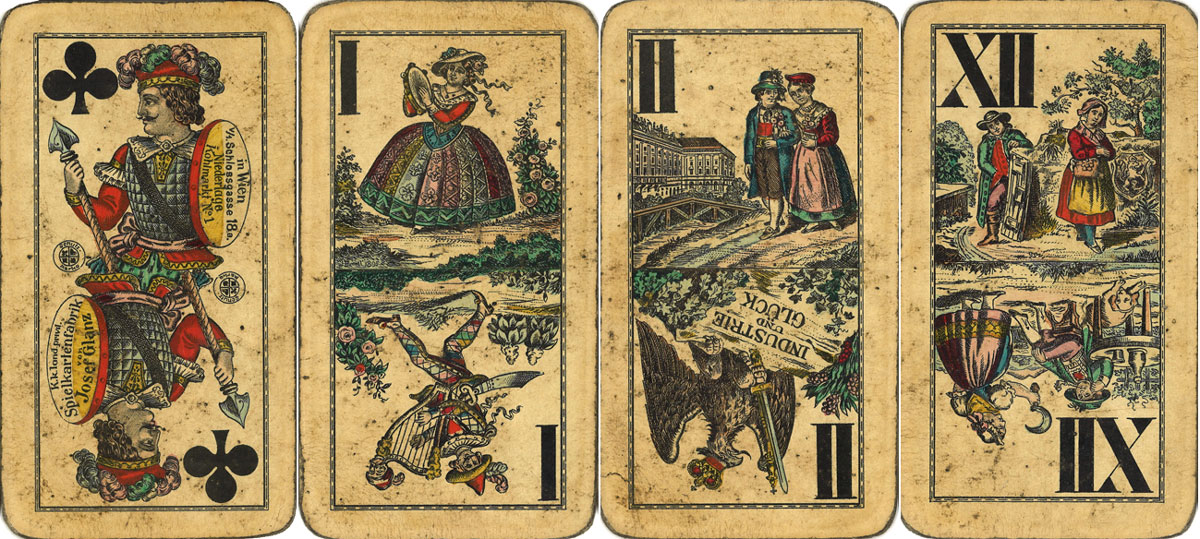
It is clear that the line lithography technology was an important medium for Berndl's work. In the case of the Austrian tarock, the graphic design is clearly overloaded with individual lines and the design lacks the light-hearted caricature abbreviation known from the Gigerl Tarock. Klaus Reisinger also refines his solution in his publications on the Salzburg, Prague and Vienna card patterns. He presents it with the incorrect first name Josef instead of Julius.
Acknowledgements & References
A big thank you goes to Mr. Wolfgang Altfahrt. His information support was very detailed and essential for this article.
Peter Endebrock: Nationalitätentarock by Josef Glanz►
Talon: information about the company Josef Glanz (in German, online)►
Klaus Reisinger: Tarocke-Kulturgeschichte auf Kartenbildern, part 5.
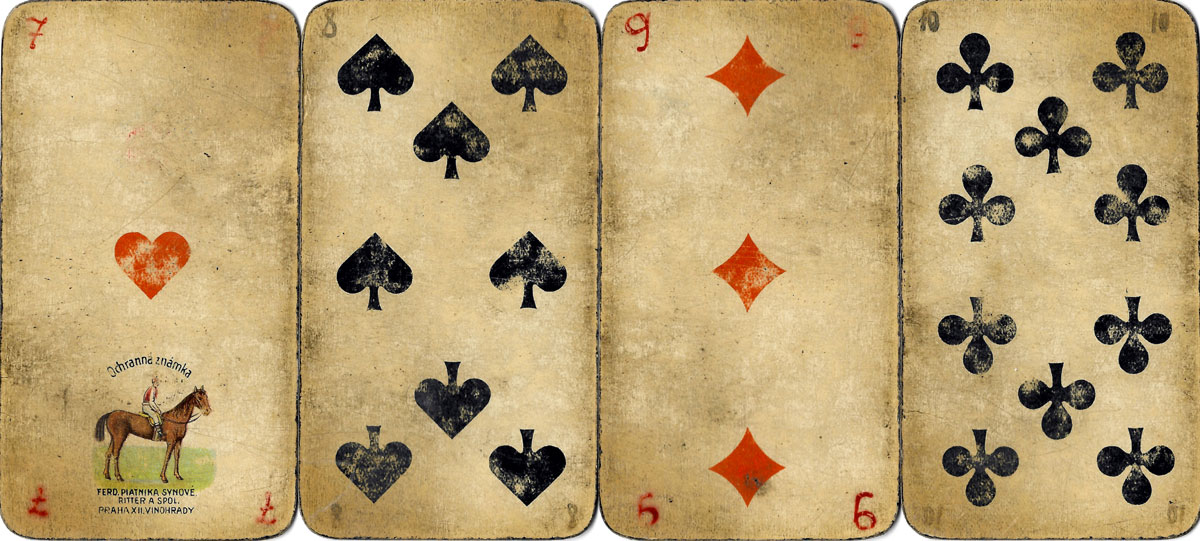
Footnote: Tarock games are known for having a unique card hierarchy and scoring system that differs from standard card games. Where a rank order such as A, K, Q, J, 10... might be the norm, Tarock decks often have a non-linear ranking and special scoring values. Players accustomed to conventional trick-taking games might find the Tarock system confusing or difficult to remember. To make life easier players might have made manual alterations to the cards, such as adding numerical values and clarifying the ranking. This gives us a glimpse into the pragmatic ways in which people adapted games to suit their needs in an era before mass-produced, standardized card sets.
By Marek Brejcha
Czech Republic • Member since June 13, 2024
My relationship with cards grew from playing to collecting and transformed into publishing as well. I am part of the team at Counter Clockwise, a small company that publishes traditional card games.

Activity for Julius Berndl and his Austrian tarock
Sign in to comment or save this article.

Related Articles
Tarock Cards by Antonín Kratochvíl
Excerpt from the catalog of a prominent Prague workshop.
Militar-Tarock No. 38
Non-standard tarock cards combining theatrical and military themes by Joseph Glanz.
Gigerl-Tarock by Joseph Glanz
Urban Dandy caricature deck from 19th century Vienna designed by Julius Berndl.
Patience by Joseph Glanz
A refined and distinctly European Patience pack by Joseph Glanz from Austria.
Animal Tarock by J. G. Pichler
Baroque tarock cards from the late 18th century.
Austrian Tarock by S.D. Modiano
Modiano’s Austrian Tarock with country scenes has been in production for over 100 years.
Tarock Cards by NIL Spielkartenfabrik
A deck of tarock cards from the eastern end of the ending Austro-Hungarian Empire.
Joseph Sürch, Engraver
Joseph Sürch, a prominent Viennese engraver, made significant contributions to card sheet engraving ...
Double-ended German-suited pack by Josef Glanz, Vienna.
From the British Museum collection.
Trappola pack by Joseph Glanz
Double-ended Trappola pack by Joseph Glanz, Vienna, late 19th century.
Animal Tarot by J. B Dubois
French-suited Bavarian Animal Tarot by J B Dubois, Liège, Belgium, late 18th C.
Animal Tarot by G. Larmoyer
Flemish Animal Tarot deck by G. Larmoyer, Liège, 1753.
Jugendstil Tarock
‘Jugendstil Tarock’ was designed by Ditha Moser and first published by Albert Berger and Josef Glanz...
J. Glanz Historical playing cards
Historical Theatrical playing cards manufactured by J. Glanz, c.1860.
Mythological Tarock by Johann Herrl
French-suited Tarock deck made by Johann Herrl in Graz 1815.
Piatnik Tarock
Deck of "Industrie und Glück" or "Rural Scenes" tarock cards manufactured by Ferd Piatnik & Söhne, V...
Estel Tarok
J. Estel Tarok, 1820.
Pittner Tarok
Ferd Pittner, Tarok Cards
Joseph Glanz, 1862
Playing cards depicting Turkish and Greek rulers manufactured by Joseph Glanz, Vienna, Austria, 1862...
Adametz, Vienna
Cards from a 54-card "Austrian Tarock" or "Industrie und Glück Tarock" pack made by Franz Adametz of...
Most Popular
Our top articles from the past 60 days


