

Dieudonné & Cie Aluette
Aluette playing cards manufactured by Dieudonné & Cie, Angers (France), early 20th century.
Aluette playing cards
manufactured by Dieudonné & Cie, Angers (France), early 20th century.
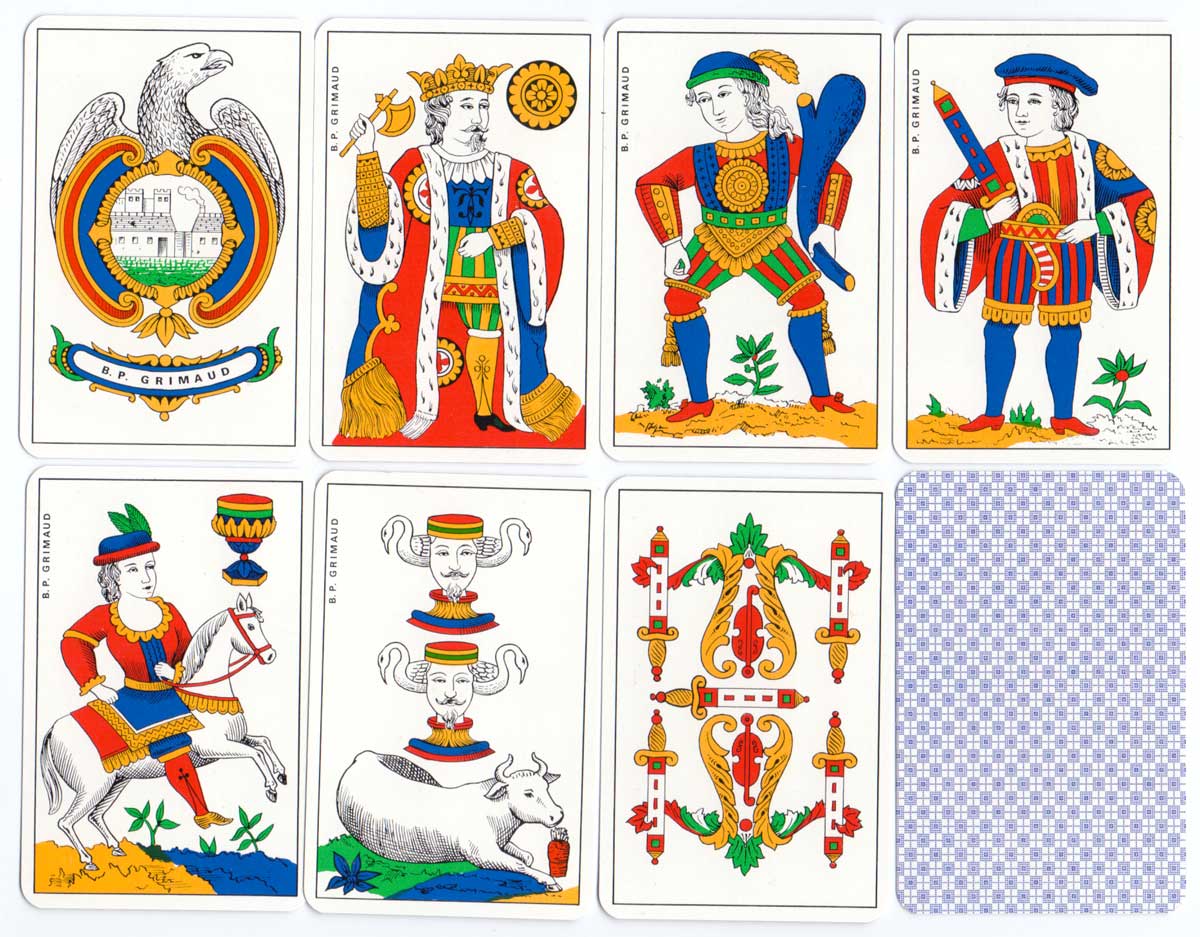
Aluette is a card game popular in Brittany and the West coast of France, usually played with a special pack the design of which is descended from Archaic Franco-Spanish models which were also used in France. The cards have Spanish suit symbols, the courts have become somewhat stylised and many of the numeral cards contain additional decorative motifs or embellishments which were incorporated by earlier manufacturers or are related to the game-play. Traditional (or archaic) features include a kissing couple on the Five of Coins (once the Catholic monarchs Ferdinand and Isabella) and a naked child on the Ace of Swords. The Cavalier of Coins is shown in partial back-view. See also → Lequart Aluette Dieudonne Catalanes France-Cartes Aluette 1976
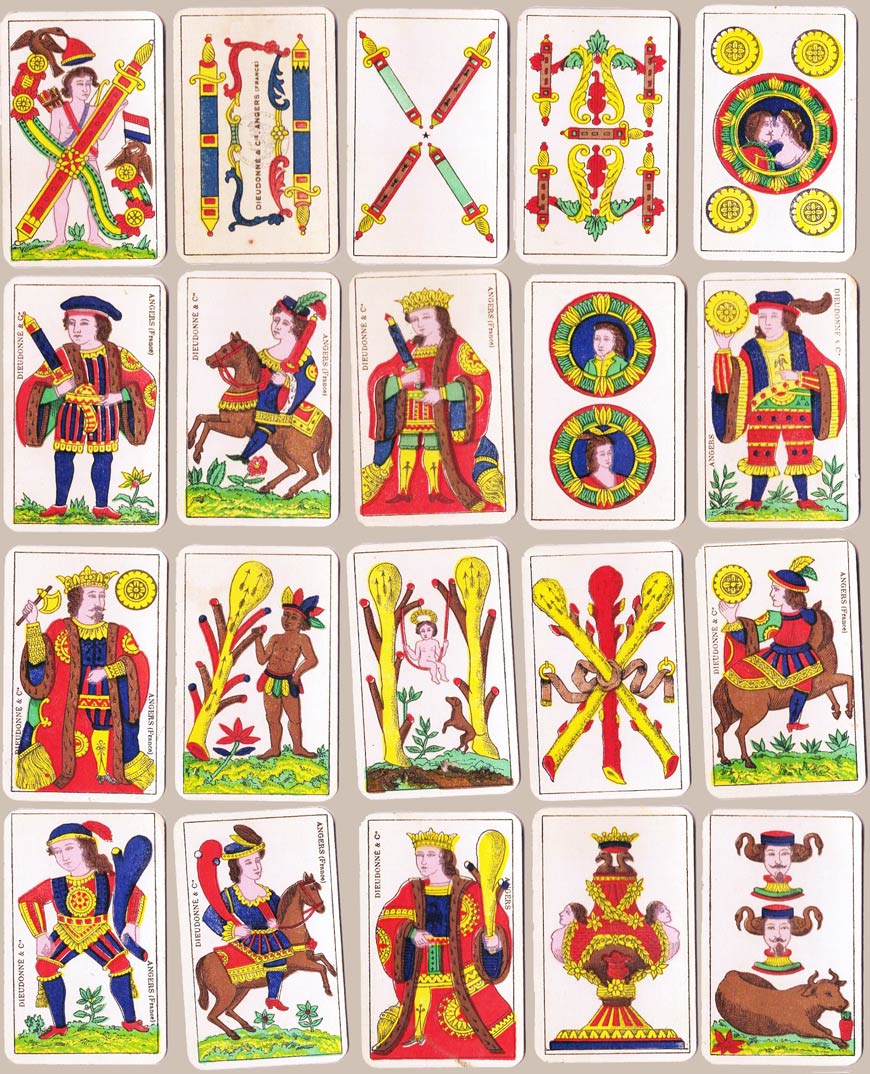
Above: Aluette playing cards by Dieudonné & Cie, Angers (France).
Some History
In around 1754 Jean Dieudonné (c.1720-1795) relocated from Metz in France to Grevenmacher, in eastern Luxembourg, near the border with Germany. In that same year, being a widower, he re-married Marie Elisabeth Lejeune, a merchant’s daughter. After launching his new business and building it up, he successfully become head of a dynasty of cardmakers. After Jean Dieudonné's death the business was managed by his widow, Marie Elisabeth Lejeune.
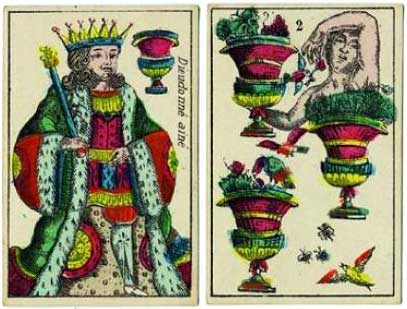
Above: 2 cards by Mathias Dieudonné the elder, before 1840.
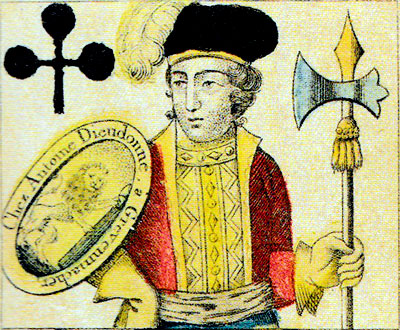
Above: reproduction of pack by Antoine Dieudonné, Grevenmacher, Luxembourg, c1850.
The history of the firm is closely linked to the political changes that have marked its existence. Thus, following the French Revolution and the annexation of Luxembourg in 1795, it was forbidden to represent crowned heads on playing cards, and when in 1797 the French government introduced the tax on card games, it took all the commercial intelligence of the Dieudonnés to ensure the survival of the company. Several sons and grandsons became cardmakers thereby continuing the family name (Georges (1759-1828), Jean II (1764-1793), Mathias I (1768-1840), Mathias II (1795-after c.1840) and Antoine Dieudonné (1789/1802-1864)).
Cremers (1994, p.63) suggests that Jean Dieudonné may have learned his trade at Metz but been forced into exile by the strict tax regulations in France. His move to Gravenmacher may have been in order to avail himself of paper supplies, materials and clients in the Rhine valley area, accessible via the Moselle river. The products of the Dieudonné factory were mainly intended for the foreign market, the tax advantages in Luxembourg creating a context favourable for this flourishing craft. Seeking government tax concessions, Dieudonné claimed to be the sole supplier of playing cards to the inhabitants of Luxembourg. The successors of Jean Dieudonné continued the manufacture in Grevenmacher until 1880, when Jean-Paul Dieudonné decided to abandon the production of cards in the township. Other branches of family descendents emigrated to France, Orleans and Angers, taking the business with them where it became known as Dieudonné et Cie.
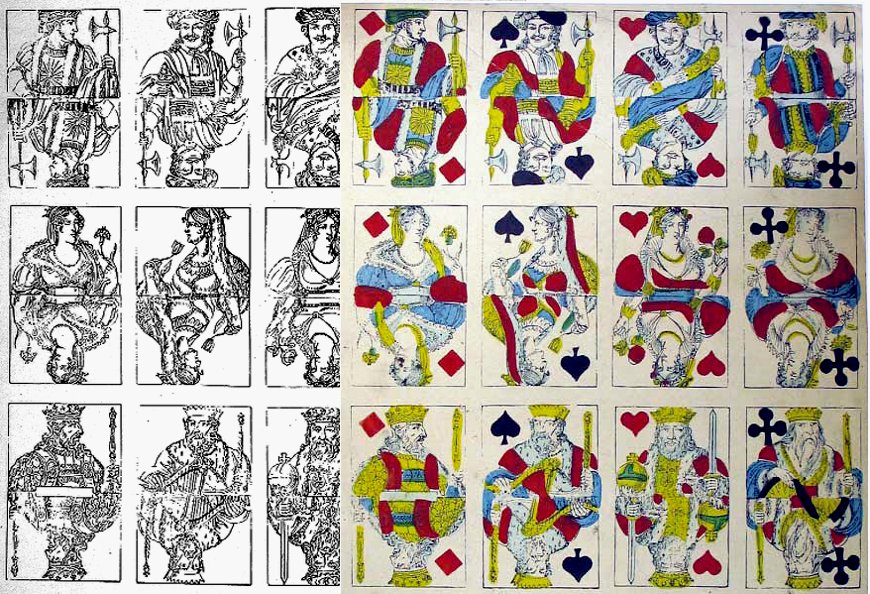
Above: uncoloured and stencil-coloured uncut sheets of the Hamburg pattern by Dieudonné (France), c.1850. In the coloured version, successive stencil colourings of pale blue, blue, yellow, red and black have been applied. The Hamburg pattern is based on the Paris pattern and was used in Germany and Scandinavia.
REFERENCES
Cremers, Filip: Kaartenmakers in Wallonië - Cartiers en Wallonie, Nationaal Museum van de Speelkaart, Turnhout, 1994
Kulturhuef Museum, Grevenmacher: the playing cards of Jean Dieudonné►

By Simon Wintle
Spain • Member since February 01, 1996
I am the founder of The World of Playing Cards (est. 1996), a website dedicated to the history, artistry and cultural significance of playing cards and tarot. Over the years I have researched various areas of the subject, acquired and traded collections and contributed as a committee member of the IPCS and graphics editor of The Playing-Card journal. Having lived in Chile, England, Wales, and now Spain, these experiences have shaped my work and passion for playing cards. Amongst my achievements is producing a limited-edition replica of a 17th-century English pack using woodblocks and stencils—a labour of love. Today, the World of Playing Cards is a global collaborative project, with my son Adam serving as the technical driving force behind its development. His innovative efforts have helped shape the site into the thriving hub it is today. You are warmly invited to become a contributor and share your enthusiasm.

Activity for Dieudonné & Cie Aluette
Sign in to comment or save this article.

Related Articles
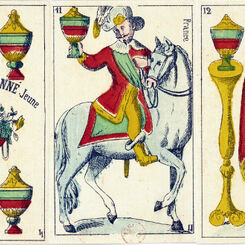
Aluette by Dieudonné Jeune, Orléans, c.1850
Aluette game by Fabrique Dieudonné Jeune, Orléans, c.1850.
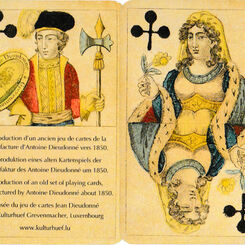
Antoine Dieudonné c.1850
Reproduction of a pack by Antoine Dieudonné, Grevenmacher, Luxembourg, c1850.
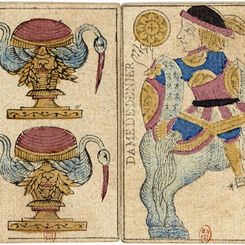
Pierre Roiné Aluette
Archaic form of Aluette published by Pierre Roiné, Nantes, c.1785.
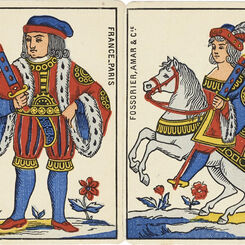
Jeu d'aluette by Fossorier, Amar et Cie
A very distinctive 48-card Spanish-suited pack is used to play Aluette.
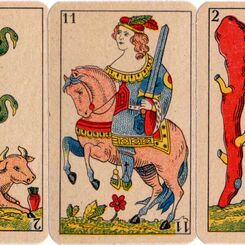
Jeu D’Aluettes - Boéchat Frères c.1950
Jeu D’Aluettes manufactured by Boéchat Frères, Bordeaux, c.1950 with archaic Spanish features mixed ...
Cartes Catalanes
Cartes Catalanes are used in a small area in the Eastern Pyrenees region of Southern France.
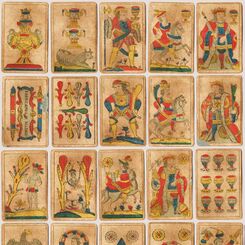
Lequart Aluette
Spanish-suited Aluette pack with 'FABRICANDO IN MADRID' printed on the Two of Swords and the legend ...
Most Popular
Our top articles from the past 60 days