


Grand jeu de la main
"Chiromancie Nouvelle" by the reputed pupil of Mlle Lenormand.
Toward the end of the nineteenth century there was a growing market for increasingly elaborate divinatory systems, often combining cartomancy, palmistry, astrology and other occult disciplines into specially designed fortune-telling cards. An example of this is “Grand jeu de la main” (subtitled “Chiromancie Nouvelle”) published by B.P Grimaud in 1890, based on a divinatory system devised by the Parisian chiromancer and cartomancer Adèle Moreau (1816-1888). Each card shows a hand palm in the centre, moon phases at each side, along with a miniature playing card, a description of the lines on the palm, a suggested divinatory interpretation at the top, and large legends at top and bottom. Some cards have additional symbols or hieroglyphs.
Paris was one of Europe's principal centres for a revival of interest in topics such as spiritualism, mesmerism, astrology, chiromancy (palmistry), graphology, phrenology, dream interpretation and cartomancy, especially among the expanding urban middle classes. A fashionable hostess might bring out a fortune-telling deck during an evening gathering, much as people later enjoyed séances or party games. Some users genuinely believed the cards revealed character and destiny. Fortune-telling manuals were explicitly addressed to readers interested in marriage prospects, social advancement and personal relationships. The first card shown, for example, predicts a "new acquaintance with a woman" (Nouvelle connaissance de Femme), illustrating the everyday concerns these systems often addressed.

Cards 1-8 from Grand jeu de la main divination cards published by B.P Grimaud, Paris, 1890. Total 56 lithoraphed cards in wrapper. Bibliothèque nationale de France
The cards occupy a cultural position somewhat comparable to modern personality tests or astrology columns. Not everyone believed them literally, but many people found them meaningful or entertaining... a blend of palmistry, cartomancy and lunar symbolism. Unlike traditional cartomantic packs, each card functions almost as a printed chart or diagram, combining multiple layers of information - palmistry, mystical symbolism, playing-card indices, personality types and predictive texts - into a single visual reference. This encyclopaedic approach reflects the nineteenth-century fascination with systems of classification and hidden correspondences.

Cards 9-16 from Grand jeu de la main divination cards published by B.P Grimaud, Paris, uncoloured, 1899. Total = 56 cards in wrapper. Bibliothèque nationale de France
The popularity of these cards is underscored by the fact that there were several editions over the years, published by Grimaud or Avril fils et Cie. The lavish design of Le Grand Jeu de la Main reflects commercial strategy: instead of simple fortune-telling cards, buyers received a more complex system that appeared sophisticated and authoritative. The hand diagrams, lunar imagery and classifications such as "Type lymphatique" gave the impression of an integrated body of systematic or scientific knowledge rather than simple fortune-telling. We continue the numerical series in a coloured version of the deck published by Avril fils et Cie in which card 55 shows the manufacturer's badge plus the claim that Adèle Moreau was a pupil of Mlle Lenormand ("Chiromancie nouvelle par A. Moreau (élève de Melle Lenormand) et de A. de Para d'Hermès"). See note below.

Cards from Grand jeu de la main divination cards published by Avril fils et Cie, Paris, chromolithography, ca 1890. Total = 56 cards. Bibliothèque nationale de France
Note Adèle Moreau (identified as Françoise Adélphine Lamy, 1816–1888) was a Parisian chiromancer and cartomancer whose Grand Jeu de la Main combined palmistry, lunar symbolism and card divination into an elaborate fortune-telling system. The deck describes her as a pupil of Mlle Lenormand, a claim repeated in later editions and noted in the BnF catalogue. This statement comes from the deck itself and is therefore evidence only that the claim was being made by the publishers or creators around 1890 whilst independent evidence for a teacher–student relationship has yet to be identified.

Detail from card no.55.
A. de Para d'Hermès was a nineteenth-century French author of palmistry manuals and divinatory card games, probably writing under a pseudonym. He is credited alongside Adèle Moreau as a collaborator in the development of the chiromantic system underlying the Grand Jeu de la Main. Although his true identity remains uncertain, his works place him within the circle of popular occult and fortune-telling authors active in Paris during the Second Empire and early Third Republic, sufficiently well known to be reprinted in modern facsimile editions. See: Hachette / Gallica / BnF►

By Simon Wintle
Spain • Member since February 01, 1996
I am the founder of The World of Playing Cards (est. 1996), a website dedicated to the history, artistry and cultural significance of playing cards and tarot. Over the years I have researched various areas of the subject, acquired and traded collections and contributed as a committee member of the IPCS and graphics editor of The Playing-Card journal. Having lived in Chile, England, Wales, and now Spain, these experiences have shaped my work and passion for playing cards. Amongst my achievements is producing a limited-edition replica of a 17th-century English pack using woodblocks and stencils—a labour of love. Today, the World of Playing Cards is a global collaborative project, with my son Adam serving as the technical driving force behind its development. His innovative efforts have helped shape the site into the thriving hub it is today. You are warmly invited to become a contributor and share your enthusiasm.

Activity for Grand jeu de la main
Sign in to comment or save this article.

Related Articles
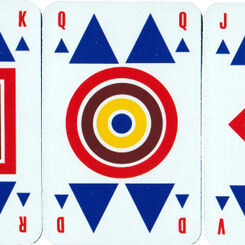
Pierre Cardin
Geometric designs in a futurist style by Jean Garçon for the couturier Pierre Cardin.
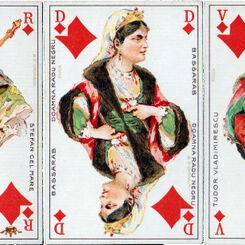
Figures from Romanian History
Named characters from Romanian history on a pack by Grimaud of Paris.
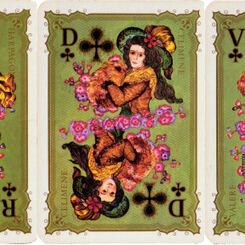
Gibert Jeune (Molière)
Pack offered by the Parisian bookshop Gibert Jeune on the tricentenary of Molière’s death.
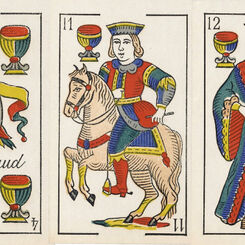
Catalan pattern by B.P Grimaud
Standard Spanish Catalan pattern deck made in Paris by B.P Grimaud.
Cartes politiques : Jeu d'actualité
Political playing cards published by Grimaud et Chartier, Paris, 1872.
Zodiaque
“Les Signes du Zodiaque” playing cards designed by Youdi des Aubrys.
Compagnie Maritime des Chargeurs Réunis
French navigators and explorers on a promotional pack for the C.M.C.R shipping company.
French External Trade Organization
Promoting the elegance and quality of a range of French products.
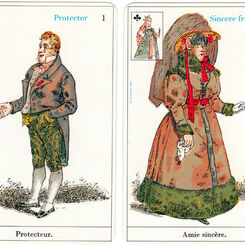
La Sibylle des Salons
La Sibylle des Salons facsimile of 19th century deck published by J M Simon, 1979.
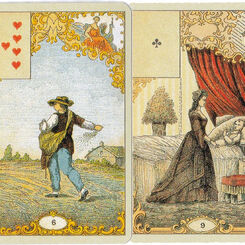
Le Destin Antique
Le Jeu du Destin Antique, originally published by Grimaud in XIX c., republished many times since......
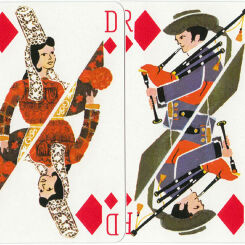
Bretagne
Bretagne (Brittany) playing cards, Grimaud, c.1970.
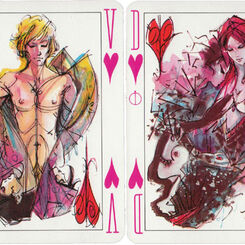
Playtex
Playtex - le jeu de la beauté et du destin, Grimaud, 1971.
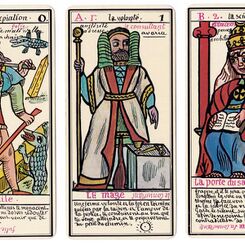
Le Grand Tarot Belline
“Le Grand Tarot Belline” after drawings by Edmond Billaudot (1829-1881).
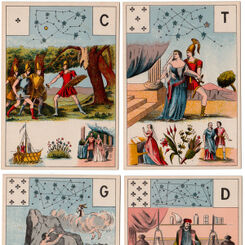
Grand Jeu Lenormand
Chaotic Grandeur in a collage of astrology, folklore and mythology from Parisian salons.
Jeu Louis XV
B.P. Grimaud of Paris issued this very ornate costume deck called “Jeu Louis XV No.1502” in c.1895. ...
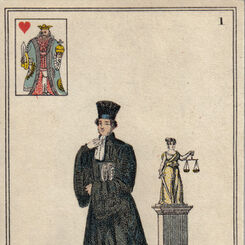
Livre du Destin
Livre du Destin / The Book of Fate, c.1900, entire deck (32 cards)
Livre du Destin
Livre du Destin or Book of Fate, printed by B.P.Grimaud, Paris, c.1900.

French Playing Cards
Some of the oldest cards still in existence come from France. During the 16th and 17th centuries Fra...
Grimaud Spanish pattern
Grimaud Spanish pattern, c.1880
Significado de los Naipes Españoles
Cartomantic meanings of Spanish playing cards by Benita the Witch (XVI century), published by Chocol...
Most Popular
Our top articles from the past 60 days


