


Cancan
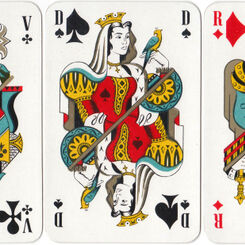
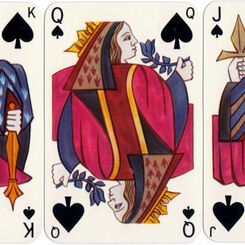
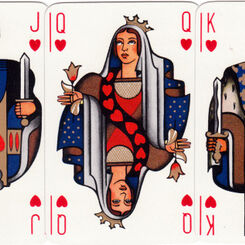
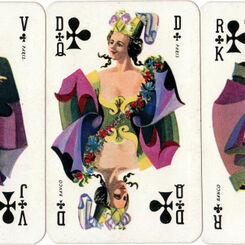
Lightly risqué luxury playing cards published by Éditions Philibert of Paris in 1956.
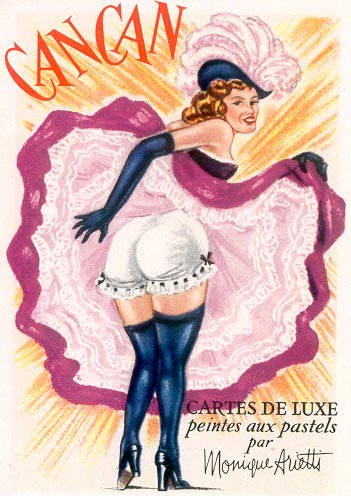
Éditions Philibert: “Cancan”
These wonderful lightly risqué luxury playing cards, with lots of lace, in the style of the 1900s, were designed by Pierre Albarran, drawn by Monique Arietti (pseudonym of Gabriel Garachon, designer at Draeger Frères who printed the cards, and herself a dancer) and published by Éditions Philibert of Paris in 1956.
See also: Le Florentin • Mémoires de Casanova
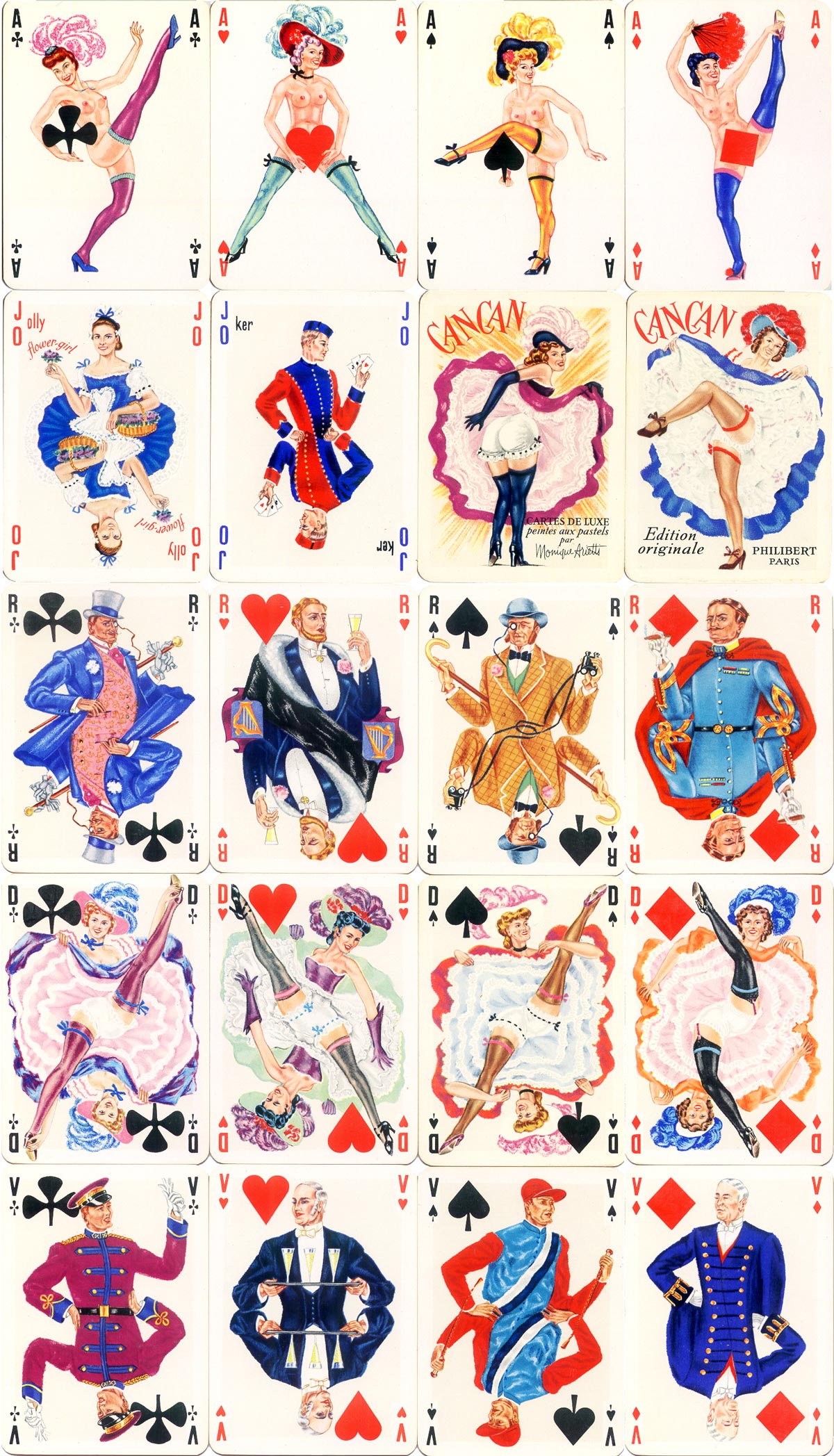
Above: lightly risqué “Cancan” luxury playing cards designed by Pierre Albarran and published by Éditions Philibert, 1956. 52 standard cards plus two Jokers and additional 4 Aces + 2 title cards. Gilt edges. Images courtesy Barney Townshend.
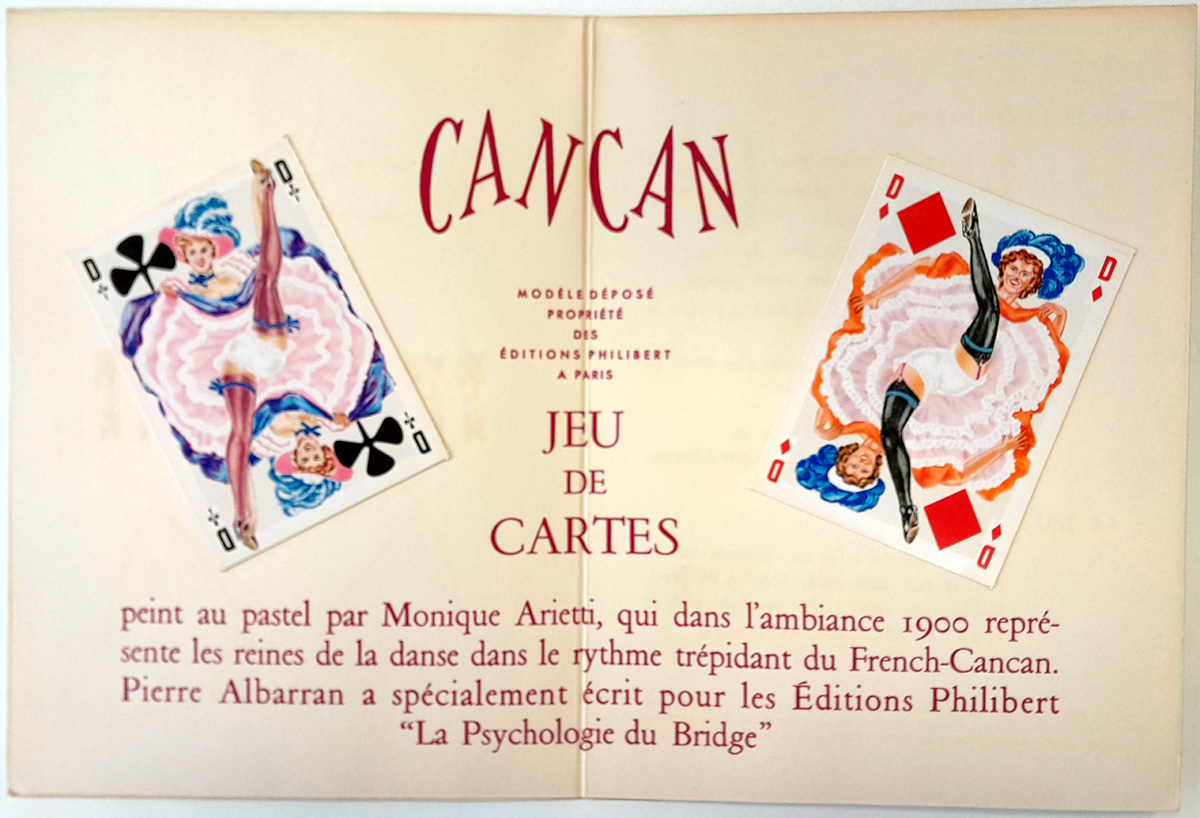
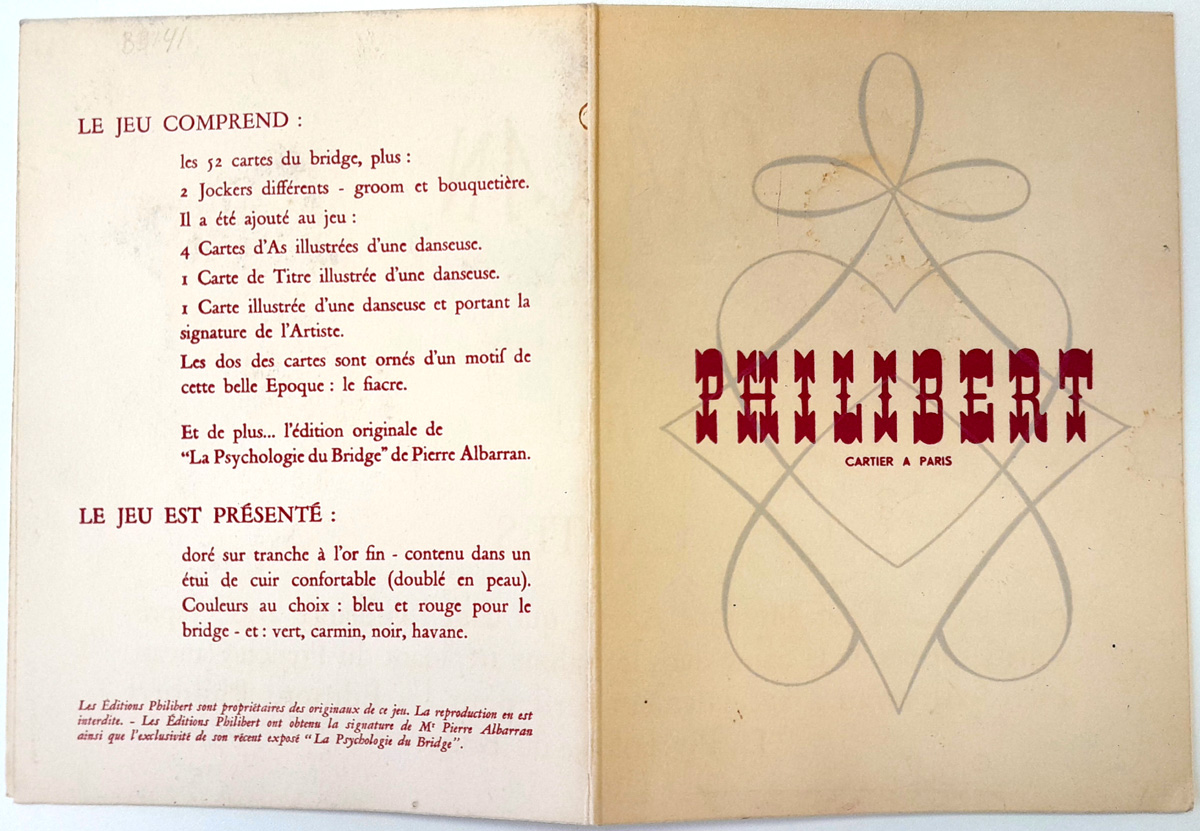
Above: promotional leaflet for the Cancan pack (undated but presumably c1956). Images courtesy of the WCMPC.

By Barney Townshend
United Kingdom • Member since October 06, 2015
Retired Airline Pilot, interested in: Transformation Playing Cards, Karl Gerich and Elaine Lewis. Secretary of the EPCS. Treasurer of the IPCS.

Activity for Cancan
Sign in to comment or save this article.

Related Articles
Hector de Trois
A 1963 facsimile of a seventeenth-century Portrait of Paris pack preserved by the Bibliothèque natio...
Luxury No. 2167
A Piatnik classic that lives up to its title.
Jeu Philatélique – Les Colonies Françaises
Philatelic card game featuring real postage stamps from the French colonies.
Alphonse Arnoult Spanish-suited pack
Luxurious Spanish-suited pack made by Alphonse Arnoult, Paris, France, c.1850.
Jean Borin
‘Cartes de Luxe’ with artwork by Belgian artist and designer Jean Borin (1907-1997).
Classique
“Classique” by Draeger Frères, Paris, c.1949 with designs reminiscent of early French cards.
Jacques Branger designs for Miro Company
Luxury packs published by Miro Company (Paris) featuring designs by Jacques Branger, c.1940s.
Banco for Air France, c.1952
Banco playing cards for Air France manufactured by Draeger Frères, c.1952.
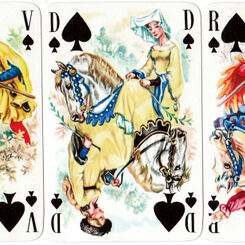
St Hubert’s Bridge
“St Hubert’s Bridge” published by Éditions Philibert, Paris, c.1956.
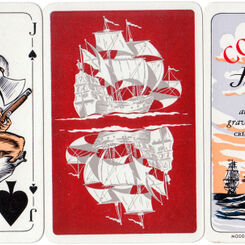
Corsaires et Flibustiers
“Corsaires et Flibustiers” playing cards created by G. Delluc and published by Éditions Philibert, P...
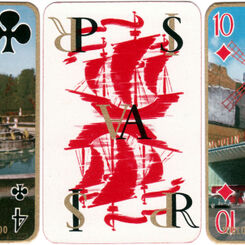
Paris Scenes
“Paris Story” playing cards published by Éditions Philibert, c.1957, showing photographic scenes of ...
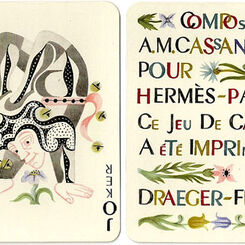
Cassandre for Hermès
Promotional playing cards created by A. M. Cassandre (pseudonym of Adolphe Jean-Marie Mouron, 1901-1...
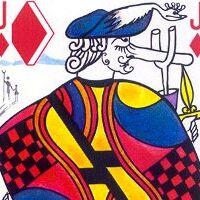
Salvador Dalí
Based on the standard French ‘Paris’ pattern, Dalí composed his playing card figures out of geometri...

Venice Simplon-Orient-Express
One of a series of sumptuous Venice Simplon-Orient-Express playing cards produced by B.P. Grimaud fo...

Les Mousquetaires
Philibert "Les Mousquetaires" Playing Cards, designed by Albert Dubout (1905-1976).

Éditions Philibert
Éditions Philibert published an outstanding series of exotic, artistic playing cards in Paris from 1...
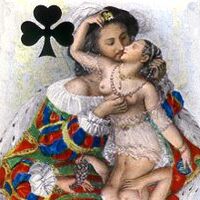
Le Florentin
Éditions Philibert published playing cards in Paris from 1954 to 1960 including Le Florentin in Rena...
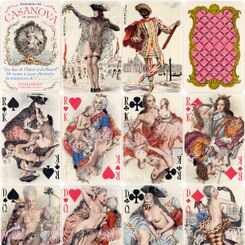
Mémoires de Casanova
Mémoires de Casanova artistic and lightly risqué playing cards with paintings by Paul-Émile Bécat, p...

Dondorf
The luxury playing card factory founded in Frankfurt am Main by Bernhard Dondorf in 1833 existed for...
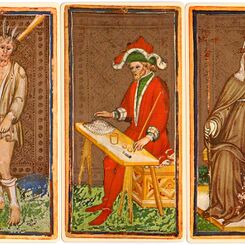
The Visconti-Sforza Tarot, c.1460
This pack of tarot cards appears to have have been made in the Bembo workshop in Cremona for Bianca ...
Most Popular
Our top articles from the past 60 days


Stefan Lauwers
19 January 2023, 14:37Can-can was designed by Pierre Albarran, the world-famous bridge- (and tennis) player. Pierre Albarran played two times in the Davis Cup tennis-team for France, and won a bronze medal in the Antwerp summer olympics in 1920 (in doubles), but he became much better known as a contract bridge player. At Bridge, he was French champion 19 times (!!!) and played in 32 international matches for France ... For many years, he organized and directed the annual bridge tournament held in Monte Carlo. He ranking first in the 1935 Brussels World-tounament for teams. He was a columnist on bridge for several French newspapers and authored several books on bridge. Perre Albarran was referred to as 'The Aristocrat of Bridge'. He died on 24 February 1960, at the age of 66. Pierre Albarran's biggest contribution to the game of Bridge is a theory for a bidding systems that includes the 'Canapé approach' and the convention that was later called "Roman two-suiter". And of course he has designed this beautiful 'Can-can'-deck. His technique in Bridge was to sometimes also bid on hands that he could not really win, thus surprising the adversaries and nevertheless winning the hand, which led him to the famous expression : "A pokerface is not limited to the only game of Poker ..." Further information on Pierre Albarran can easely be found on wikipedia, or any website dedicated to Bridge.
Peter Burnett
19 November 2025, 09:47SavedSaved this article to Peter's Collection