


French Spanish-suited cards for South America
Early example of the Parisian Spanish style before it became standardized by later Parisian publishers.
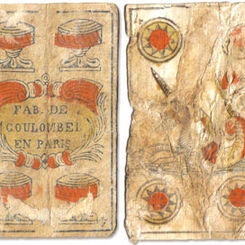
On the ace of coins is “F_ca. de Naypes, año de 1828” (“Playing Card Factory, year 1828”) and around the radiant sun motif “De la Fabrica de Louis en Burdoes”. This combination of French manufacture with Spanish text and suit designs is characteristic of Franco-Spanish patterns, which reinterpreted the old Spanish National pattern through a distinctly French lens while responding to export markets. This was one of several French workshops producing Spanish-style barajas, primarily for distribution to former Spanish colonies in South America. A similar radiant sun appears in the central coin on the five, though without inscription, while the twos and threes are embellished with simple floral ornaments.
By 1828, the “Sol de Mayo” was already a widely recognised revolutionary emblem, appearing on flags, coins and proclamations carried by liberation armies from Argentina to Peru. A French manufacturer producing cards for this market could well have adopted a radiant sun to evoke the identity and aspirations of the new republics. The marine unicorn on the four of coins, resembling a narwhal, a creature long associated with wonder and curiosity, was likely a deliberate addition by French designers, lending a note of exoticism and maritime imagination, and enhancing the deck’s appeal to overseas buyers.


The ace of clubs is supported by a hand emerging from the left-hand border (reminiscent of the Tarot de Marseille style), echoed by hands on the four of swords. The corner indices mostly appear in the top-right rather than the top-left, and even vary within the pack (as on the cavalier of cups), which might seem counterintuitive to modern players. However, this likely reflects the absence of a fixed indexing convention at the time rather than a design flaw. In practice, such indices were of secondary importance, as the cards retain the traditional pintas (breaks in the outer borders indicating the suits; one for cups, two for swords, three for clubs), allowing players to identify their hands discreetly while keeping the cards closely grouped. Together, these features point to a transitional period, where older Iberian functional elements remained dominant even as newer conventions were beginning to emerge.

The four of cups has a semi-eclipsed sun and moon motif inside a sunburst and clouds, which is another creative device echoing Spanish trademarks. The sotas (jacks) have moustaches, but the cavaliers and kings have no facial hair and the kings wear ermine-lined robes down to the ground. In later examples the robes became shorter, revealing stockinged legs. The sota of cups has a small dog jumping up his side, which in later examples becomes a tethered dog on the jack of coins. The cavalier of cups, on a prancing horse, has the legend ‘AHIVA’. Two of the cavaliers appear to be female, judging from curved lines representing breasts (cups & clubs). This pack illustrates an early phase in the French reinterpretation of the Spanish National pattern, after the end of the Spanish Royal Monopoly, and preceding the later standardisation of the Parisian Spanish style.

Above: cards from a 48-card pack, woodcut printed with black outlines on pasteboard, stencil-coloured in turquoise/green, red, yellow and pale blue, backs printed in blue with a diagonal pattern, 57x89 mm. Published by Louis, Bordeaux (“Fabrica en Burdoes”), France, 1828. © The Trustees of the British Museum

References
British Museum : number 1896,0501.864 ►
The British Museum lists various satirical prints published in Paris by “Louis” dated 1815 but they do not appear to be by the same engraver as these cards [https://www.britishmuseum.org/collection/term/BIOG178930].
Schreiber : Catalogue of the collection of playing cards bequeathed to the British Museum by Lady Charlotte Schreiber (Spanish 18)
elmirador.edu.co : Sol de Mayo ►
Denning, Trevor : The Playing-Cards of Spain, Cygnus Arts, London, 1996

By Simon Wintle
Spain • Member since February 01, 1996
I am the founder of The World of Playing Cards (est. 1996), a website dedicated to the history, artistry and cultural significance of playing cards and tarot. Over the years I have researched various areas of the subject, acquired and traded collections and contributed as a committee member of the IPCS and graphics editor of The Playing-Card journal. Having lived in Chile, England, Wales, and now Spain, these experiences have shaped my work and passion for playing cards. Amongst my achievements is producing a limited-edition replica of a 17th-century English pack using woodblocks and stencils—a labour of love. Today, the World of Playing Cards is a global collaborative project, with my son Adam serving as the technical driving force behind its development. His innovative efforts have helped shape the site into the thriving hub it is today. You are warmly invited to become a contributor and share your enthusiasm.

Activity for French Spanish-suited cards for South America
Sign in to comment or save this article.

Related Articles
Illustrated Playing Cards
Illustrated (or “pictorial”) playing cards replace the standard faces with scenes and text, turning ...
Giovanni Battista Marcovich
An early example of the Triestine pattern.
Catalan pattern by B.P Grimaud
Standard Spanish Catalan pattern deck made in Paris by B.P Grimaud.
Archaic Spanish proof sheets
2 x uncoloured proof sheets of archaic Spanish-suited playing cards produced for “New Spain”, possib...
Are Playing Cards a Good Investment?
Playing cards can appreciate modestly, with historical annual gains of 2-3%. Rare cards offer higher...
B.P. Grimaud pack for Bolivia
Spanish-suited pack made in France for sale in Bolivia, c.1880.
Chinese Money-Suited Playing Cards from the British Museum
This deck of Chinese playing cards, donated to the British Museum in 1896, is believed to have been ...
Parisian Spanish pattern by Fossorier, Amar et Cie
‘Parisian’ Spanish pattern published by Fossorier, Amar et Cie (Paris), c.1902.
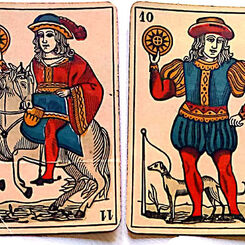
Parisian style Spanish deck by Grimaud
Parisian style Spanish deck by Grimaud for export to Uruguay.
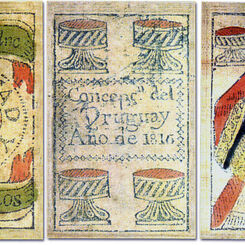
Naipes Artiguistas, 1816
Naipes Artiguistas published in Concepción del Uruguay, Entre Rios province (Argentina) in 1816, by ...
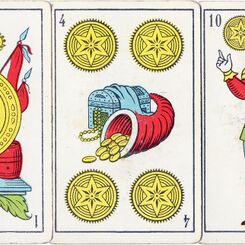
Supermercados CHIP
Supermercados CHIP playing cards manufactured in Uruguay by Compañía General de Fósforos Montevidean...
Naipes Victoria Gaucho
Naipes Victoria Spanish-suited, gaucho-themed pack celebrating the culture and traditions of the gau...
Naipes ‘Baccarat’
An example of the typical version of the Spanish Catalan pattern which is widely used in South Ameri...
Instituto Nacional de Calidad 2006 awards
Spanish-suited playing cards made specially for the Instituto Nacional de Calidad 2006 awards.
Uruguayan Playing Cards
Until the 19th century playing cards were imported into Uruguay from Spain.
Las Cartas de Tacuabe by Manos del Uruguay
Tacuabé was a Charrúa native from Uruguay, an indigenous tribe that became extinct following Europea...
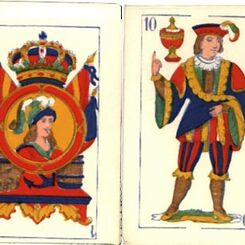
Grimaud Spanish pattern
Grimaud Spanish pattern, c.1880
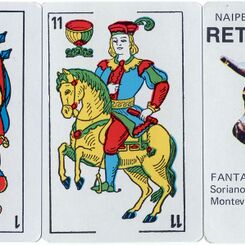
Naipes ‘Retruco’
Naipes ‘Retruco’ published by Fantasias S.A., Montevideo, c.1980.
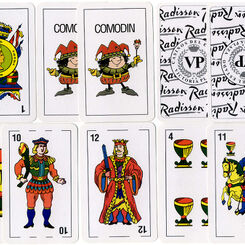
Radisson Hotels
Playing cards for Radisson Hotels - Casinos del Estado - Victoria Plaza, Montevideo, Uruguay, c.2009...
The ‘Parisian’ Spanish pattern
A version of the old Spanish National pattern which was manufactured by Parisian card makers in the ...
Most Popular
Our top articles from the past 60 days


Adam Wintle
11 April 2026, 14:32SavedSaved this article to Researching & Reading