


Cartomancy deck by Johann Ernst Backofen
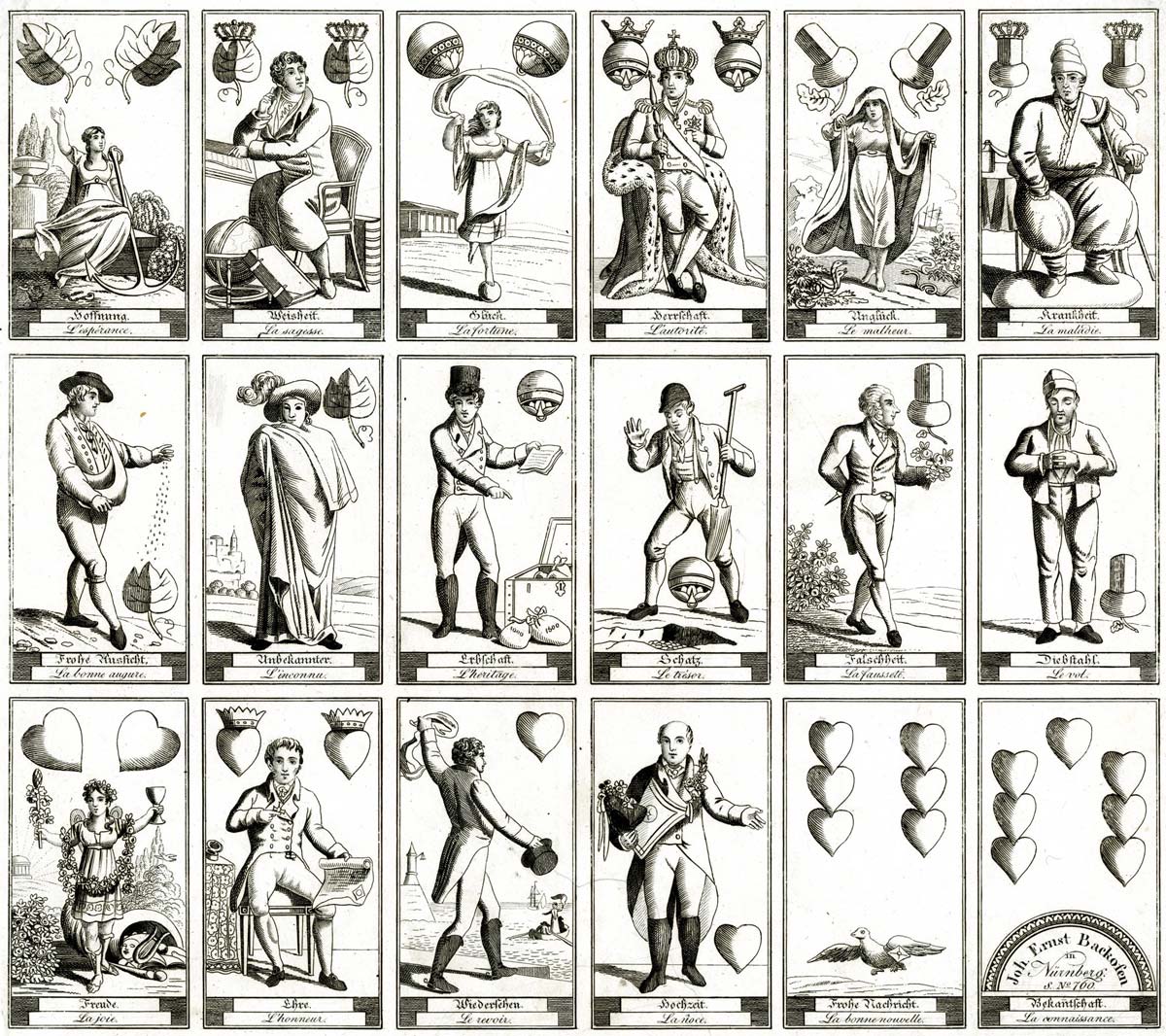
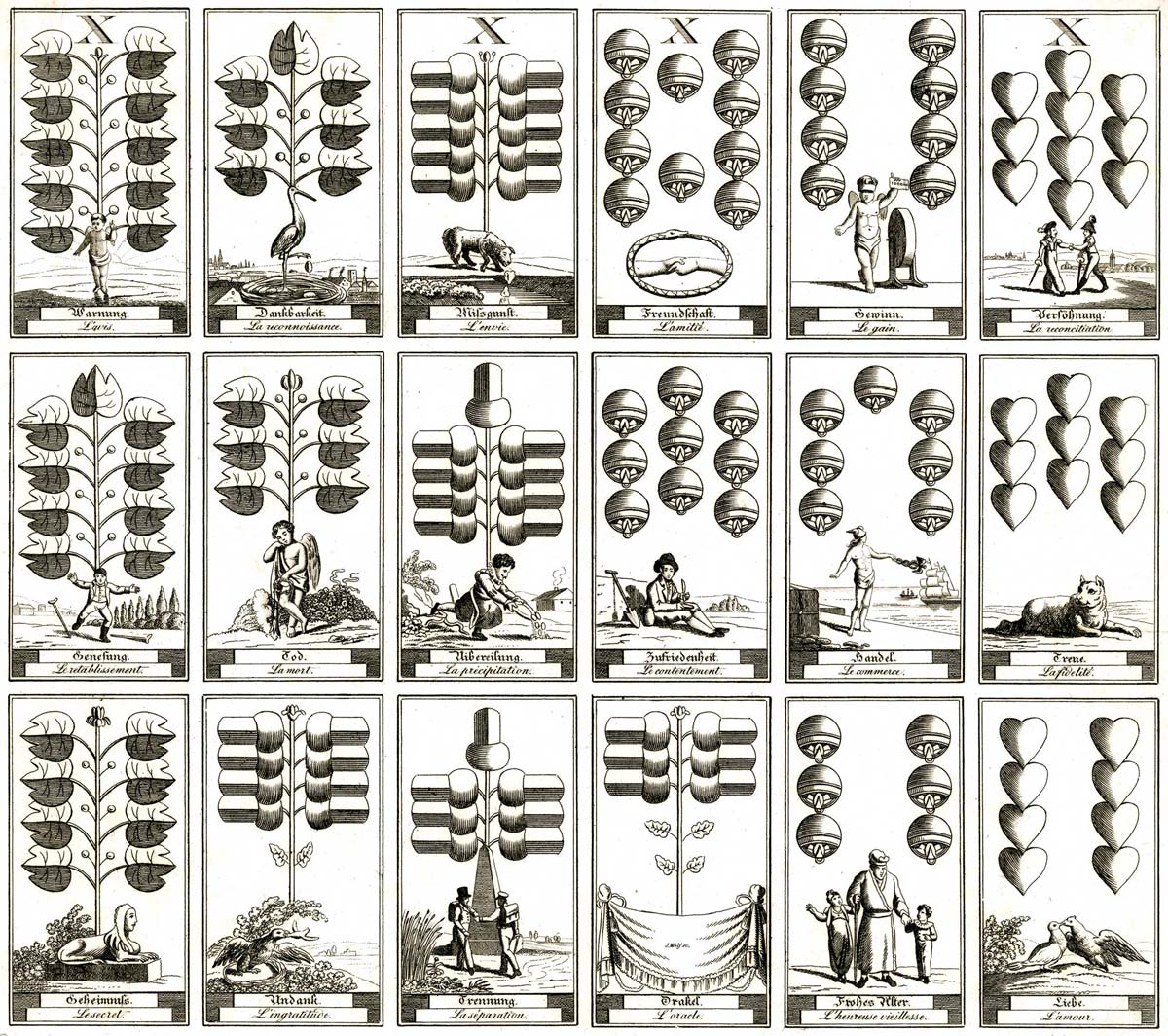
German-suited Cartomancy deck published by Johann Ernst Backofen, Nürnberg.
A fine 36-card Cartomancy deck with emblematical figures on both the court and pip cards engraved by J. Wolf and published by Johann Ernst Backofen, Nürnberg, early 19th century. The titles are printed at the bottom of each card in German and French; those on the four deuces are “Freude", “Glück", “Unglück" and “Hoffnung". The tablet on the 7 of hearts is lettered “Joh. Ernst Backofen in Nürnberg S. No. 760” and the drapery on the 6 of acorns bears the engraver’s name “J. Wolf sc.”
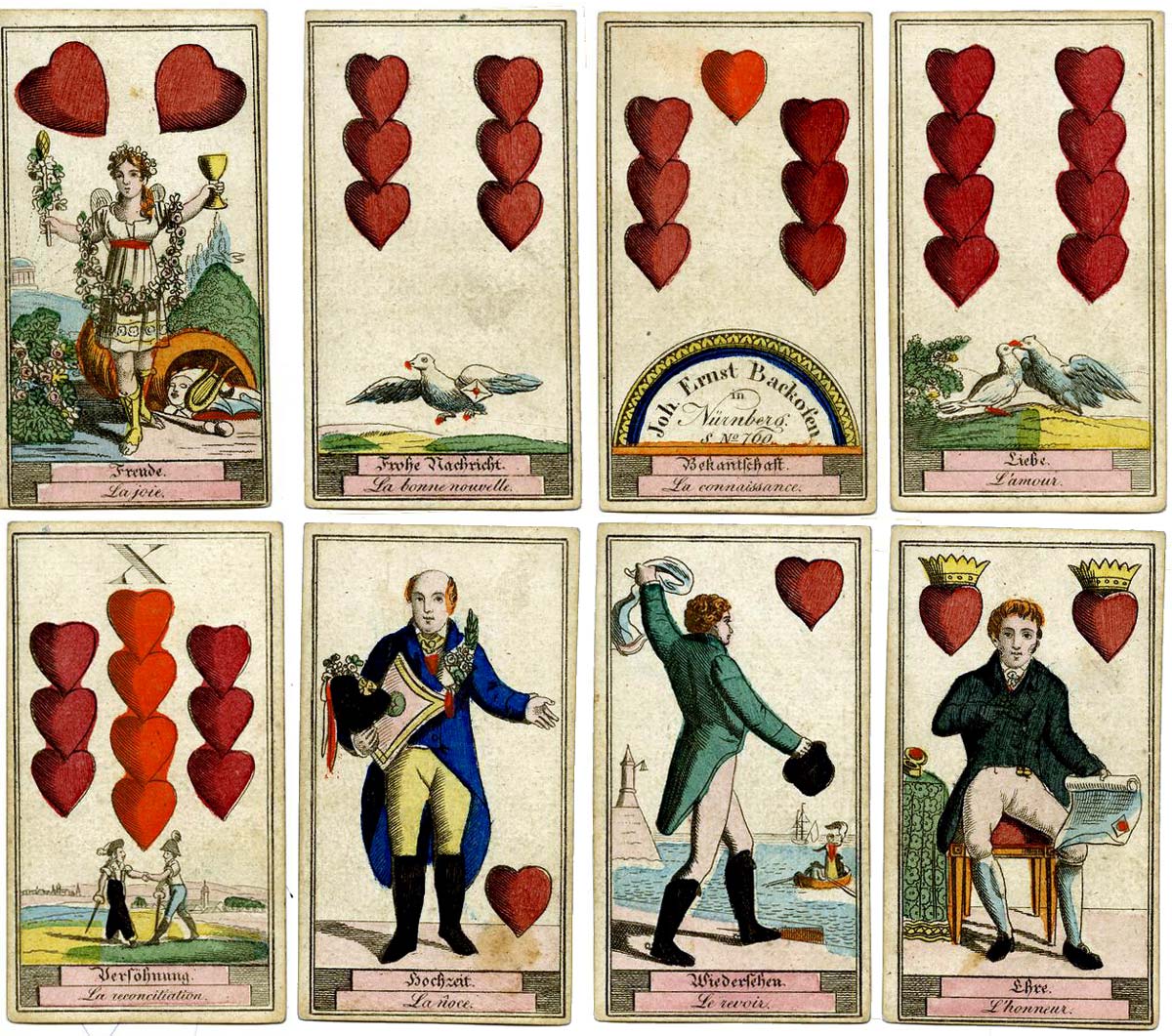
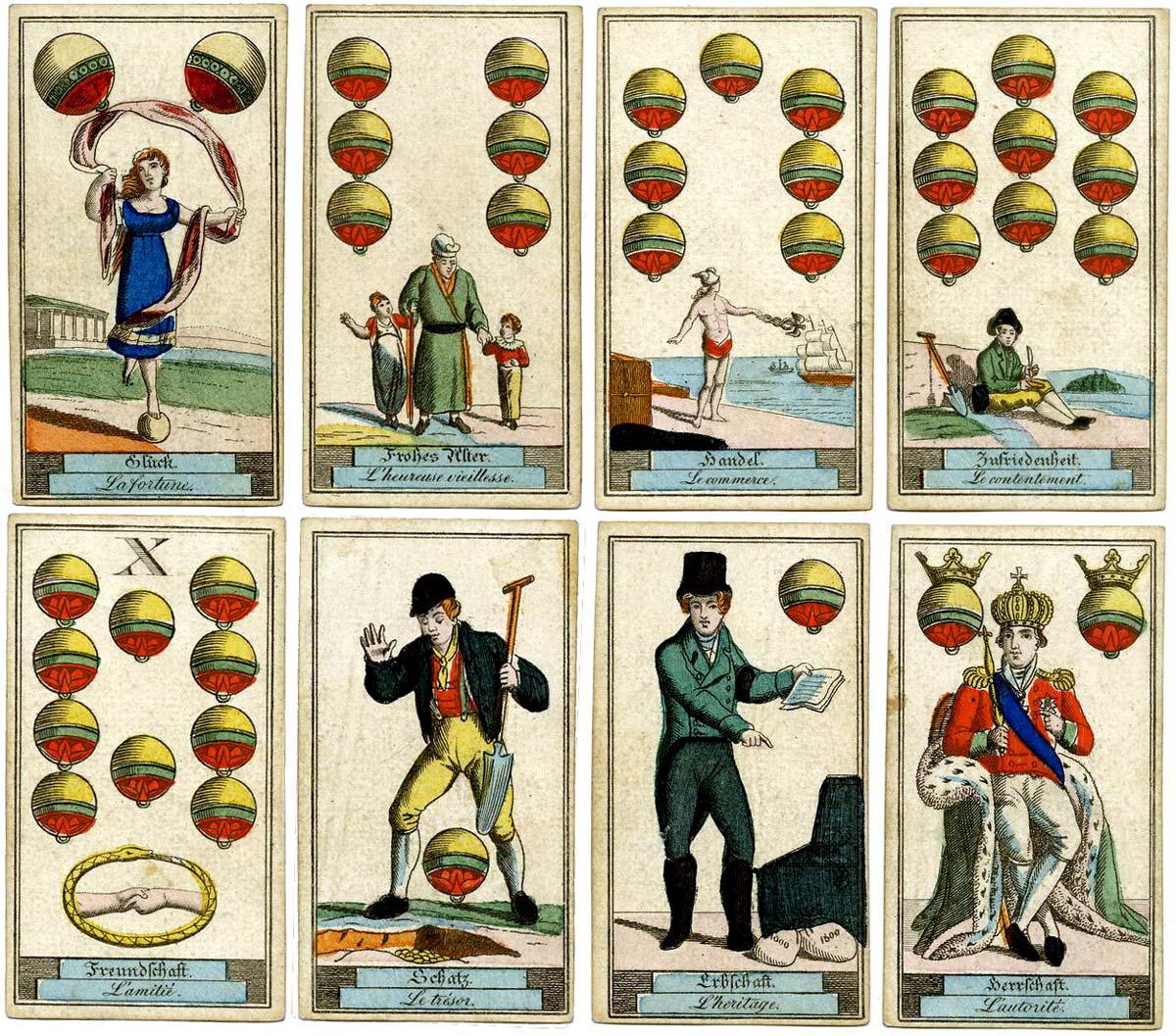
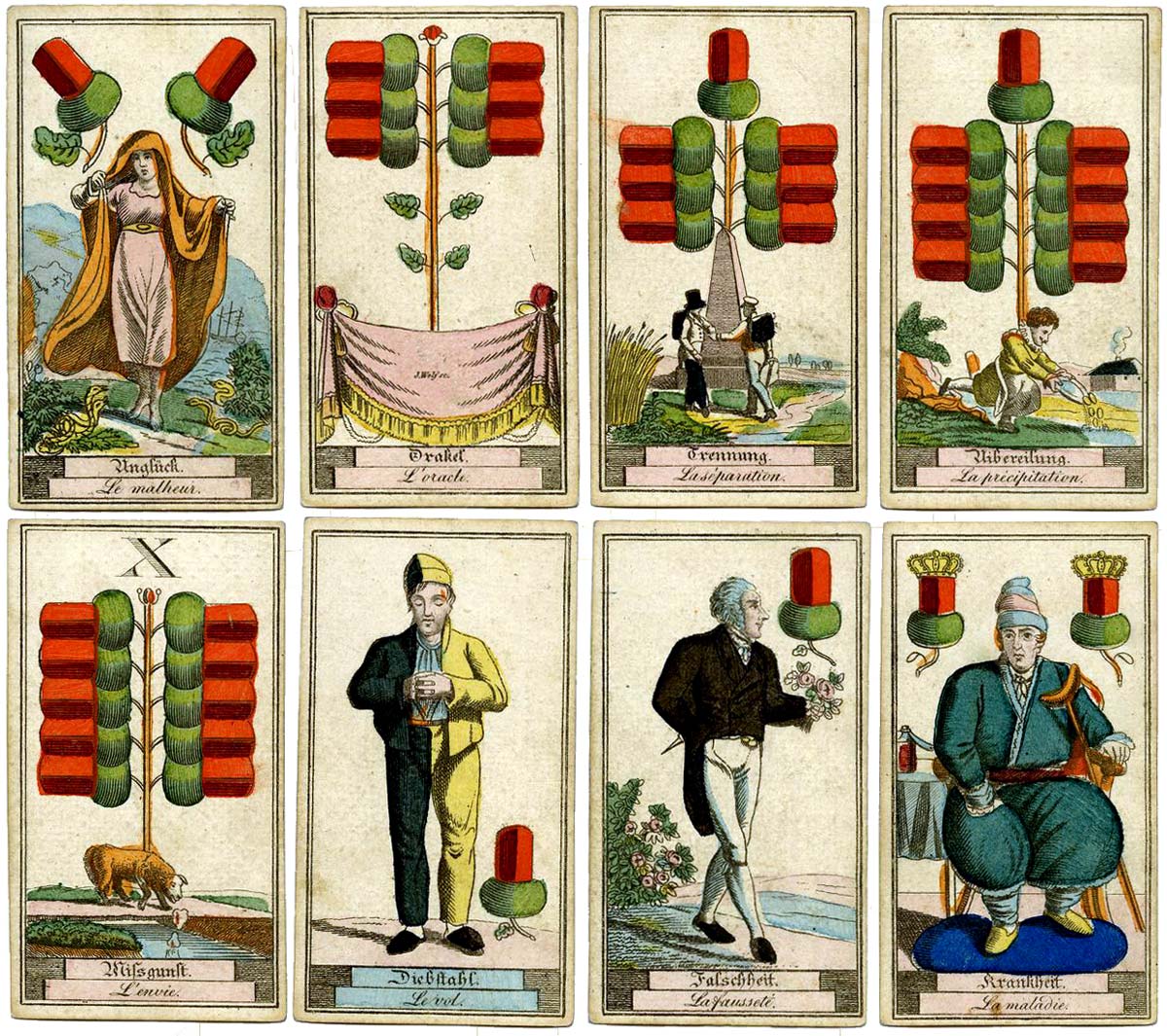
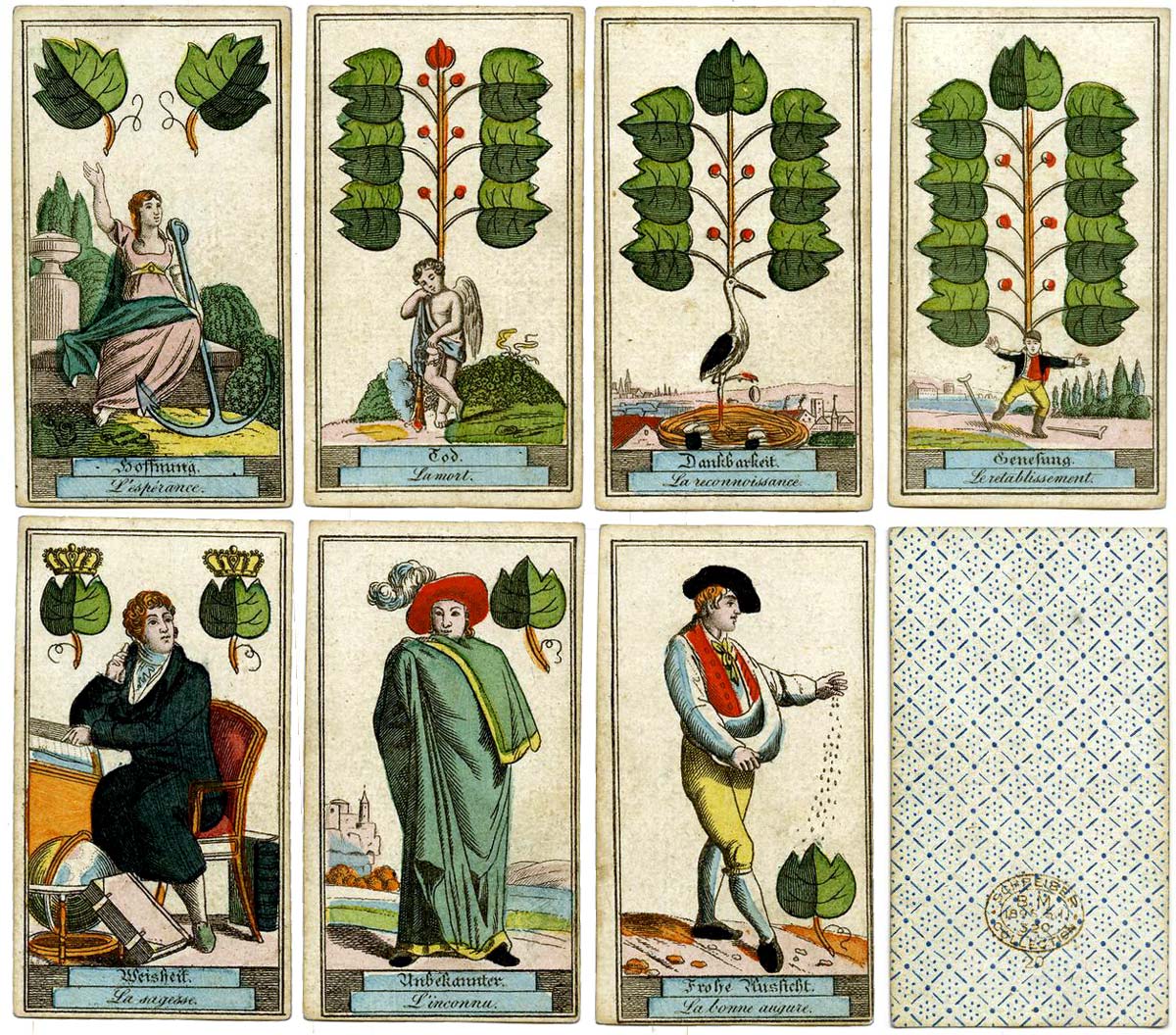
Above: cards from a 36-card Cartomancy deck engraved by J. Wolf and published by Johann Ernst Backofen, Nürnberg, early 19th century. Hand-coloured etching, backs printed with a diagonal blue pattern. © The Trustees of the British Museum • Museum number 1896,0501.320►
Further References
O’Donoghue, Freeman M: Catalogue of the collection of playing cards bequeathed by Lady Charlotte Schreiber (German 32), Trustees of the British Museum, London, 1901 [digital version here]
A pack with similar subjects produced by Leipzig Industrie Comptoir can be viewed here and also at the British Museum (Schreiber German 19): Museum number 1896,0501.281►
Two uncut, uncoloured sheets are also preserved in the British Museum • Museum numbers 1883,1110.127 and 1883,1110.128►

By Simon Wintle
Spain • Member since February 01, 1996
I am the founder of The World of Playing Cards (est. 1996), a website dedicated to the history, artistry and cultural significance of playing cards and tarot. Over the years I have researched various areas of the subject, acquired and traded collections and contributed as a committee member of the IPCS and graphics editor of The Playing-Card journal. Having lived in Chile, England, Wales, and now Spain, these experiences have shaped my work and passion for playing cards. Amongst my achievements is producing a limited-edition replica of a 17th-century English pack using woodblocks and stencils—a labour of love. Today, the World of Playing Cards is a global collaborative project, with my son Adam serving as the technical driving force behind its development. His innovative efforts have helped shape the site into the thriving hub it is today. You are warmly invited to become a contributor and share your enthusiasm.

Activity for Cartomancy deck by Johann Ernst Backofen
Sign in to comment or save this article.

Related Articles
Baraja Nefertiti
Mexican fortune-telling pack with black and white designs by Thania Nicolopulus.
Lo Zodiaco
French-suited fortune-telling pack with distinctive designs by Italian artist Sergio Ruffolo.
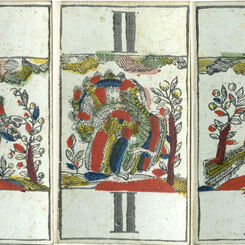
Animal Tarot by Johann M Backofen
French-suited ‘Bavarian Animal Tarot’ by Johann Matheus Backofen, Nürnberg, late 18th C.
Playing Cards and Calendars
In this video Ana Cortez examines the relationship between ordinary playing cards and the calendar. ...
Karty Lyubvi
Karty lyubvi Slavyanskie (Slavonic love cards) and Karty lyubvi Starinnye (Ancient love cards).
Polish fortune-telling cards
Fortune-telling pack with divinatory rhymes in Polish, c.1985.
Cartomancy, Oracle and Divination Cards
Playing cards are used for fortune-telling - turning another card illumines the moment and a new per...
Gambling and Vice in the Middle Ages
Gambling and Vice in the Hours of Charles V: card-playing in the local tavern
Georgian Fortune Telling Cards
Georgian Fortune Telling Cards, c.1800.
Wüst Lenormand deck, c.1860
Wüst Lenormand deck, c.1860
The Playing Card Oracles
The Picture Book of Ana Cortez is an original work of art designed to facilitate Divination.
Austrian Cartomancy Cards
During the 19th century a system of fortune telling arose in Europe using unnumbered, pictorial card...
Wahrsage-Karten
In this version an explanatory verse is printed at the top of each card.
Carreras Fortune Telling Cards
Carreras Fortune Telling Cards.
Cartes Lenormand
“Cartes Lenormand” published by H. P. Gibson & Sons Ltd, London, printed in Germany by B. Dondorf, 1...
Lenormand Cartomancy
Mlle Lenormand Cartomancy deck made by Vereinigte Stralsunder Spielkartenfabriken, Stralsund, c.1890...
Fortune Telling Deck, c.1818
Fortune Telling Deck by Industrie Comptoir, Leipzig c.1818.
Johann Matheus Backofen
French-suited deck manufactured by Johann Matheus Backofen, Nürnberg c.1800.
Geistliche Karten
Geistliche Karten, Augsburg, 1718. Each card carries a text in Gothic typeface giving advice regardi...
Significado de los Naipes Españoles
Cartomantic meanings of Spanish playing cards by Benita the Witch (XVI century), published by Chocol...
Most Popular
Our top articles from the past 60 days


