


Schiller deck
Schiller deck made by Conrad Ludwig Wüst, Frankfurt/Main, ca. 1834.
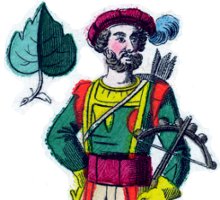
Schiller deck, C. L. Wüst, Frankfurt/Main, c.1834
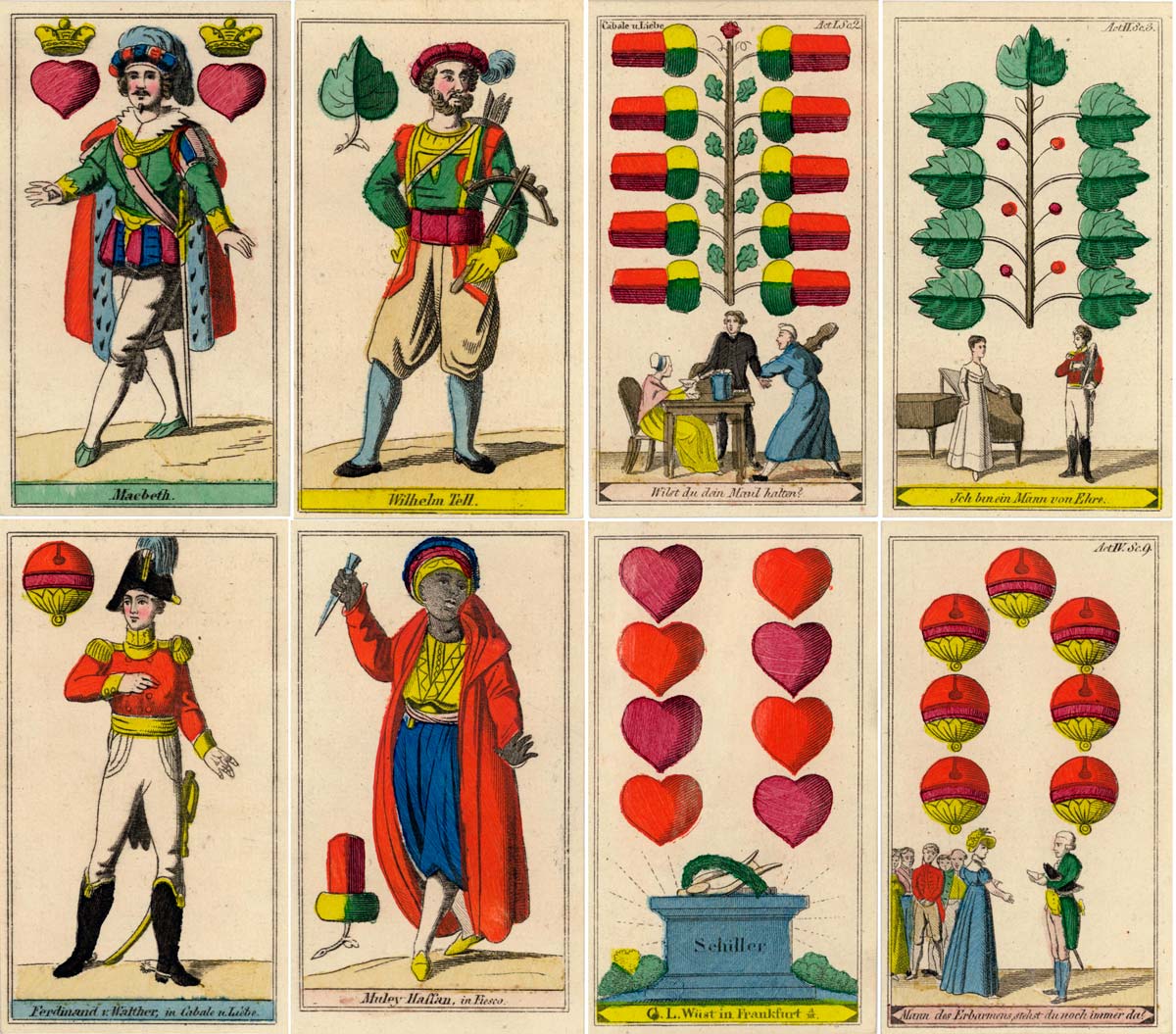
Johann Christoph Friedrich von Schiller (1759 – 1805) was a German poet, philosopher, historian, and playwright. The ‘Schiller’ deck was made by Conrad Ludwig Wüst (1811-1927), Frankfurt/Main, ca. 1834 to commemorate Schiller’s 75th birthday. Designed and copper engraved by J. Wulf, stencil coloured, 36 cards. The aces depict theatrical attributes, the court cards depict figures from different dramas by Schiller and the pip cards have vignettes of scenes from his most popular works. The King of Hearts is reminiscent of Schiller as a translator of Shakespeare.
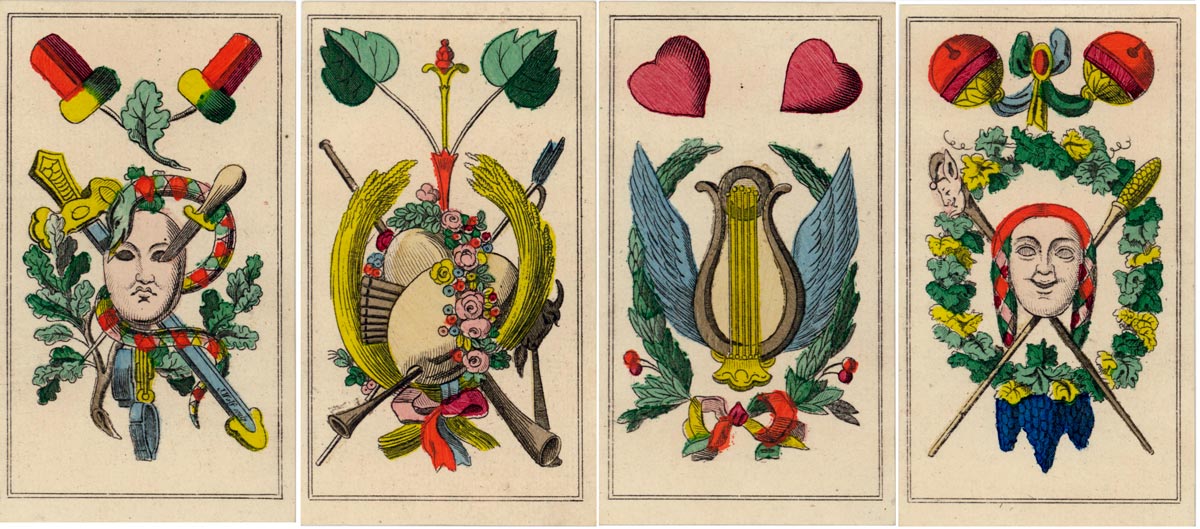
Above: Schiller deck made by Conrad Ludwig Wüst, Frankfurt/Main, ca. 1834. The manufacturer's name can be read on the Eight of Hearts.
C. L. Wüst was eventually taken over by the Vereinigte Altenburger Stralsunder Spielkarten Fabriken AG (V.A.S.S.), Altenburg (1931-1945), who from time to time made use of the old designs and plates. See also: C.L. Wüst: Brazil Scenic Aces • Swiss Album Patience • Shakespearean Playing Cards • Germany Homepage
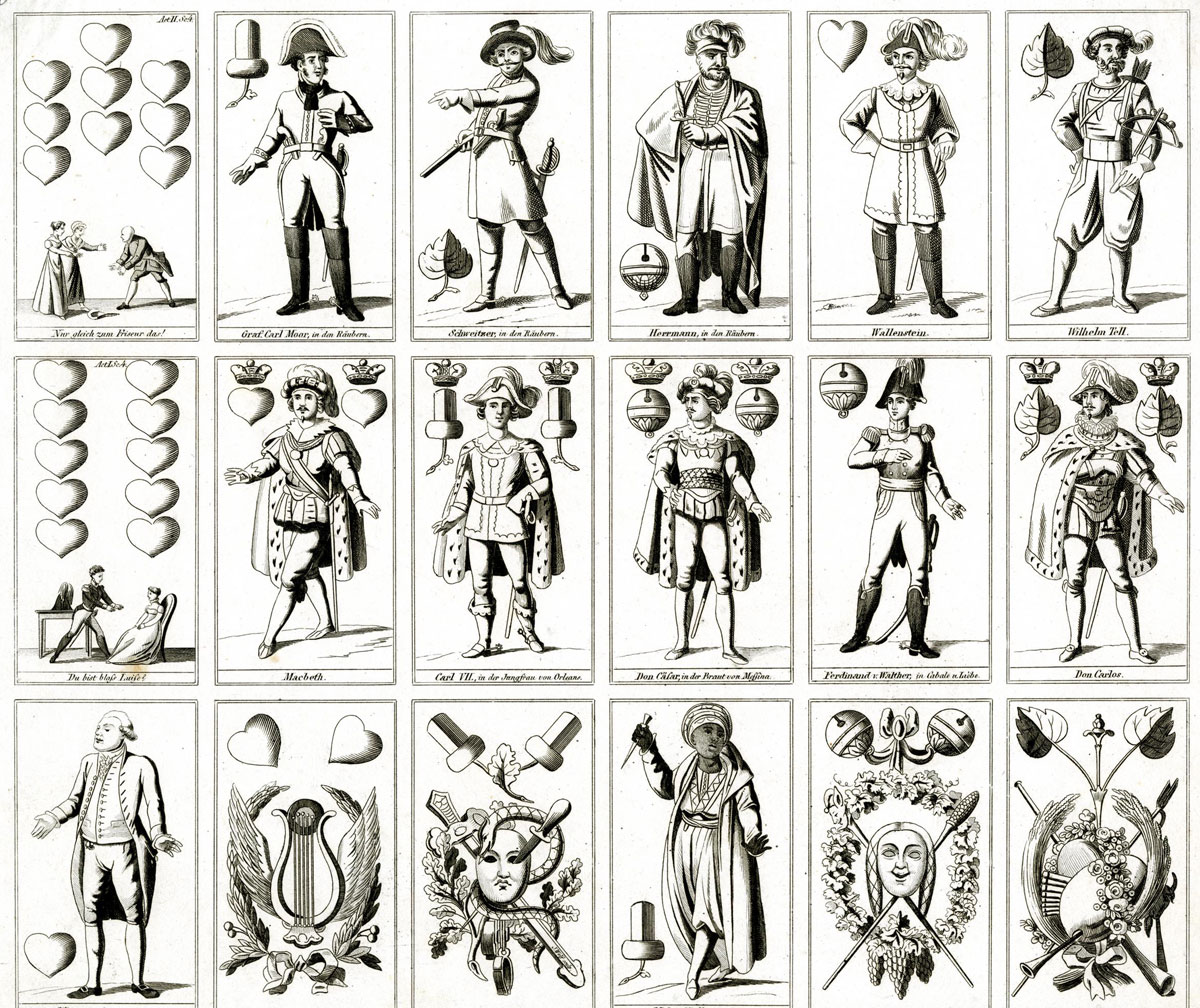
Above: an uncut sheet with 18 playing-cards with German suit-marks showing scenes and characters from different plays, some associated with German playwright Friedrich Schiller (1759-1805). The cards are the 4 aces, 4 knaves, 4 knights, 4 kings, and the 9 and 10 of hearts. Each pip card has the act and scene number in the top right corner and a description of the scene on the lower margin. The court cards have the name of the character in the lower margin. The partner to this sheet (no. 1883,1110.129) has on the 8 of hearts a stone monument with the name of "Schiller" printed in the centre. Below is "C.L. Wüst in Frankfurt a/m." © The Trustees of the British Museum • Museum number 1883,1110.126►
REFERENCES
Shaw, Martin & Symons, Paul: Playing cards from the factory C.L.Wüst, Frankfurt, Germany (1811-1927), Catalogue of the exhibition held at the Nationaal Museum van de Speelkaart, Turnhout, Belgium, 23 September-31 December 2005.

By Klaus-Juergen Schultz (1948-2025)
Germany • Member since February 03, 2024
From the collection of Klaus-Jürgen Schultz.

Activity for Schiller deck
Sign in to comment or save this article.

Related Articles
Crimean War Deck
1854 saw the declaration of the Crimean War and this deck was published by Wüst around, or shortly a...
-playing-cards-with-wüst-courts/images/rijks-1.f6075e41.jpg "Oude Kunst (Old Art) playing cards with Wüst courts")
Oude Kunst (Old Art) playing cards with Wüst courts
made for export to the Netherlands.
Copies of Wüst House pattern playing cards
both by Christian Heinrich Reuter of Nuremberg, Germany
Goodall’s modernised Wüst House pattern playing cards
A remodelled version of the first Wüst house pattern.
Wüst Costumes Suisses No.93
Two version of a Swiss souvenir pack by C.L.Wúst
Wüst Oval Patience Playing Cards No.240
A review of all three known versions
Renaissance Playing cards made by C.L.Wüst
Rococo style playing cards from Frankfurt.
Decorated pip cards from C.L.Wüst
Several Wüst patience packs with special pip cards
My Fair Lady
Theatre programme in the form of a pack of cards. East Germany, c.1967.
Miniature Theatre playing cards
Miniature playing cards, possibly for children, with a romantic theatrical theme. C.L. Wüst c.1890. ...
Schweizer Trachten
Schweizer Trachten No.174 (Costumes Suisses) by Dondorf.
Berliner Originale
“Berliner Originale” designed by Manfred Bofinger, 1986.
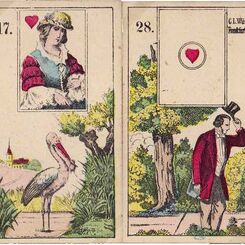
Wüst Lenormand deck, c.1860
Wüst Lenormand deck, c.1860
C.L. Wüst, 1811 - 1927
SPIELKARTENFABRIEK VON C.L. WÜST, 1811 - 1927. A short history of the Wüst factory by Martin Shaw & ...
Wüst “Encyclopedic Tarot”
“Encyclopedic Tarot” by C. L. Wüst with “bourgeois” views of life on the Trumps.
Carl Arnold Transformation
Transformation playing cards designed by Carl Johann Arnold (1829-1916), the court artist for King F...
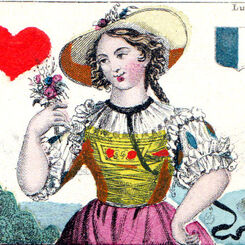
Swiss Costumes
Wüst's Swiss Cantons souvenir deck was published in Frankfurt in c.1875 for the emerging tourist mar...
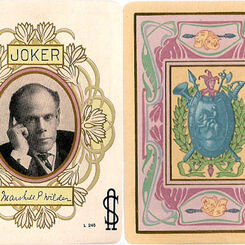
Tales from the Stage
"Tales from the Stage" - an article about theatrical playing cards by Rod Starling
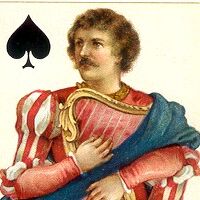
Luxus Club Karte No.184
Another of Dondorf's masterpieces of chromolithography, the detailed artwork on these cards has mult...
The History of Playing Cards
Playing cards appear in European records in the late 14th century, but their earlier history lies fu...
Most Popular
Our top articles from the past 60 days


