


49: De La Rue in detail
A detailed presentation of the variants of De La Rue's standard cards.
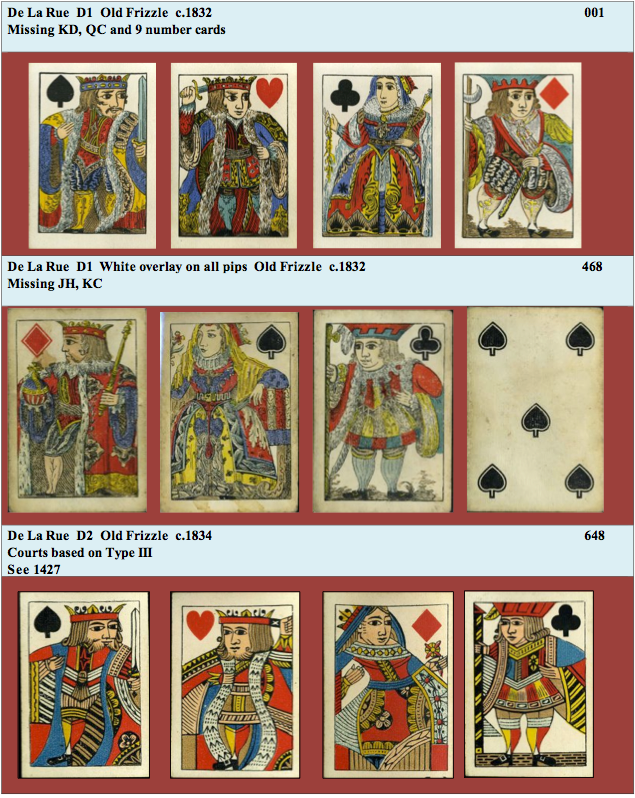
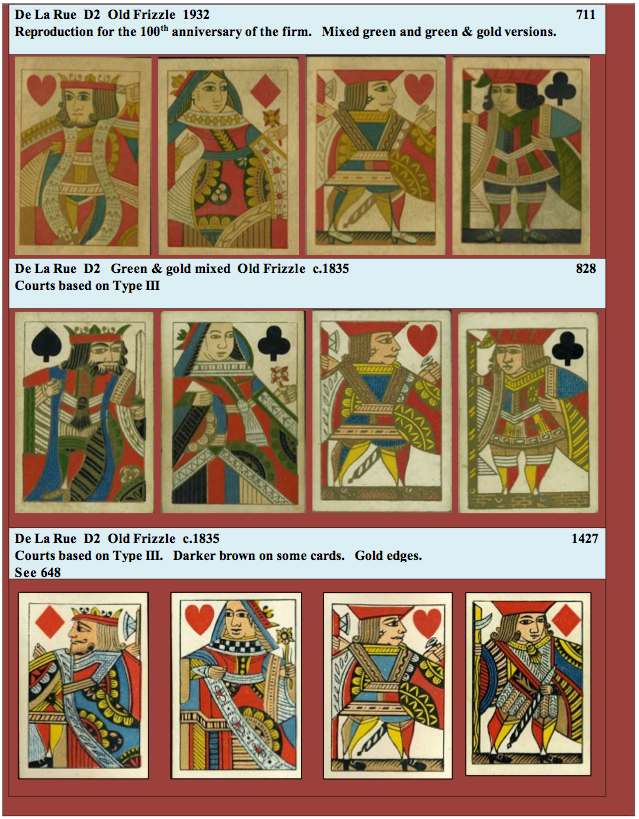
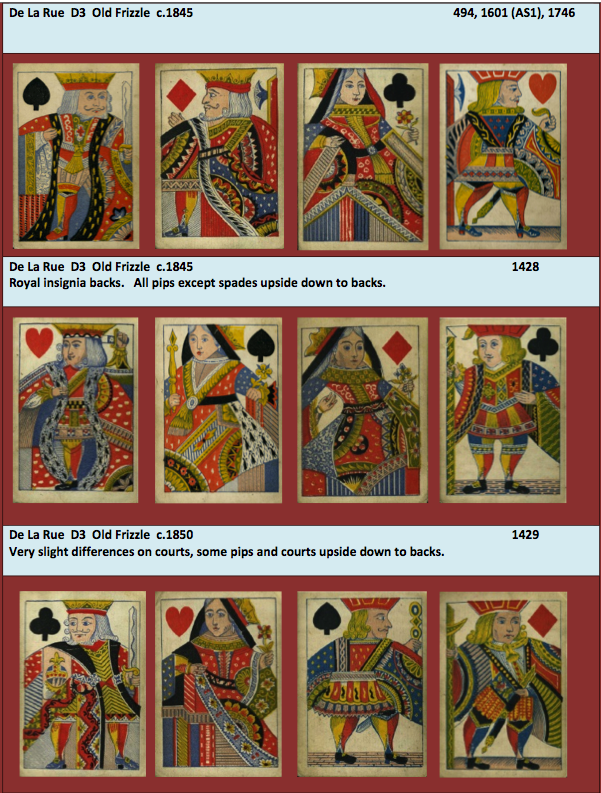
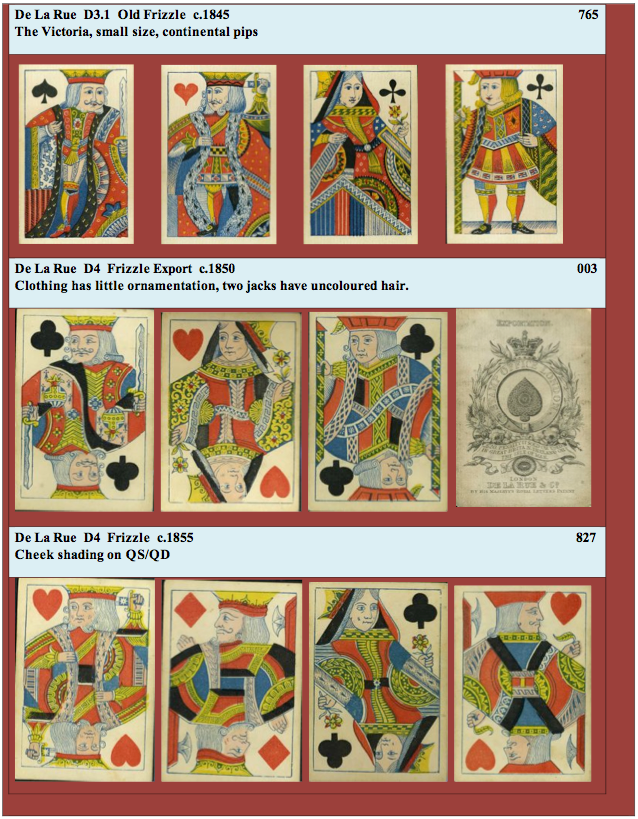
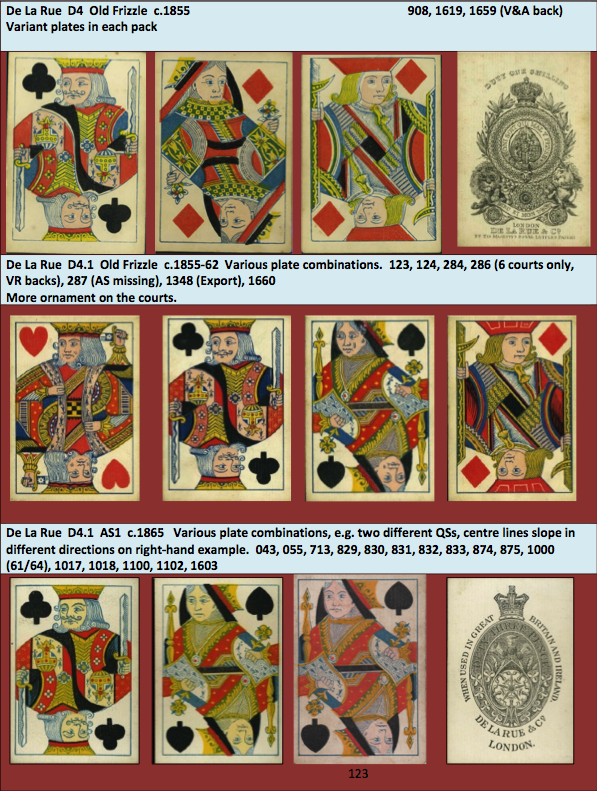
Some people may ask, with justification, "How can I be so certain about my statements, particularly as regards dating?" The answer lies not simply in the length of time I've been collecting and observing cards, but in the background information that's available (sometimes rather limited) and the cards themselves. The task is to relate the cards to the background circumstances to give an overall picture of how a maker's cards developed. I have already dealt with De La Rue's cards on page 5 and page 28, but here is the database of cards I have. The three- and four-digit numbers on a blue ground and in square brackets in the text are my catalogue entry numbers; some images have no numbers, as they are of packs no longer in my possession. For a complete list of all the De La Rue packs in my collection, including those with Goodall courts and Waddington courts, click the links: part 1 / part 2►
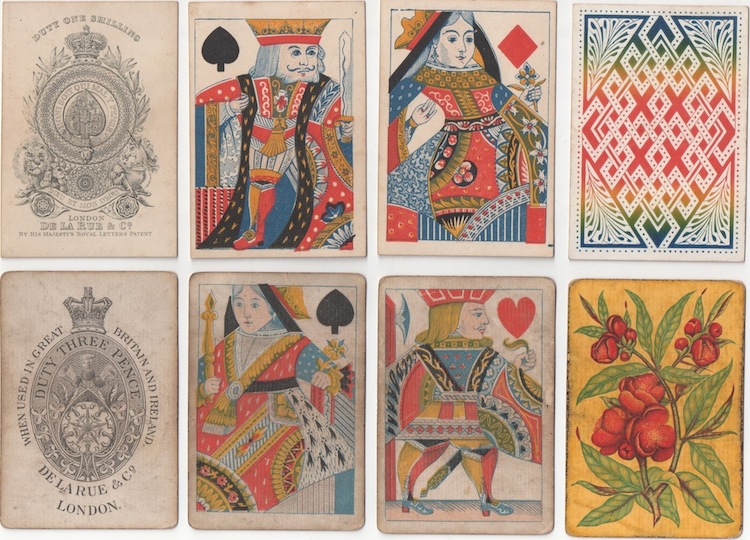
Above: D3: [1746] with a non-Jones back, c.1855; [1601] with post-Frizzle AS, c.1863
On the basis of a number of packs celebrating the wedding of Queen Victoria and Prince Albert it is possible to see that they were popular and were produced over several years in the Old Frizzle period. They were presumably discontinued after Albert's death in 1861. All the following courts are found with this back design: D2, D3, D3.1 and D4.
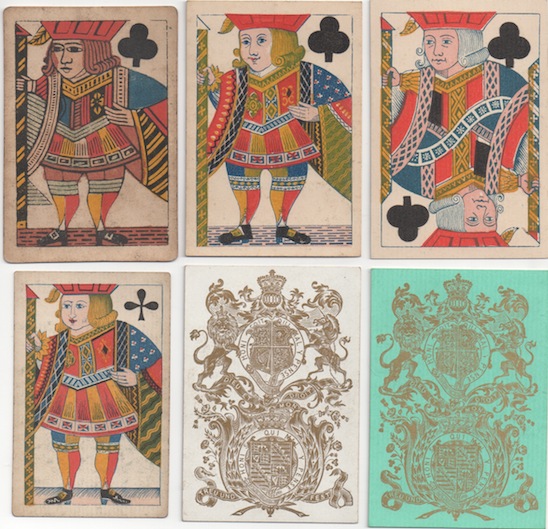
Above: DLR Queen Victoria's Wedding.
Another version of the Victoria had double-ended courts and floral backs.
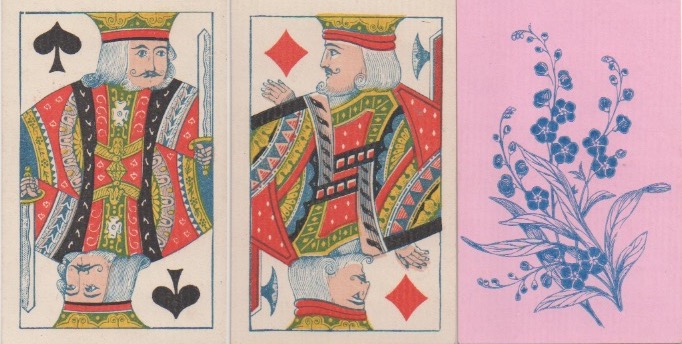 D3.2, c.1855
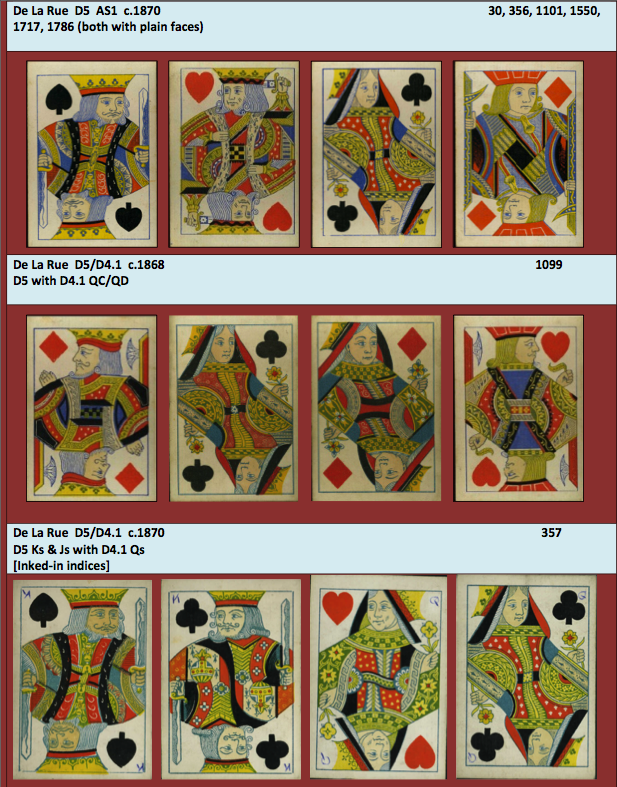
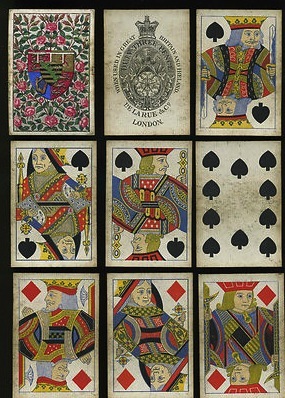
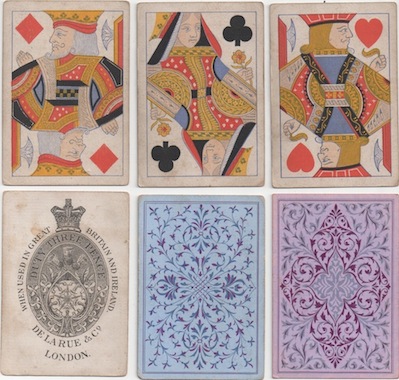
Above: D5: [1550] with Prince of Wales wedding backs, c.1872 (not the first edition); with similar backs, c.1870
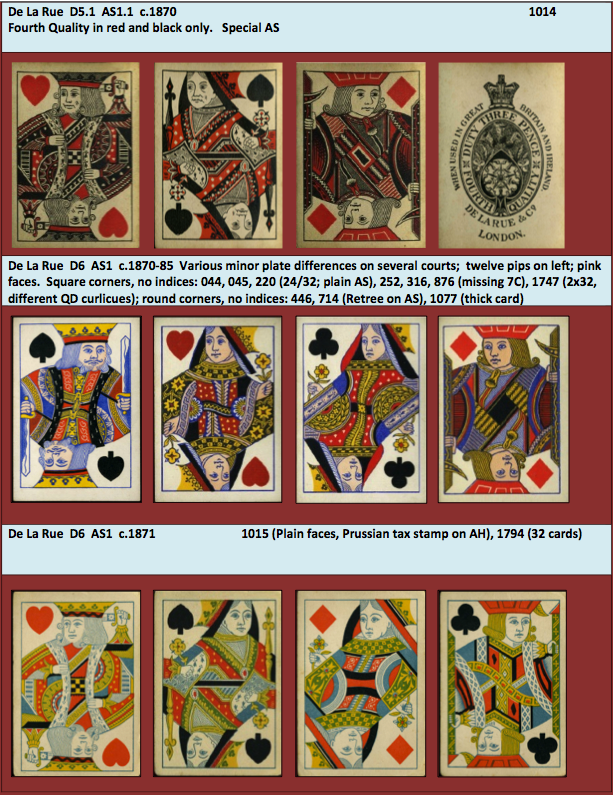
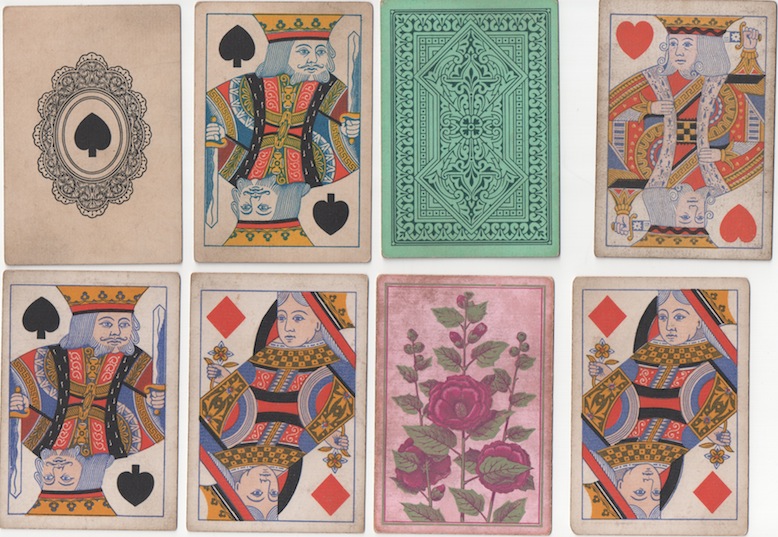
Above: D6: [1661] anonymous AS, plain faces, green backs; [1501] with coloured faces; c.1880
Above: D6: [1747] bézique set, same backs, QD bodice curlicue variants: "S S" left; "S Z" right (usually "Z S"), double-ended pips, c.1878
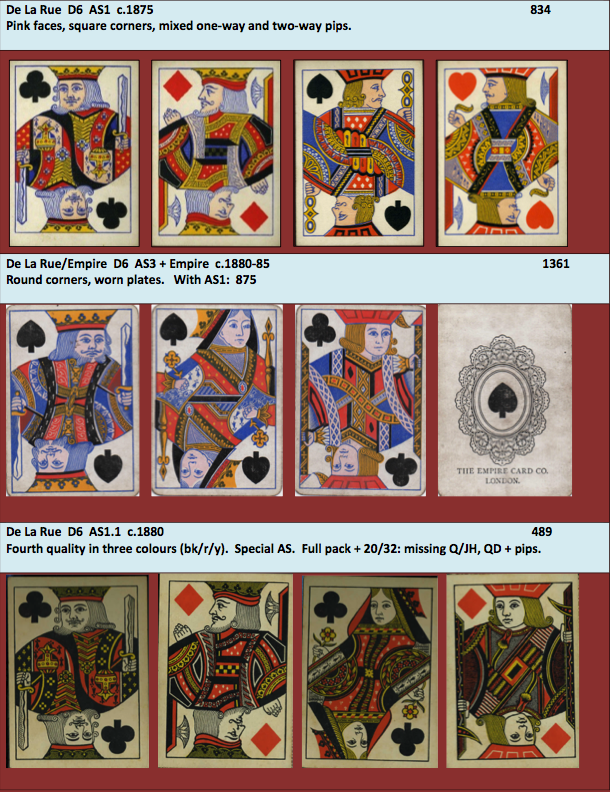
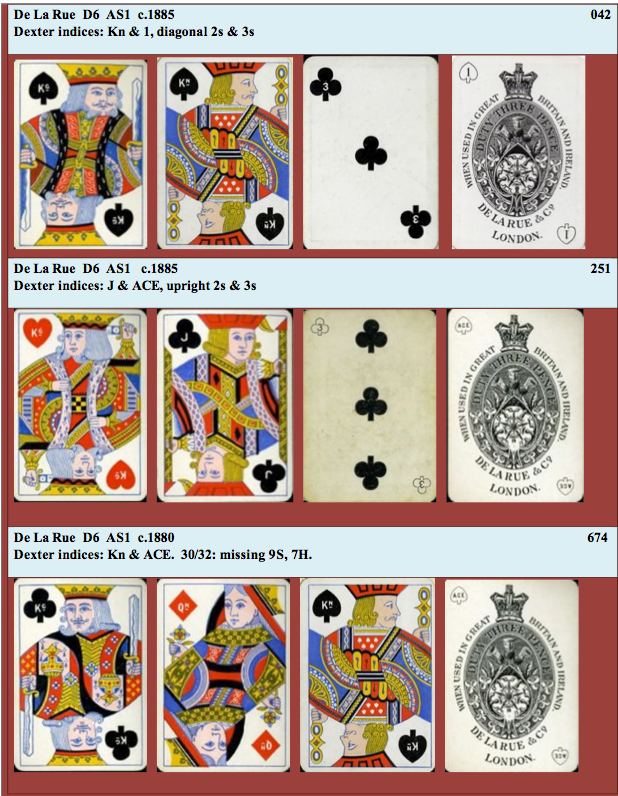
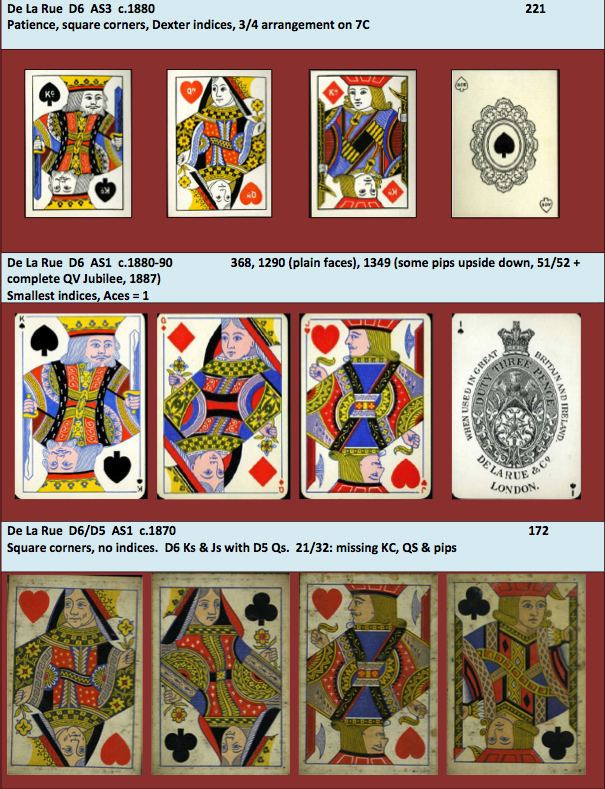
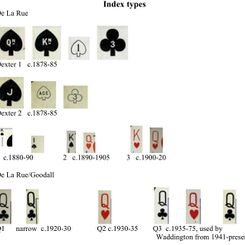
I have a bézique set [1663] with matching backs from 1890, but one pack has the smallest indices and the other has the medium ones. Dated packs/sets which can be relied on for their authenticity are very valuable in getting an overview of chronology. The set indicates some overlap of use of the two types of index around 1890. The 1887 Jubilee pack [1349] has the smallest indices with aces represented by 1.
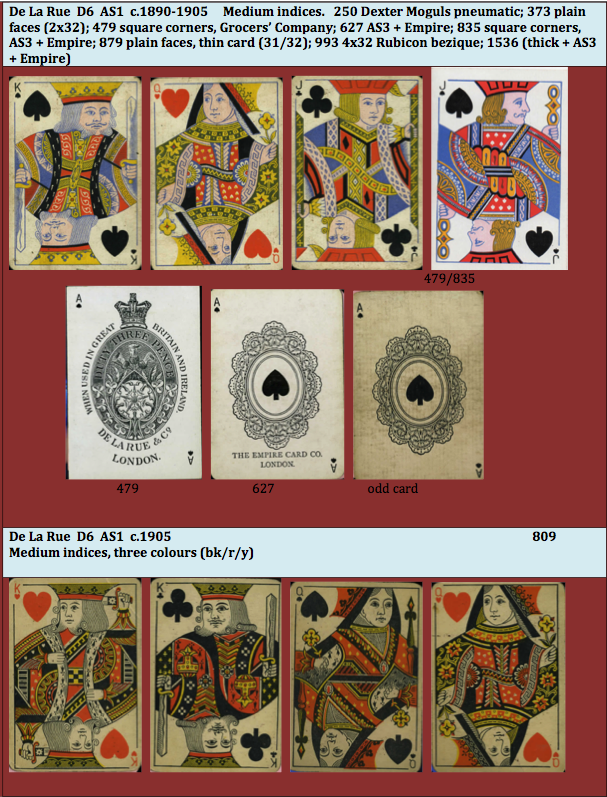
The medium-sized indices were in 1902 in the Coronation pack for Edward VII; the larger ones were used in the De La Rue special pack for the Worshipful company of 1904. There was no doubt some overlap between the two types of index.
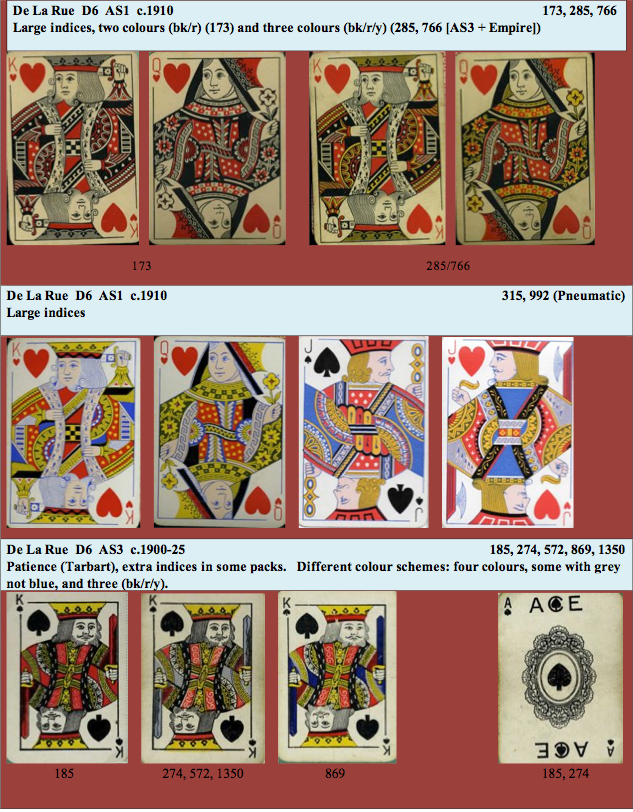
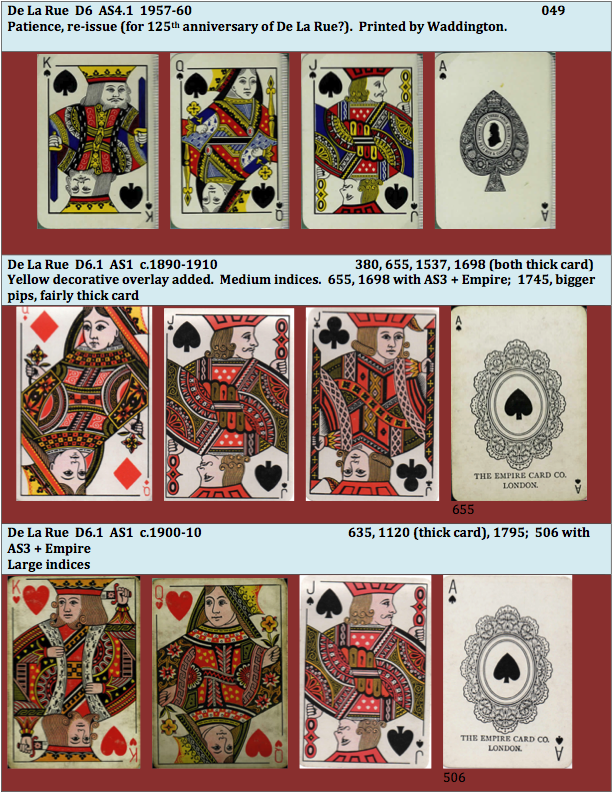
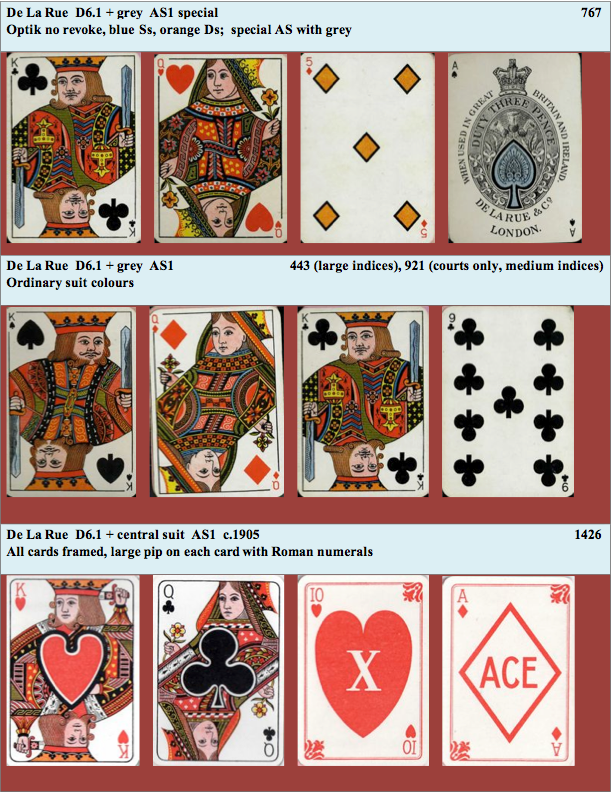
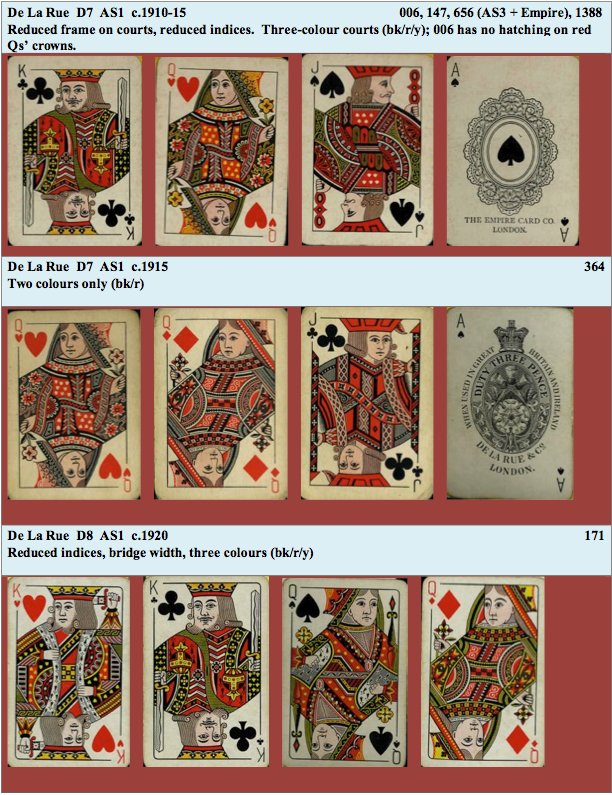
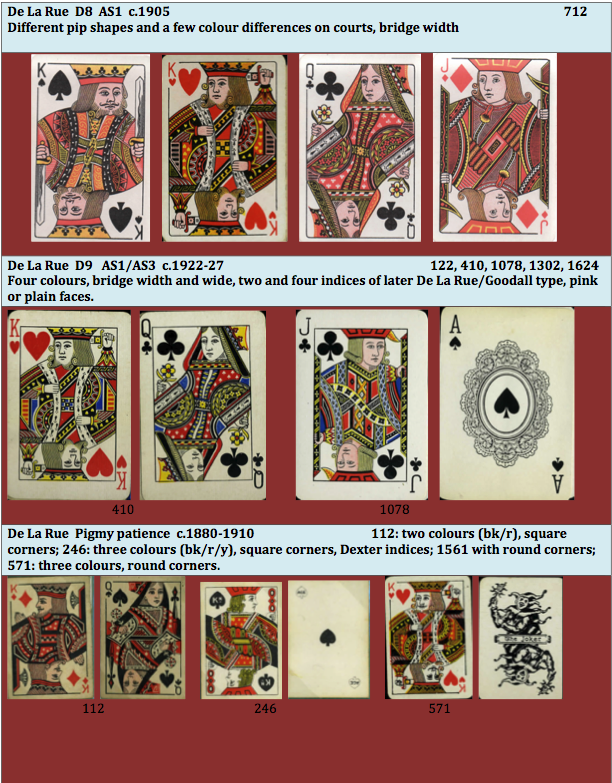
The earliest dated example of D9 I know is the 1919 Peace pack. The latest dated De La Rue cards I know with D9 courts is 1927, so some time around this date the De La Rue design was discontinued and the Goodall design was used in all packs. Such packs are dealt with under the Goodall design (page 12). In the 1940s there were also De La Rue packs with Waddington courts, as illustrated on page 12 (under Goodall).

By Ken Lodge
United Kingdom • Member since May 14, 2012
I'm Ken Lodge and have been collecting playing cards since I was about eighteen months old (1945). I am also a trained academic, so I can observe and analyze reasonably well. I've applied these analytical techniques over a long period of time to the study of playing cards and have managed to assemble a large amount of information about them, especially those of the standard English pattern. About Ken Lodge →

Activity for 49: De La Rue in detail
Sign in to comment or save this article.

Related Articles
78: The Standard English pattern - Part 2, the tricky bits
There are many less straightforward aspects to the designs of the English pattern, which need carefu...
Hand-drawn transformation cards, c1875
A complete set of hand-drawn transformation cards from c1875, using a standard De La Rue pack.
The Douce Collection
The Douce Collection of playing cards in the Bodleian Libraries, University of Oxford.
Dutch Court playing cards
Games & Print Services’ version of the Dutch pattern.
69: My Collection
This is an archive list of my collection. I hope it will be of use and interest to others.
68: Playing cards in glass
My wife and I have recently commissioned a unique pair of stained glass windows for our home.
51: Some modern variations
A brief survey of some current variations in the standard English pattern.
Cribbage Board Collection
A collection of antique and vintage Cribbage Boards by Tony Hall
Pneumatic c.1960-1965
De la Rue were producing Pneumatic cards with the “special graining for ease of handling” as late as...
Rufford Playing Cards
Rufford playing cards is one of several brand names used by Boots for their stationery department, a...
41: A Guide to Dating Playing Cards
Dating is a particularly tricky but very interesting problem to tackle and there are many pitfalls. ...
39: Mixed Packs
A number of mixed packs appear for sale from time to time, but it's important to sort out what is me...
Suicide King
The King of Hearts, holding a sword behind his head, is sometimes nicknamed the “Suicide King”. He c...
Draughts League Medals
Arthur Charles Prince worked for De la Rue as a playing card cutter and later was promoted to superv...
Paramount Film Stars
Promotional playing cards for the Paramount film company with film stars on the court cards.
5: De La Rue
In December 1831 Thomas de la Rue was granted his patent for printing playing cards by letterpress.
2: Still Collecting Playing Cards at 80
This is a personal account of some of my experiences collecting playing cards.

De La Rue Continental
During the latter part of the nineteenth century De La Rue produced two special packs of cards for t...

De La Rue
De La Rue introduced letter-press printing into playing card production and his patent was granted i...
Traditional English Court
Games & Print Services Ltd traditional English courts.
Most Popular
Our top articles from the past 60 days


