


David James Binns
Hand-made “Tudor Playing Cards” by David James Binns, age 12.
David James Binns ~ “Tudor Playing Cards”
Hand-made “Tudor Playing Cards” by David James Binns, age 12. David wrote: “I know the clubs aren't perfect, but I'm only twelve so I can't do them as good as real Tudor cards. I set out to make a Hewson/ Tudor replica deck after seeing Tudor artwork and Tudor playing cards. I decided to do it in the correct fashion so made pip templates out of parchment. I made the cards a size between bridge and poker size. As you can see the court cards are not a 100% Hewson design, they are merged with my own ideas as well, I gathered resources from WoPC.co.uk and a sheet of court cards from a museum. (I found the picture on a site about Tudor cards.) It is my first try and the pip stencils wore out at the end, but I am pleased about the outcome.” We think they are excellent and successfully capture the look and feel of real Tudor playing cards.
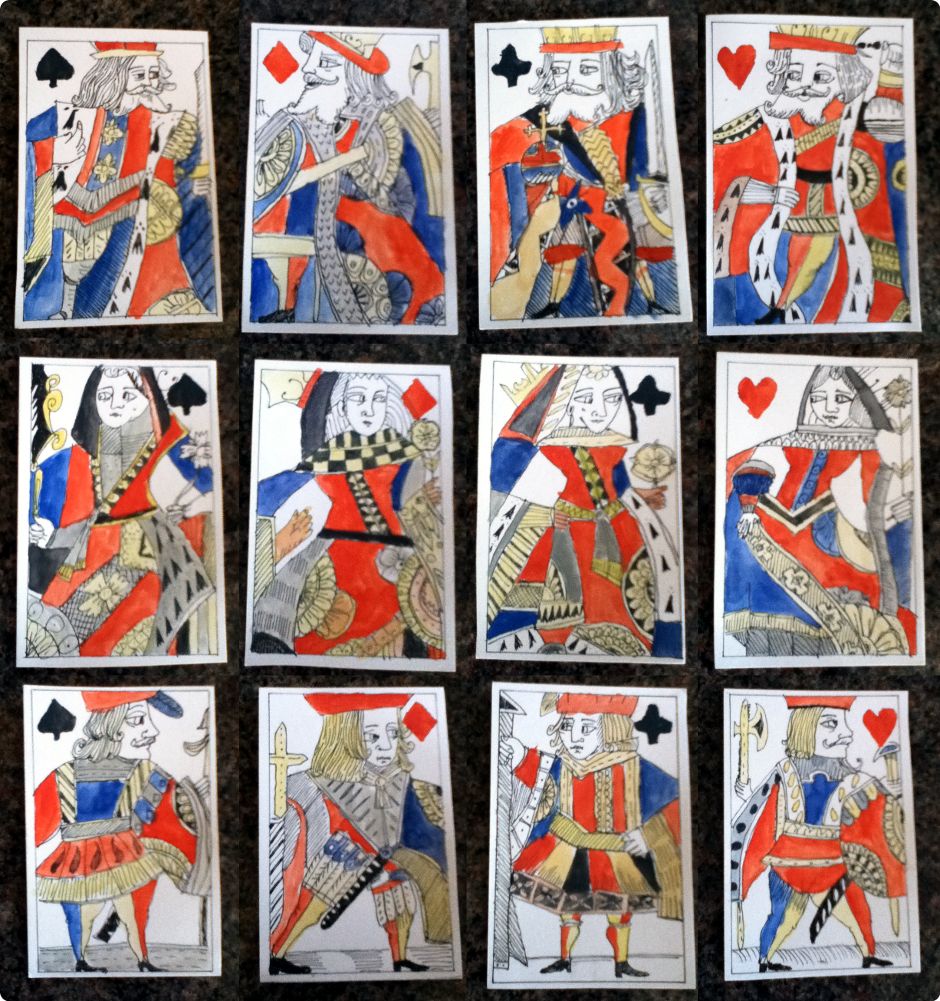
Above: hand-drawn and painted “Tudor Playing Cards” made by David James Binns, age 12. Images (c) David James Binns 2012.
Version 2 ~ “Hewson Facsimile Playing Cards”
“I sought to make a more historically accurate pack of Hewson facsimile cards that would be more similar to existing replicas available today. I used laminated paper for the stencils, to recreate the “heavily oiled card” used in the 1600s. The card stock was made from white paper pasted on brown thicker paper, records state this is how cards were made in the past. I then pressed them together between wooden boards by hand. I traced the court designs directly from a print of an original Hewson sheet, to give them the most practical historical accuracy. For the paints I used watercolours to recreate the “water based paints”, I spent a while mixing the colours to get the closest colour to the real 17th century paints. I used stencils for the pip cards and hand painted the courts.”
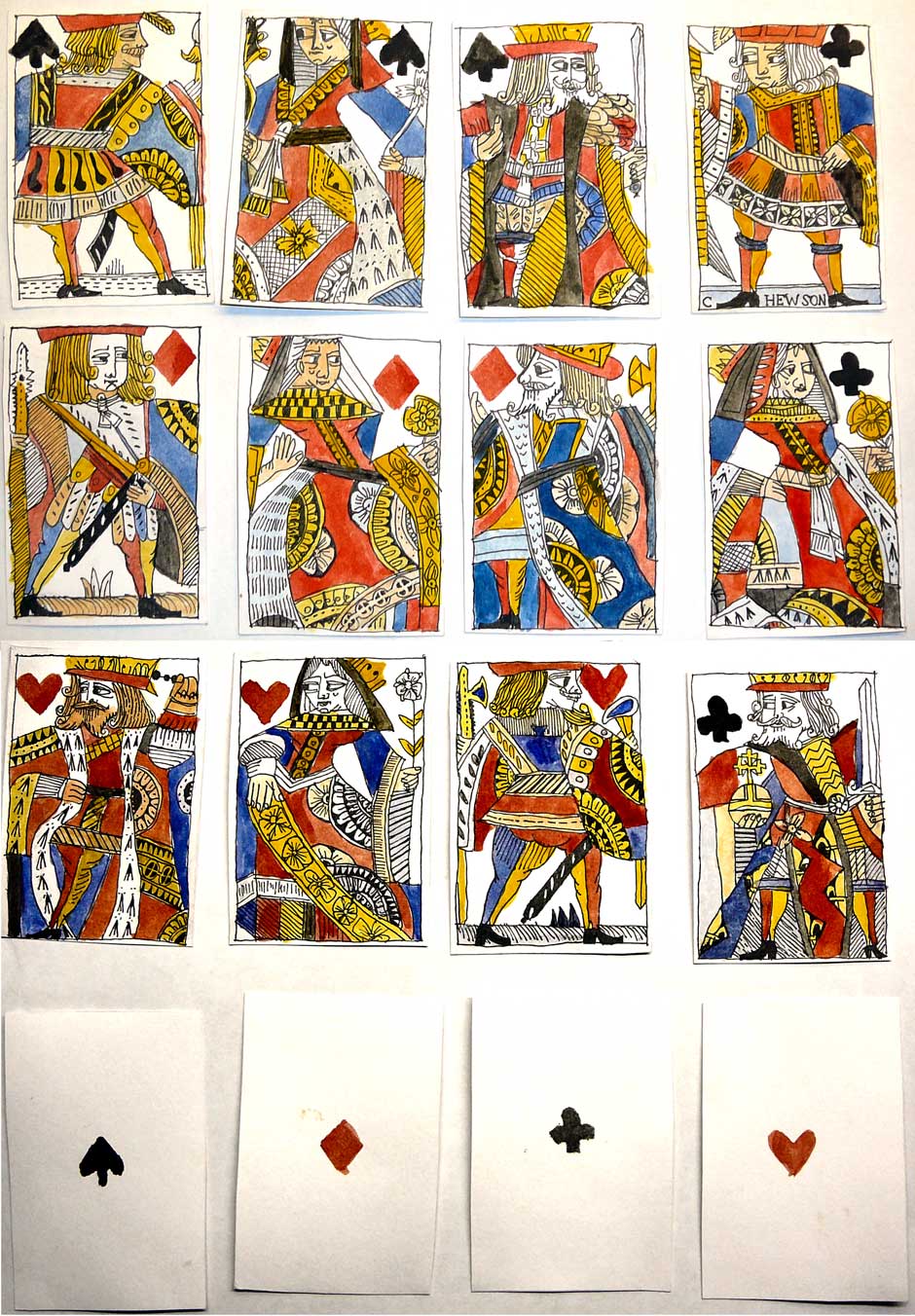
Above: hand-drawn and painted “Hewson Facsimile Playing Cards” made by David James Binns. “I pasted white paper on both sides of cartridge paper to recreate 17th century playing card stock, I then traced the court from a scan of an actual Hewson sheet dated 1680, and painted with water based paints mixed to the closest colours based on actual Hewson cards.” Images (c) David James Binns 2013.
Version 3 ~ “Hewson Facsimile Playing Cards”
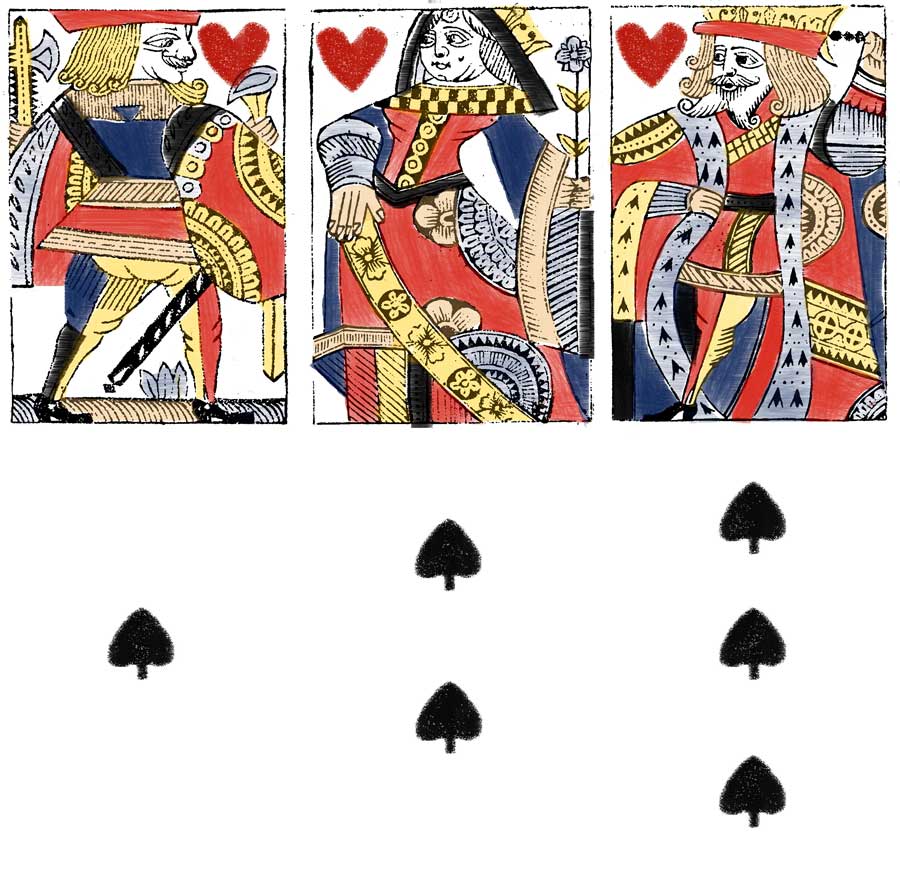
Above: these are my latest designs (August 2014). I've been experimenting with different soap polishes, and different papers. I'll make the cards out of three papers, the middle one a dark brown, I think, and polish them. This would, however, be the last digital or hand drawn pack of Hewson cards I should make I think, but that's not to say I won't still design other historical packs. A while ago, I bought some woodcut tools and have been practising on MDF, perhaps one day I could make a woodcut pack of some sort, but that would be a while away.

By Simon Wintle
Spain • Member since February 01, 1996 • Contact
I am the founder of The World of Playing Cards (est. 1996), a website dedicated to the history, artistry and cultural significance of playing cards and tarot. Over the years I have researched various areas of the subject, acquired and traded collections and contributed as a committee member of the IPCS and graphics editor of The Playing-Card journal. Having lived in Chile, England, Wales, and now Spain, these experiences have shaped my work and passion for playing cards. Amongst my achievements is producing a limited-edition replica of a 17th-century English pack using woodblocks and stencils—a labour of love. Today, the World of Playing Cards is a global collaborative project, with my son Adam serving as the technical driving force behind its development. His innovative efforts have helped shape the site into the thriving hub it is today. You are warmly invited to become a contributor and share your enthusiasm.

Related Articles
Gilbert & Sullivan Cards
“Gilbert & Sullivan” hand-made Savoy Operas pack designed and created by Rex Pitts.
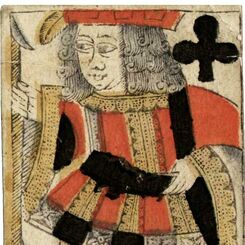
Hewson
Antique English woodblock playing cards by a card maker named C. Hewson, mid-17th century.
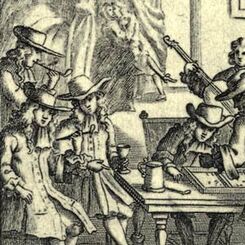
William Warter
William Warter's Proverbial Cards, which carry illustrations of old English proverbs, were first pub...

Hand-made Spanish Suited Playing Cards
Decks are made on two-ply pasteboard which reproduces the tactile quality of antique cards.
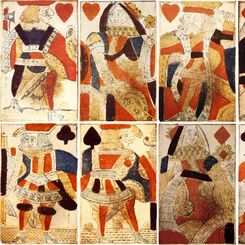
Hunt, c.1800
Standard English pattern playing cards manufactured by Hunt, c.1800.

About Witta Jensen
WITTA JENSEN… on the cards.

About Karl Gerich (1956-2016)
About Karl Alexander Gerich, 23rd April 1956 — 4th January 2016
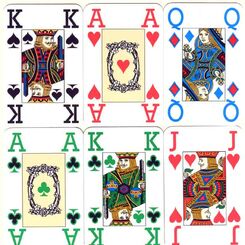
John Newman’s Colour Cards
John Newman’s Colour Cards

About Peter Wood
Peter Wood is a UK based artist.
Hidden Mickeys
“HiddenMickeys” by Peter Wood
About Georgina Harvey
Georgina Harvey worked together with Karl Gerich.

About Shelley Fowles
Shelley Fowles was born in South Africa but has lived in the United Kingdom since 1979. She trained ...

Grace Cards
My creativity proved useful in the Primary School classroom and children's clubs I run at Brooke Bap...
The Beggars’ Opera
The Beggars’ Opera Playing Cards were first published in 1728. The cards carry the words and music o...
South Sea Bubble
The South Sea Bubble Playing Cards were first published in London by Thomas Bowles in 1720. The card...
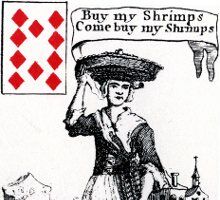
Cries of London
The cards were printed from copper plates, with the red suit symbols being applied later by stencil....
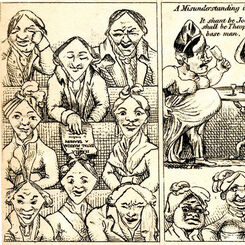
Transformation Playing Cards, 1811
Transformation playing cards, first published in 1811. Each card bears a picture in which the suit m...

Marlborough’s Victories
Marlborough’s Victories playing cards, first published in 1707, depict Marlborough's campaigns and t...
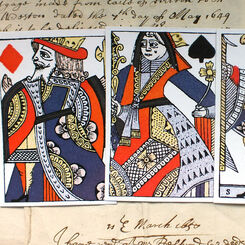
Hewson Replica Pack
Hand-made replica 17th century English playing cards, based on museum originals.
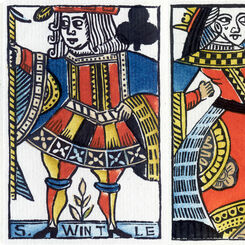
Woodblock and Stencil Playing Cards
Around 1987 I decided to make a pack of playing cards from woodblocks and coloured with stencils. I ...
Most Popular
Our top articles from the past 60 days


