


Woodblock and Stencil Playing Cards
Around 1987 I decided to make a pack of playing cards from woodblocks and coloured with stencils. I imagined I was carrying out my 'apprenticeship'.
TRADITIONAL ENGLISH PLAYING CARDS
printed from woodblocks
and hand-coloured with stencils
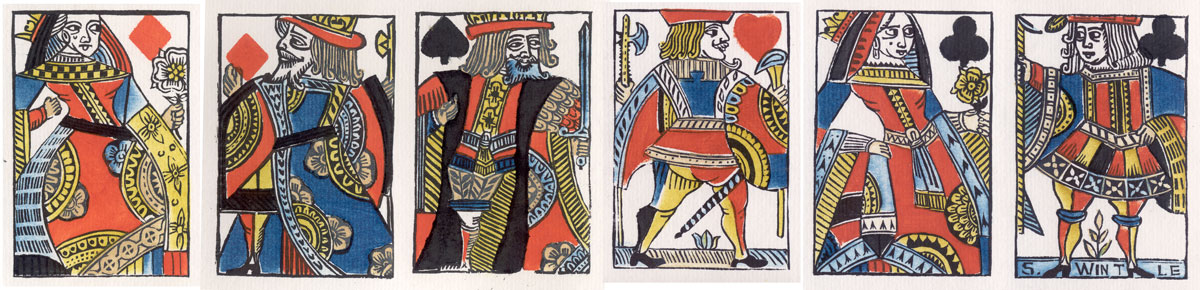
 rom documentary evidence, such as statutes and prohibitions, we get the impression that playing cards were being used in England in the fifteenth century. It is questionable whether these cards were actually made in England from their earliest introduction, so for quite some time they must have been imported. But the 1463 ban on importation leads one to suppose that a domestic industry already existed by this time.
Around 1987 I decided to make a pack of playing cards from woodblocks and coloured with stencils. The purpose of the exercise was to acquire insight and practical experience into the circumstantial problems of printing playing cards from woodblocks, their design, colouring with stencils, etc. I was carrying out my 'apprenticeship'.
I acquired the necessary blank wood blocks (lime wood) and had them planed flat and made 'type high'. I then discovered that the woodcutting tools which I had acquired for the task were useless, and so I made my own set out of watchmaker's tools, which are made from higher grade steel.
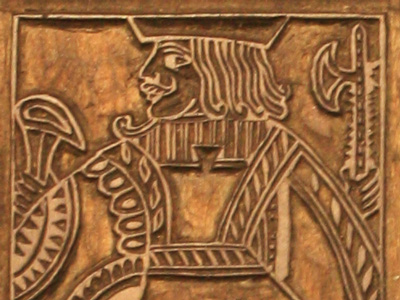
Above: one of the woodblocks, 1987
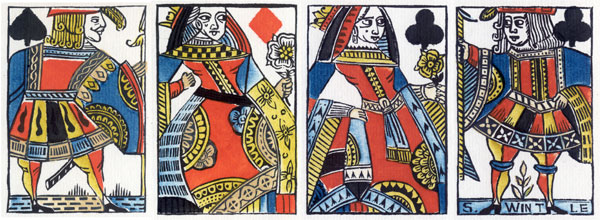
Above: four finished cards, 1987
The Court Cards
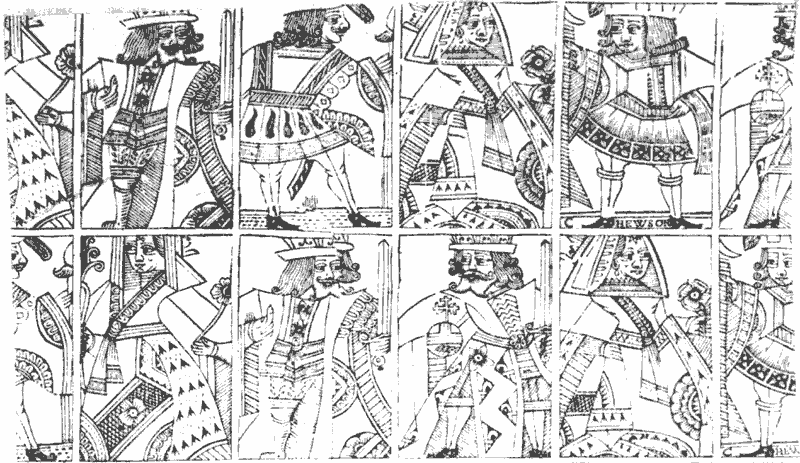
The next decision was the model for the court cards. I chose the seventeenth century designs of Hewson, which exemplify the 'English' style which had crystallised by then. Hewson's cards seem very formal and exhibit that geometric construction which characterises the English pattern, as opposed to the earlier cards which had been imported from the continent (by card makers such as Valery Faucil, Pierre Marechal, Jehan Henault, Anthoine Le Cornu, etc.)
Whilst French cards had a tradition of being named after historical personalities, English court cards were never named or based on any historical personalities. The costume worn by the English court pattern came from a French perception of that worn by the monarchy and their attendants, presumably at the time when the designs were first made. This partly explains the strange costumes on the cards, alongside poor copying.
To explain: when copying from an earlier design, or adapting it to a different size or medium, the figures may become 'squeezed' into the desired shape by distorting the limbs, shortening the neck or ankles, and losing the proportions of the original figure, particularly if one is not a very competent artist. We can confirm that English cards are shorter and wider than their French counterparts. Furthermore, when cutting out the designs on the woodblock, perhaps intent on finishing as soon as possible, finer features of the design will be simplified, ignored or removed… in which case the design may become corrupted or modified. English playing cards often look as though this sort of thing has happened. The stencilling is often slap-dash which further obliterates the designs. These reductions in quality are probably due to cost-effectiveness: there is often a sense of expediency. Did this matter?
The English Pattern
Perhaps the problem was compounded in that they weren't always sure exactly what they were representing. It is ironic that embargos had been secured against imported cards, but that home-produced ones were so badly designed! However, due to the formalisation of the designs, and whether they are called 'packs' or 'decks', today the English pattern has become the leading international pattern. The Americans took it with them and perpetuated it over there, although they introduced innovations including the joker and (probably) corner indices►
THE PIP CARDS
There is more to making a pack of playing cards than designing and printing the court cards… namely the pip cards. The stencils were made from heavy, oiled card and the pips were cut with punches which I had specially made. I believe that this is how they were traditionally made, otherwise there would have been noticeable variations between adjacent pips had they been cut out by hand.
With the benefit of hindsight I can now see where I made mistakes, particularly at the colouring stage. It was fascinating to rediscover why the old card makers did things in particular ways, which may appear odd or eccentric until we try to do it differently. Then we see the logic!
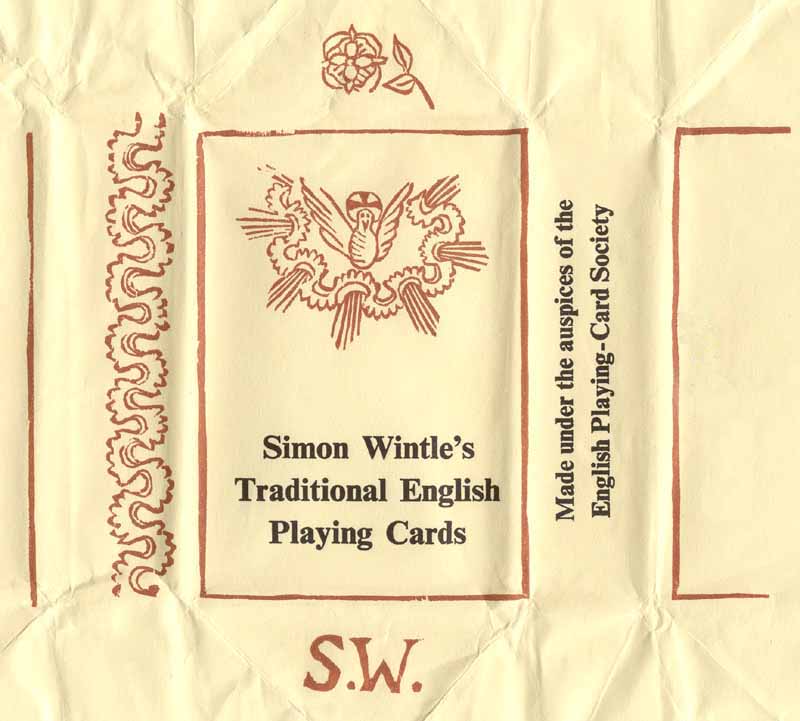
The wrappers were printed from woodblocks with letterpress overprinting. The backs were plain white, as they were traditionally.
Alternative Colour Scheme

Above: during the stencilling stage I also tried alternative colour schemes.
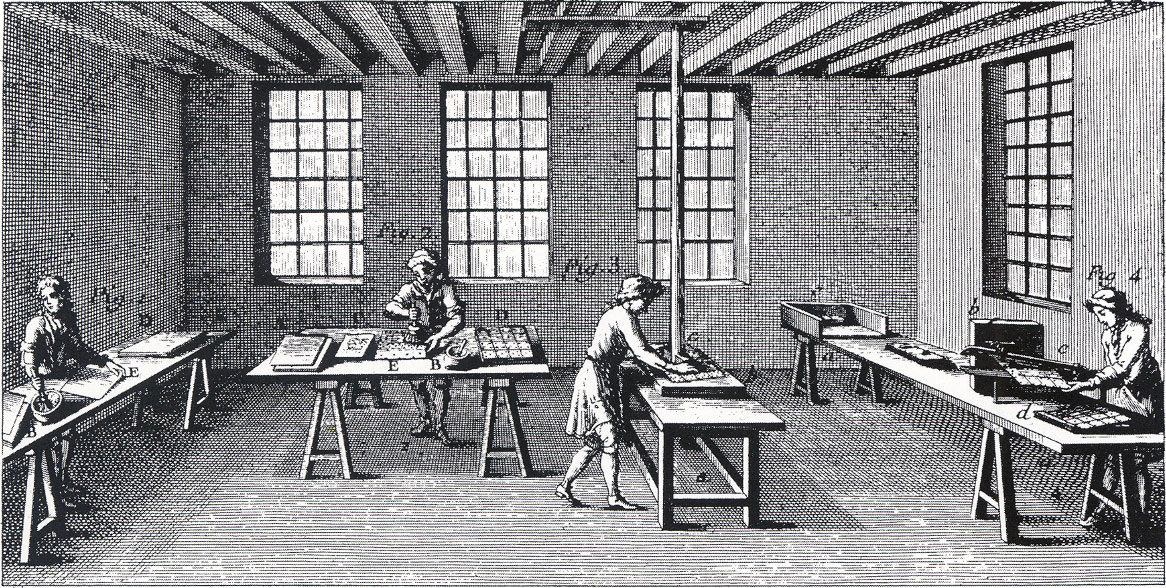
See also: Amos Whitney's Factory Inventory Chromolithography Design of Playing Cards Make your own Playing Cards Letterpress Printing Manufacture of Cardboard Manufacture of Playing Cards, 1825 Rotxotxo Workshop Inventories, Barcelona The Art of Stencilling

By Simon Wintle
Spain • Member since February 01, 1996
I am the founder of The World of Playing Cards (est. 1996), a website dedicated to the history, artistry and cultural significance of playing cards and tarot. Over the years I have researched various areas of the subject, acquired and traded collections and contributed as a committee member of the IPCS and graphics editor of The Playing-Card journal. Having lived in Chile, England, Wales, and now Spain, these experiences have shaped my work and passion for playing cards. Amongst my achievements is producing a limited-edition replica of a 17th-century English pack using woodblocks and stencils—a labour of love. Today, the World of Playing Cards is a global collaborative project, with my son Adam serving as the technical driving force behind its development. His innovative efforts have helped shape the site into the thriving hub it is today. You are warmly invited to become a contributor and share your enthusiasm.

Activity for Woodblock and Stencil Playing Cards
Sign in to comment or save this article.

Related Articles
Winstanley Geographical cards
Facsimile of Winstanley’s Geographical cards produced by Harold & Virginia Wayland, 1967.
Meal Tub Plot
Meal Tub Plot playing cards [facsimile] with 17th century sketches by Francis Barlow.
New Orleans and Gulf souvenir
New Orleans and Gulf souvenir playing cards from c1900 reprinted for the 52 Plus Joker Convention in...
Some Facts About Facsimiles
A short note on facsimile decks: what counts as a facsimile, how reprints differ from originals, and...
Fake ‘Four Seasons’ pattern
More than just a copy, this is a fake!
“Deck with French suits”
A facsimile of an early 19th century French-suited deck from the collection of F.X. Schmid.
Heraldic playing cards
Reproduction of Richard Blome’s Heraldic playing cards, 1684, presented to lady guests at WCMPC Summ...
71: Woodblock and stencil: the hearts
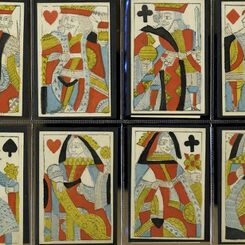
A presentation of the main characteristics of the wood-block courts of the heart suit.
70: Woodblock and stencil : the spade courts
This is a presentation in a more straight forward fashion of the work done by Paul Bostock and me in...
I. Hardy facsimile
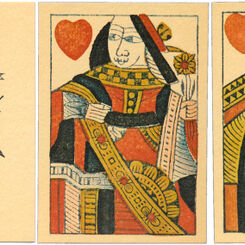
Facsimile edition of 19th century I. Hardy Exportation deck complete with reproduction tax wrapper, ...
David James Binns
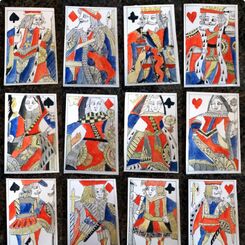
Hand-made “Tudor Playing Cards” by David James Binns, age 12.
Reynolds c.1830
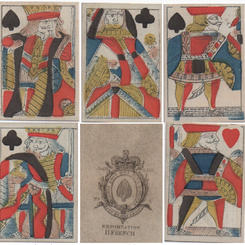
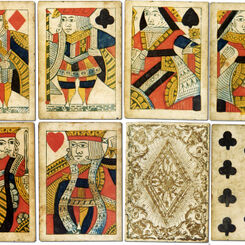
Woodblock and stencil playing cards, produced by Reynolds & Sons c.1830-1850.
Early Anglo-French Cards
Cards produced in Rouen during the sixteenth century. It was cards like these which were imported to...

The Beggars’ Opera
The Beggars’ Opera Playing Cards were first published in 1728. The cards carry the words and music o...
Cries of London
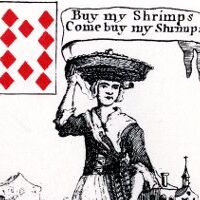
The cards were printed from copper plates, with the red suit symbols being applied later by stencil....
Hewson Replica Pack
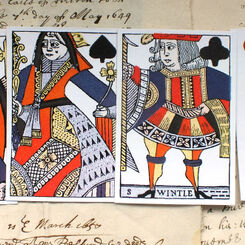
Hand-made replica 17th century English playing cards, based on museum originals.
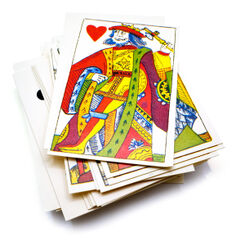
16th Century French Playing Cards based on Illustrations by Gurney Benham
This pack of cards by Rose & Pentagram is said to be based off Pierre Marechal, Rouen pack from the ...

Hand-made Spanish Suited Playing Cards
Decks are made on two-ply pasteboard which reproduces the tactile quality of antique cards.
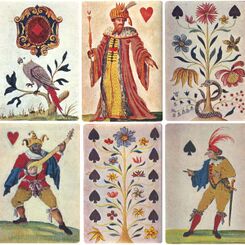
Silk Inlaid playing cards for Charles I.
Silk Inlaid playing cards said to have been made for Charles I
Most Popular
Our top articles from the past 60 days


Terry Belanger
18 June 2022, 22:08I'd like to purchase a set of Simon Wintle's hand-stenciled facsimile English playing cards; I understand that sets are still available. If sets are still for sale, can you provide information on how one purchases them? I am too stupid to be able to find this information on this website. Many thanks. The cards are for the teaching collections of Rare Book School at the University of Virginia (on which, see Wikipedia). Many thanks! -Terry Belanger
Simon Wintle
19 June 2022, 17:10Hi Terry, I made the woodblock and stencil deck in around 1987-8 and only around 50 copies were produced. Those are all sold out and hard to find today. From time to time one comes up on ebay or with a dealer who has purchased someone’s collection. There is a chance that a Kickstarter replica edition may be produced in the future, but nothing is planned yet.
Terry Belanger
19 June 2022, 17:42Thanks very much for your fast reply. I figured that the original issue had sold out, but was under the impression that you had issued a second batch. I'll keep an eye out for a set on eBay, &c. Has anyone else, so far as you know, created a similar set, i.e. one as authentic as the one you made? At Rare Book School, we have a ? late c17 woodblock strip with three tarot cards on it, from a much larger block that probably contained 3x4 or 3x5 = 12 or 15 images. When the block was still intact, it was used as a cabinet door (our strip has indentations and screw holes where the two hinges were fastened). I bought our strip in the 1980s or 1990s from an American ephemera dealer, by which point it had been cut up into four or five strips. I've always been an admirer of Melbert B. Cary; William Keller, who later late compiled the four-volume catalogue of the Cary playing card collection at Yale, was my student at the Columbia University School of Library Service in the late 1970s or early 1980s. -terry.belanger@virginia.edu
Vicki Miko
27 September 2023, 02:43WOW, I HAVE NO WORDS , THIS IS SO INCREDIBLE, WOW! !
"Around 1987 I decided to make a pack of playing cards from woodblocks and coloured with stencils. The purpose of the exercise was to acquire insight and practical experience into the circumstantial problems of printing playing cards from woodblocks, their design, colouring with stencils, etc. I was carrying out my 'apprenticeship'.
I acquired the necessary blank wood blocks (lime wood) and had them planed flat and made 'type high'. I then discovered that the woodcutting tools which I had acquired for the task were useless, and so I made my own set out of watchmaker's tools, which are made from higher grade steel."
Simon Wintle
28 September 2023, 16:04Thanks, I'm very grateful for your positive feedback. By the way, you can get art prints based on some of the cards from my shop: https://www.wopc.co.uk/simonwintle/shop/
Elisav Bizau
16 October 2023, 13:37This truly is marvellous. I fantasise of the day when I'll be able to do something like this as well. Man, I can imagine it being so much fun (as long as you love playing cards, of course).
Zhao Chen
29 December 2023, 10:20I would like to know if playing cards are made the most traditional way, how does the paper become hard? How to keep the paint from fading, thank you! I would really like guidance on the answer!
Simon Wintle
29 December 2023, 11:18Hi Zhao, the paper becomes hard when it is made into pasteboard, which is several layers of paper glued together. First it is pressed and then hung up to dry. See here: https://www.wopc.co.uk/playing-cards/paper-and-cardboard
The colours can fade slowly over time, depending on what pigments are used etc.