


Woodcutting Tools
Woodcutting Tools
Having acquired the necessary blank wood blocks (lime wood) and planing them flat I, made my own set of woodcutting tools using watchmaker's tools, which are made from higher grade steel, and inserted them into wooden handles.
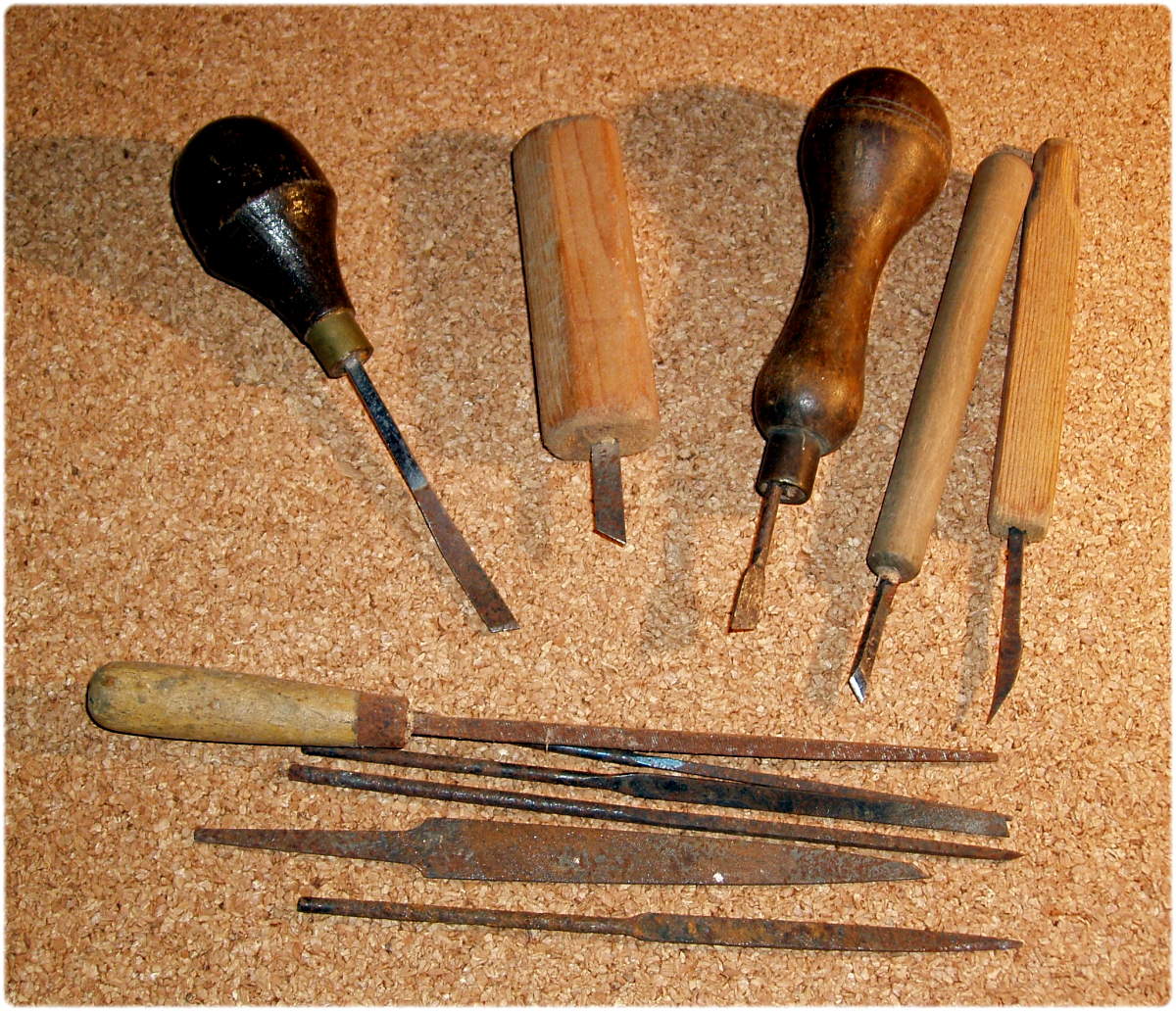
Above: set of woodcutting tools made from watchmaker's tools.

By Simon Wintle
Spain • Member since February 01, 1996
I am the founder of The World of Playing Cards (est. 1996), a website dedicated to the history, artistry and cultural significance of playing cards and tarot. Over the years I have researched various areas of the subject, acquired and traded collections and contributed as a committee member of the IPCS and graphics editor of The Playing-Card journal. Having lived in Chile, England, Wales, and now Spain, these experiences have shaped my work and passion for playing cards. Amongst my achievements is producing a limited-edition replica of a 17th-century English pack using woodblocks and stencils—a labour of love. Today, the World of Playing Cards is a global collaborative project, with my son Adam serving as the technical driving force behind its development. His innovative efforts have helped shape the site into the thriving hub it is today. You are warmly invited to become a contributor and share your enthusiasm.

Activity for Woodcutting Tools
Sign in to comment or save this article.

Related Articles

Luditz Pattern by Georg Geiselreiter
The discovery of 2024 changes the current state of knowledge of the history of this pattern.

Playing cards with prints by Sumio Kawakami
Woodblock print designs created by Sumio Kawakami in 1938-9, each card having a different illustrati...
Venus et Cupidon
“Venus et Cupidon” from Costante Costantini in his distinctive woodcut style.

Calcio Storico Fiorentino
‘Calcio Storico Fiorentino’ by Costante Costantini is based on an early form of football that origi...
Geschichte des Buchgewerbes
Geschichte des Buchgewerbes illustrated by Ludwig Winkler, published by Verlag für Lehrmittel Pößnec...
“Deck with French suits”
A facsimile of an early 19th century French-suited deck from the collection of F.X. Schmid.
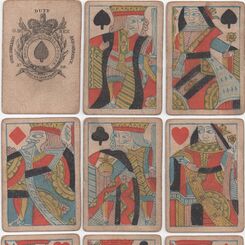
71: Woodblock and stencil: the hearts
A presentation of the main characteristics of the wood-block courts of the heart suit.
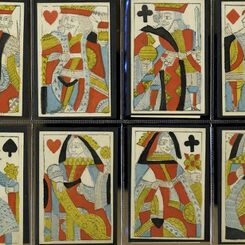
70: Woodblock and stencil : the spade courts
This is a presentation in a more straight forward fashion of the work done by Paul Bostock and me in...
Lilian Cailleaud’s Tarot Project
Lilian Caillaeud lino-cuts his version of the tarot by Nicolas Rolichon of Lyon c.1600
Xilografías de Mallorca
Spanish National pattern re-printed from original woodblocks which are preserved in the monastery at...
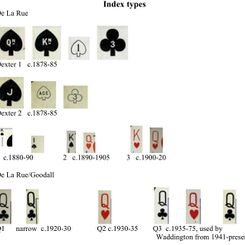
41: A Guide to Dating Playing Cards
Dating is a particularly tricky but very interesting problem to tackle and there are many pitfalls. ...
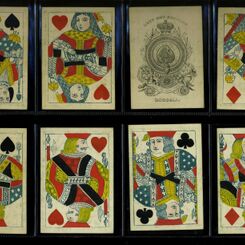
33: Functional Changes to Playing Cards
The emphasis throughout my collecting has been on the design of the courts cards, and it should be p...
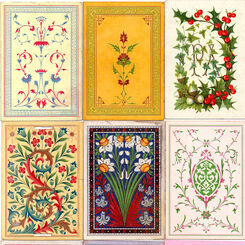
14: Back Designs
A few examples of the many interesting back designs.
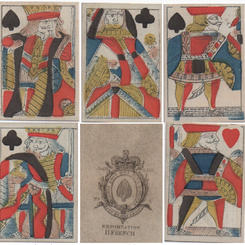

Rotxotxo Workshop Inventories
Rotxotxo Workshop Inventories, Barcelona, 1660-1800.
Printing of Playing Cards: Stencilling
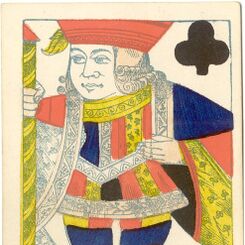
Printing of Playing Cards :: Stencilling can usually be detected by observing the outlines of the co...
Reynolds c.1830
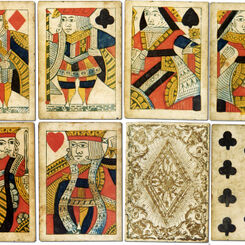
Woodblock and stencil playing cards, produced by Reynolds & Sons c.1830-1850.

Regarding the designs of playing cards
The quality of playing card designs often deteriorates with time…

Russian Standard Playing Cards
Cards from an early version of a Russian standard woodblock and stencil pack of circa 1820.

Most Popular
Our top articles from the past 60 days


