


Bertschinger y Codina
Fantasy Spanish-suited playing cards by Bertschinger y Codina (Barcelona), c.1850.
The four of cups has the inscription “Bertschinger y Codina“ plus a rising sun trademark.
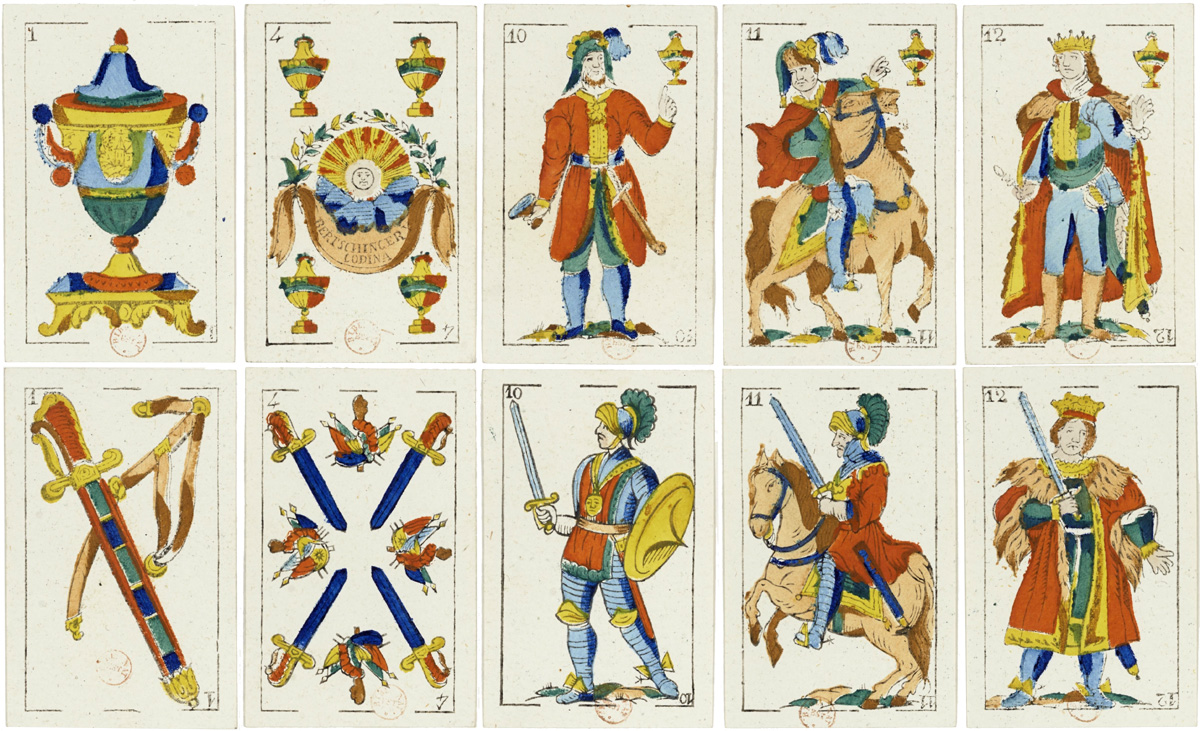
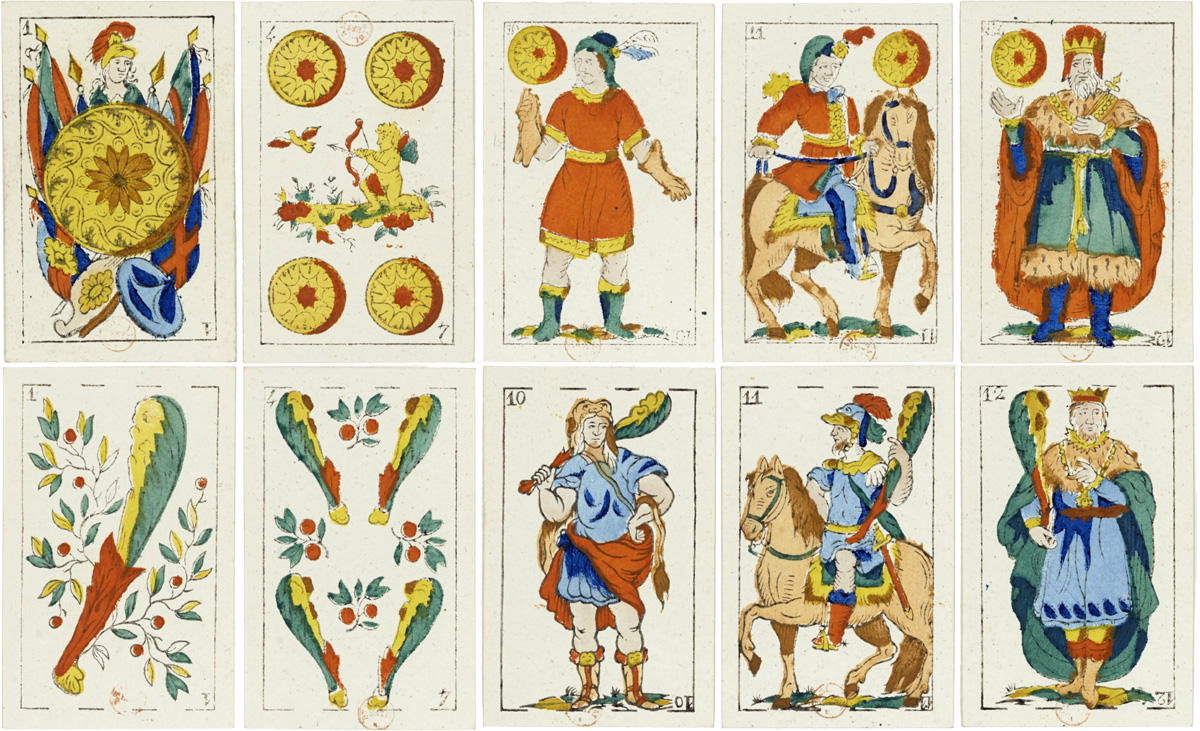
Above: Spanish-suited playing cards by Bertschinger y Codina (Barcelona), c.1850. Stencil-coloured woodcuts, 48 cards. Backs have gray zigzag pattern. Source gallica.bnf.fr / Bibliothèque nationale de France • Bertschinger y Codina (Barcelone) 1850►
Brief history of the Bertschinger playing card factory
Samuel Bertschinger (Fábrica de Bertschinger), originally from Lenzburg in Switzerland, was a playing card manufacturer working in Barcelona during the period c.1805-1836 • See cards . A registration in the historic archive of Barcelona records a building permit granted in July, 1826, for Samuel Bertschinger to modify 3 balconies and windows in a house he had recently acquired in Sant Pere Més Baix 5, Barcelona. In March 1828 Bertschinger receicved a royal visit to his factory.
Samuel’s son, Manuel Bertschinger, and his son-in-law Antoni Codina i Augerolas became involved in the family business, trading as Bertschinger y Codina (active c.1822-1861) and continued producing playing cards and later expanded into wallpaper due to its growing popularity. Other printing businesses began to do the same, for instance, Pablo Miñón in León (active 1813-1836) also expanded their offerings beyond traditional playing cards. The skills and techniques used for printing playing cards could evidently be applied to creating other visually appealing products but competition from foreign imports and other market forces was tough and many businesses failed. The Bertschinger y Codina factory building was sold by auction in November, 1871.
Change of address of Bertschinger playing card factory, 1819

Above: Diario de Barcelona 4 March 1819. Change of address from Calle San Pablo 13 -> Plaza de las Cols 8.
Change of address of Bertschinger y Codina playing card factory, 1824

Above: Diario de Barcelona 11 February 1824. Change of address from Plaza de las Cols 8 -> Calle de Ripoll 4.
Change of address of Bertschinger y Codina playing card factory, 1826

Above: Diario de Barcelona 12 March 1826. Change of address from Calle de Ripoll 4 -> Calle mas baja de San Pedro, 5. Upgrades were carried out on the building and it seems it later became the home address of Samuel Bertschinger. The business was still recorded at this address on 3 April 1831.
Royal visit to Bertschinger y Codina playing card factory, 1828
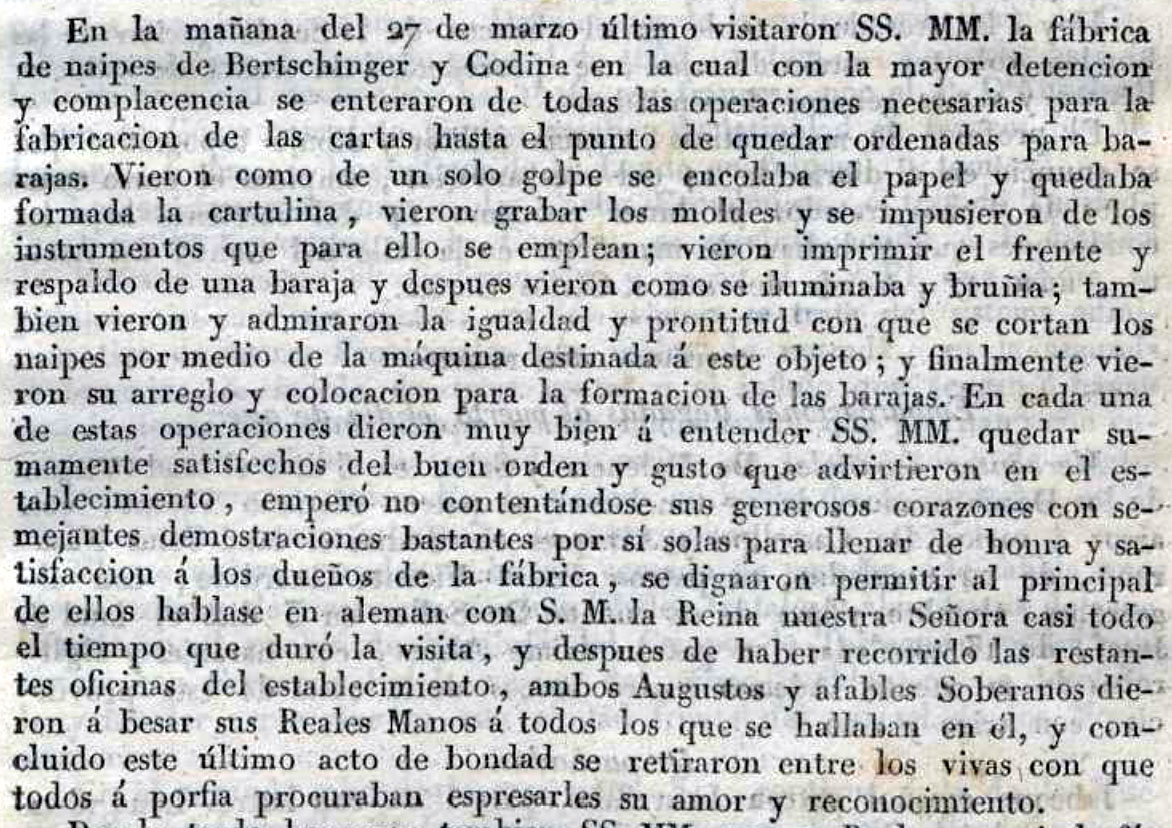
Above: Diario de Barcelona 10 April 1828. The translation is as follows:
On the morning of March 27th, Their Majesties visited the playing card factory of Bertschinger and Codina, where they attentively and with great pleasure learned about all the operations necessary for the manufacture of cards up to the point of readiness for packaging. They saw how, with a single stroke, the paper was glued and card stock was formed, they saw the molds being engraved and learned about the instruments used for this purpose; they saw the front and back of a deck being printed and then saw how it was illuminated and polished; they also saw and admired the uniformity and promptness with which the cards are cut by the machine designed for this purpose; and finally, they saw their arrangement and placement for the formation of the decks. In each of these operations, Their Majesties made it very clear that they were extremely satisfied with the good order and taste they observed in the establishment, but their generous hearts were not content with such demonstrations alone to fill the owners of the factory with honor and satisfaction. They allowed the principal of the factory to speak in German with Her Majesty the Queen for almost the entire duration of the visit, and after having toured the rest of the establishment's offices, both august and affable Sovereigns gave their Royal Hands to all those present, and concluded this last act of kindness by leaving amidst cheers, which they tried to reciprocate by expressing their love and gratitude.
Samuel Bertschinger, 1833
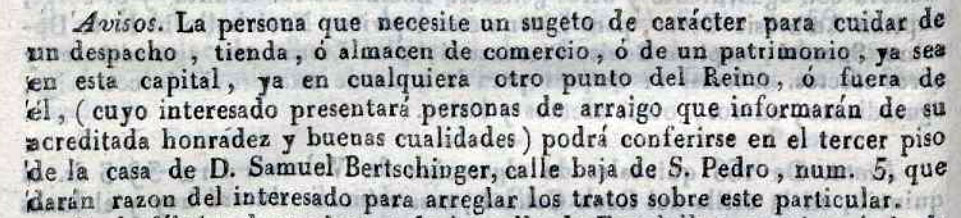
Above: Diario de Barcelona 1 June 1833.
Fábrica de Naipes Bertschinger y Codina, 1835

Above: Diario de Barcelona 19 March 1835. Reporting the loss of a pair of spectacles and address give as Calle mas baja de S. Pedro 31.
Fábrica de Naipes Bertschinger y Codina, 1835

Above: Diario de Barcelona 28 November 1835. Reporting the loss of an earring and the same address is given.
Antonio Codina y Rosa Bertschinger tax amortization, 1839
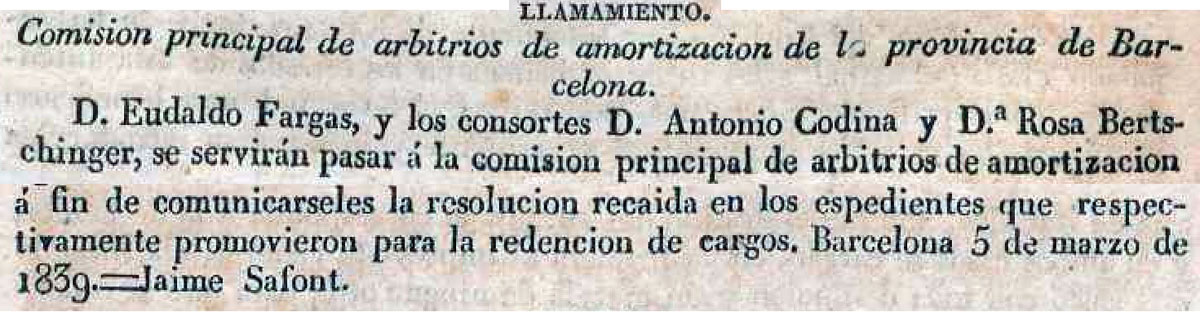
Above: Diario de Barcelona 6 March 1839. The notice, dated March 5, 1839, calls upon Mr. Eudaldo Fargas and Mr. Antonio Codina and Mrs. Rosa Bertschinger to present themselves to the tax authorities to be informed of the resolution regarding their respective requests for charge reductions. The document is signed by Jaime Safont.
Bertschinger y Codina playing card factory, 1841

Above: Diario de Barcelona 30 Sept 1841. Confirmation of address at Calle baja de San Pedro 83.
Change of address of Bertschinger y Codina playing card factory, 1845

Above: Diario de Barcelona 8 March 1845. Change of address from Calle baja de San Pedro 83 -> Plaza del Correo Viejo 12.
Bertschinger y Codina were awarded a bronze medal by the Evaluation Committee of the 1850 Industrial Exhibition. Diario de Barcelona 24 April 1851.
New address of Bertschinger y Codina playing card factory, 1855
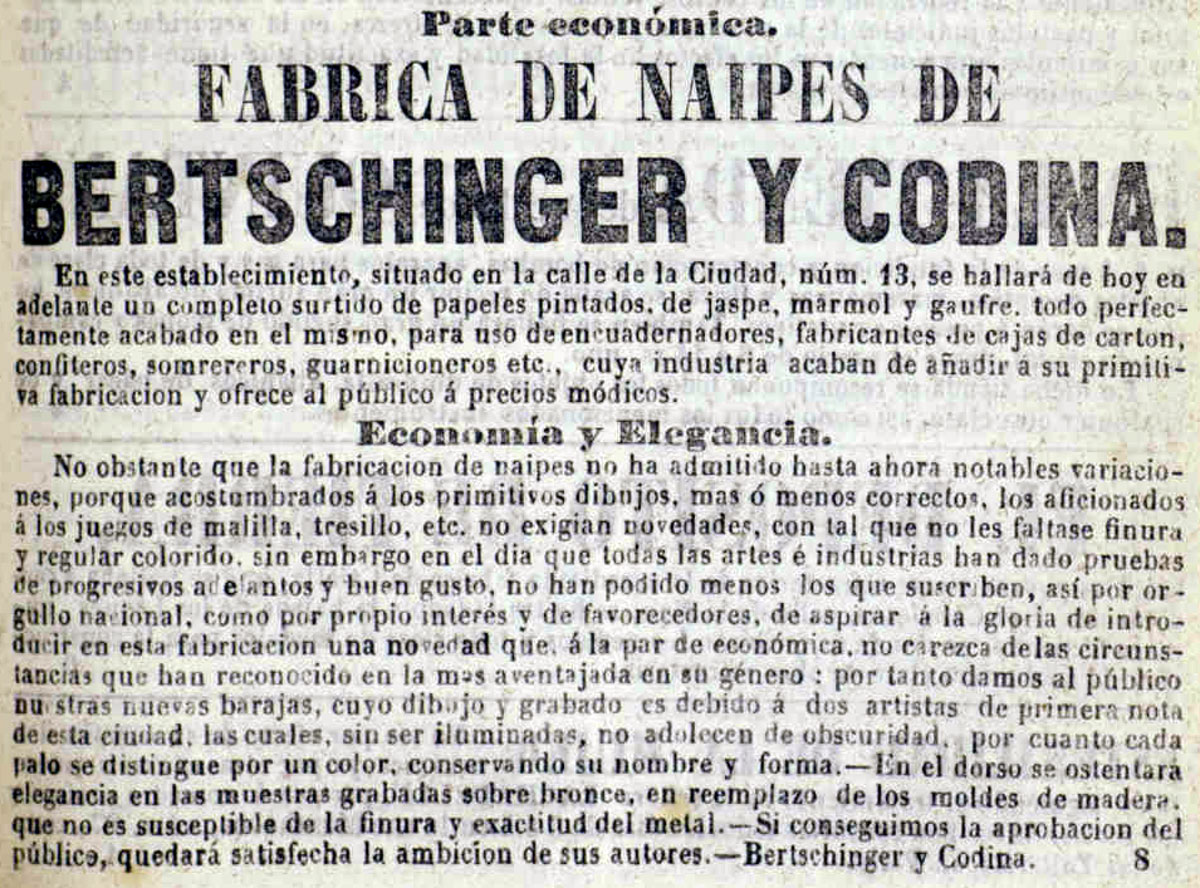
Above: Diario de Barcelona 27, 28 and 29 June 1855. A new address is given at Calle de la Ciudad 13.
Announcing “a complete assortment of painted papers, jasper, marble, and embossed papers, all perfectly finished. These are intended for use by bookbinders, manufacturers of cardboard boxes, confectioners, hatters, upholsterers, etc. ... we have introduced innovation that combines economy and high-quality craftsmanship. Our new decks feature designs and engravings by two top artists from this city. These cards are easy to distinguish as each suit is marked by a different colour, and the names and shapes of the suits are preserved. The back of the cards showcases elegance with samples engraved in bronze instead of wooden molds, offering a finer and more precise finish. If the public approves, we will consider our ambition fulfilled”. — Bertschinger and Codina.
Legal proceeding and notification of Debt, 1867

Above: Diario de Barcelona 30 May 1867. Antonio José Codina y Bertschinger is mentioned as a defendant in a legal proceeding concerning the liquidation of the company Font, Alexander y Compañía. He, along with Manuel de Lasarre, the liquidator of the company, is summoned to respond to the lawsuit within five days to avoid being declared in default.
Auction of Bertschinger y Codina playing card factory at Calle de la Ciudad 13, 1871

Above: Diario de Barcelona 9 Nov 1871. The text is an official announcement regarding a public auction of a property ordered by the judge of the first instance of the San Pedro district in the city, Francisco Galicia y Junquera. The auction involves a case between the Sociedad de Crédito Mobiliario Barcelonés and Antonio José Codina y Bertschinger. The property to be auctioned is a house with a water fountain, located at Calle de la Ciudad 13. The house has a ground floor and four upper floors. This was presumably the former Bertschinger y Codina factory.

Above: Homorary mention in the Corona de Aragón, 19 Jan 1857. "Papel gaufré", embossed paper, with a raised or textured pattern, used for decorative purposes, giving it a tactile quality.
References
Ajuntament de Barcelona: Sant Pere Més Baix 5. Samuel Bertschinger►
Arxiu de Revistes Catalanes Antigues: ARCA►
Bartolomé García, Fernando R.: «La popularización del papel pintado en España a lo largo del siglo XIX», download PDF ABS Bilduma, 2020►
Ferro Torrelles, Victor: Registro de Naiperías Españolas 1380-2004, Asescoin, Madrid.
Wikipedia: Casa-fàbrica Bertschinger-Masriera►
A standard 48-card Catalan pattern pack by Manuel Bertschinger can be seen on the British Museum website with the rising sun trademark and an inscription on the four of cups “Por. Bertschinger. En. Barcelona. 1832”: Museum number 1957,1121.6►
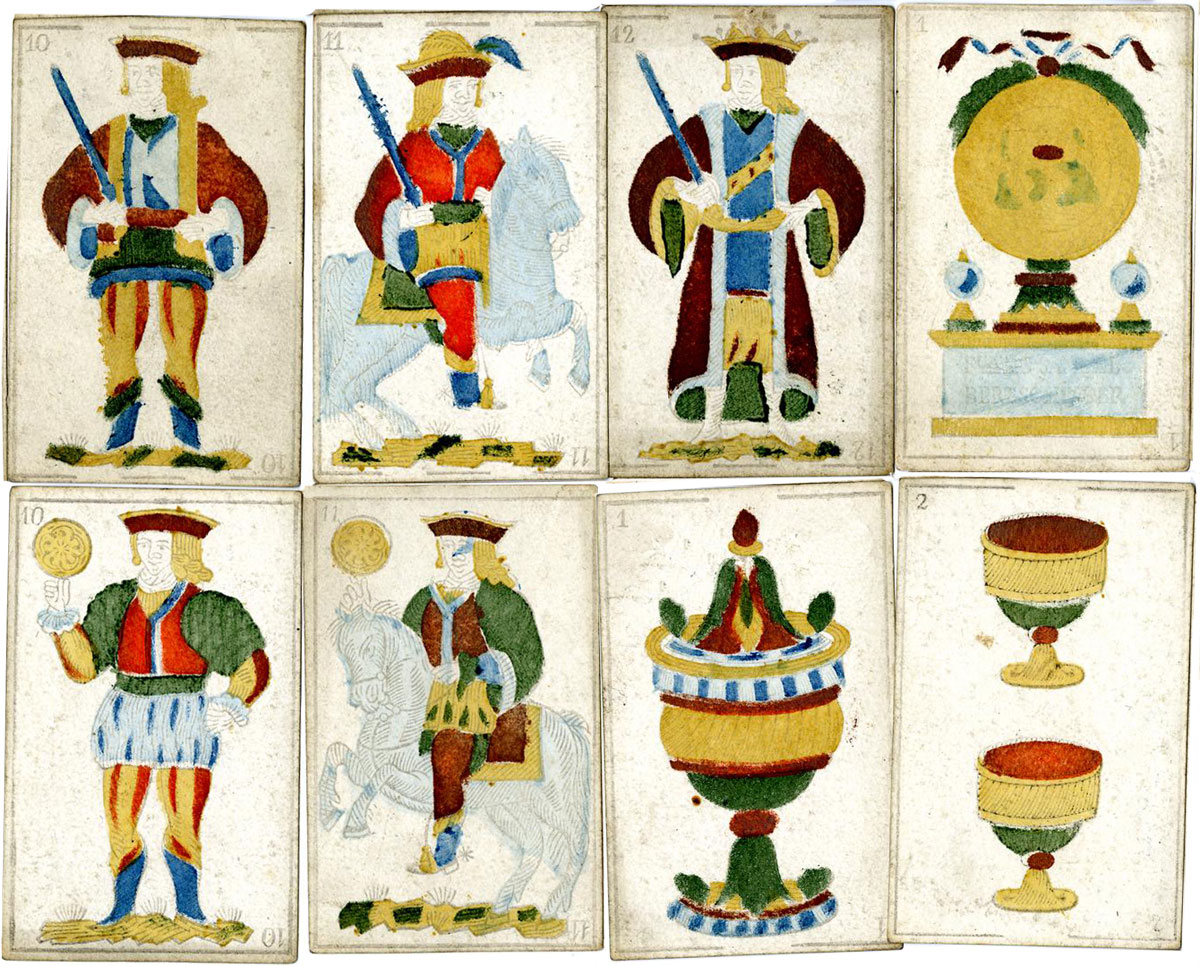
Above: cards from a standard 48-card Catalan pattern pack by Manuel Bertschinger, 1832. © The Trustees of the British Museum • number 1957,1121.6►

By Simon Wintle
Spain • Member since February 01, 1996 • Contact
I am the founder of The World of Playing Cards (est. 1996), a website dedicated to the history, artistry and cultural significance of playing cards and tarot. Over the years I have researched various areas of the subject, acquired and traded collections and contributed as a committee member of the IPCS and graphics editor of The Playing-Card journal. Having lived in Chile, England, Wales, and now Spain, these experiences have shaped my work and passion for playing cards. Amongst my achievements is producing a limited-edition replica of a 17th-century English pack using woodblocks and stencils—a labour of love. Today, the World of Playing Cards is a global collaborative project, with my son Adam serving as the technical driving force behind its development. His innovative efforts have helped shape the site into the thriving hub it is today. You are warmly invited to become a contributor and share your enthusiasm.

Related Articles
Fantasy Spanish-suited deck
Fantasy Spanish-suited deck by Bertschinger y Codina, Barcelona.

Bertschinger y Codina - Cartes Françaises
French ‘Paris’ pattern made by Bertschinger y Codina, Barcelona, c.1850.
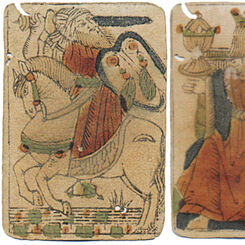
XV Century Spanish-suited playing cards
XV Century Spanish-suited playing cards with moorish influences
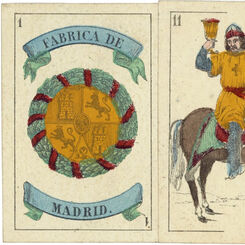
Vicente Gombau y Labad
Elegant fantasy designs by Vicente Gombau y Labad (Madrid), 1861.
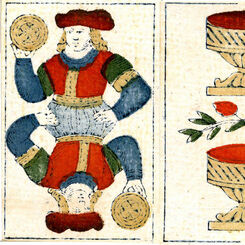
Clemente Roxas double-ended Spanish pack
Double-ended Spanish-suited playing cards published by Clemente de Roxas in Madrid, 1814.
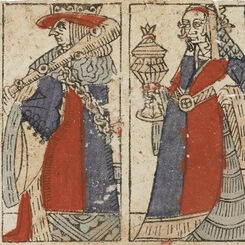
J. Deluy c.1490s
Archaic Spanish-suited cards produced by J. Deluy c.1490s.
Cádiz Pattern playing cards
A popular Spanish playing card pattern widely exported to Spanish-influenced markets.
Philishave
Spanish-suited advertising deck for Philishave electric razors.

Baraja Edad Media
Baraja Edad Media, fantasy Spanish-suited medieval playing cards published Mas-Reynals, Barcelona, 1...

Naipes del Salitre
Playing cards recovered from the Northern Chile saltpetre workers. The cards are mostly from Spanish...

S. Giráldez, Barcelona
Standard Spanish Catalan pattern playing cards by S. Giráldez, Barcelona, c.1905.
Baraja de Amor
Hijos de José Garcia Taboadela was a book-seller who also published this charming pack of lovers' fo...
José Gombau
Deck of half-sized Spanish-suited playing cards in the Maciá pattern produced by José Gombau, Zarago...
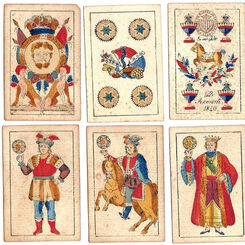
Sanmartí, 1840
Sanmartí, 1840.
Francisco Flores
Playing cards in this style have been discovered in various parts of the world, suggesting that they...
Spanish Playing Cards ~ La Baraja Española
Spain has played a pivotal role in the history of playing cards in Europe and Latin America.
Significado de los Naipes Españoles
Cartomantic meanings of Spanish playing cards by Benita the Witch (XVI century), published by Chocol...

Juan Roura Catalan
Catalan type by Juan Roura, La Hispano-Americana, Barcelona (1872 - 1962).
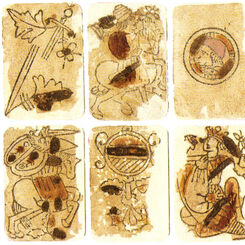
Baraja Morisca — Early XV century playing cards
Primitive Latin suited pack, dated by paper analysis as early XV century, which makes this one of th...

Hand-made Spanish Suited Playing Cards
Decks are made on two-ply pasteboard which reproduces the tactile quality of antique cards.
Most Popular
Our top articles from the past 60 days


