


Fantasy Spanish-suited deck
Fantasy Spanish-suited deck by Bertschinger y Codina, Barcelona.
Bertschinger y Codina were active in Barcelona between c.1824 to 1861. In this pack the four suits are printed monochromatically in inks of four different colours, but are otherwise uncoloured, giving a distinctive aesthetic appeal. The coins suit symbols have moorish portraits in them and the courts are also moorish, turbanned figures, reflecting a fascination with Moorish aesthetics and history which harks back to the period of Muslim rule in Spain. The other three suits depict medieval Spanish characters. It is unusual to see the four cavaliers leading their horses by hand rather than mounted. The manufacturer's name appears on the four of cups while the name of the Catalan engraver Miguel Torner y Germà (1802-1863) appears on the king of coins.
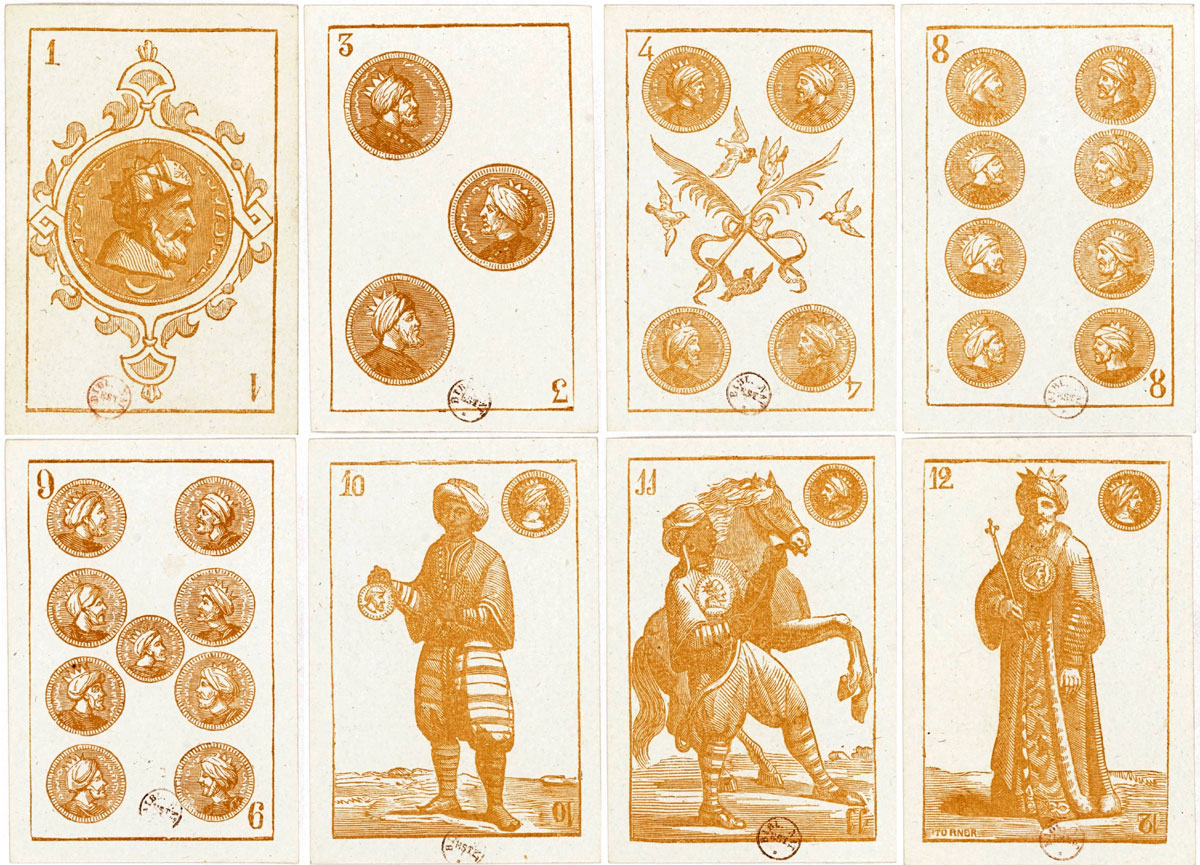
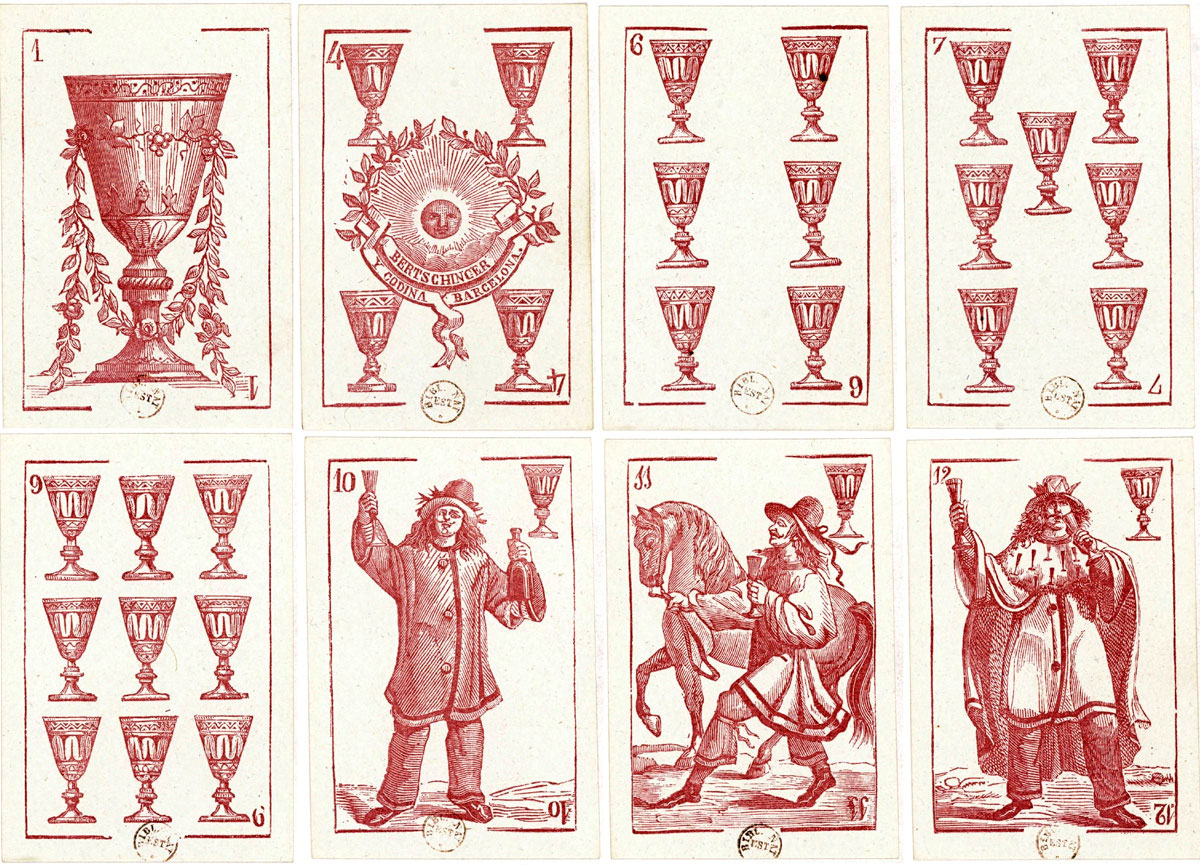
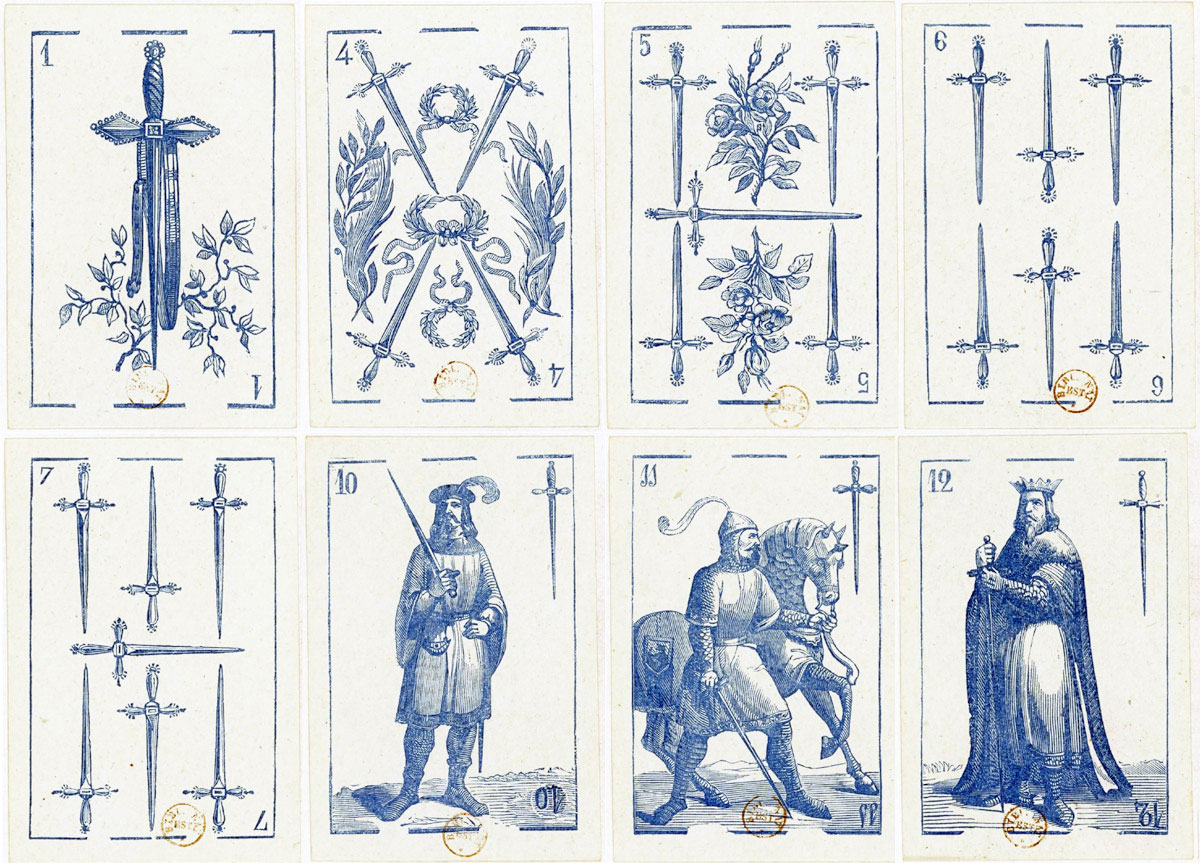
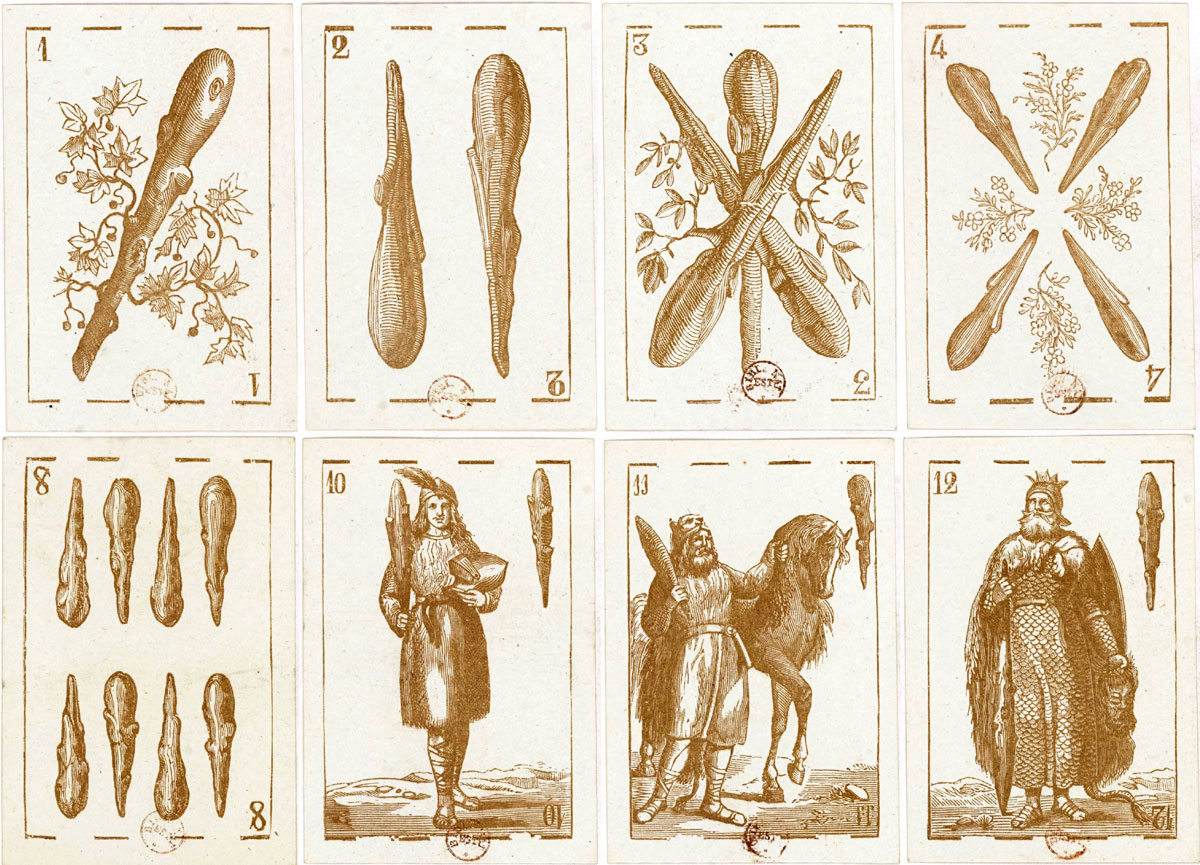
Above: Fantasy Spanish-suited deck by Bertschinger y Codina, Barcelona, c.1855. 48 cards printed in inks of four different colours, otherwise uncoloured. Source gallica.bnf.fr / Bibliothèque nationale de France • Jeu de cartes à enseignes espagnoles►
Trade announcement by Bertschinger y Codina, 1855
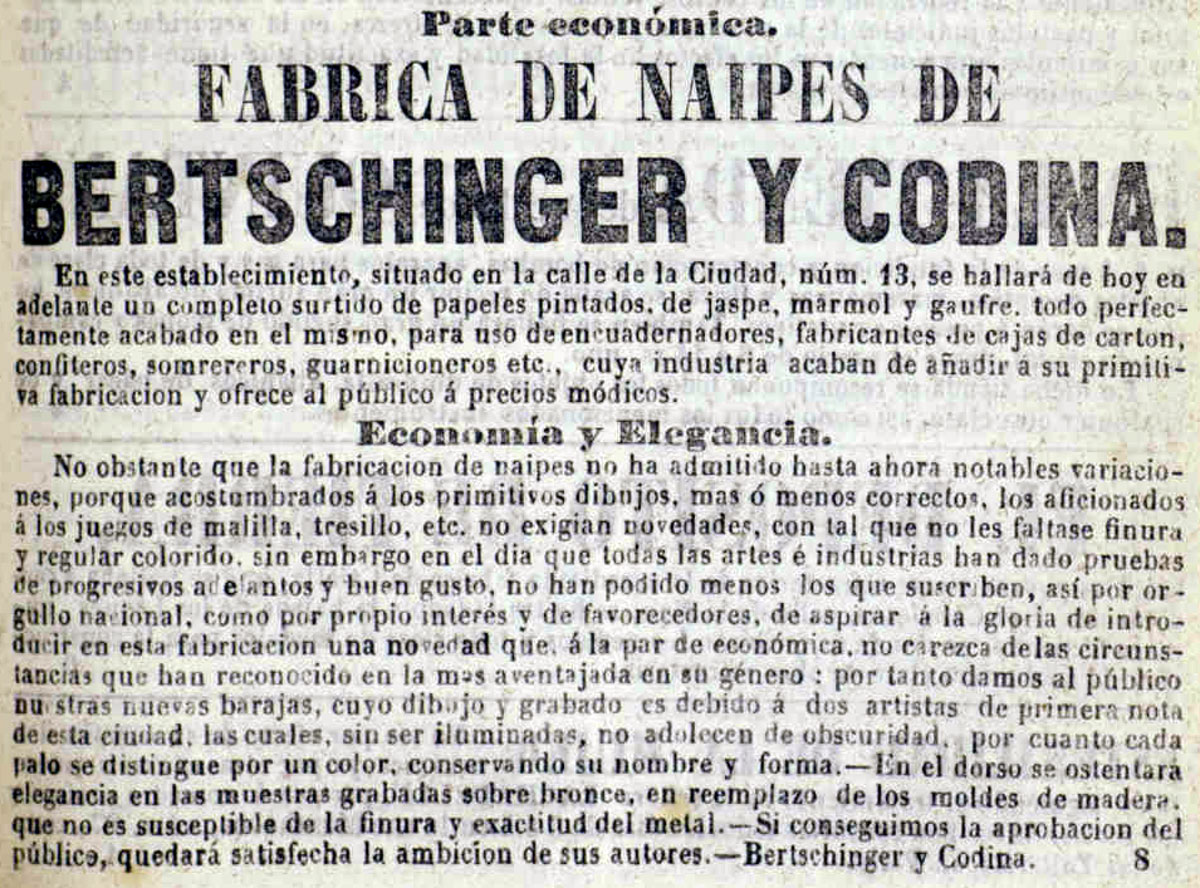
Above: Diario de Barcelona 27 June 1855.
Announcing “a complete assortment of painted papers (wallpaper), jasper, marble, and embossed papers, all perfectly finished. These are intended for use by bookbinders, manufacturers of cardboard boxes, confectioners, hatters, upholsterers, etc. ... we have introduced innovation that combines economy and high-quality craftsmanship. Our new decks feature designs and engravings by two top artists from this city. These cards are easy to distinguish as each suit is marked by a different colour, and the names and shapes of the suits are preserved. The back of the cards showcases elegance with samples engraved in bronze instead of wooden blocks, offering a finer and more precise finish. If the public approves, we will consider our ambition fulfilled”. — Bertschinger and Codina.
Bertschinger y Codina initially produced playing cards and later expanded into wallpaper due to its growing popularity and their need to diversify. The use of four different inks for the cards of the four suits in this pack may have added visual distinction and appeal, but this had been done before, earlier in the century, in cards published by Clemente Roxas and José Martínez de Castro in Madrid. Coincidentally, Bertschinger y Codina also published a Sardinia pattern pack after designs engraved by José Martínez de Castro, first published by Clemente Roxas, Madrid, 1810. (See Mann 1990, no.45) so were no doubt inspired by these earlier works.
Reference
Mann, Sylvia: All Cards on the Table, Jonas Verlag/Deutsches Spielkarten-Museum, Leinfelden-Echterdingen, 1990

By Simon Wintle
Spain • Member since February 01, 1996
I am the founder of The World of Playing Cards (est. 1996), a website dedicated to the history, artistry and cultural significance of playing cards and tarot. Over the years I have researched various areas of the subject, acquired and traded collections and contributed as a committee member of the IPCS and graphics editor of The Playing-Card journal. Having lived in Chile, England, Wales, and now Spain, these experiences have shaped my work and passion for playing cards. Amongst my achievements is producing a limited-edition replica of a 17th-century English pack using woodblocks and stencils—a labour of love. Today, the World of Playing Cards is a global collaborative project, with my son Adam serving as the technical driving force behind its development. His innovative efforts have helped shape the site into the thriving hub it is today. You are warmly invited to become a contributor and share your enthusiasm.

Activity for Fantasy Spanish-suited deck
Sign in to comment or save this article.

Related Articles
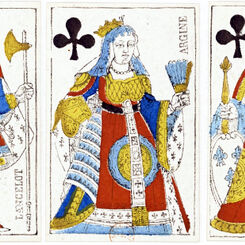
Bertschinger y Codina - Cartes Françaises
French ‘Paris’ pattern made by Bertschinger y Codina, Barcelona, c.1850.
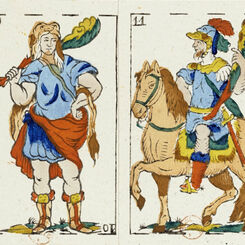
Bertschinger y Codina
Fantasy Spanish-suited playing cards by Bertschinger y Codina (Barcelona), c.1850.
Most Popular
Our top articles from the past 60 days


