


Heritage Preservation Cards : Afghanistan and Iraq
Twin decks with a noble purpose.
In 2007, as the US was mired in its Global War on Terror, Archaeology Magazine ran an article about the Pentagon issuing 40,000 decks of playing cards to educate soldiers on the conservation of archeological sites and artifacts in Iraq and Afghanistan, which had seen widespread looting and destruction in war’s wake. One deck was dedicated solely to Afghanistan, the other to both Afghanistan and Iraq.
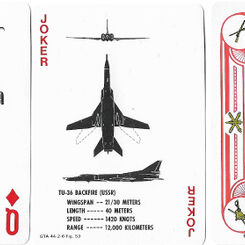
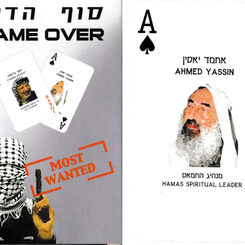
These served a counterpart of sorts to the 2003 Iraqi Most Wanted cards, which had photos of prominent members of Saddam Hussein’s government who remained at large. Both sets of cards relied on soldiers’ love of card playing to enforce an idea. The Most Wanted deck’s message was – If you see this, grab it; the Heritage Preservation decks’ – If you see this, leave it alone. The Pentagon’s use of playing cards goes back to at least 1979 when the Army created decks to help identify military aircraft.
As a lover of both ancient history and playing cards, I had to get these. Unfortunately, unlike the widely available Most Wanted cards, the preservation decks were issued strictly to troops in the theater. It took me two years and a lot of begging of anyone I met with any connection to the military to finally get through to US Army archaeologist Laurie Rush (Ace of Hearts), the decks’ creator. Dr. Rush had the unenviable task of getting young American soldiers in the middle of insurgent-filled warzones to care about preserving what appear to be little more than piles of dirt to the untrained eye. She employed photos and simple messaging to generate awareness and build connections between the GIs and the history.
Afghanistan deck


Afghanistan deck from Heritage Preservation Cards, 2007.
The Afghanistan deck’s joker is a 1st century AD carving of the perpetually tipsy Greek god Silenus while the backs feature a lovely 3rd century BC silver ceremonial plaque. The Iraq and Afghanistan deck has a disappointingly typical joker and a remarkably preserved cuneiform tablet on the back. Both decks also serve as jigsaw puzzles; the images on the cards’ borders form a larger picture.
The cards emphasize shared cultural and religious heritage by featuring things like the purported resting place of the prophet Jonah in Mosul, Iraq (Two of Clubs, Iraq deck). The Jack of Diamonds shows the Statue of Liberty with the blunt question of “How would we feel if someone destroyed her torch?” Lastly – and perhaps most importantly – the cards remind soldiers that protecting local shrines is crucial to winning hearts and minds; respecting that pile of dirt could help save your life. It’s hard to think of a more conscientious and worthier use of playing cards.
Iraq & Afghanistan deck

Iraq & Afghanistan deck from Heritage Preservation Cards, 2007.
Further reading
Colorado State University : Preserving cultural heritage during war – it’s all in the cards ►

By Lev Golinkin
United States • Member since May 26, 2026
I'm a US-based author and journalist. I've been collecting playing cards since I was about 8 years old, when I got mesmerized by the various decks that were used in Soviet Ukraine, where I'm from. I collect mainly European decks such as those by Dondorf, Grimaud, and Piatnik. I love courts above all else, and am drawn toward historical and artistic decks.

Activity for Heritage Preservation Cards : Afghanistan and Iraq
Sign in to comment or save this article.

Related Articles
US Army Aircraft Recognition Cards
Air defense combined with gameplay.
Learning to play Cribbage
I learned to pay cribbage when I was very young, aged around six or seven.
American Civil War playing cards
American Civil War playing cards with suits of stars, US flags, US shields and eagles.
Game Over
‘Game Over’ political playing cards from Israel, 2006.
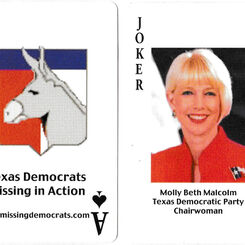
Texas Democrats Missing in Action
“Texas Democrats Missing in Action” playing cards published by Bernsen Consulting, Austin, Texas, 20...
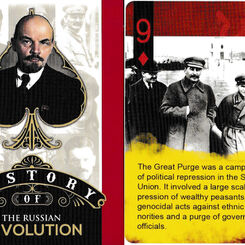
History of the Russian Revolution
A pack of playing cards about the Russian Revolution, USA, c. 2021.
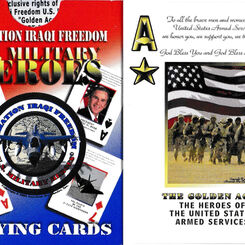
Operation Iraqi Freedom playing cards
Operation Iraqi Freedom: U.S. Military heroes playing cards, 2003.
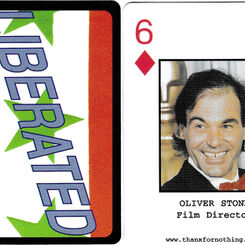
Liberated: America's Most Unwanted
“Liberated: America's Most Unwanted” playing cards published in support of the Iraqi War, c.2003.
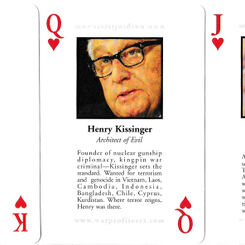
War Profiteers playing cards
“War Profiteers” playing cards, USA, c. 2004.
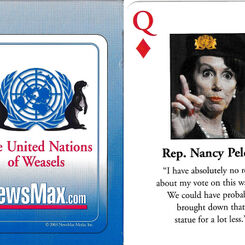
United Nations of Weasels
“United Nations of Weasels” anti-war political playing cards, USA, 2003.
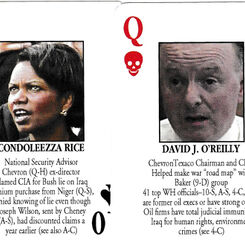
Try’em playing cards
Try’em: the U.S. Regime Change, or “52 Most Wanted Criminals” c. 2003.
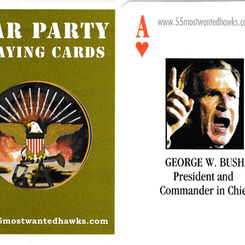
War Party playing cards
War Party playing cards, in opposition to the Iraq War, USA, 2003.
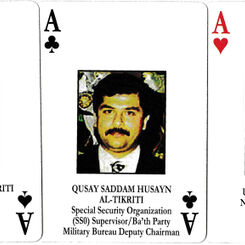
Iraqi Most Wanted Playing Cards
Playing cards used to help troops identify the most-wanted members of Saddam Hussein's government. 2...
Anma US Armed Forces
Anma US Armed Forces, 1942.
Victory
“Victory" cards celebrating U.S. participation in the Allied victory, c.1945.
Atouts de la Vie
“Atouts de la Vie” wartime card game created by Madame Lucien Willemetz, c.1940.
In der Fuehrer’s Face
“In der Fuehrer’s Face” playing cards designed in 1945 by Antonio Arias Bernal, a Mexican artist, bu...
Ordnance Recognition
Ordnance Recognition Playing Cards cards designed to help people at risk from unexploded bombs
Army & Navy
Andrew Dougherty’s Army & Navy deck from the Civil War era, c.1865.
Anheuser-Busch Army & Navy
This deck is commonly known as the “Anheuser-Busch Spanish-American War deck”, issued at the end of ...
Most Popular
Our top articles from the past 60 days


