


Portuguese Playing Cards
The Real Fábrica de Cartas de Jogar was founded in 1769, by Royal Charter of King José, under the master craftsman Lorenzo Solezio, brother of Félix Solesio who ran the Spanish Real Fábrica at Macharaviaya.

The period of Portuguese greatness began in the 15th century when Portuguese sailors explored the Atlantic coast of Africa, round the Cape to India and west to Brazil. The earliest known reference to playing cards in Portugal dates from 1490. Cards and other games were subjected to the same prohibitions as in other European countries. A special group of early Iberian playing cards, with dragons on the Aces, are known as “Dragon cards” and early examples made in Spain by Francisco Flores survive. These were made using a method which was also used in Italy and the shape and arrangement of the suit symbols is more aligned to Italian rather than Spanish ones. Examples of these cards have been unearthed as far afield as Netherlands, Malta and Peru. Portugal has also influenced the playing cards in many other parts of the world and the so-called 'dragon' cards reached as far as Japan, Java, Indonesia and Brazil.

Above: Portuguese playing cards, Real Fabrica, c.1800. In the early 1800s about 30 workers, including the Master, produced around 200,000 ‘Spanish’, ‘French’ and ‘Portuguese’ decks a year more →
A playing card monopoly existed in Portugal at the beginning of the 17th century. Nicolas de la Cattoir, also known as De Locatori, was a bookseller in Lisbon (ca. 1615-1627). He also exclusively owned the rights to playing cards, a facility rented for 12,500 cruzados.
The Real Fábrica de Cartas de Jogar was founded in 1769, along with a paper mill, by Royal Charter of King José, under the master craftsman Lorenzo Solezio, brother of Félix Solesio who ran the Spanish Real Fábrica at Macharaviaya. Lorenzo received permission to make cards and sell them in Portugal and overseas territories. The production and sale of playing cards was a profitable business. In 1769 the Royal Playing Card Factory was annexed to the Impressão Régia (Royal Press). The name changed to Imprenta Nacional in 1820. After 1832, this company lost its monopoly.
The ‘Portuguese-suited’ deck with dragon aces was also introduced into India and Japan in the late 15th and early 16th centuries and influenced the production of local versions there. Thus it must have been a well-established pattern back then, by no means confined to mainland Portugal alone.
See also: Francisco Flores 1580 • 'Alla Colonna' 1613 • A. Infirrera 1693 • Malta late 18th c.

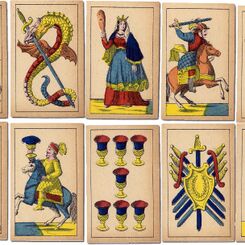
Above: 12 cards from Portuguese pack printed by Impressao Règia, Lisbon c.1768-1832. Hand-coloured lithograph. Backs printed with a design of small blue dots running diagonally. On the 4 of coins is a scroll with "Real Fabrica". On the 6 of cups are the intials "F.B." interlaced and repeated in reverse, with a crown above them. © The Trustees of the British Museum • Museum number 1850,0612.533-580►

Above: anonymous Portuguese playing cards purportiung to be from the Real Fabrica, c.1850-60, woodblock and stencil, plain pink backs. Possibly these are cheaply made ‘Dragon’ cards for Portugal and Brazil manufactured in Belgium in spite of initials "FB" on the six of cups and "Real" Fabrica" on the four of coins. Source gallica.bnf.fr / Bibliothèque nationale de France • Jeu de cartes au portrait portugais►


Above: various examples of Portuguese playing cards. Click images to see more.
A Royal Decree, dated 24th December 1802, refers to the Impressão Régia, including the Portuguese Playing Card monopoly, and ratifies the earlier legislation regarding the playing card monopoly and sets out updated regulations governing the industry. Nevertheless, the Decree dated 18th May 1808 dealt the first serious blow to this factory’s production through the establishment of a similar factory in Brazil. At that time King John VI and the entire Portuguese Court were in Rio de Janeiro. A decree dated May 1810 announced price increases due to scarcity of paper and also referred to ‘Spanish’, ‘French’ and ‘Portuguese’ cards.
The Real Fábrica de Cartas de Jogar was nationalised and this was the beginning of the end of one of Portugal’s most profitable manufactures. The decline was not directly caused by the introduction of other factories in the market, but by the imposition of the stamp duty in 1832: although other factories could easily evade the law, the State factory couldn’t, and so it became harder to compete in the open market. In 1837 a lithographic machine was set up in the National Press (as it was then called) which, until 1843, worked exclusively at printing playing cards.
However, in 1856 The Fábrica Nacional closed down, and Belgian and other card makers stepped in by producing ‘Dragon’ cards for Portugal and Brazil, and ‘Dutch’-style cards based on German models. Over its 87 odd year lifetime, many decks were created and sold by this Portuguese manufacturer. In 1834, for example, there were Indian cards, the deck of the Four Parts of the World; Manuel Luis Rodrigues Viana’s Constitutional Cards, which were available in two different versions; cards allusive to 12th September and 5th November, etc., adding up to a total of 16 different types of deck.
An important clue to dating Portuguese playing cards is the presence of tax stamps and/or manufacturer's details printed on certain cards - often the Four of Diamonds or Hearts. This included cards imported from other countries, such as Germany or Switzerland, and also including Mme Lenormand Fortune-Telling packs and Mexican Bullfighting packs.
Manufacturers include Impressão Régia, Germano & Ca (Lisbon), M.A. Beato, Justero Rodrigo, Costa & Valerio, J.J. Nunes and Litografia Maia. Card-making in Portugal today has lost a lot of its former glory and is virtually limited to the output of Litografia Maia of Porto.

Above: playing cards No.31 by Litografia Maia of Porto.
From the beginning of the 19th century, “Portuguese-style cards” were gradually replaced by the French model, which remains in use to this day and is universally accepted.
See also: Early Spanish/Portuguese type • Madeira Souvenir • Biermans (Belgium) • Mesmaekers (Belgium) • J. Maillard • Costa y Valerio • J.J. Nunes • Litografia União • Litografia Maia • Casais Portugueses • Fernando Pessoa • Playing Cards in Brazil • IEFP insurance
Thanks to Fernanda Frazão and José Manuel Murcia. For more information about the history of Portuguese playing cards see the two publications by Fernanda Frazão listed in the bibliography and which are available from the publishers. Also see: García Martín, Enrique: Naipes Portugueses in La Sota Nº 16, Asescoin, Madrid, March 1997, pp.3-26.
Souvenir playing cards
Many portuguese souvenir playing cards are manufactured in Taiwan or China and sell for half the price of Portuguese-manufactured packs.
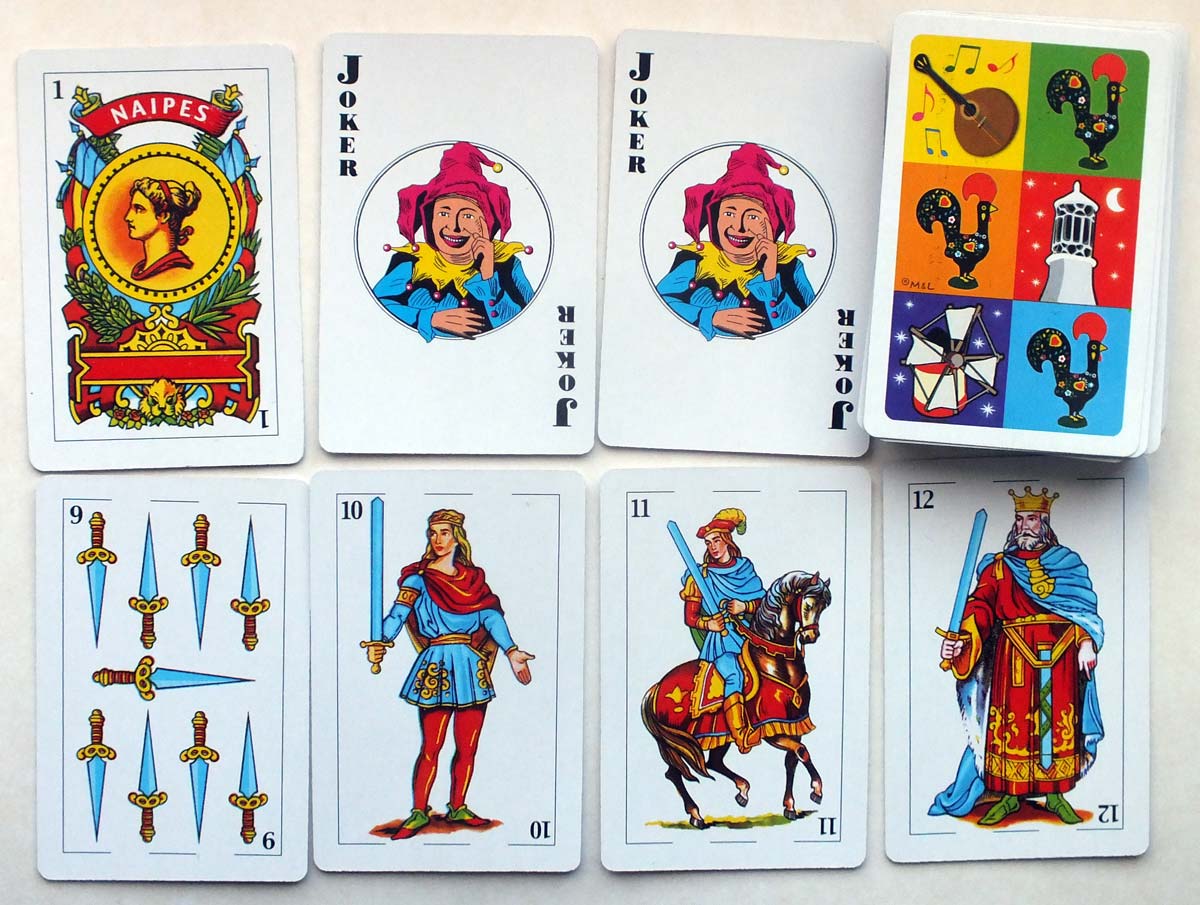
Above: Spanish-suited souvenir of Portugal playing cards from a tourist shop, 2019. Completely anonymous, 48 plastic-coated cards + 2 jokers, cello wrapped.

Above: souvenir of Portugal playing cards from a tourist shop, 2019. Completely anonymous, 52 cards + 2 jokers + extra card in box.

By Simon Wintle
Spain • Member since February 01, 1996
I am the founder of The World of Playing Cards (est. 1996), a website dedicated to the history, artistry and cultural significance of playing cards and tarot. Over the years I have researched various areas of the subject, acquired and traded collections and contributed as a committee member of the IPCS and graphics editor of The Playing-Card journal. Having lived in Chile, England, Wales, and now Spain, these experiences have shaped my work and passion for playing cards. Amongst my achievements is producing a limited-edition replica of a 17th-century English pack using woodblocks and stencils—a labour of love. Today, the World of Playing Cards is a global collaborative project, with my son Adam serving as the technical driving force behind its development. His innovative efforts have helped shape the site into the thriving hub it is today. You are warmly invited to become a contributor and share your enthusiasm.

Activity for Portuguese Playing Cards
Sign in to comment or save this article.

Related Articles
Naipes en Chile
Noticias y crónicas de la época del virreinato.

Portuguese pattern by Real Fábrica
Later Portuguese pattern by Impressão Règia, Real Fábrica de Lisboa.
Russian Playing Card Monopoly
The Russian Playing Card Monopoly was established in March 1798 with all revenue going to support th...

English pattern from Portugal
English pattern by Litografia Maia, Porto, Portugal, c.1960.

Middle Ages
Middle Ages by Germano & Cª, (Litografia Maia),
Greek Heroes
Playing Cards manufactured by Aspioti Elka A.E., 1960, with ancient greek-style courts.
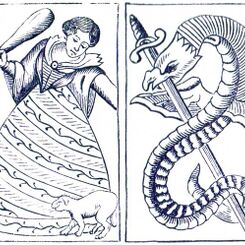
Portuguese pattern
19th century Portuguese pattern, re-printed from original woodblocks.
Iranian Popular Art
Representing Iranian culture and history and intended for a Persian market, these playing cards were...

Tunisia
Playing Cards in Tunisia. Chkobba is one of the most popular card games in Tunisia, mainly played by...
Thai Playing Cards Manufacturing Factory
Thai Playing Cards Manufacturing Factory was established in 1938 as part of the government Excise De...
Tax on Spanish Playing Cards
Taxation on Spanish playing cards, the monopolies and smuggling.

Estonian Historic Playing Cards
The court cards and indices on Estonian playing cards are Södur, Emand, Kuninga.
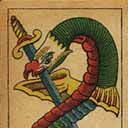
Portuguese Type Cards made in Belgium
Portuguese Type Playing Cards made in Belgium, c.1878.
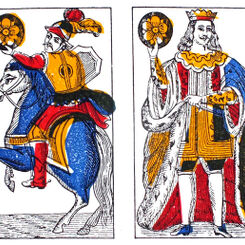
Portuguese Type Playing Cards c.1860
10 cards from a pack of later Portuguese ‘Dragon’ type cards from c.1860, with the Maid of batons ab...
Playing Cards in Mexico
MEXICO shares a long tradition with Spain in the field of playing cards and also merges two complete...
United Kingdom
Playing cards first arrived in England during the 15th century, but none have survived from such an ...
Portuguese Type Playing Cards made in Belgium
Portuguese type pack with ‘dragon’ aces made in Belgium by Mesmaekers Frères, Turnhout, c.1875-1900....
History of Danish Playing Cards
The earliest mention of playing-cards in Denmark dates from 1487 when King Hans, who reigned from 14...
Most Popular
Our top articles from the past 60 days


