


Militar-Tarock No. 38
Non-standard tarock cards combining theatrical and military themes by Joseph Glanz.
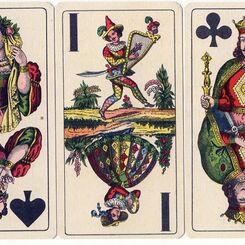
The elaborate and sumptuous court cards are double-ended and contain characters from theatrical plays, thematically similar to Glanz's piquet deck from the same period. The creator is stated to be Glanz's engraver Joseph Sürch, whose monogram is on the king of diamonds. The fine cross-hatching and line shading in these engravings give depth and a sense of three-dimensional form.

Above: 8 court cards from Militar-Tarock No.38 engraved by Joseph Sürch in 1849, this later edition published by Joseph Glanz in c.1880. The costumes, drawn from historical and literary figures like Romeo and King Lear, reflect 19th-century interest in medieval romance and drama. © The Trustees of the British Museum
In contrast, the trump cards, with large Roman numerals, are single-ended and contain patriotic or heroic military scenes: references to battles and portraits of important or gallant commanders, but often the common situations of ordinary soldiers on outpost duty or returning home wounded have a quiet, almost contemplative quality. The exception is tarock no. I (Pagat), showing a caricature of a supplier, and also the Sküs (tarock without a number and the highest card in the game), which in its design is more akin to the court cards. Overall the colours are bright, the uniforms pristine, and even in the “winter hardship” scene there is a touch of noble endurance rather than suffering.


Above: the 22 trump cards, plus back pattern and ace of hearts, from Militar-Tarock No.38 engraved by Joseph Sürch in 1849, 54 cards, this edition published by Joseph Glanz in c.1880. The tax stamp on the ace of hearts was used in Austria-Hungary in the years 1877-1881. © The Trustees of the British Museum
Militar-Tarock is known in several editions, which document their gradual evolution as they successively were updated to reflect the latest military conflicts in which the Austro-Hungarian army was engaged. This popular deck was published repeatedly between 1854 and 1912: over time, the emperor (tarock no. II ) ages in various editions and the ranks of the commanders change. The court cards remain more or less the same. The solution combining theatrical characters and a military theme leads to the hypothesis that the court cards may originally have been intended for another theatrical(?) tarock, but were subsequently repurposed for a military tarock. However, the two-way solution of “single-ended versus double-ended” is not decisive in this, as it is common with non-standard tarock decks. Single-ended tarock cards make better use of the entire surface to illustrate the chosen theme.
The oldest edition from the 1850s probably refers to the First Italian War of Independence (tar. VIII) and the Hungarian Revolution of 1848 (tar. XI). In the deck presented here, these cards have been converted to general scenes by removing the original date. Examples of these changes can be seen on the World Web Playing Card Museum.¹
A later, third version of this deck is the one held in the British Museum.² The museum collection also includes an original wrapper illustrated with soldiers playing a game of tarock. Various clues offered by the cards can be used to date it. Joseph Sürch dated his engraving as 1849 . The battles mentioned on the tarock cards refer to the First Schleswig War (1849, tar. XVII) and the Second Schleswig War (1864, tar. VII, X and XIII). The wrapper also shows the medal of merit that the manufacturer received at the World Exhibition in Vienna in 1873. The address “Niederlage am Kohlmarkt No. 20” (Jack of hearts) appears on Glanz products between 1867-1885. The tax stamp on the 1 or ace of hearts was used in Austria-Hungary in the years 1877-1881.
Also on the BM deck, the caparison under the saddle of Archduke Albrecht (tar. V) has a number 79 which is not visible on earlier issues. This may be the date of the modification of the cards, the Archduke was also given the title of Field Marshal (F.M.). (If it is a question of dating, this modification would certainly not have been carried out by Joseph Sürch, who died in 1877). The year 1880 seems to be a reasonable approximation from these indications.
Rather than propaganda encouraging a society for wartime, I assume the main motivation for the cards’ publication was their memorial function. If contemporary painters filled aristocratic salons with monumental images of the turmoil of war, which served to commemorate and present the noble patron, Glanz’s deck of cards also offered this service to a wider, less affluent society. It certainly allowed veterans to reminisce about old times during game evenings. An obvious example showing such a comparison may be the motif on tarock card No. X “Erstürmung des Königberges”. The monumental version by the painter Siegmund L’Allemand is owned by the Heeresgeschichtliches Museum in Vienna.

Above: Siegmund L'Allemand, The storming of the Königsberg near Oberselk, 1864. Museum of Military History, Vienna - https://www.hgm.at/museum.html
The popularity of the military tarock is also confirmed by the publication of the same deck by the Moravian manufacturer Vincenc Proksch (1870s), but mainly by the product of the competing company Ferd. Piatnik & Söhne, Vienna “Das Drei-Kaiser-Treffen-Tarock” from 1882. It offers a thematically similar solution of tarock deck that relate to the Austrian military campaign in Bosnia and Herzegovina in 1878-1879. Piatnik's deck also preserves the strange connection of theatrical court cards with military tarock cards.
References
1. Trionfi.eu : Franz Josef Military Tarock►
2. British Museum : number 1896.0501.205►
3. Petr Bílý : Jeho apoštolské veličenstvo - císař František Josef I. / Ročenka Clubu sběratelů karetních her 2020
4. Wikipedia : Siegmund L'Allemand The Storming of Königsberg near Oberselk 1864►
By Marek Brejcha
Czech Republic • Member since June 13, 2024
My relationship with cards grew from playing to collecting and transformed into publishing as well. I am part of the team at Counter Clockwise, a small company that publishes traditional card games.

Activity for Militar-Tarock No. 38
Sign in to comment or save this article.

Related Articles
Warrior from Cattaro
A typology of Austrian Tarock documented through the evolution of one of its motifs.
Julius Berndl and his Austrian tarock
Josef Glanz's Tarock: a classic deck with artistic innovation by Julius Berndl.
Gigerl-Tarock by Joseph Glanz
Urban Dandy caricature deck from 19th century Vienna designed by Julius Berndl.
Patience by Joseph Glanz
A refined and distinctly European Patience pack by Joseph Glanz from Austria.
Tarock Nr. 71 by Ferd. Piatnik & Söhne
Special tarock deck for the Tyrolean game Droggn.
Animal Tarock by J. G. Pichler
Baroque tarock cards from the late 18th century.
Johann Nejedly Tarok Cards
Johann Nejedly, a 19th-century Viennese card maker, produced Tarock cards featuring modern scenes th...
Joseph Sürch, Engraver
Joseph Sürch, a prominent Viennese engraver, made significant contributions to card sheet engraving ...
Double-ended German-suited pack by Josef Glanz, Vienna.
From the British Museum collection.
Trappola pack by Joseph Glanz
Double-ended Trappola pack by Joseph Glanz, Vienna, late 19th century.
Ordnance Recognition
Ordnance Recognition Playing Cards cards designed to help people at risk from unexploded bombs
Jugendstil Tarock
‘Jugendstil Tarock’ was designed by Ditha Moser and first published by Albert Berger and Josef Glanz...
J. Glanz Historical playing cards
Historical Theatrical playing cards manufactured by J. Glanz, c.1860.
Soldaten Tarock
Piatnik was known for their magnificent quality of chromo-lithographic printing, and this facsimile,...
Mythological Tarock by Johann Herrl
French-suited Tarock deck made by Johann Herrl in Graz 1815.
Piatnik Tarock
Deck of "Industrie und Glück" or "Rural Scenes" tarock cards manufactured by Ferd Piatnik & Söhne, V...
Estel Tarok
J. Estel Tarok, 1820.
Pittner Tarok
Ferd Pittner, Tarok Cards
Joseph Glanz, 1862
Playing cards depicting Turkish and Greek rulers manufactured by Joseph Glanz, Vienna, Austria, 1862...
Adametz, Vienna
Cards from a 54-card "Austrian Tarock" or "Industrie und Glück Tarock" pack made by Franz Adametz of...
Most Popular
Our top articles from the past 60 days


