


Patience-Whist No. 140 by Piatnik
A Small Connection Between Austria, Denmark, and Czechoslovakia.
At the beginning of the 20th century, the Patience card deck was part of Piatnik’s regular product line.¹ This leading European manufacturer also offered Patience-Whist No. 140 as part of its extensive product range. See the box
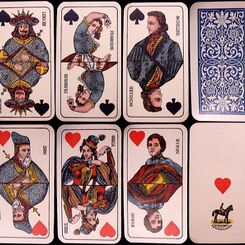
The deck does not deviate in any way from the expected format for a Solitaire game. Piatnik released this successful design in many editions throughout the 20th century.² This particular deck contains cards measuring 68 x 44 mm³ in a chromolithographic design with gilded corners. The court cards depict traditional aristocratic figures, and the pip cards also follow the standard design without any anomalies. The ace cards feature simple rococo cartouches.⁴ In terms of the deck’s development, this version lacks corner indices and a Joker card, which were added in later editions. The rhombus on the ace of hearts, which in other editions serves as the manufacturer’s logo, features only an unusual text stamp . The extra card bearing the company’s logo has a plain white back.
A distinctive feature of this deck is the reverse side, which features a blue-and-yellow ornament that does not match the pattern shown on the box. The main point of interest is the text on the Jack of Clubs: “S. Salomon & Co., Kjøbenhavn ”. The fact that the Piatnik company supplied its cards to this Danish firm is well documented elsewhere. In this case, therefore, it appears that unsold stock is being sold under the company’s own brand. According to the tax stamp on the ace of hearts, the cards were supplied for sale in Czechoslovakia between 1918 and 1920.
An Austrian deck, originally produced for the Danish market, is being used in Czechoslovakia. Cards have always been a medium that crosses borders and connects nations.


Above: Patience-Whist No.140 manufactured by Ferd. Piatnik & Söhne for S. Salomon & Co., Kjøbenhavn, c.1919.
Acknowledgements & References
I would like to thank Vladislav Šedivý for his consultation regarding the precise identification of the tax stamp .
- The company name “Ferd. Piatnik & Söhne AG” is documented between 1919 and 1939: Kartenmacher in Wien ►
- WWPCM01638: patience deck "Rococco" ►
- Tony Hall classifies this as a medium size: Patience Cards and their Boxes ►
- The typical Rococo motif may cause occasional confusion with a similar product from Piatnik known as “Rococo Patience”.
By Marek Brejcha
Czech Republic • Member since June 13, 2024
My relationship with cards grew from playing to collecting and transformed into publishing as well. I am part of the team at Counter Clockwise, a small company that publishes traditional card games.

Activity for Patience-Whist No. 140 by Piatnik
Sign in to comment or save this article.

Related Articles
Luxury No. 2167
A Piatnik classic that lives up to its title.
Tarock Cards by Antonín Kratochvíl
Excerpt from the catalog of a prominent Prague workshop.
Tarock Nr. 71 by Ferd. Piatnik & Söhne
Special tarock deck for the Tyrolean game Droggn.
Art pack I
Art pack featuring Old Masters, including Bruegel, Vermeer, Titian, Raphael, Caravaggio, Canaletto, ...
Rika playing cards
Playing cards depicting famous Austrian skiers of the 1970s.
Piatnik No.97
Non-standard French-suited cards published by Ferd Piatnik & Sõhne, Vienna, c.1940s.
Vienna (ex-Lyon) pattern
‘Vienna pattern’ derived from archaic Lyon pattern by Ferd Piatnik & Söhne A.G., c.1926-1934.
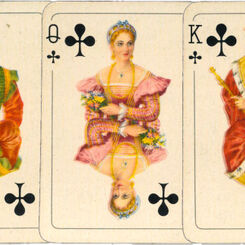
Piccadilly Patience
Piccadilly Patience by Piatnik, c.1955
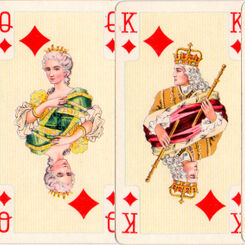
Rococo Playing Cards
Piatnik’s Rococo style playing cards issued as “Rococo Patience”, “Luxus-Patience”, “Empire Patience...
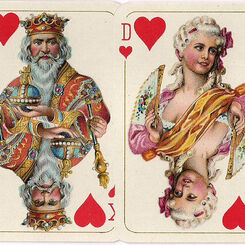
Baroque No.2118
“Baroque” by Ferd Piatnik & Sons, Vienna, reflecting a bygone era of fashion.
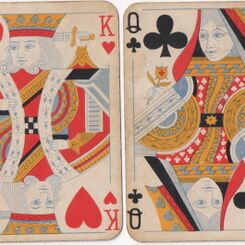
48: Ferdinand Piatnik & Sons
Ferd. Piatnik produced a very large range of cards with many different standard and non-standard pat...
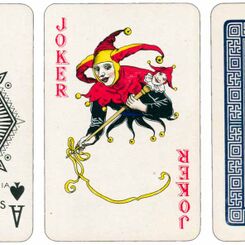
Popular No.257
Piatnik’s “Popular Playing Cards” No.257
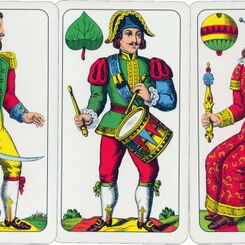
Salzburger Pattern
Salzburger pattern by Ferd. Piatnik & Söhne, Vienna
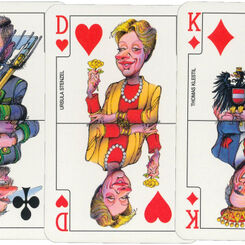
Die Neue ÖVP
Promotional deck for the Austrian People’s Party (ÖVP) printed by Piatnik, 1996.
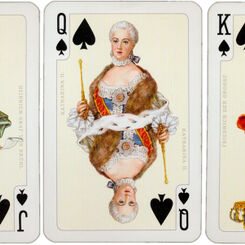
Rococo No. 2130
Piatnik: Rococo No. 2130 playing cards designed by Prof. Kuno Hock, c.1975
Bjørn Wiinblad
Bjørn Wiinblad (1918-2006) was a Danish painter, designer and ceramics artist.
Vienna Melange
“Vienna Melange” Playing Cards by Piatnik with a historical feel representing the four races that ma...
Ferd. Piatnik & Söhne
Ferdinand Piatnik was born in Ofen on October 14, 1819.
Piatnik Tarock
Deck of "Industrie und Glück" or "Rural Scenes" tarock cards manufactured by Ferd Piatnik & Söhne, V...
Literary Figures
Non-Standard Literary Figures playing cards manufactured by Ferd. Piatnik & Söhne A.G., Vienna, 1924...
Most Popular
Our top articles from the past 60 days


Adam Wintle
11 April 2026, 14:32SavedSaved this article to Researching & Reading