Jeu de Cartes Napoléon
Deck created by Matéja celebrating the bicentenary of the birth of Napoleon (1769-1969)
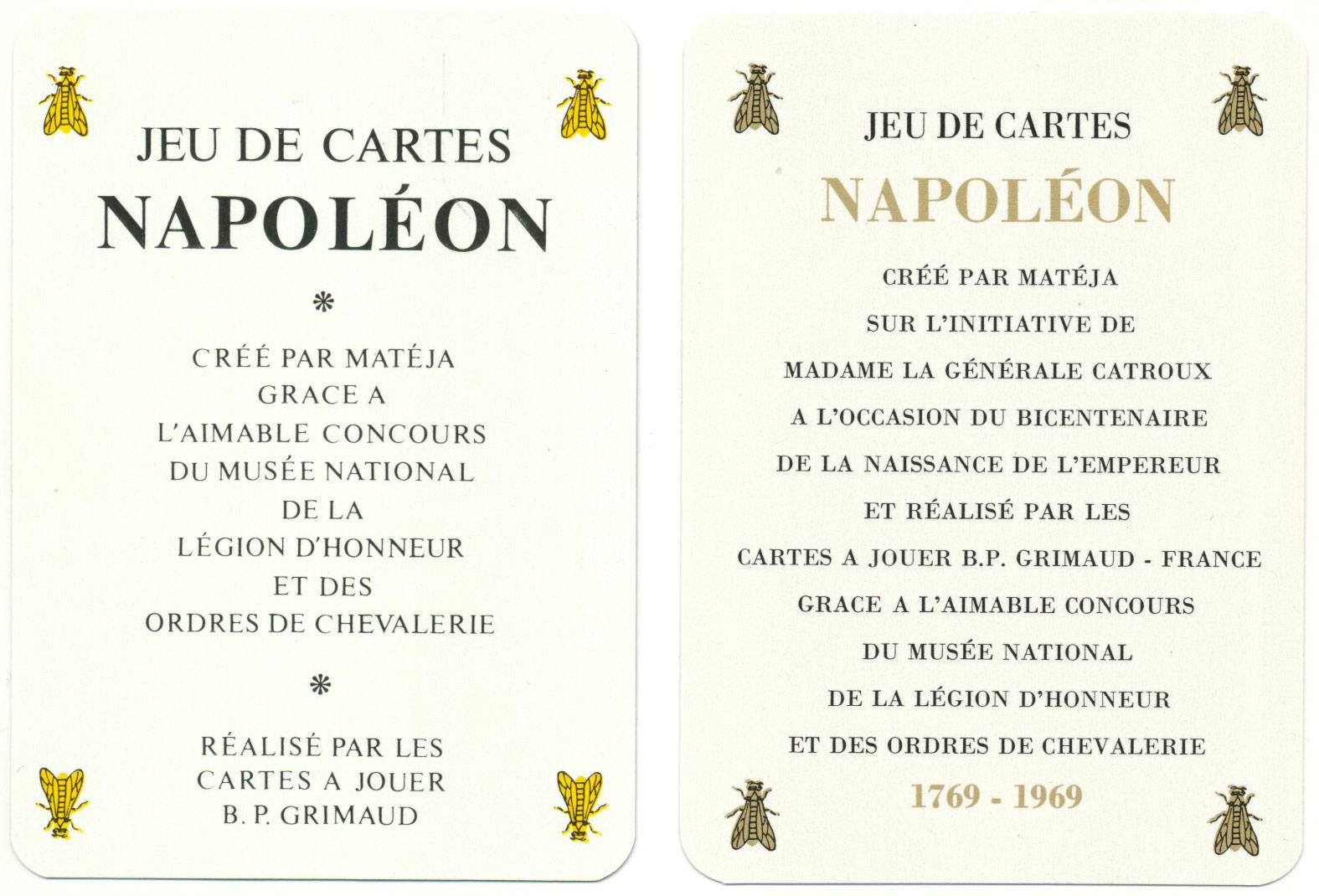
“Jeu de Cartes Napoléon” created by Matéja celebrating the bicentenary of the birth of Napoleon (1769-1969). The cards have French indices and are double-ended. See the Information cards►
Napoleon is almost universally depicted as a short man while the truth is that he was probably slightly above average height for the period, only his generals and marshals were taller. According to a contemporary observer, Napoleon possessed a magnetic personality and a fascinating smile... but, when excited by any violent passion his face took on a stern and even terrible expression. His eyes were reported to be grey or blue, penetrating and wonderfully mobile.
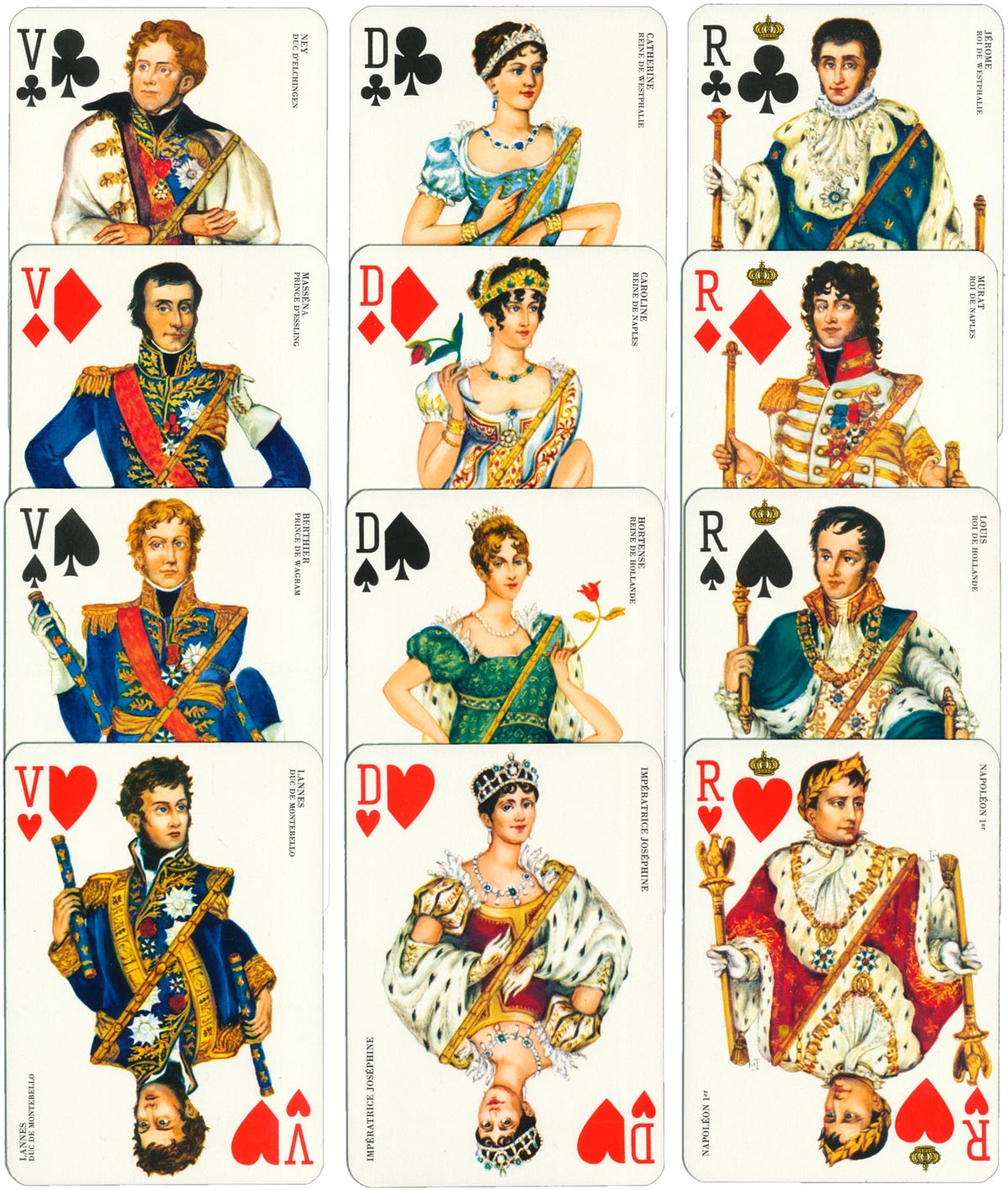
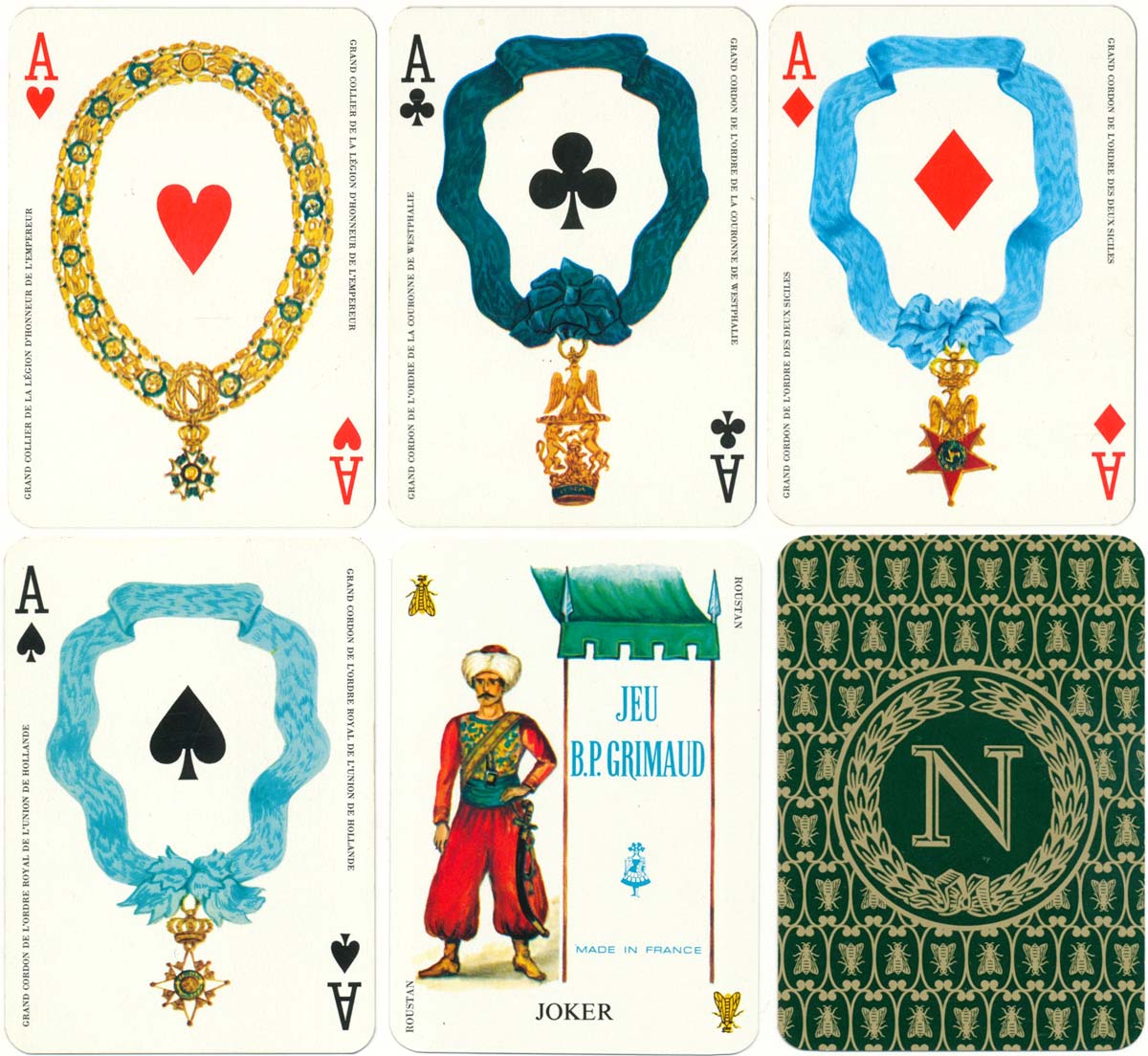
Above: cards from a dual deck created by Matéja celebrating the bicentenary of the birth of Napoleon, manufactured by B.P Grimaud, 1969. Each ace carries a medal of a French order of honour, while the court cards depict important leaders from the time of Napoleon. Green or maroon backs.
English Indices Version
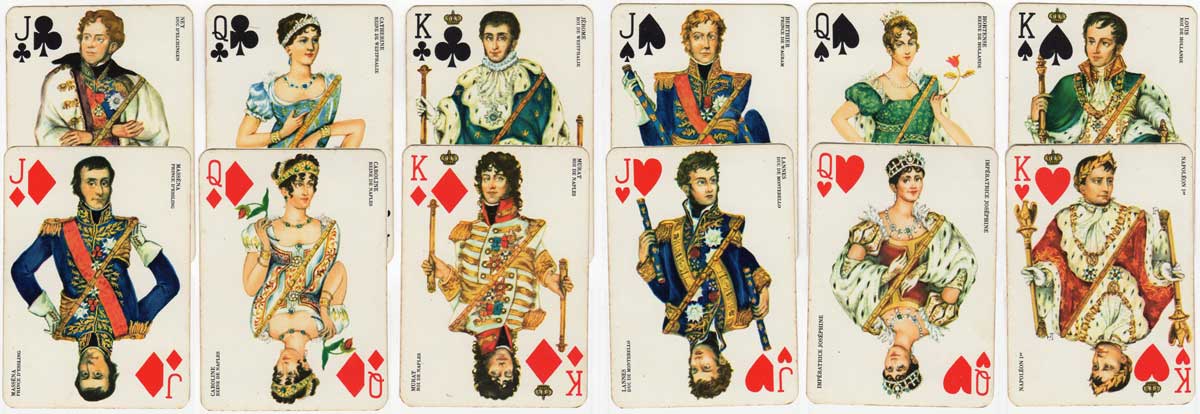
Above: English (International) indexed version of these cards. Packaged as a single pack, rather than a dual set, the courts have English indices and the jokers lack the maker's name. All images courtesy Matt Probert.

By Matt Probert
United Kingdom • Member since March 02, 2012
I have adored playing cards since before I was seven years old, and was brought up on packs of Waddington's No 1. As a child I was fascinated by the pictures of the court cards.
Over the next fifty years I was seduced by the artwork in Piatnik's packs and became a collector of playing cards.
Seeking more information about various unidentified packs I discovered the World of Playing Cards website and became an enthusiastic contributor researching and documenting different packs of cards.
I describe my self as a playing card archaeologist, using detective work to identify and date obscure packs of cards discovered in old houses, flea markets and car boot sales.

Activity for Jeu de Cartes Napoléon
Sign in to comment or save this article.

Related Articles
Les Amoureux de Peynet
An iconic cartoon veers from cute to sexual with no stops in between.
Les Quatre Saisons
A lyrical cycle of the seasons woven into the language of playing cards.
Gibert Jeune (Molière)
Pack offered by the Parisian bookshop Gibert Jeune on the tricentenary of Molière’s death.
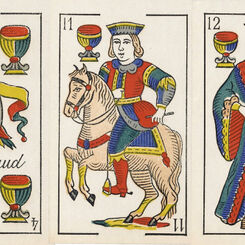
Catalan pattern by B.P Grimaud
Standard Spanish Catalan pattern deck made in Paris by B.P Grimaud.
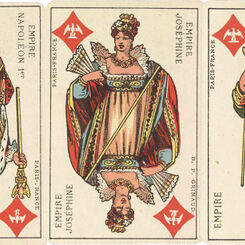
Cartes politiques : Jeu d'actualité
Political playing cards published by Grimaud et Chartier, Paris, 1872.
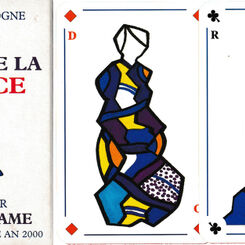
Le Jeu de la Chance
Original designs by French artist Jean Vérame, with clubs replaced by four-leaf clovers to bring goo...
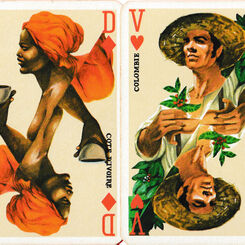
Le Café
Four of the great coffee-producing countries represented in a commemorative pack of playing cards.
Schweizer Trachten
Schweizer Trachten No.174 (Costumes Suisses) by Dondorf.
Boulogne-sur-Mer Chamber of Commerce
Boulogne-sur-Mer Chamber of Commerce & Industry playing cards illustrated by James Hodges, c.1974.
Jeu des Drapeaux c.1816
“Jeu des Drapeaux” commemorating Napoleon’s greatest battles, c.1816.

Versailles
Sumptuous ‘Versailles’ playing cards created by Matéjà and printed by B. P. Grimaud, c.1970

1900 Jeu de Cartes
‘Jeu de Cartes 1900’ designed by Marie Christine Schira in the Art Nouveau or Jugendstil style, 1979...
Pirates et Corsaires
“Pirates et Corsaires” playing cards illustrated by Jean Bruneau, 1984.

Jeu Moyen Age
Quénioux believed that aesthetic feelings are the highest values: “C’est précisément cet amour de l’...
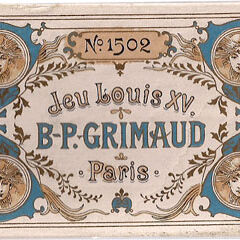
Jeu Louis XV
B.P. Grimaud of Paris issued this very ornate costume deck called “Jeu Louis XV No.1502” in c.1895. ...
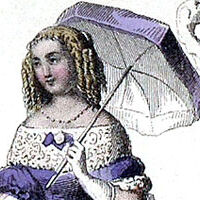
Jeu des Rois de France
This beautifully engraved and pleasing deck designed in 1856 has French Kings and consorts as the Ki...

Le Jeu de Marseille
Having deconstructed traditional, bourgeois playing card symbolism they produced new, liberated desi...
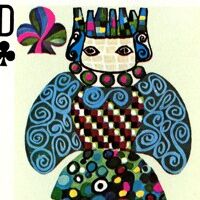
Geneviève Lirola
Stylish modern designs by the painter, decorator and ceramist Geneviève Lirola, featuring unity of c...
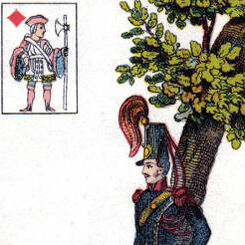
Livre du Destin
Livre du Destin or Book of Fate, printed by B.P.Grimaud, Paris, c.1900.
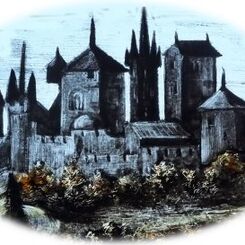
French Playing Cards
Some of the oldest cards still in existence come from France. During the 16th and 17th centuries Fra...
Most Popular
Our top articles from the past 60 days