


Lyon Pattern type iii
This pattern was used in various parts of eastern France but was ultimately replaced by the official ‘Paris’ pattern in c.1780.
Lyon Pattern
Anonymous manufacturer, c.1765-1780
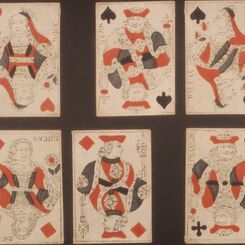
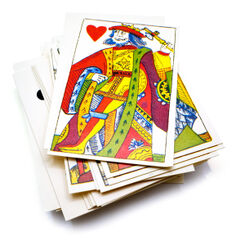
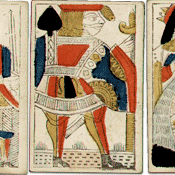
In 1701 a law was passed in France which specified a fixed design for each of the nine regions which card makers were required to conform to by the tax authorities. This uncoloured proof sheet shows the Lyon regional pattern in its final state, before it became obsolete around 1780. The designs, of course, had evolved from much earlier late medieval models but here they show signs of being produced in a stereotyped manner, for example in the clothing and hands. This pattern was used in various parts of eastern France throughout the eighteenth century but was ultimately replaced by the official ‘Paris’ pattern in c.1780. The King of Hearts carries a hawk on his wrist, while the King of Clubs holds an orb with a surmounted cross. All the Queens hold fans as well as flowers; the Jack of Clubs carries a shield.
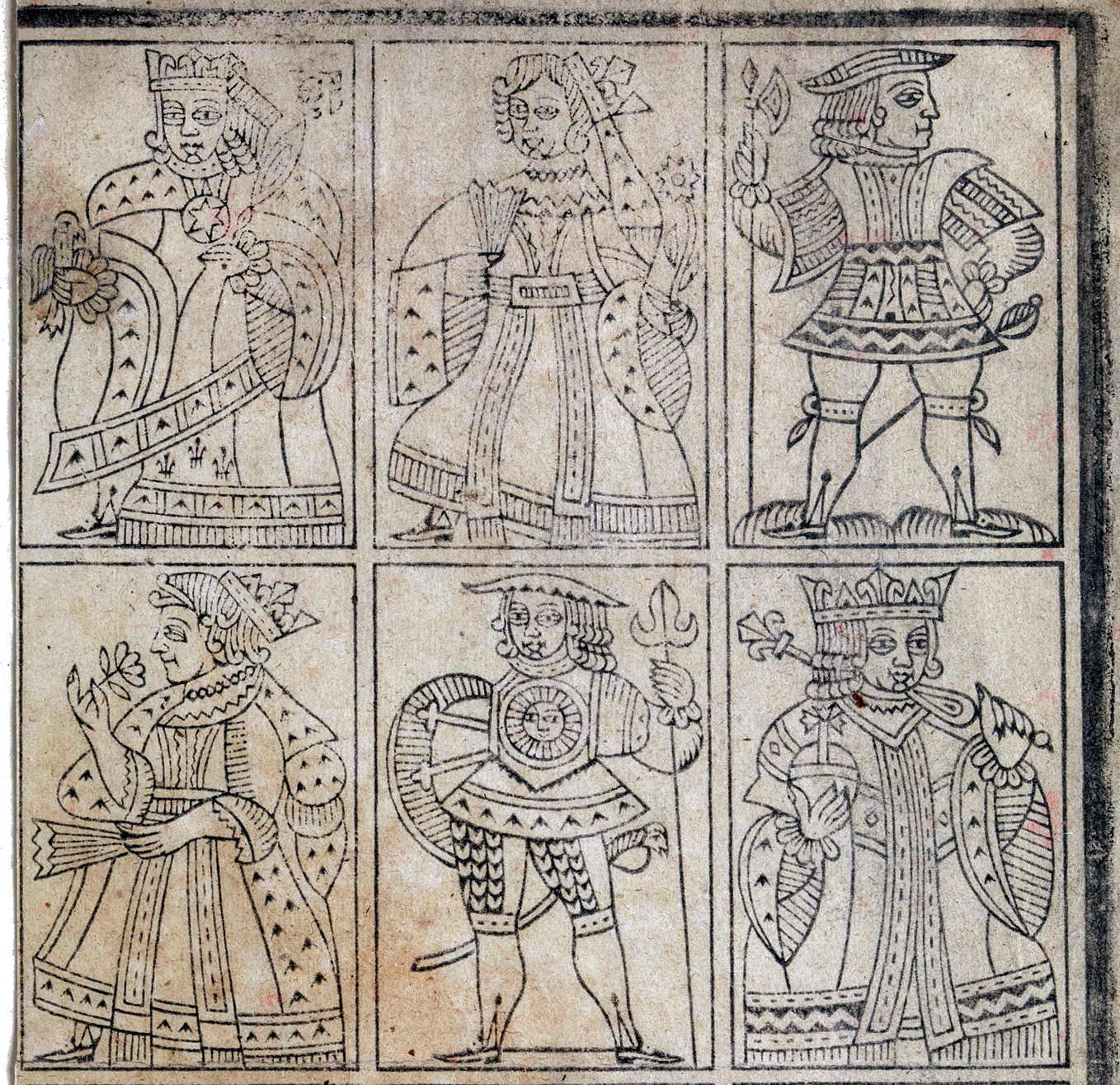
Above: detail from an anonymous, uncoloured woodblock print of eighteenth century 'Lyon' pattern cards. They would have been stencil-coloured and the suit symbols added in the empty areas at the top. The top row shows King, Queen and Jack of Hearts; the second row shows Queen, Jack and King of Clubs. Image courtesy the Public Library of Cincinnati and Hamilton County.
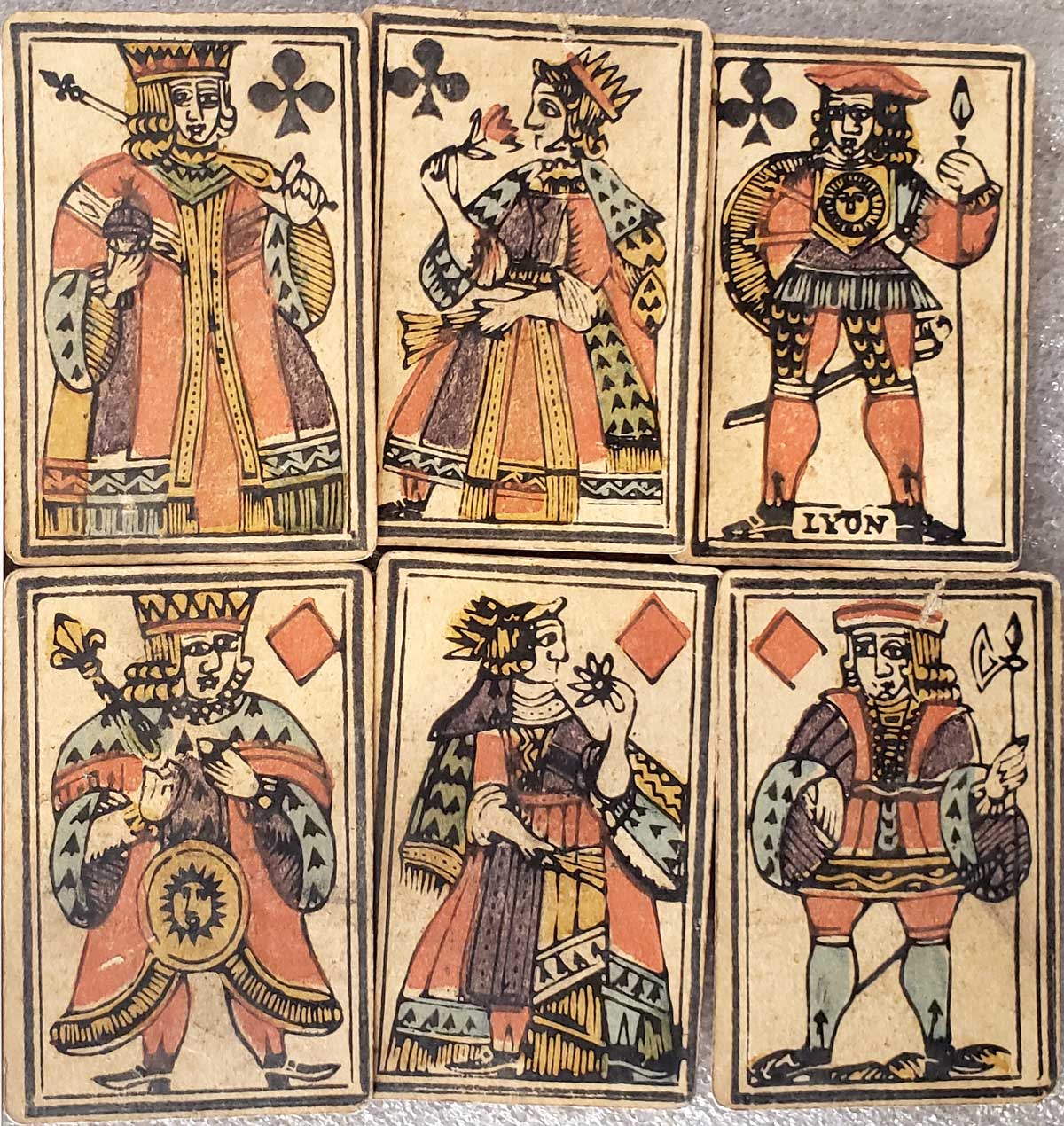
Above: a slightly later coloured varsion of the Lyon pattern. Image courtesy Marya Van't Hul.
Ten of Clubs: This was the first card ever drawn by Louis XIV in play (when he was under the age of ten). Cardinal Mazarin kept the card more or less as a souvenir and it was found in his belongings when he died some forty years later.

By Simon Wintle
Spain • Member since February 01, 1996
I am the founder of The World of Playing Cards (est. 1996), a website dedicated to the history, artistry and cultural significance of playing cards and tarot. Over the years I have researched various areas of the subject, acquired and traded collections and contributed as a committee member of the IPCS and graphics editor of The Playing-Card journal. Having lived in Chile, England, Wales, and now Spain, these experiences have shaped my work and passion for playing cards. Amongst my achievements is producing a limited-edition replica of a 17th-century English pack using woodblocks and stencils—a labour of love. Today, the World of Playing Cards is a global collaborative project, with my son Adam serving as the technical driving force behind its development. His innovative efforts have helped shape the site into the thriving hub it is today. You are warmly invited to become a contributor and share your enthusiasm.

Activity for Lyon Pattern type iii
Sign in to comment or save this article.

Related Articles
La baraja de Almagro
De la chimenea al monumento nacional: la baraja de Almagro y el renacer del corral de comedias.
French Revolutionary cards by Pinaut
Seven cards from a French Revolutionary pack by Pinaut featuring characters from classical antiquity...
The Parisian Tarot
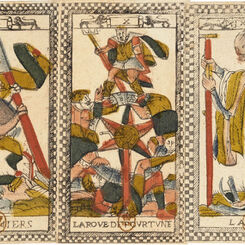
The “Parisian Tarot”, early 1600s, with imagery and design synthesizing several influences.
Languedoc pattern - Portrait de Languedoc
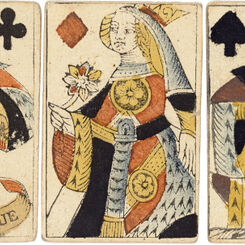
The old Languedoc pattern was known at the beginning of the seventeenth century, if not before.
Pierre Roiné Aluette
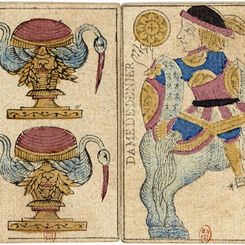
Archaic form of Aluette published by Pierre Roiné, Nantes, c.1785.
Antoine de Logiriera
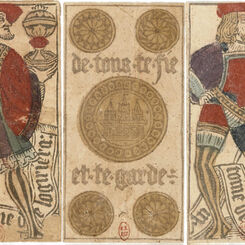
Archaic Spanish-suited playing cards published in Toulouse by Antoine de Logiriera (1495-1518).
A. Camoin & Cie
This deck was inherited from ancestors, it has has a family history surrounding it. Details of the l...
“Deck with French suits”
A facsimile of an early 19th century French-suited deck from the collection of F.X. Schmid.
64: The descendants of the French regional patterns: 2
A continuation oF the development of the off-spring of the Paris patterns and a few examples of how ...
63: The descendants of the French regional patterns: 1
A great many regional patterns were exported from France and subsequently copied elsewhere. Some of ...
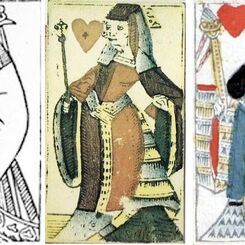
62: French regional patterns: the queens and jacks
Continuing our look at the figures from the regional patterns of France.
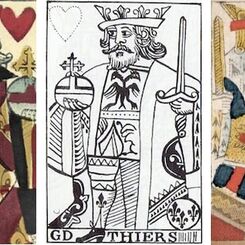
61: French regional patterns: the kings
On page 11 I illustrated several examples of the regional French patterns from Sylvia Mann's collect...
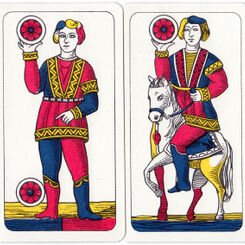
Trentine Pattern
Trentine Pattern
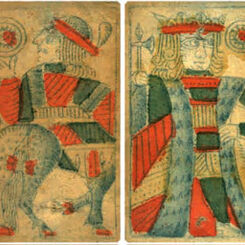
Pedro Varangot, 1786
Archaic Navarra pattern produced for the Pamplona General Hospital Monopoly by Pedro Varangot in 178...
Pierre Marechal
Rouen became an important centre for card-making whose influence extended far afield. Cards from Rou...
Benoist Laius
Spanish playing cards such as these were used in those parts of France where certain games were enjo...
1: Playing Cards and their History: An Introduction and some links to other sites
What was considered the first mention of playing cards in England is in 1463 when Edward I banned th...
Paris Pattern
The Paris pattern was established as such around the middle of the seventeenth century (based, perha...
16th Century French Playing Cards based on Illustrations by Gurney Benham
This pack of cards by Rose & Pentagram is said to be based off Pierre Marechal, Rouen pack from the ...
History of Court Cards
The court cards in English packs of playing cards derive from models produced by Pierre Marechal in ...
Most Popular
Our top articles from the past 60 days


