


Question and Answer Games
A card game called “Impertinent Questions and Pertinent Answers” was launched in the early 1920s by H.P Gibson & Sons Ltd.
I was recently persuaded by my 15-year-old grandson to buy a modern game. All the family knows that modern games are fairly low on my priority list compared with anything launched in the 19th century or earlier. However, I succumbed, despite the game being rated 17+. The game, as its promotion suggests, is not for the faint hearted or prudish. It is extremely rude (as my mother would have said) and about as un-PC as you can imagine. Indeed, the grandchildren had to explain some of the terms used to the older players! But it is, frankly, very funny when played with three generations of a family that is, fortunately, not really shocked by anything. When you think that I am of the generation which saw Donald McGill successfully prosecuted under the Obscene Publications Act of 1857 for some of his “saucy” seaside postcards, one can get some idea of how much society has evolved in the last 80 or so years!
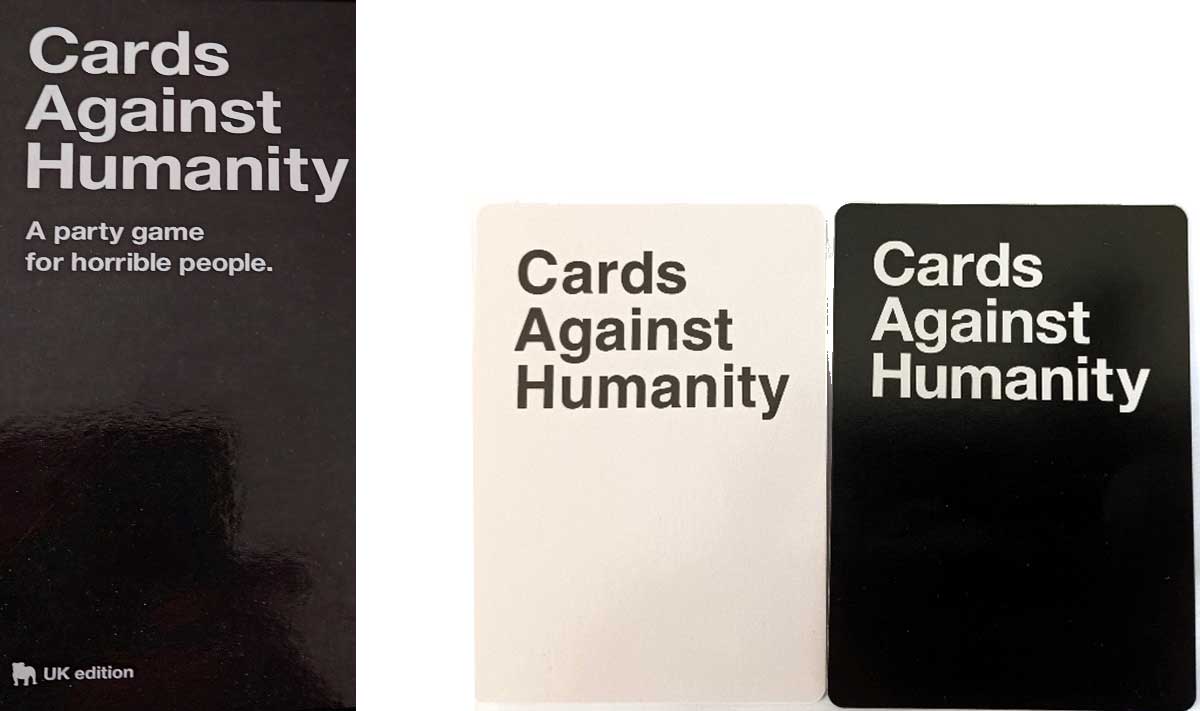
Above: Cards Against Humanity was first released in May 2011 • www.cardsagainsthumanity.com►
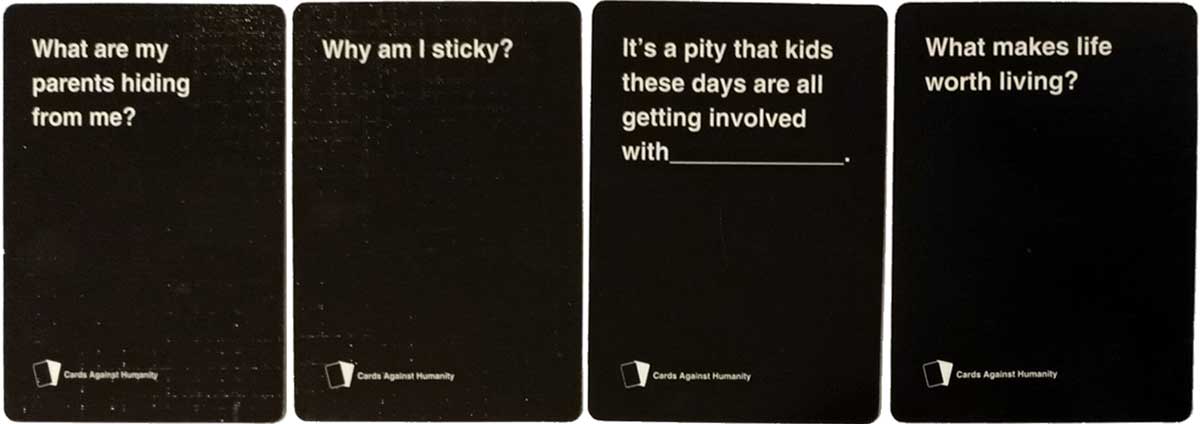
The game comprises two sets of cards – black question cards and a much larger stock of white potential answer or response cards. Ten white cards are dealt to each player. Each player in turn selects a black question card from the top of the pack and reads the question. All the other players select a possible response from their hand of white cards. The questioner then, in turn, reads the question and response selected. After all responses have been given, the questioner selects the best (on whatever criteria he or she decides) and the role of questioner rotates round the group for as long as the game continues, and a winner is determined. Winning, as you can guess, is far less important than the outrageous humour it generates.
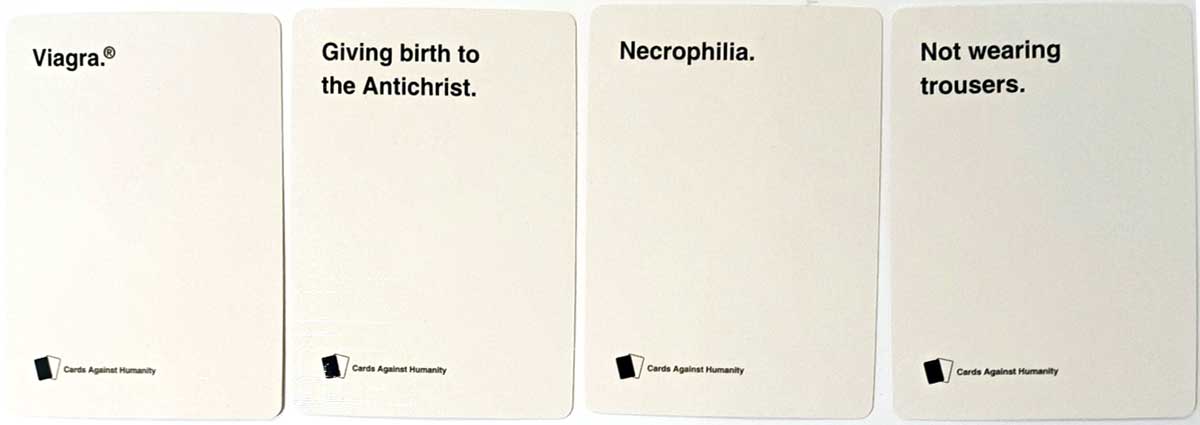
I was tempted but cannot really show any of the more extreme questions or responses which include bodily functions, sexual behaviour, contentious statements, celebrities and just about anything judged to be outrageous. However, I have carefully selected four fairly uncontentious examples just to demonstrate the style of presentation.
And similarly a set of possible answers or responses.
Now, I obviously would not use the good offices of the wopc website to promote a modern game for its own sake. There is clearly a reason. I got to thinking this is a great format for a parlour game. Something like this must have been done before; there is very little in the card games business which is entirely original. And sure enough, a little research indentified a much earlier game called Impertinent Questions and Pertinent Answers. The game was launched in the early 1920s by H.P Gibson & Sons Ltd. In its original form in the late 1920s it looked like this • See advertising leaflet
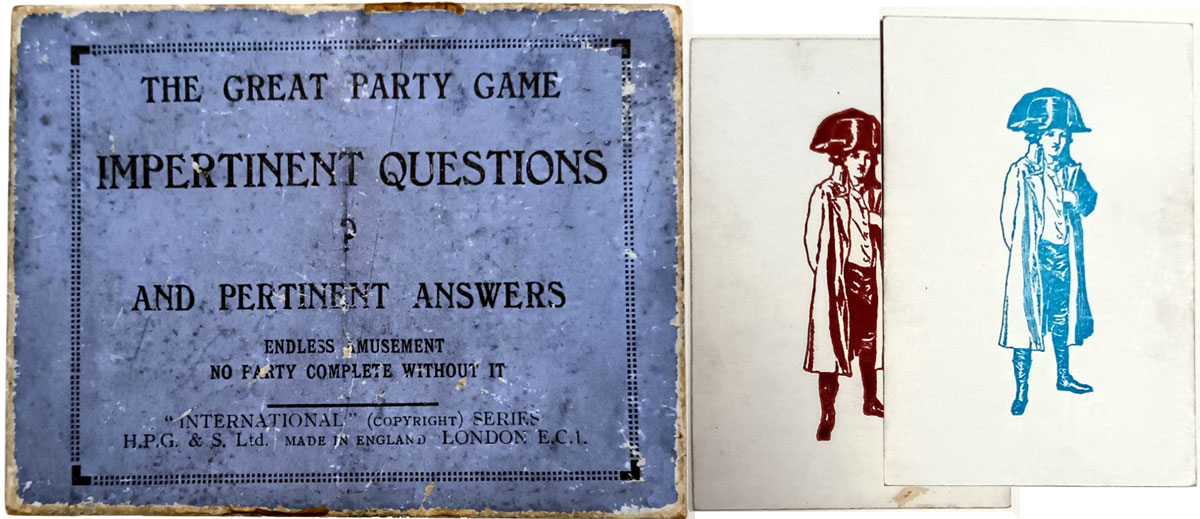
Above: Impertinent Questions and Pertinent Answers by H.P Gibson & Sons Ltd, early 1920s. H.P Gibson and Sons wasted little money on design or production costs when it was first launched.
The original sets of 64 cards carried the same backing motif, card quality and design as another H.P.G game I have written about elsewhere, The History of England►
It is described as “an amusing and entertaining Card Game for Parties” for any number of players. Half the cards contain questions, while the other 32 have answers or responses. Unlike the more modern game each card has two questions or answers, thus:
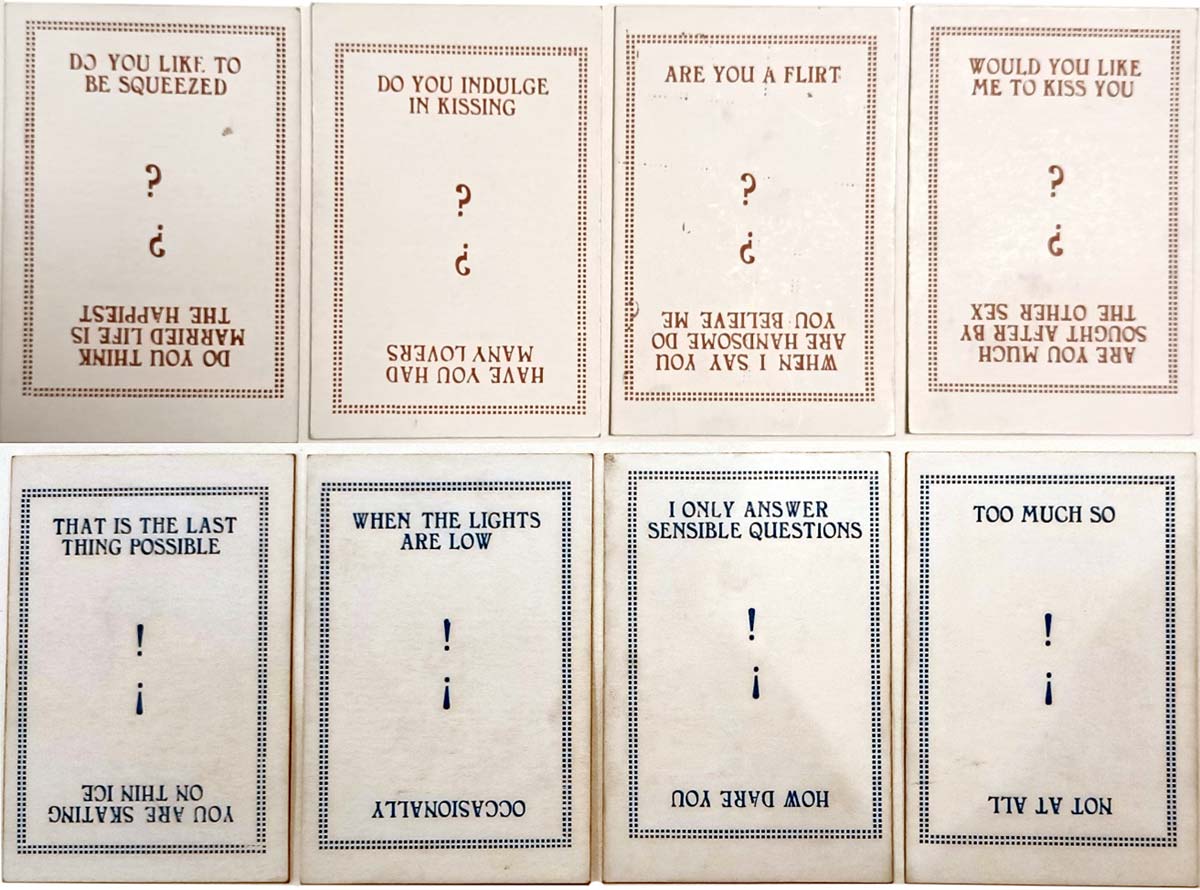
Unlike “Cards Against Humanity” I could happily have selected any of the sets of questions and responses. They are cheeky rather than outrageous and one can imagine their use in a 1920s drawing room. However, the words and phrases used are interesting in that they reflect the English language as it was spoken at the time and indicate some of the sensitivities of the earlier age.
The game play too is different. Players sit in two equal rows opposite each other. Each pack is shuffled separately, and each player is dealt one question card and one answer card face down. Then in turn, down the row, each player turns the question card and reads the question from the top of their card; the player opposite reads the answer from their card, and so on. The cards are then turned upside down and the second sequence of questions and answers are asked. Play proceeds, according to the instruction leaflet, “keeping the company in a continual roar of laughter”. Shuffling the packs and redistributing the cards means “the combination of Questions and Answers obtainable is almost unlimited, and endless amusement and fun can be obtained”.
The basic version of the game must have been successful as into the 1930s it was given a new design and a promotional boost in various formats. Sadly, Gibson records were lost in December 1940 in the blitz so one can only guess at the scale and longevity of this game as for others from the same source.
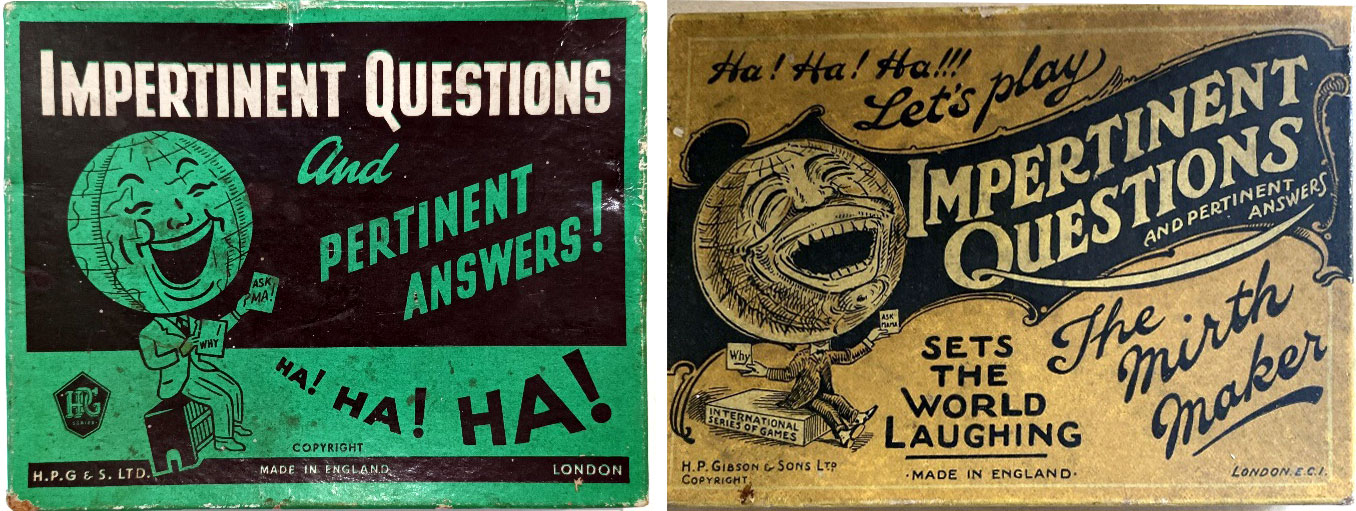
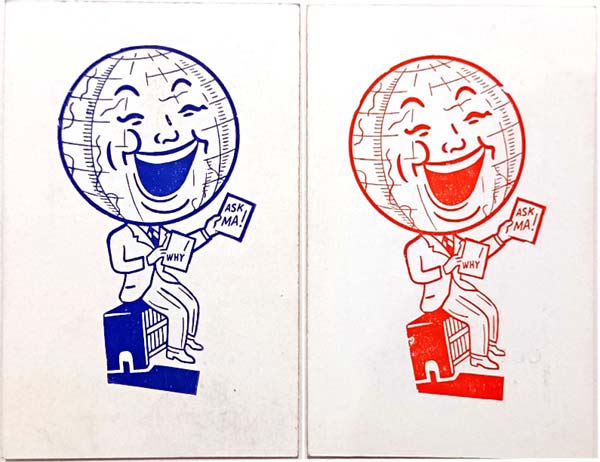
Above: Impertinent Questions and Pertinent Answers by H.P Gibson & Sons Ltd, 1930s
The back of the cards too took on a new look although the questions and responses varied very little from the first examples. There were many new ones but very much in the same style.
The game must have been a success because it was worth Gibsons also producing a pocket version, with a different backing design and the use of a new logo.
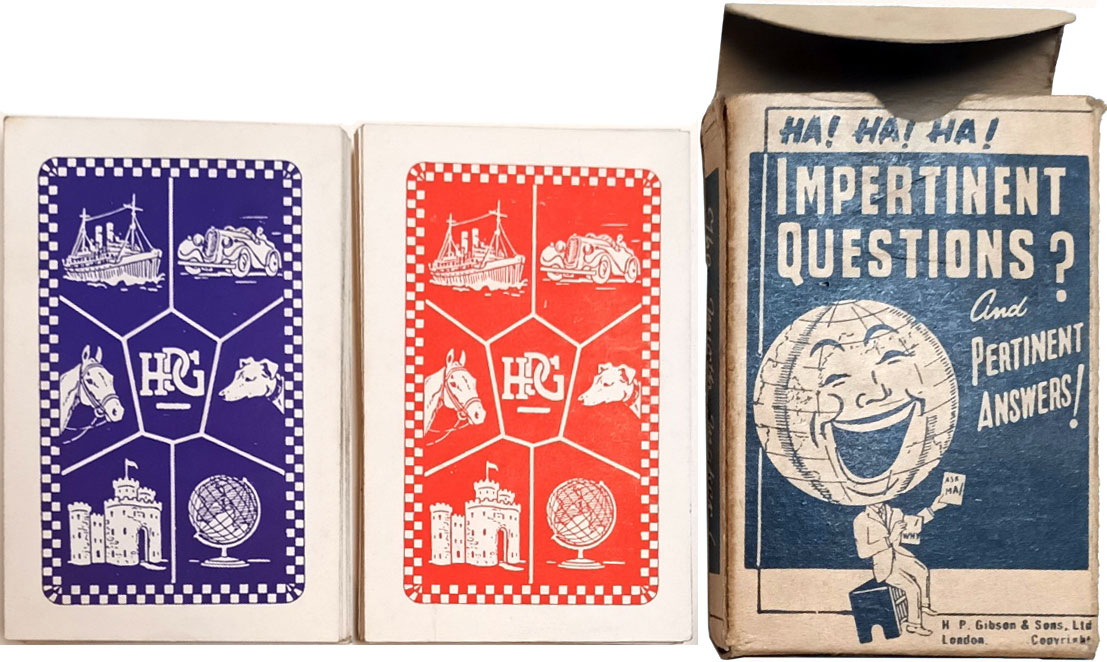
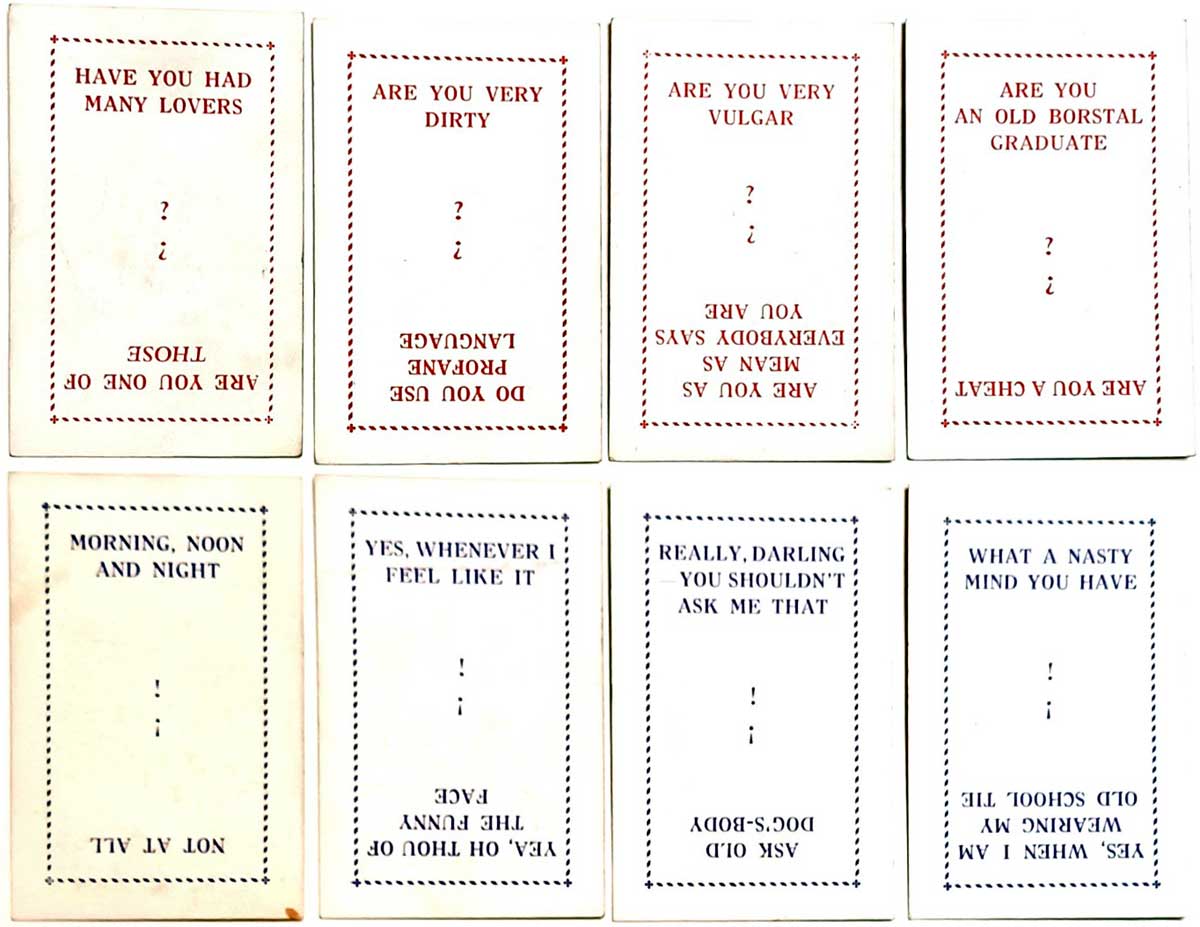
Nothing very startling in questions or answers, but is it my imagination that this later version showns some sign of moving towards the style of Cards Against Humanity?
Tony Hall, November 2024
Editor's Comment
The evolution from polite card games like "Impertinent Questions and Pertinent Answers" of the 1920s to the provocative and edgy "Cards Against Humanity" reflects cultural and social shifts over a 100 year period. Modern society's embrace of more relaxed, open and unfiltered humour, combined with the influence of media and the internet, has paved the way for content that pushes boundaries.

By Tony Hall
United Kingdom • Member since January 30, 2015
I started my interest in card games about 70 years ago, playing cribbage with my grandfather. Collecting card game materials started 50 years or so later, when time permitted. One cribbage board was a memory; two became the start of a collection currently exceeding 150!
Once interest in the social history of card games was sparked, I bought a wooden whist marker from the 1880s which was ingenious in design and unbelievably tactile. One lead to two and there was no stopping.
What happened thereafter is reflected in my articles and downloads on this site, for which I will be eternally grateful.

Activity for Question and Answer Games
Sign in to comment or save this article.

Related Articles
Learning to play Cribbage
I learned to pay cribbage when I was very young, aged around six or seven.
Gibson’s History of England
History without tears for young and old, 1920s.
Comic Question & Answer cards
Comic Question & Answer cards by Josh. Reynolds & Sons, circa 1850.
Forfeits
Forfeits party card game by Merit Games, J & L Randall Ltd, c.1950.
Pranks & Mimics for the Party
Pranks & Mimics for the Party, 1950s.
Biff! Bang!! Wallop!!!
Biff! Bang!! Wallop!!! family card game published by H.P. Gibson & Sons Ltd, 1939.
Transport
Transport card game published by H.P. Gibson & Sons Ltd in mid-1930s.
Stop! I forbid the Sale!
“Stop! I forbid the Sale!” card game published by H.P. Gibson & Sons Ltd, c.1939.
Neues Frag˗ und Antwortspiel
Neues Frag- und Antwortspiel (new question and answer game) from Germany.
Countries of the World
“Countries of the World” published by H.P. Gibson & Sons, Ltd, c.1939.
Candid Confessions
“Candid Confessions” published by Jaques & Son, Ltd, c.1905.
Lincard
“Lincard” card game invented by John William Wolf and patented in 1937.
District Messenger
District Messengers were uniformed young men wearing little pill-box hats and mounted on bicycles wh...
Mr Chad
Anonymous ‘Mr Chad’ card game, 1940s.
Animal Grab
Animal Grab card game by Thomas De La Rue & Co., 110 Bunhill Row, London..
Games Leaflets
Thos De la Rue & Co. & Gibson's Games Leaflets.
Most Laughable Thing on Earth
The Most Laughable Thing on Earth, or, A Trip to Paris published by H. G. Clarke & Co., London, c.18...
The Virtue of Princes
The Virtue of Princes, 1938.
Oh I Say! Snap
The screamingly funny “Oh I Say!” Snap game, c.1920.
Jolly Jack Tar Snap
Jolly Jack Tar Snap made in England, 1920s.
Most Popular
Our top articles from the past 60 days


