


The Modern Württemberg Pattern
Early 2000s modernization based on designs from 1865 and 1926.
The Modern Württemberg Pattern is the standardized regional pack of Württemberg, South Germany, used primarily for the traditional games Gaigel and Binokel. These games are played with two sets of 24 cards each, consisting of the ranks Ace, King, Ober, Unter, 10, and 7. The design originates from the Württemberg pattern introduced by Conrad Wüst in Frankfurt in 1865. This pattern was formally unified in 1926 and subsequently became the traditional standard of the region. In the early 2000s, Carta Mundi modernized the design, clarifying the line work, strengthening the colors, and improving the overall printing quality. The result is the “Modern Württemberg Pattern,” which today dominates the market.
One of the key features of this modernization was the addition of corner indices: numerals together with suit signs (Acorns, Bells, Leaves, and Hearts). This greatly enhanced playability, especially for left-handed players. Another distinctive detail is that the word Ober is printed on the Ober cards to distinguish them more clearly from the Kings. The Kings wear crowns and beards, the Obers are shown as mounted horsemen (a motif reminiscent of the Cavallo/Caballo of italien/Spanish cards), while the Unters appear as simple wanderers. The Aces often carry references to the viticulture and wine traditions.

Above: the Modern Württemberg Pattern printed by F.X. Schmid of Meckenbeuren, early 2000s.
Although this modern version was initiated by Carta Mundi, it has since been printed by a wide range of manufacturers, including Ferd. Piatnik & Söhne of Vienna, ASS Altenburger, Berliner Spielkarten GmbH, Heraclio Fournier of Vitoria, or with this specific deck: F.X. Schmid of Meckenbeuren. Interestingly, even when other F.X.Schmid’s logos appear on the packaging and listed as the manufacturer, the Aces often the Carta Mundi trademark.
- IPCS pattern sheet 98 : Württemberg pattern►
- Klaus-Peter Emig : Württemberger Doppelbild playing cards►

By Konrad Hämmerle
Austria • Member since December 04, 2024
Konrad Hämmerle is a student and card artist from Vorarlberg, the westernmost region of Austria. He founded his own company with his deck Vorarlberger Büschel: a unique reinterpretation of traditional Jass cards. His deck showcases Vorarlberg’s rich cultural heritage, featuring detailed illustrations of traditional clothing, mythical creatures, and real historical figures from the region. Through this project, Konrad has become a true card enthusiast, particularly fascinated by playing cards that represent countries, regions, or historical themes. His passion lies in blending storytelling with design to keep cultural heritage and identity alive in the world of playing cards.

Activity for The Modern Württemberg Pattern
Sign in to comment or save this article.

Related Articles
Modern F.X. Schmid Bavarian Cards
From Plastic to Premium: The legendary F.X. Schmid Tarock & Schafkopf deck, reboxed, refreshed and r...
Munich is Trumps
Famous men and women associated with Munich on a pack with dual suits.
Crimean War Deck
1854 saw the declaration of the Crimean War and this deck was published by Wüst around, or shortly a...

Dallas playing cards
Seven of the top stars from the famous TV series Dallas.
Grimaud copy of Wüst playing cards
A copy of Wüst house pattern 3
Goodall’s modernised Wüst House pattern playing cards
A remodelled version of the first Wüst house pattern.
Wüst Costumes Suisses No.93
Two version of a Swiss souvenir pack by C.L.Wúst
Renaissance Playing cards made by C.L.Wüst
Rococo style playing cards from Frankfurt.
Decorated pip cards from C.L.Wüst
Several Wüst patience packs with special pip cards
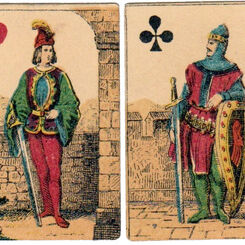
Miniature Theatre playing cards
Miniature playing cards, possibly for children, with a romantic theatrical theme. C.L. Wüst c.1890. ...
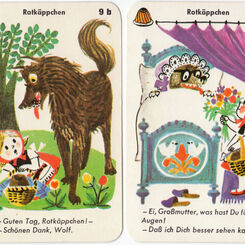
Märchen-Quartett
Fairy Tales quartet game by F.X. Schmid, Munich, 1960.
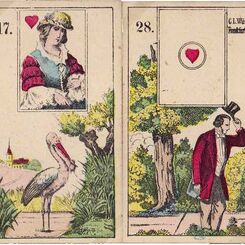
Wüst Lenormand deck, c.1860
Wüst Lenormand deck, c.1860
C.L. Wüst, 1811 - 1927
SPIELKARTENFABRIEK VON C.L. WÜST, 1811 - 1927. A short history of the Wüst factory by Martin Shaw & ...
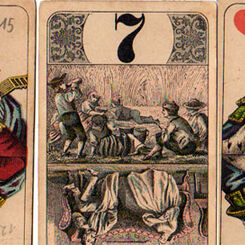
Wüst “Encyclopedic Tarot”
“Encyclopedic Tarot” by C. L. Wüst with “bourgeois” views of life on the Trumps.
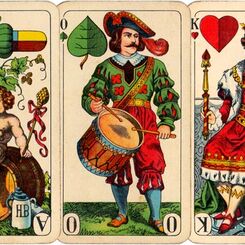
Later Bavarian Pattern
Later Bavarian single-ended pattern by Vereinigte Altenburg-Stralsunder Spielkarten-Fabriken
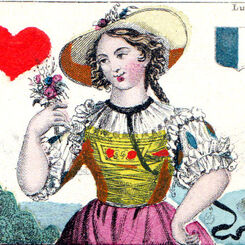
Swiss Costumes
Wüst's Swiss Cantons souvenir deck was published in Frankfurt in c.1875 for the emerging tourist mar...
10: Playing Cards in Germany
The playing card manufacturers of Germany from 1900 until 1939 provide a complicated set of relation...
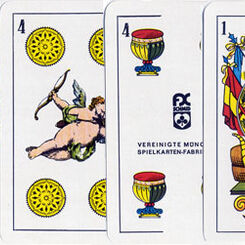
No.407 Naipe Español by F. X. Schmid
Naipe Español No.407 by F. X. Schmid, c.1980.
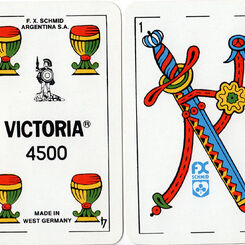
VICTORIA 4500 by F. X. Schmid (Argentina) S.A.
Naipe Español VICTORIA 4500 by F. X. Schmid (Argentina) S.A.
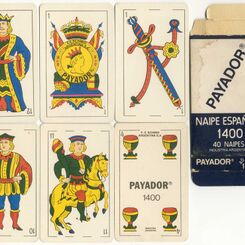
Naipe PAYADOR by F.X. Schmid (Argentina) S.A.
Naipe Español "PAYADOR ®"
Most Popular
Our top articles from the past 60 days


Stephen Scharber
03 April 2026, 16:54SavedSaved this article to Stephen Scharber's Collection
Glo Lexa
28 April 2026, 00:49SavedSaved this article to Suit systems