


Latvian Mythological Cards ~ Latju Mītoloģiskās Kārtis
A loving and well-researched celebration of Latvian mythology and culture based around the four seasons.
Baltic deities and symbols – Latvian culture is replete with geometrical signs representing gods, elements, and nature – thrive in this deck. The cards are arranged by the seasons: spades are fall, hearts are summer, clubs are winter, and diamonds are spring. Aces bear deities representing with the seasons together with appropriate symbols. These symbols are also found on the pip cards.
For example, the Ace of Spades features the Archangel Michael (Miķelis), who is celebrated on the autumn equinox, together with the symbol for Jumis, god of fertility and the harvest, represented by two crossed stalks of grain. That symbol is also present on each spade pip card. The kings and queens are Latvian mythology figures matching the themes of each season. For example, the King of Spades is Potrimps, another harvest deity, while the Queen of Spades is Laima, the goddess of blessing and happiness. Winter, on the other hand, is represented by Pīkols, the god of death, and Kārta, the goddess of survival. The jacks represent men doing seasonal tasks such as scything and threshing.


Latvian Mythological Cards (Latju Mītoloģiskās Kārtis) created by Vilnis Rasa for Jānis Mētra in either 1992 or 2013.
There are three evocative jokers. One is Staburadze, a Niobe-like figure who wept for the loss of her lover and turned into a cliff. The second is sumpurnis, a werewolf. The third is a sexualized figure of a spīgana, a witch figure in Baltic folklore. The backs feature geometric patterns.
Everything is explained on an accompanying extra card which is curiously handmade with what appears to be paper glued to either business cards or playing cards.
According to the World Web Playing Card Museum, this deck was created by Vilnis Rasa for Jānis Mētra in either 1992 or 2013 : Latvju Mitologiskas►

By Lev Golinkin
United States • Member since May 26, 2026
I'm a US-based author and journalist. I've been collecting playing cards since I was about 8 years old, when I got mesmerized by the various decks that were used in Soviet Ukraine, where I'm from. I collect mainly European decks such as those by Dondorf, Grimaud, and Piatnik. I love courts above all else, and am drawn toward historical and artistic decks.

Activity for Latvian Mythological Cards ~ Latju Mītoloģiskās Kārtis
Sign in to comment or save this article.

Related Articles
La Provence
A Piatnik pack drawing on Provençal heraldry and local legend.
Baraja Mexicana Calendárica
Scholarly Mexican playing cards with Aztec and Maya calendar motifs.
Allegories and Myths
Semi-transformation playing cards from artist Violeta Monreal.
Mythological Zoo
An extraordinary collection of fabulous beasts.
Calon Arang • Калон Аранг - Бали
Calon Arang, a figure from 12th-century Javanese and Balinese folklore known as a witch skilled in b...
Nipponia Playing Cards
Nipponia Playing Cards are a Japanese-themed playing cards featuring samurai, kunoichi and oiran. De...
Casais Portugueses
Matching game by Majora, Lisbon, c.1970, featuring figures in national dress from Portuguese provinc...
Naipes Criollos
“Naipes Criollos” Gaucho playing cards, 1995.
Naipes Cardón
Naipes Cardón designed by Mario Luis Rivero depicting traditional Argentine culture and identity, 20...
Folklore No.169
Austrian Folklore deck first published by Piatnik in 1934.
Divine Art
Divine Art Playing Cards by Sunish Chabba & Guru Playing Card Company, 2016.
Four Races
“Four Races” playing cards designed by Latvian artist Vilnis Rasa in 1989.
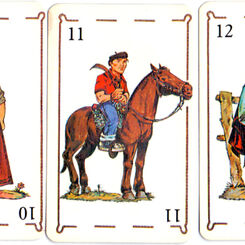
Gaucho Naipes
‘Gaucho’ Spanish-suited deck, anonymous manufacturer, made in Argentina, 2001.
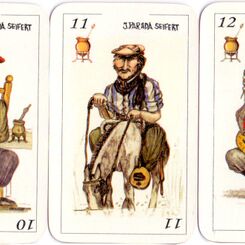
Naipe Criollo Caraí Pujol
‘Naipe Criollo Caraí Pujol’ with Gaucho designs by Julio F. Parada Seifert capturing the spirit of A...
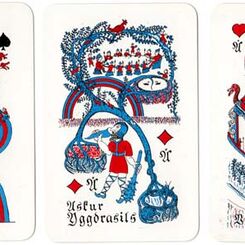
Iceland Mythological Playing Cards
Iceland Mythological Playing Cards designed by Sigurlinna Pétursson, 1958
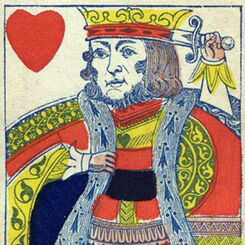
Suicide King
The King of Hearts, holding a sword behind his head, is sometimes nicknamed the “Suicide King”. He c...
Latvia Art
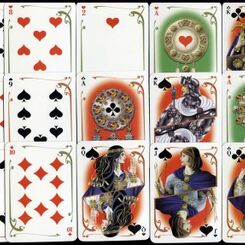
Playing cards designed by artist Larisa Kovalass-Kovalevska on the theme of the Latvian folk epic “L...
Mayan Cards
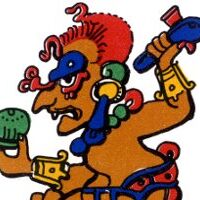
Mayan Playing Cards from Guatemala / Baraja Maya / containing illustrations of archaeology, art, fol...
Stefans Bercs
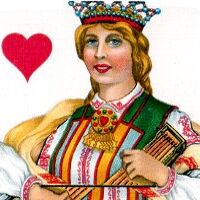
In 1923 a competition was announced for a new Latvian pack. The winner of this competition was Stefa...
Rihards Zarinš
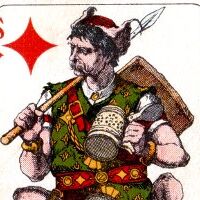
Playing cards designed by Rihards Zarinš, 1921. Latvian indices and with heraldic and hunting m...
Most Popular
Our top articles from the past 60 days


