


21: Belgian Makers: Brepols and Biermans
Brepols started making playing cards in 1826, although he had been in the printing trade since 1800. In 1833 the firm was called Brepols & Dierckx (the former's son-in-law). Biermans (1875-1970) was a relatively late arrival on the Turnhout playing card scene.
Brepols started making playing cards in 1826, although he had been in the printing trade since 1800. In 1833 the firm was called Brepols & Dierckx (the former's son-in-law). By 1858 it was called Brepols & Dierckx Zoon (BDZ), which lasted until 1911, when the simple designation became Brepols. The playing card division of the firm was sold to Carta Mundi in 1970, but it still survives today as a publishing house. Brepols is thus the only Turnhout maker to straddle the foundation of Belgium as a separate state in 1830. The firm produced a wide range of cards, but I don't know what the earliest cards were like. A version of the single-figure courts they produced, with purple added to the usual colours, is illustrated on page 18 of this blog.
For a list of my Brepols cards, click here►
They (along with Van Genechten) produced a set of double-ended courts which were designed to look like the contemporary continental court types of the period. Below are a few more courts of the kind illustrated on page 18. They were available with coloured or plain faces and with gold edges.

T2, c.1870
These seem to have disappeared fairly soon (perhaps they were not popular with card-players), but they were replaced by more conventional-looking courts, sometimes of their own design but often copies of others'. The design below was used by all the Turnhout makers except Biermans, with different plates in each case.

T3, c.1875
Other designs that were copied were those of De La Rue (D4) and Reynolds (R1), of which they also did a double-ended version. The execution is much cruder than the originals.

TD4, copy of De La Rue's D4 design, c.1875

TR1, copy of Reynolds' R1 design, c.1875
It's possible that such copies, along with similar ones by Van Genechten, which I shall illustrate on a later page, have given rise to the suggestion that a Turnhout maker produced the later Reynolds cards for the English firm. This seems highly unlikely. Reynolds' cards are very consistent and are produced from the same plates; the Turnhout ones are clearly copies using different plates. The double-ended version from Van Genechten is made from two single-ended heads and quite different from Reynolds' own redrawing (R2). I haven't seen a double-ended version by Brepols.
Yet another copied design is of the Lawrence & Cohen US8, which is very like the courts of Whitaker (which were possibly made in Belgium, anyway). In this case the JS has been turned and redrawn.


TUS8.2, copy of Lawrence & Cohen courts, c.1875
From around the same time there is also a copy of Dougherty's Triplicates with both square and round corners. Although the model is American, they are still called "Cartes anglaises".

TUS4.1, Triplicates, c.1878
It's difficult to know why so many versions of the English pattern were used concurrently; all the above courts are to be found in the same sample book from the 1870s.
Later, in the early 20th century, American designs were popular as models, as with the copy of New York Consolidated Card Co courts from c.1910.

Brepols used De La Rue's D9 design in the 1960s, long after it had ceased to be used in England (c.1927-30).

I have a very tatty sample book of Brepols's English cards, which was in such poor condition that the pages fell to pieces, as they were so brittle. (For some reason there are also three pages of Chinese Kwan Pai samples.) So, as my interest was in the court designs, I took many of the courts off what remained of the pages. However, the book gives a good sense of what was available from Brepols in the 1870s and there are reference numbers for most of the packs. These numbers relate to packs, but not necessarily to the court designs or the back designs. The price in francs is given, presumably for a dozen packs, which I indicate in brackets below. Most of the backs are overall patterns, such as Tartan, as in cheap packs, which are used on many of the different offerings. There are one or two up-market back designs, too. I list the numbered items below with the price and the design number I use; I illustrate some of them.
One version of TD3 is better printed and comes in two different colour schemes, one of which includes green and pale purple, as 731. It has no number in my sample book, but is identified as 730 in a book formerly in the possession of Paul Symons. Compare the JS's moustache with those below.
730 TD3

731 (4F) TD3

735 (3F) T3 736 (3F) T3
740 (4F) TD3 and 741 (3F) TD3: another set of plates, compare the KH and QS with 731. 742 is from the same plates with different colour distribution.

743 (3F) TD3
745 (3F) TD3: same plates as 740/741 with different colours; compare the JS with 731, note the different moustache.

746 (4F) and 747 (4F) TR1

There is another design marked 747, but this may be a misprint for 748, which is otherwise missing. (3F) T3

749 (3F/4F) T3

750 and 751 are both TD4.
754 (4F) T2 755 & 756 (3F) T2. These were also available with gold edges.

757 (3F) TUS8.2 758 (2F) TUS8.2
760 (3F) TUS6

These were also available with round gold corners.
Brepols also produced some better quality back designs, but relied heavily on English designs as their models. Top centre (1000) is a copy of one of Owen Jones's designs for De La Rue; the bottom left (1003) is a copy of one of Goodall's hunting designs from the 1850s; and the bottom centre (1002) is a copy of one of Reynolds' multi-colour designs.

Biermans (1875-1970) was a relatively late arrival on the Turnhout playing card scene. He produced his own version of TD3 as his single-ended court cards.
For a list of my Biermans cards, click here►

He also produced quite fancy designs for his courts. I give a selection below.

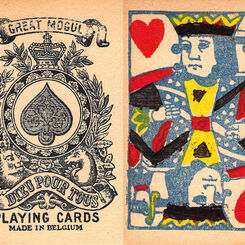
Great Moguls, c.1890
This design was copied in a very crudely made pack; whether by Biermans or another maker is difficult to determine, as the AS is anonymous.

He also produced a copy of NYCC courts.

TUSD5 copy of NYCC courts
He produced another fancy design with indices, c.1900 or a bit earlier.

c.1900
In the 1930s the firm produced cards for Venezuela with Belgo-Venezolane on the AS, which was based on one of their standard designs of Punch balancing the globe on his foot. Note that the KH is actually the figure of the KD with altered clothing.


Belgo-Venezolane, c.1935
Later packs by Biermans had copies of USPCC designs. The firm became part of Carta Mundi in 1970.
For examples of the non-standard cards made by Biermans, see elsewhere on the wopc site.

By Ken Lodge
United Kingdom • Member since May 14, 2012
I'm Ken Lodge and have been collecting playing cards since I was about eighteen months old (1945). I am also a trained academic, so I can observe and analyze reasonably well. I've applied these analytical techniques over a long period of time to the study of playing cards and have managed to assemble a large amount of information about them, especially those of the standard English pattern. About Ken Lodge →

Activity for 21: Belgian Makers: Brepols and Biermans
Sign in to comment or save this article.

Related Articles
Cartamundi
Cartamundi is a Belgian playing-card manufacturer formed in 1970 through the consolidation of severa...
Jeep Playing cards
Pack of cards celebrating Allied Victory in the Second World War.
Dutch costume playing cards from an unknown maker
Another pack of Dutch costume playing cards c.1880.
Dubois
Dubois card makers from Liège in the Walloon Region of Belgium.
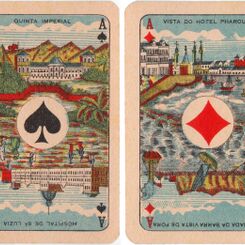
Brazil Pictorial Aces
Genoese pattern with Pictorial Aces for Brazil by Brepols, Turnhout, c.1920.
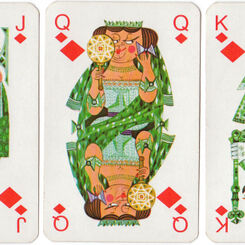
Belle Vue Gueuze
Promotional playing cards designed by Wim Simons, Belgium, 1960s.
Anonymous Spanish Suited pack, c.1760
Anonymous archaic Spanish suited pack, c.1760.
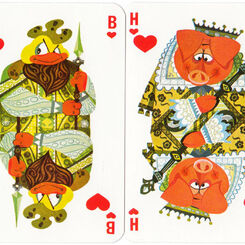
Boerenbond Veevoeders
Promotional deck designed by Ray Goossens for the Boerenbond farmers’ union, c.1968.
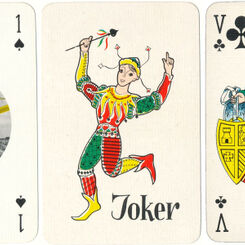
Biermans Genoese pattern
Biermans Genoese pattern for Clayson agricultural machinery, late 1960s.
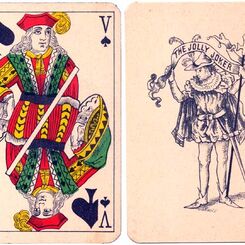
Brepols Genoese pattern
“Cartes Françaises” and Genoese pattern by Brepols.
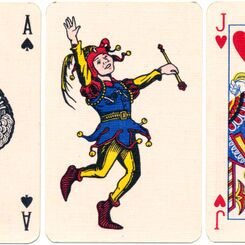
Abbey Playing Cards
Abbey Playing Cards made in Belgium by La Turnhoutoise, c.1950s.
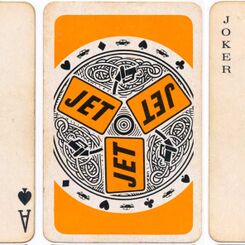
Lion Brand No.1492 : Jet Fuel
Advertising deck for "Jet" fuels, and "Lion Brand" No.1429 manufactured in Belgium by Biermans, 1960...
WW1 Commemorative
In 1919 Brepols commemorated the victories of World War I with two new packs featuring portraits of ...
18: Belgian Cards: An Introduction
The card-makers of Turnhout were prolific in their output and inveterate copiers.
Renée Sturbelle
Artistic playing cards with abstract designs by Renée Sturbelle, first published by Brepols S.A., Tu...

A Todos Alumbra
40-card “A Todos Alumbra - Naypes Refinos” pack manufactured by Léonard Biermans, Turnhout.
Biermans for the Estanco de Naipes del Peru
Standard Genoese pattern with French indices made by Biermans for Cigarrillo Holiday and the Estanco...
Portuguese Type Cards made in Belgium
Portuguese Type Playing Cards made in Belgium, c.1878.
Naypes Finos made in Belgium
Belgian manufacturers were competing against Spanish makers. Features of the traditional Spanish des...
Most Popular
Our top articles from the past 60 days


