


Advice and General Knowledge for Newer Collectors
A little general knowledge goes a long way for newer collectors, helping you choose a focus and understand what you are seeing. These notes place collecting interests within the broader history of playing cards.
If you are new to collecting playing cards, you are probably discovering new things all the time. Perhaps you just found out that your grandma’s oldest Bicycle cards look just the same as your brand new ones. They’ve been going a long time! Maybe you have seen some of Will Roya’s recent reproductions of the 200 year old Cotta Transformation cards? You might wonder if there are any original copies out there. In the last ‘Clear The Decks’ I discovered all about the special packs made for Casinos (Harry Wastrack’s article, page 5). One of the attractions of collecting cards is that you’ll keep making exciting discoveries because you’ll never know it all. It is a very big field.
My first piece of advice follows on from the sheer size of the subject. It is helpful to build up your general knowledge of the subject as a whole, even if this misses a lot out. I’ll be saying more about this shortly. This ‘big picture’ knowledge will help you understand your own collection and to give it a useful context.
It helps tremendously if you limit your range of collecting interests. If you are very specific about what to collect, you can focus your time and money much more effectively. In a practical way, choosing a very specific area will mean wasting less money on cards that you really aren’t so interested in. Being decisive about what you want to collect will mean that you can make the best use of the time you spend looking for new items and reading around the subject.
We will now put these together - building your knowledge, limiting your interests - and run through the kind of general knowledge that can help you to frame your collecting interests.
General knowledge: advice on general card-collecting interests as they relate to a timeline for playing cards
-
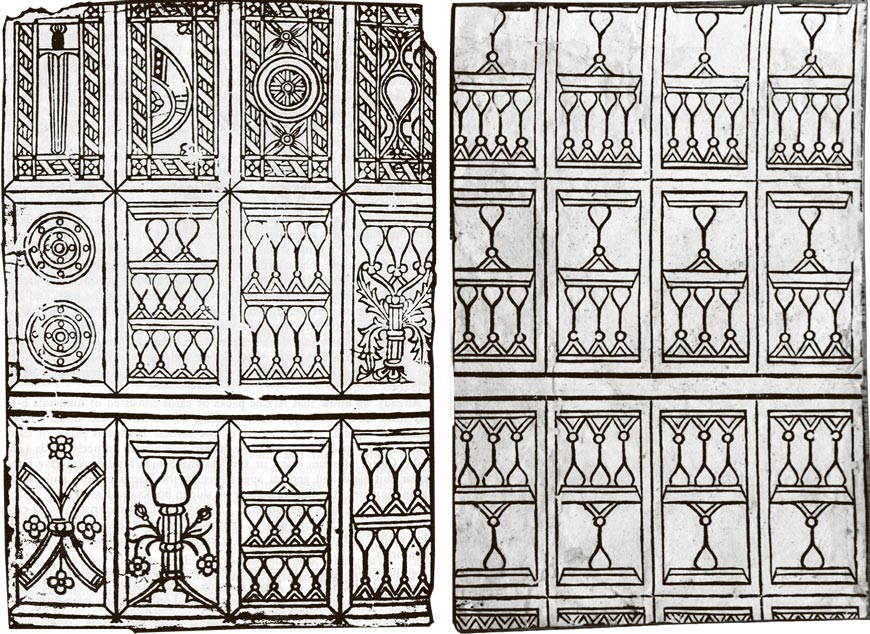
Above: Very early cards, before 1500, see Moorish playing cards.
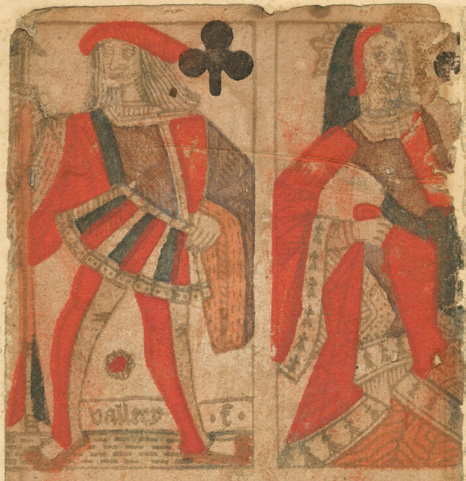
Above: c1516, cards of the Rouen type popular in England.
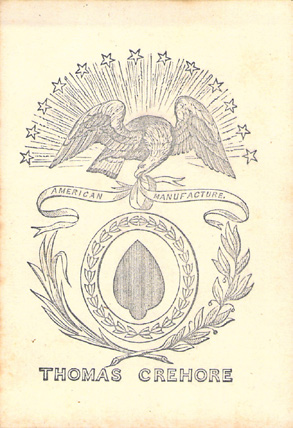
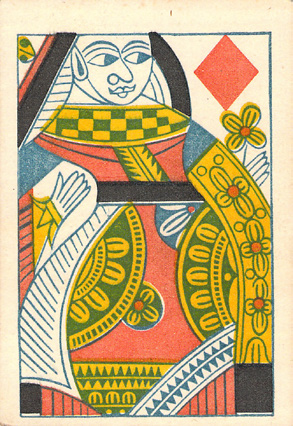
Above: early American cards by Crehore (c.1820–30).
1370s
The first cards are recorded in documents. They are in Europe and mainly around the rim of the Mediterranean Sea. If early history takes your fancy, it is an area that would benefit from more research - and this means proper research on the ground. You’d need to be like an archaeologist, digging in this case through ancient libraries and archives to try to find those elusive early records of cards and if you are very lucky, maybe some extemely early cards too.
The Moorish playing cards shown (right) were found by Simon Wintle in a Barcelona library in 1986.
-
1400s-1500s
Small numbers of cards survive from these centuries. There are some spectacular hand-painted Tarot cards and ‘hunting’ decks, and small numbers of the mass produced cards. A lot of the development has already taken place: there are different suits in Italy and Spain (cups, swords, coins, batons), in the Germanic region (leaves, hearts, bells, acorns) and in France (spades, hearts, diamonds and clubs). Tarot cards appear as early as this, too.
If this sounds exciting, again you could take to the most in-depth research. For pure fun, this would make for a glamorous (and expensive) travel concept - you could tour the world’s institutions: the Met in New York has ‘The Cloisters’ playing cards, the oldest-known complete set there is. These were probably made in the ‘Burgundian Netherlands’, modern-day Holland or Belgium, around 1475-80. You’d want to see the almost complete hunting deck in Stuttgart (1430) too. The Biblioteque Nationale in Paris has en extensive collection of playing cards and related treasures, and there are similar treasures in national museums and institutions worldwide. Note: the really special cards will not necessarily be on public display so check in advance and ask for permission to see what you want.
As a collector, you will sometimes come across cards from this era and it will mostly be single cards or fragments from a sheet. These will be very expensive (most likely in thousand of dollars for a single card).
-
1600s and 1700s
Cards are fully established in many areas (of Europe and in India and Asia), and it becomes a more realistic collecting ambition to find them. There will be more complete sets and more documentation about their makers.
-
1800s
By 1800 cards are made in the USA and between about 1840 and 1880 there is a worldwide revolution in the appearance of cards. Production moved out of the artisan workshops where cards have been made for almost 500 years. From the 1840s onwards, cards were produced in specialist factories.
The cards themselves were the subject of several lasting changes. Again from the 1840s, the backs were now printed as well as the fronts and soon took on an importance of their own (there was more money to be made, for example through advertising on the backs).
The fronts become double ended, making it much easier for players to handle the cards (and giving less away as they no longer had to rotate some cards to see what they are). Even more helpfully, the little indices in the corners were introduced - these help the players even more. These indices were a US innovation and so were the Jokers that also began to appear.
As a collecting area this period represents a gold mine. You could specialise in early American makers and in any of the areas mentioned - early card backs, early Jokers, early experiments with card indices and so on. You could also pick a manufacturer or handful of manufacturers - the NY Consolidated family of makers, for example in the USA, or De la Rue or Dondorf in Europe.
-
1900s (20th century)
All the changes had been made and the new cards very quickly became the norm. For the making of playing cards, the twentieth century was one of consolidation. Around 1900, the US would have had perhaps a hundred card makers, by the end of the century USPCC had a near-monopoly. The same thing happened in Europe, where Cartmundi became the one dominant producer.
The 20th century offers many collecting opportunities. There are so many advertising decks that you could focus your collection on one area (for examples ports, beers, airlines). Similarly there are promotions and commemorative packs for all sorts of events - the Olympic games, presidencies, the British Royal family, national events and anniversaries around the world. There are manufacturers and brands that came and went - you could aim to cover one of more of these, like The Congress Guy.
As for collecting advice, I believe that the 20th century cards offer the best value now too. Many of these fall into an awkward area where they are just plain old and used, but not yet old enough to be ‘antique’ and more obviously collectable. You will still find these in thrift shops and charity sales. As an investment, 20th century cards must be a good place to begin.
As for the 21st century, I’ve said it before, but I believe we’re seeing the emergence of a new artist- and designer-led era for playing cards, in other words aretreat from the factories and a return to artisanal values.
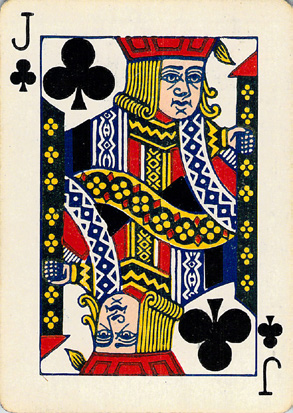
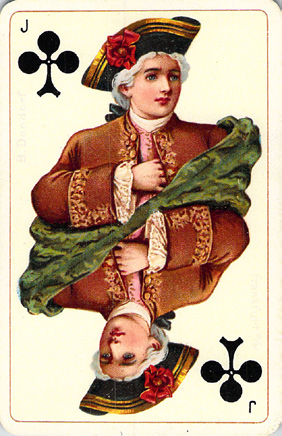
Card-collecting interests as they relate to card fronts and backs
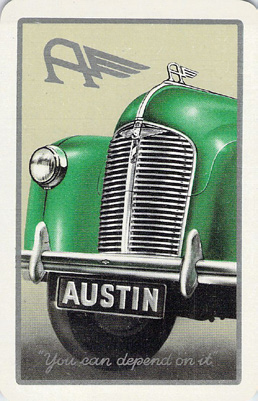
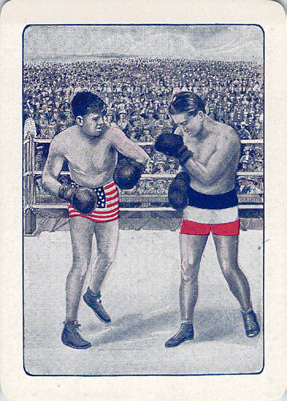
Above: Card backs: an Austin advertising card (c.1950), and a souvenir back commemorating the Dempsey–Carpentier boxing match (1921).
Cards are simple - they have fronts and they have backs. Yes, edges too and these can be gilded and made to look amazing (see luxury playing cards), but it’s the front and the back that get printed.
The fronts are the dominant feature in most decks and the reason that we have playing cards at all. The designation of suits and ranks (A, 2-10, J, Q, K) forms the structure for all our card games. We will see shortly that there are several types of front design that have become collecting interests in their own right.
As we noted, the backs of cards only became printed from the 1830s onwards, and became more fully exploited commercially in the 20th century. There are also several collecting communities that take their interest in the backs of cards.
Advice relating to specific card types
Our first few kinds of playing cards relate to what we find on the fronts. We will go into more detail about Standard cards, Portrait cards, Artistic cards, Illustrated cards, Pictorial cards and Transformation cards.
Standard cards are the backbone of our subject. These are the cards that originated in the 1370s, and they are cards that mattered most. For a long time cards were expensive to make and buy and assuming the buyers expected something in return, it’s likely that the main event was gambling. Standard cards have been behind vast changes in wealth and then the retribution that follows in violence and death.
It turns out that ‘standard’ cards are like dialects and languages - populations often have their own. (See national types and patterns.)
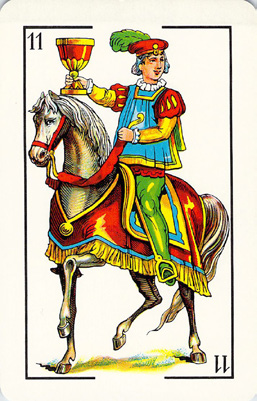
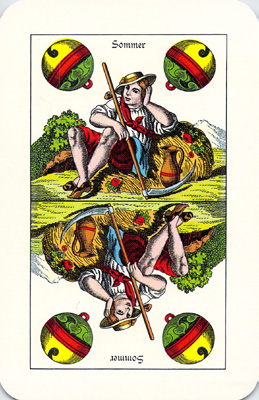
The specification of a locally standard pack will be determined by the most popular card game and its rules. Few games use a full 52 cards - in most of Europe, slightly smaller packs are the norm. In Spain and Italy, the standard packs have 48 cards or 40 cards, while in the north - Germany and surrounding area - 36 and 32 card decks are the norm. Meanwhile, in India, a Gangifa set will often have 96 or 120 cards. If you take an interest in cards from a different area, you are likely to discover a new world of variation and history.
Collecting cards from a different country certainly does not have to be costly because there will be brand new decks on sale and nearly-new decks to be found.
Portrait cards are those most like standard cards, but in these sets the kings, queens and jacks show more realistic human figures and these are often chosen to represent specific people - real kings and queens, or characters from Shakespeare or Star Wars or any others that the designer chooses.
Artistic cards, likewise, replace the standards but this card genre gives full licence to the designer and the cards can move a long way from the expectations of standard sets.
For collectors, portrait and artistic cards can be very satisfying areas. The ideas go back centuries, yet cards of this type are also one of the most popular with contemporary designers. This natural popularity means that the cards are often less scarce - which is good - but it may be common to find that other collectors have many similar sets in their collections and that because the cards are unlikely to be used in games, they will take a long time to become rare.
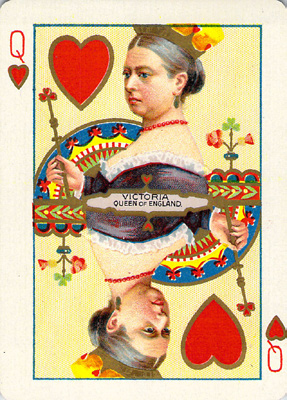
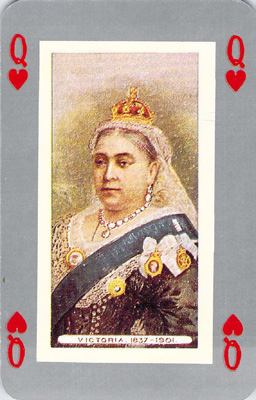
Above: Queen Victoria in a ‘Portrait’ style (left), NYCC Illuminated Royal 1896, looking like a playing card. The Artistic card (right) has taken a lot more licence (Wills tobacco, 200th Anniversary 1986).
Illustrated cards also have a long history. Please beware that the term is not always intended to be used with precision. I used ‘illustrated’ cards to refer to the fairly formal style in which a set of cards carries a themed set of pictures often with captions and often with a small inset standard card in one corner, so that the cards can in theory be used. Examples would be the history sets (the early stock market ‘bubble’ cards, the Spanish Armada and so on), early map cards, collections of coats of arms and so on. This can be a fascinating collecting interest with potential for real research into history, but these cards are expensive.
Pictorial cards covers a similar but less formal idea - the name is now self-explanatory and examples might be the early railroad decks and many souvenir styles. Again these decks can be a route into historical research interests or contemporary travel, and this time the cards can be more affordable. These are further from the mainstream and their ability to hold their value probably relies on their subject matter and its interest to future collectors.
Transformation cards also contain artistic images but these are specifically tailored around the standard cards. The pip signs in the numeral cards - the five club signs on a 5 of clubs, say - might be included in a scene as five arches in the interior of a church. The challenge to the artist is to build the suit signs into a scene as naturally as they can. Transformation cards began in 1805 and continue to be made now - our previous Clear The Decks cover featured new cards by the English artist Elaine Lewis.
As a collecting interest this is a popular area for good reason. The cards are more ‘mainstream’ than many artistic ideas, in the sense that the standard pattern is still present. It takes considerable skill and ingenuity to pull off a successful transformation design and a full set of cards is a real achievement. The results are often full of genuine artistry and a sense of humor is often evident too.
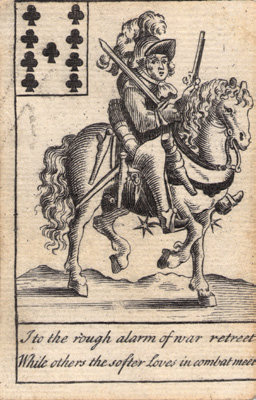
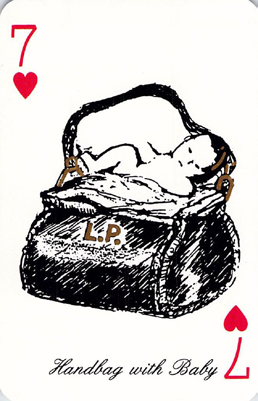
Above: Illustrated (Lenthall 1723 left) and pictorial (Oscar Wilde 1986 right)
There are many positives to collecting transformation cards, and for the future I would expect these to be good investments too, as it is a special area that is not likely to fade out. In auctions, the transformation cards seem to attract more interest than others and this popularity means that older sets and original cards from the 19th century will be expensive. For those who want to enjoy the cards, many sets have by now been produced as facsimiles - only last year Will Roya made a full set of the first ‘Cotta’ cards. Good reproduction sets - those with high quality card stock, probably matt with square corners where appropriate and with sharp colorful imaging - should be a pretty good investment, too.
Collecting cards for their backs
And so we turn the cards around! Typical themes begin with advertising and souvenirs/commemorative cards. However, “singles collectors” also specialise in particular artists who design backs and in particular card manufacturers. Indeed, when it comes to knowing the dates and ranges of a particular manufacturers output, the singles collectors have great expertise.
Advertising, commemorative and souvenir backs are more or less self-explanatory. There’s a terrific amount of scope here - advertising covers almost anything manufactured. There is an entire card society in the UK dedicated to ‘breweriana’, the advertising and promotion of the drinks industry.
Commemorative cards are generally for special events - the anniversary of a historic event, a royal event, a sporting event, the opening of a new building or facility and so on. The Souvenir cards may be made by places we go to visit - there are souvenirs for whole countries, US States, Cities, art galleries and museums and so on.
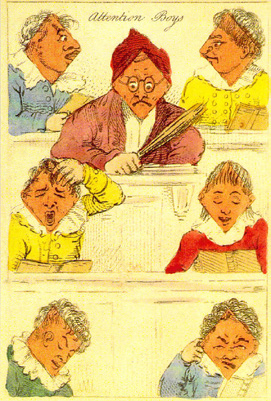

As a way of collecting cards this has the advantage that singles are easier on the budget, but against that, the scope of the area is huge and singles collectors may have tens of thousand of examples.
Concluding advice
I started out collecting packs I came across and then made a little more effort particularly on travels abroad. Like many, my early collection was a little bit of everything.
My definite advice is to start focusing your target cards as soon as you can. The same budget will be much more effective. Many collectors will start in one area and find themselves later becoming keener on something else. That works quite well. The collection can just grow that way and if funds are needed the older cards can be swapped with other collectors or of course sold.
It’s wise to buy cards you like and to enjoy those you have. This aspect of collecting is something in itself whether or not there are any financial gains.
For cards as an investment, that is a subject in itself (and one we may return to in a later article). My guess is that the returns will be borderline for long-term value, similar to antiques in general.
For now I would say that the key factors are genuine interest and quality. By genuine interest I mean that a set of cards is likely to appreciate in value if it has its own place in the world - perhaps it tells its own story. Among the contemporary cards, Alex Chin’s cards for Playing Card Collectors’ Day would be an example, or any of our Club Decks. It is surely not complete speculation to guess that a collector 100 years hence will find that a sufficient reason to favor these packs over those that don’t have such a story to tell. By quality, the simple advice is to favor complete sets - really complete with all the extra cards - and in the best possible condition. These may cost more now but they will always be the most desirable.
References
- Bostock, Paul; Clear the Decks, 52 Plus Joker (2022).

By Paul Bostock
United Kingdom • Member since May 07, 2024
Paul has been a collector of playing cards since his early teenage years, the mid 1970s. In the last 20 years or so he has specialised in standard English cards and their story. His collection, including many other English Standards, are featured on his website plainbacks.com. Paul is currently editor of Clear the Decks, the Journal of 52 Plus Joker, the American club for playing card collectors, and is a member of the IPCS Council, an EPCS member and a Past Master of the Worshipful Company of Makers of Playing cards, a City of London livery company.

Activity for Advice and General Knowledge for Newer Collectors
Sign in to comment or save this article.

Related Articles
History of Tarot and Playing Cards: Timeline & Origins
An alternative history of tarot and playing cards – from Mamluk Egypt to the invention of tarot in R...
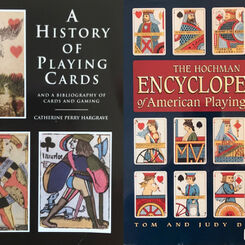
Playing Card Books - References
A guide to reference books for playing-card collectors, focusing on museum catalogues, collection su...
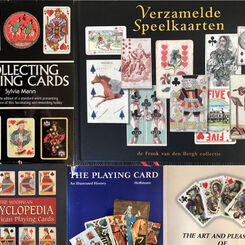
Playing Card Books - Introductions to Collecting
A guide to introductory books for playing-card collectors, with reviews of Sylvia Mann, Rod Starling...
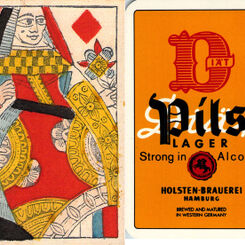
Introduction to Collecting Themes
Playing cards can be broadly categorised into standard and non-standard designs, with collectors app...
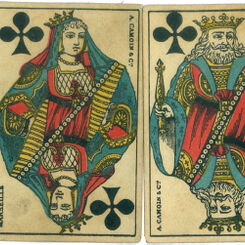
A. Camoin & Cie
This deck was inherited from ancestors, it has has a family history surrounding it. Details of the l...
Collecting Playing Cards with Jan Walls
I collected playing cards when I was in primary school, by Jan Walls.
Is Card Collecting an Investment?
“Is Card Collecting an Investment?” - an article by Rod Starling.
Master of the Playing Cards
Animal suited playing cards engraved by the Master of the Playing Cards, Germany, c.1455
56: Number cards and Chinese Crackers
A brief look at the number cards used in standard English packs.
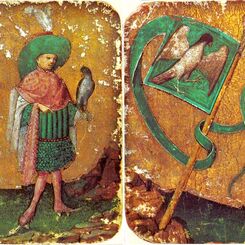
Stuttgart pack, c.1430
The luxury, hand-painted Stuttgart Cards (Stuttgarter Kartenspiel) dated c.1430, with suits of ducks...

Collecting Playing Cards
How I began Collecting Playing Cards by Robert S. Lancaster.
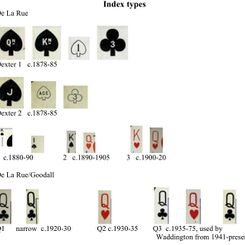
41: A Guide to Dating Playing Cards
Dating is a particularly tricky but very interesting problem to tackle and there are many pitfalls. ...
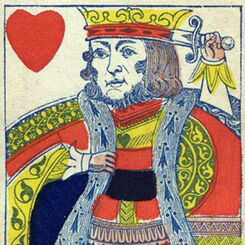
Suicide King
The King of Hearts, holding a sword behind his head, is sometimes nicknamed the “Suicide King”. He c...
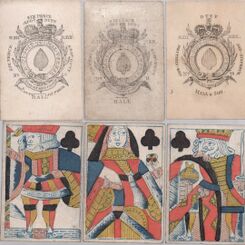
26: Playing Cards: Rarity, Value, Dating, Sellers and eBay
Notions like rarity and monetary value are slippery customers and need careful handling. And there a...
11: Some Cards from Sylvia Mann’s Collection
A fascinating collection that was the basis of a lot of research that we still benefit rom today.
1: Playing Cards and their History: An Introduction and some links to other sites
What was considered the first mention of playing cards in England is in 1463 when Edward I banned th...
Paris Pattern
The Paris pattern was established as such around the middle of the seventeenth century (based, perha...
Mamluk Playing Cards
Nã'ib, the game of lieutenants... these cards are amongst the earliest Arabic playing cards ext...
Italian Playing Cards
The first reliable evidence that playing cards were being used in Italy is from 1376, when a game ca...
The History of Playing Cards
Playing cards appear in European records in the late 14th century, but their earlier history lies fu...
Most Popular
Our top articles from the past 60 days


