


Paper and Cardboard
The manufacture of the pasteboard used for playing cards contains a number of interesting processes including mingling, pasting and drying.
How Paper is Made
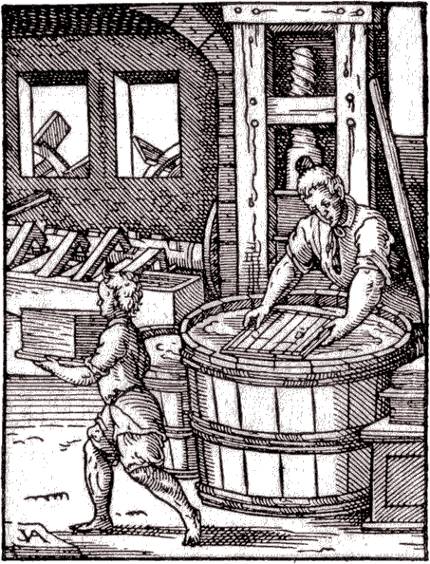
The paper to make into pasteboard or cardboard is manufactured as shown below. This was not normally carried out by the cardmakers themselves, but by a paper mill. The earliest forms comprised rectangular pieces of cloth on wooden frames, onto which the pulp was ladled. Later, bamboo strips bound with horse hair or silk replaced the cloth. Forms made with copper threads were an Arab invention. The illustration below shows the pulping hammers mashing old rags, and pulp being laid onto the sieves or forms to make paper, which is then pressed and hung up to dry.
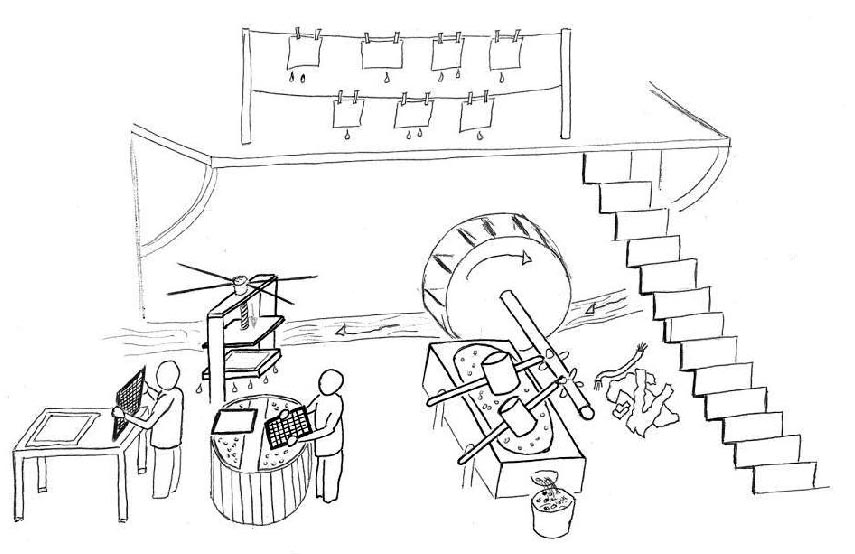
Above: paper making. Source: Malmundarium, 4960 Malmedy, Belgium.
Watermarks
In Europe the custom of printing a design into the paper dates back to the 13th century. Watermarks identify the owners of paper-mills or the source of the paper. The watermark is created with fine threads or wires welded onto the sieve so that thinner layers of fibres are deposited on the motif area, which becomes more transparent once the paper has dried.
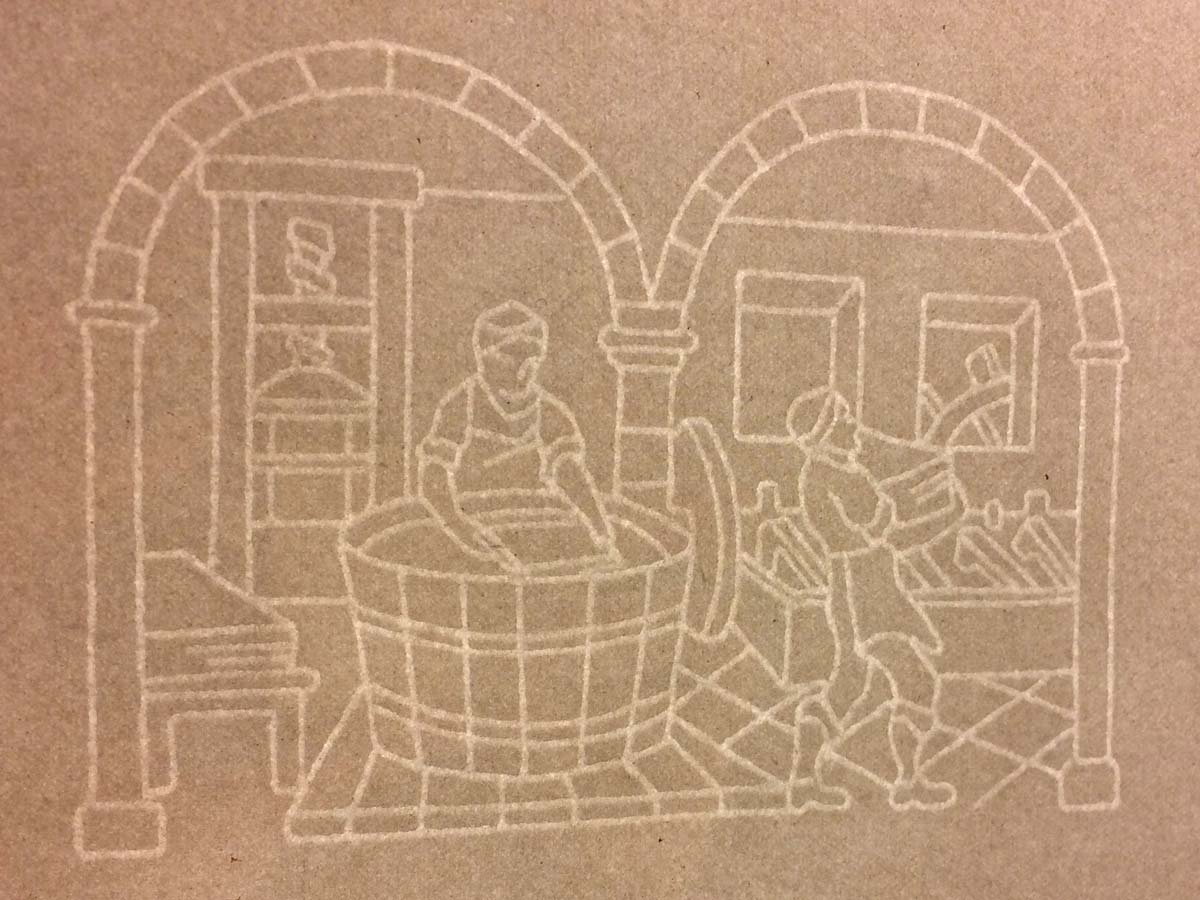
Above: watermark. Source: Malmundarium, 4960 Malmedy, Belgium. Notice that the design of the watermark is based on the woodcut illustration by Jost Amman from The Book of Trades, 1568, shown further below.
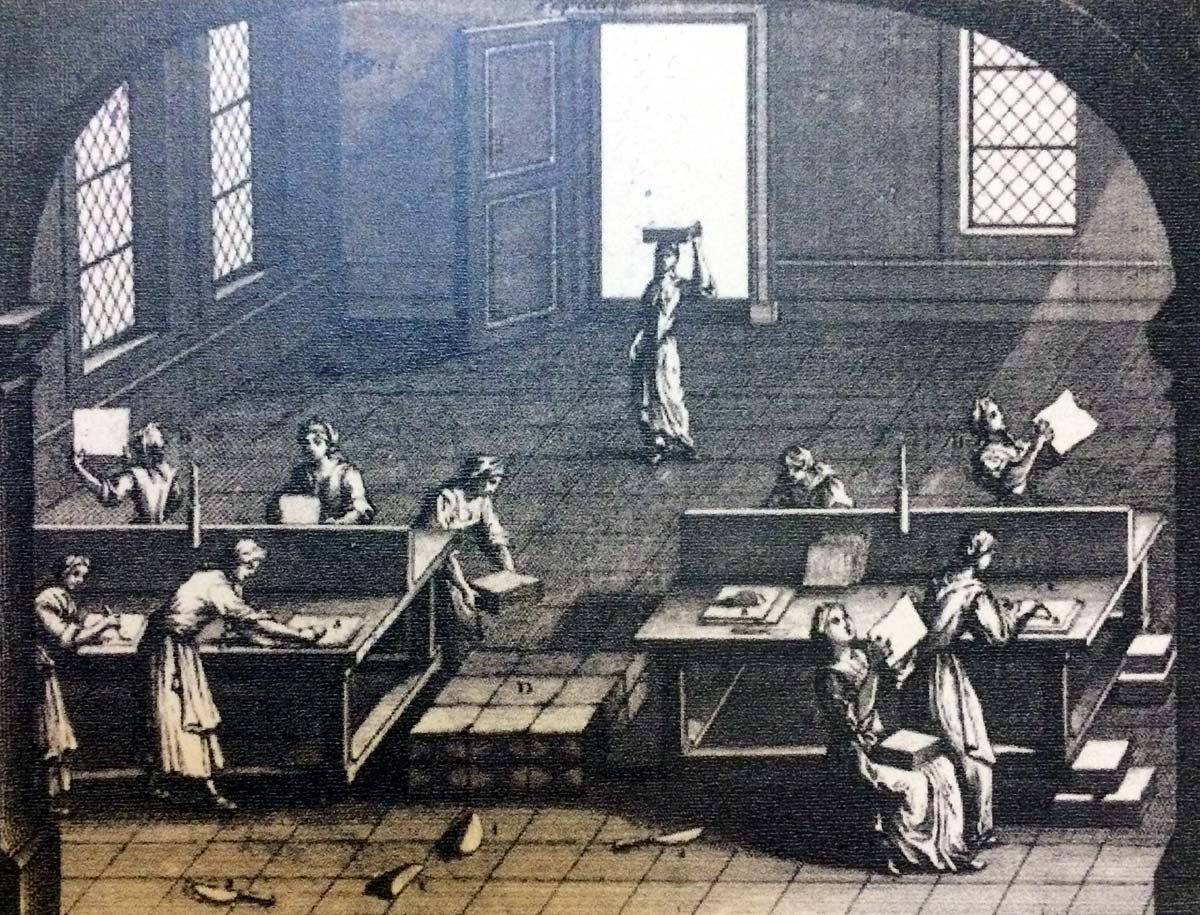
Above: women trimming, examinig and sorting the finished paper.
Further information here►
Playing cards were formerly made from several sheets of paper, of varying qualities, glued together. The face of the cards, which will receive the printed outlines and colouring, was usually printed on fine quality paper. The backs require a smooth, unblemished paper which will have no marks which might identify the value of the face card, otherwise the pack is not suitable for play. In between these front and back papers a third layer of opaque grey or brown paper was inserted, so that the cards obtain the required degree of firmness and strength for sustained use.
In addition, cardmakers required paper to print the wrappers►
How Card is Made
“The manufacture of the cardboard used for playing cards contains a number of interesting processes which we will describe in the order
in which we recently witnessed them at the house of Messrs. Sabine, Poppin's Court, Fleet Street.”
[Source: Tomlinson’s Cyclopedia of Useful Arts, 1854]
Cardboard consists of a number of thicknesses of paper pasted together, pressed and polished on two surfaces. Ordinary cardboard consists of two sheets of white paper with a sheet of cartridge paper between them, and the thickness of the board is determined by the stoutness of the paper. For stout cards two or more sheets of cartridge paper are interposed. Modern playing-card board is usually laminated with a black adhesive and comes in a range of weights and with matt, glazed or embossed finishes including ‘linen grain’ or ‘air cushion’ finish. The following notes describe the manufacture of cardboard in the nineteenth century.
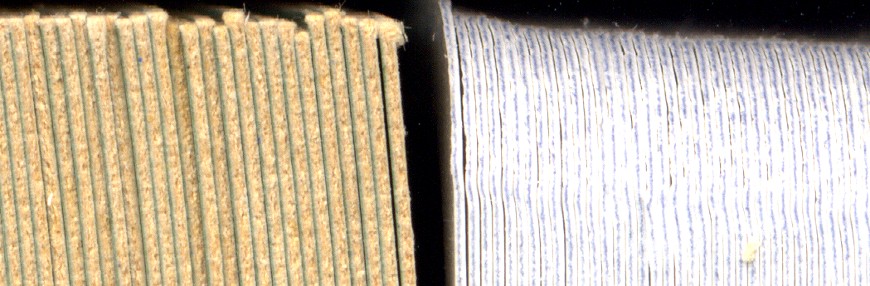
Above: close-up view of the edges of two packs of playing cards. The left-hand cards are manufactured around 1880, the right-hand cards are from c.1990. In both cases the 3-ply composition of the cardboard is discernible, with a thick, opaque layer inside two surface papers. This prevents the cards from being transparent and also gives the necessary strength and firmness to be used for play.
Consider the manufacture of three-sheet card. The arranging of the paper for this is called mingling. That is, a ream of white demy paper is spread open, and between every two sheets one sheet of cartridge paper is placed; and the pile when complete is called a head, consisting, of course, of a ream and a half of paper.
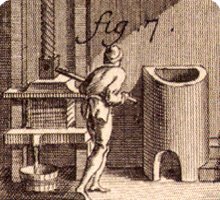
Above: the freshly pasted card is pressed. The press itself was probably inspired by wine presses in the late 14th century. See also: History of Playing Cards.
The next process is pasting. A man stands at a bench with a mahogany slab before him, the head of paper on his left hand and a large tub of paste on his right. Pulling the first sheet from the head upon the mahogany slab with his left hand, the paster with his large brush saturated with thin smooth paste covers it with a layer by two or three skilful movements of the arm and hand. He then pulls down upon this pasted surface a sheet of cartridge paper, the top surface of which is in like manner pasted. He next pulls down upon the pasted cartridge surface two sheets of white paper, and covers the upper surface only with paste. One sheet of cartridge paper is pulled down upon this and pasted; then two sheets of white paper, and so on until the whole head has been pasted. Now it is obvious that by pulling down two sheets of white paper with no paste between them the boundary between two sheets of cardboard is made.
One man will paste 4 heads of paper, or 7 gross of cardboards in one day. This will consume about 14 lbs or 16 lbs of flour, reckoning 1 lb of flour equal to one gallon of paste. In some cases it helps to dampen the paper beforehand.
When the head has been pasted, it is put into an upright press, and condensed by the action of a well-oiled iron screw and a long lever worked by two men. The water of the paste oozes out at the edges of the head, and falling into a channel in the lower bed of the press, escapes through a hole into a bucket, which becomes entirely filled with clear water from the produce of one man's work in the course of one day.
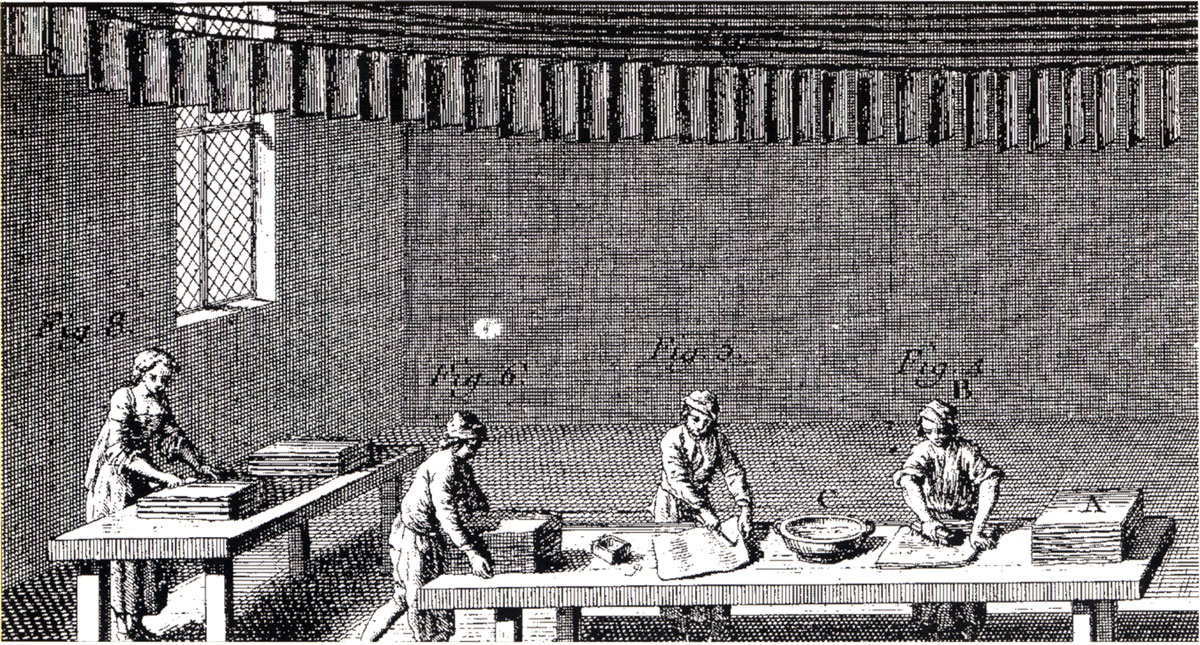
Above: interior view of playing card workshop drying area. The freshly pasted sheets of cardboard are prepared for hanging up to dry on wires. After a certain time the sheets of cardboard were removed from the press, brushed to remove any dirt and then pierced with a spike so that they could be hung up on wires in the drying rooms. These areas were well ventilated rooms at the top of the building. The dried cardboard was then stored. Illustration from L'Encyclopedie by Diderot, d'Alembert, Paris, 1751.
The next process is drying. Every evening before the men leave off work, each man takes out of the press the heads which he has pasted during the day and hangs the cardboard pieces on lines to dry. This involves piercing the corner of each sheet and passing a 1½" length of thin copper wire through the hole which then serves to hook the piece to the drying lines. The room is artificially heated, and in the course of twenty-four hours, that is, on the next evening when the lines are wanted for the next day's work, the boards are sufficiently dry. Then they are separately brushed with a hair brush to remove any dust &c.
Right: “Paper Production”, a woodcut illustration by Jost Amman from The Book of Trades (Das Ständebuch), 1568. The manufacture of paper in Europe began in Spain during the 11th century but it had been used at least as early as the eighth century by the Chinese and Arabs. Spain, therefore, was the channel by which paper spread into Europe several centuries before it began to be used for the manufacture of playing cards. The art of printing gave a great boost to the paper making industries and brought about a scarcity of old rags, until the technology for making wood pulp was improved.
The boards are now rough on the surface, warped and uneven. They are made smooth and even by passing them between a couple of powerful iron rollers in contact with thin sheets of smooth copper plate. The rough uneven cardboard is converted into a perfectly even board with a beautifully polished glazed surface. Several boys are employed taking out sheets of cardboard and arranging them into heaps.
The cards are now ready to be formed into playing cards... as a final cautionary remark, researchers have found that toxic chemicals from recycled newspapers had contaminated food sold in many cardboard cartons. The chemicals, known as mineral oils, come from printing inks!
Ready-made cardboard did not exist in the past. To give playing cards strength, the card maker glued two or three sheets of paper together. In the photograph below, a young man can be seen operating the press at the left-hand side, while at the right-hand end we see a pile of finished sheets of pasteboard.
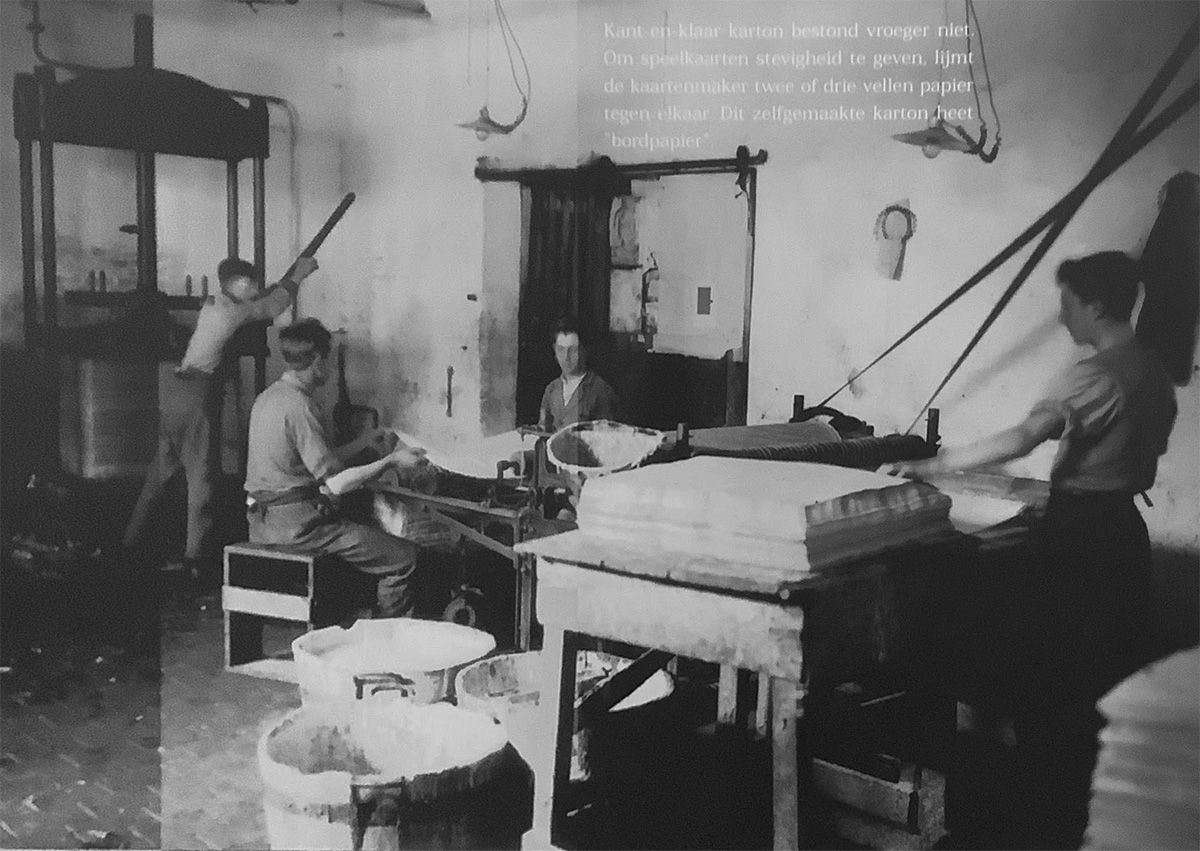
Above: courtesy Turnhout Playing Card Museum (Belgium).

See also: Amos Whitney's Factory Inventory Chromolithography Design of Playing Cards Make your own Playing Cards Letterpress Printing Rotxotxo Workshop Inventories, Barcelona

By Simon Wintle
Spain • Member since February 01, 1996
I am the founder of The World of Playing Cards (est. 1996), a website dedicated to the history, artistry and cultural significance of playing cards and tarot. Over the years I have researched various areas of the subject, acquired and traded collections and contributed as a committee member of the IPCS and graphics editor of The Playing-Card journal. Having lived in Chile, England, Wales, and now Spain, these experiences have shaped my work and passion for playing cards. Amongst my achievements is producing a limited-edition replica of a 17th-century English pack using woodblocks and stencils—a labour of love. Today, the World of Playing Cards is a global collaborative project, with my son Adam serving as the technical driving force behind its development. His innovative efforts have helped shape the site into the thriving hub it is today. You are warmly invited to become a contributor and share your enthusiasm.

Activity for Paper and Cardboard
Sign in to comment or save this article.

Related Articles
Learning to play Cribbage
I learned to pay cribbage when I was very young, aged around six or seven.
Hispania Romana
Educational card game depicting the Roman period in Spanish history.
Safety playing cards
Safety playing cards designed to reinforce the “Think and Be Safe” concept.
Carte Osteologiche
Skulls and bones of all descriptions have become the suits and pips in this 40-card pack from Italy....
Postgeschichte
A celebration of different postal systems in Germany from 1630 to 1850, with designs by Volker Hartm...
Ethics Education playing cards
Ethics Education playing cards produced by the Centre for Military Ethics at King’s College London, ...
Radical playing cards
Radical playing cards, identifying radical characters from history, United Kingdom, 2021
Geschichte des Buchgewerbes
Geschichte des Buchgewerbes illustrated by Ludwig Winkler, published by Verlag für Lehrmittel Pößnec...
Aesop’s Fables
Aesop’s Fables playing cards by I. Kirk, c.1759.
Pantheon or Heathen Mythology
Pantheon or Heathen Mythology cards for instruction of youth, c.1770.
Nap
Nap card games published by Multum in Parvo Ltd, London, c.1900
Bio-Pack
Bio-Pack flashcards produced for Thai biology students

University of Essex
Playing Cards produced for the University of Essex during 2005-2007.
Lingo Pix
Lingo Pix Tourist Picture Cards by TM Cards, India, 2006
Lingo Phrasebook Playing Cards by Diana Stanciulescu
Lingo is an interactive phrasebook providing you new way of learning new language through playing ca...
Snapshots
Snapshots, a Missionary Card Game depicting people from different cultural contexts engaged in their...
Uta Garuta
These cards are basically a poetry anthology (the Hyakunin Isshu, or 百人一首), transposed onto cards.
Printing of Playing Cards: Stencilling
Printing of Playing Cards :: Stencilling can usually be detected by observing the outlines of the co...

Most Popular
Our top articles from the past 60 days


