


Amos Whitney Inventory
Amos Whitney Factory Inventory. What it was like inside an 18th century playing card factory...
Amos Whitney Factory Inventory
What did an 18th Century Playing Card Factory look like?
Amos Whitney (1766-1804) was a playing card manufacturer from Boston, USA. An advertisement dated October 1799 offered Superfine Columbian, Harry the Eighth and Merry Andrew Playing Cards for sale. The following list of the items sold at auction following the death of Amos Whitney give us an insight into the equipment which was used inside a playing card manufacturing workshop:
2 sets new Court Blocks; and 8 do partly worn, for English or American Cards; 1 set do for Spanish Cards; 1 set do for French Cards; 1 shew card block; 2 sets Types for printing backs of French or Spanish cards; 1 set Court Blocks in brass, for English; 1 Block and 2 Copperplates for Aces; 10 Blocks for do of various descriptions in metal; 2 Blocks for Counters; 15 sets new Court Card stencils, 8 of which from new blocks; a number sets do in good condition; 1 set do for Shew Cards; 8 sets do for pips or spots, new; 6 sets do for Spanish Cards; 2 sets do for French Cards; 7 pasting brushes; about 4 doz Painting do part of them new; 11 Loting do; 4 Glazing machines and Marbles complete; about 4 doz Flints for polishing, chiefly new; 1 Printing Press; one hand do for wrappers; 8 Cutting Machines large and small; about 1200 Poles for hanging paper; about 1500 Hooks for do; about 4700 printed Covers or Wrappers for Cards of different descriptions; and 10 dozen Press boards of maple and pine. Also listed were: a Copper, containing 55 gallons; 3 large iron bound screw presses; 4 Stoves and Funnels; 1 large and 2 small Scale Beams, scales and weights; a quantity of Vermillion; Red Lead; French Berries; Lamp Black, etc.
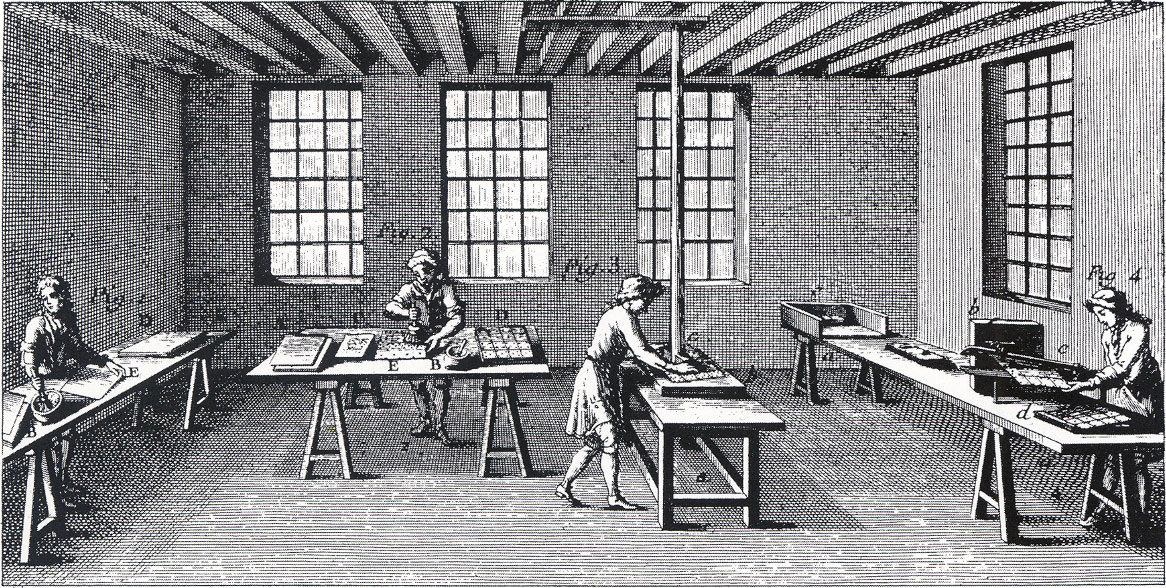
Above: interior view of playing card workshop where colouring, polishing and cutting operations are taking place. The polishing was done using a marble slab and flint stones fixed to the apparatus hanging from the ceiling. The person at the right is using some industrial scissors to cut out the finished playing cards. Illustration from L'Encyclopedie by Diderot, d'Alembert, Paris, 1751.
From the above list of equipment we learn that several types of blocks were used for printing English or American, Spanish and French-type cards, and that some blocks were made of brass. The others may have been woodblocks. There were pasting brushes and painting brushes. Also, cutting machines were used, probably similar to the big scissors apparatus which can be seen in the illustration. From the above it is possible to reconstruct the processes that went into the making of cards of that time, including the pigments for the colours. It is also interesting to compare this with the earlier descriptions of the Rotxotxo Workshop Inventories, Barcelona and Thomas de la Rue's “Innovations in Playing Card Printing” →
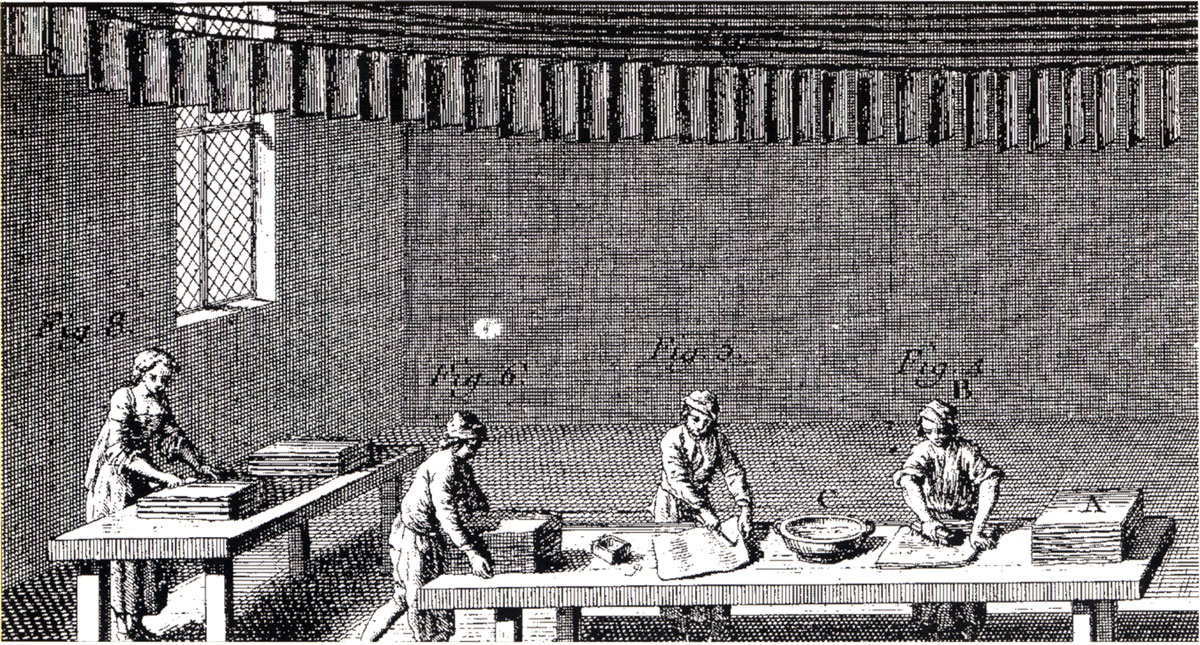
Above: interior view of playing card workshop drying area. The freshly pasted sheets of cardboard are prepared for hanging up to dry on wires. After a certain time the sheets of cardboard were removed from the press, brushed to remove any dirt and then pierced with a spike so that they could be hung up on wires in the drying rooms. These areas were well ventilated rooms at the top of the building. The dried cardboard was then stored. Illustration from L'Encyclopedie by Diderot, d'Alembert, Paris, 1751.
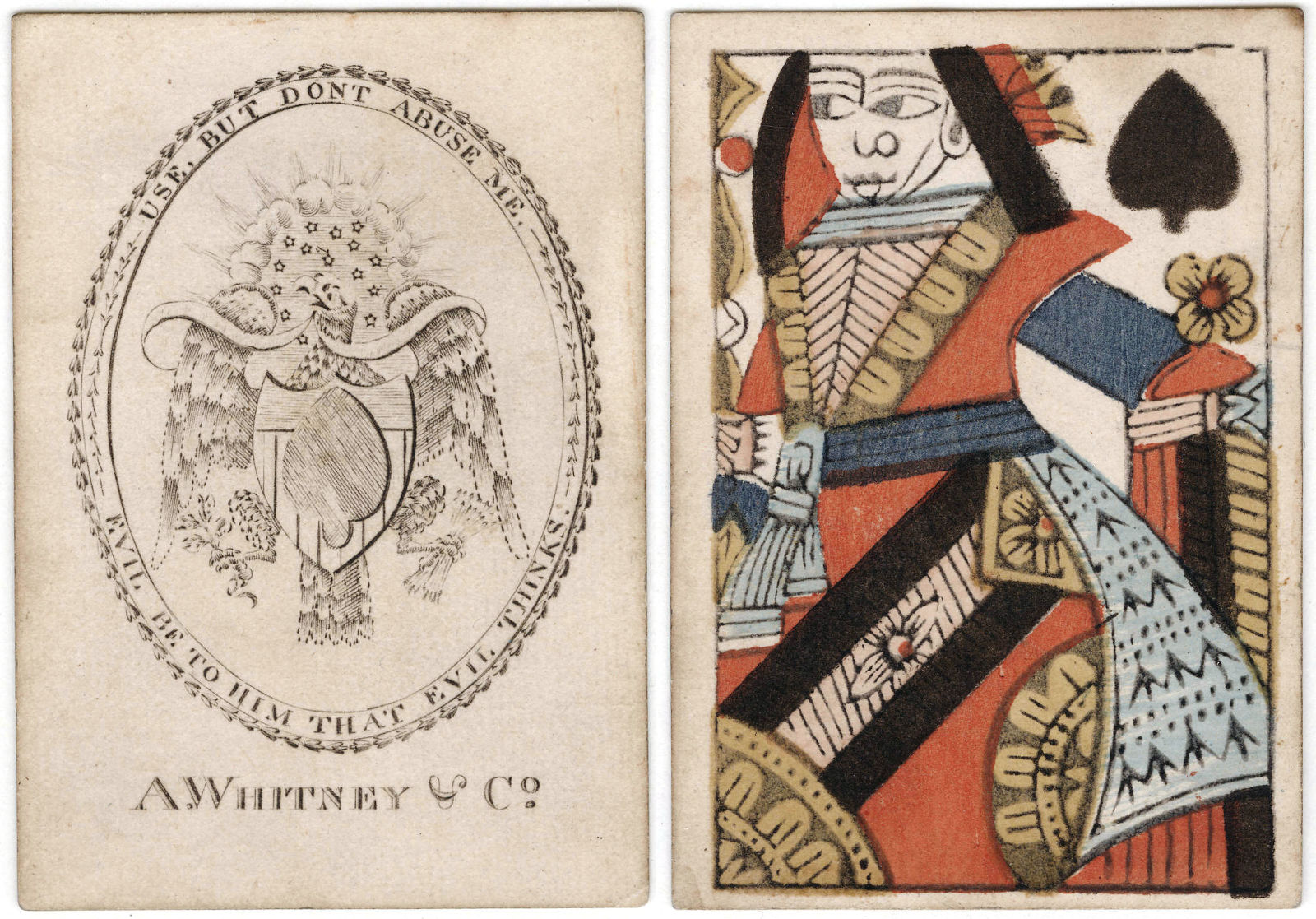
Until the latter end of the 18th century playing card backs were left plain white. The problem with this was that card backs became easily marked during play, and would thereby become recognisable by an opponent. It was expensive to buy another new pack, so spoilt cards would be returned to the workshop for cleaning. Some playing card manufacturers began to print repeating geometric patterns of stars or dots on the reverse of the cards to minimise this problem, and we can see that Amos Whitney used types for printing the backs of cards. Marbled or mottled backs were also produced. During the 19th century more elaborate designs appeared, and ultimately... advertising.

By Simon Wintle
Spain • Member since February 01, 1996
I am the founder of The World of Playing Cards (est. 1996), a website dedicated to the history, artistry and cultural significance of playing cards and tarot. Over the years I have researched various areas of the subject, acquired and traded collections and contributed as a committee member of the IPCS and graphics editor of The Playing-Card journal. Having lived in Chile, England, Wales, and now Spain, these experiences have shaped my work and passion for playing cards. Amongst my achievements is producing a limited-edition replica of a 17th-century English pack using woodblocks and stencils—a labour of love. Today, the World of Playing Cards is a global collaborative project, with my son Adam serving as the technical driving force behind its development. His innovative efforts have helped shape the site into the thriving hub it is today. You are warmly invited to become a contributor and share your enthusiasm.

Activity for Amos Whitney Inventory
Sign in to comment or save this article.

Related Articles
Geschichte des Buchgewerbes
Geschichte des Buchgewerbes illustrated by Ludwig Winkler, published by Verlag für Lehrmittel Pößnec...
Lilian Cailleaud’s Tarot Project
Lilian Caillaeud lino-cuts his version of the tarot by Nicolas Rolichon of Lyon c.1600
41: A Guide to Dating Playing Cards
Dating is a particularly tricky but very interesting problem to tackle and there are many pitfalls. ...
33: Functional Changes to Playing Cards
The emphasis throughout my collecting has been on the design of the courts cards, and it should be p...
![28: How to Analyze and Differentiate Playing Card Plates (De La Rue, Waddington and the Berlin pattern [Französisches Bild])](/core/cache-wopc-thumbs/var/www/wopc/production/www/images/contributors/kenlodge/4889-analyzing-playing-card-plates/JS_D1-D2-D3.b26b0503.jpg "28: How to Analyze and Differentiate Playing Card Plates (De La Rue, Waddington and the Berlin pattern [Französisches Bild])")
28: How to Analyze and Differentiate Playing Card Plates (De La Rue, Waddington and the Berlin pattern [Französisches Bild])
My interest in postage stamp variants led me to apply the same principles to playing cards.
Ivorette
Dougherty was at the forefront of innovation, adding Best Bowers and then Jokers, rounded corners an...
14: Back Designs
A few examples of the many interesting back designs.
Rotxotxo Workshop Inventories
Rotxotxo Workshop Inventories, Barcelona, 1660-1800.
Manufacture of Playing Cards
Traditionally cardmakers worked in guilds with long apprenticeships under master craftsmen.
Chromolithography
Colour lithography was invented in 1798 by a Bavarian actor and playwright named Alois Senefelder (1...
Printing of Playing Cards: Stencilling
Printing of Playing Cards :: Stencilling can usually be detected by observing the outlines of the co...
Paper and Cardboard
The manufacture of the pasteboard used for playing cards contains a number of interesting processes ...
Printing of Playing Cards: Letterpress
Some notes on the manufacture of playing cards taken from Thomas De la Rue's patent, 1831.
Pneumatic Playing Cards
The surface of the cards was slightly grooved by being rolled on prepared plates, so that there were...
Regarding the designs of playing cards
The quality of playing card designs often deteriorates with time…

Most Popular
Our top articles from the past 60 days


