


Chromolithography
Colour lithography was invented in 1798 by a Bavarian actor and playwright named Alois Senefelder (1771-1834). It is based on the principle that oil and water do not mix.
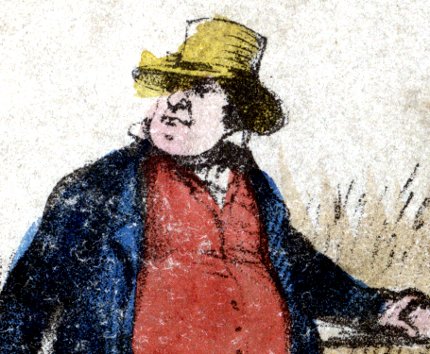
Right: mid-nineteenth century children's playing card in which the black outline drawing has been printed by lithography and the coloured areas applied by hand with a paint brush, c.1850 see more →
Printing of Playing Cards :: Chromolithography
It is based on the principle that oil and water do not mix. The process involves the artist drawing the design directly onto a highly polished lithographic stone (carboniferous limestone) using a greasy, acid resistant pigment. When the stone is then placed in a weak acid the uncoloured areas are etched by the acid, leaving the painted areas intact and ready to be used as a printing surface. For multi-colour printing, several stones would be prepared, one for each colour. Gradations of colour were achieved by applying hundreds of tiny dots of each colour on their respective stones, so that when each stone was printed onto the paper the resultant area would be printed with multiple dots of different colours which to the human eye would appear realistic. But if a magnifying glass is used to examine the printed areas, the presence of irregular, multicoloured dots will indicate that the card was printed by the chromolithographic method. Furhermore there will be no “ink squeeze” as with letterpress printing.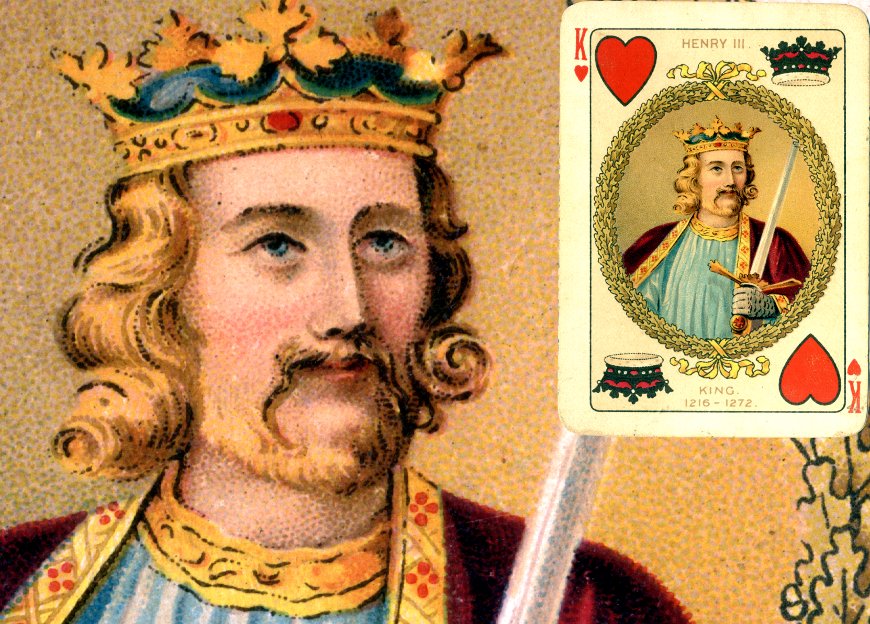
Above: 'Historic' playing card printed by chromolithography, Goodall & Son, London, c.1897, showing the irregular, multicoloured dots which indicate that the card was printed by the chromolithographic method see more →
This process, known as chromolithography, was one of the more popular methods of printing playing cards during the 19th century and at its height produced very high quality colour prints. It continued to be used until the late 1930s to produce inexpensive, “cheap and cheerful” colour images and zinc sheets eventually replaced the heavier and more expensive limestones. The B. Dondorf factory in Germany was especially famous for its beautiful chromolithography playing cards, and Spanish, French, Belgian, Swiss, British and American firms also used this process for playing card production.
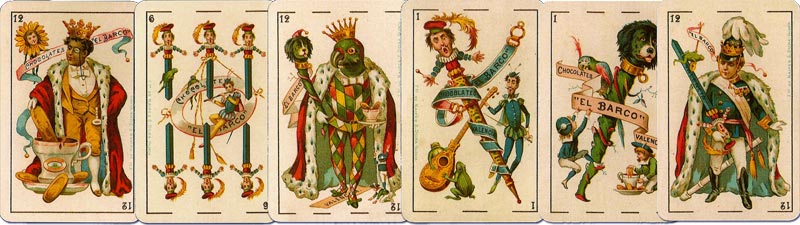
Above: chromolithographed advertising playing cards for Chocolates "El Barco" designed by E. Pastor and manufactured by Simeon Durá, Valencia, Spain, c.1895. See more →
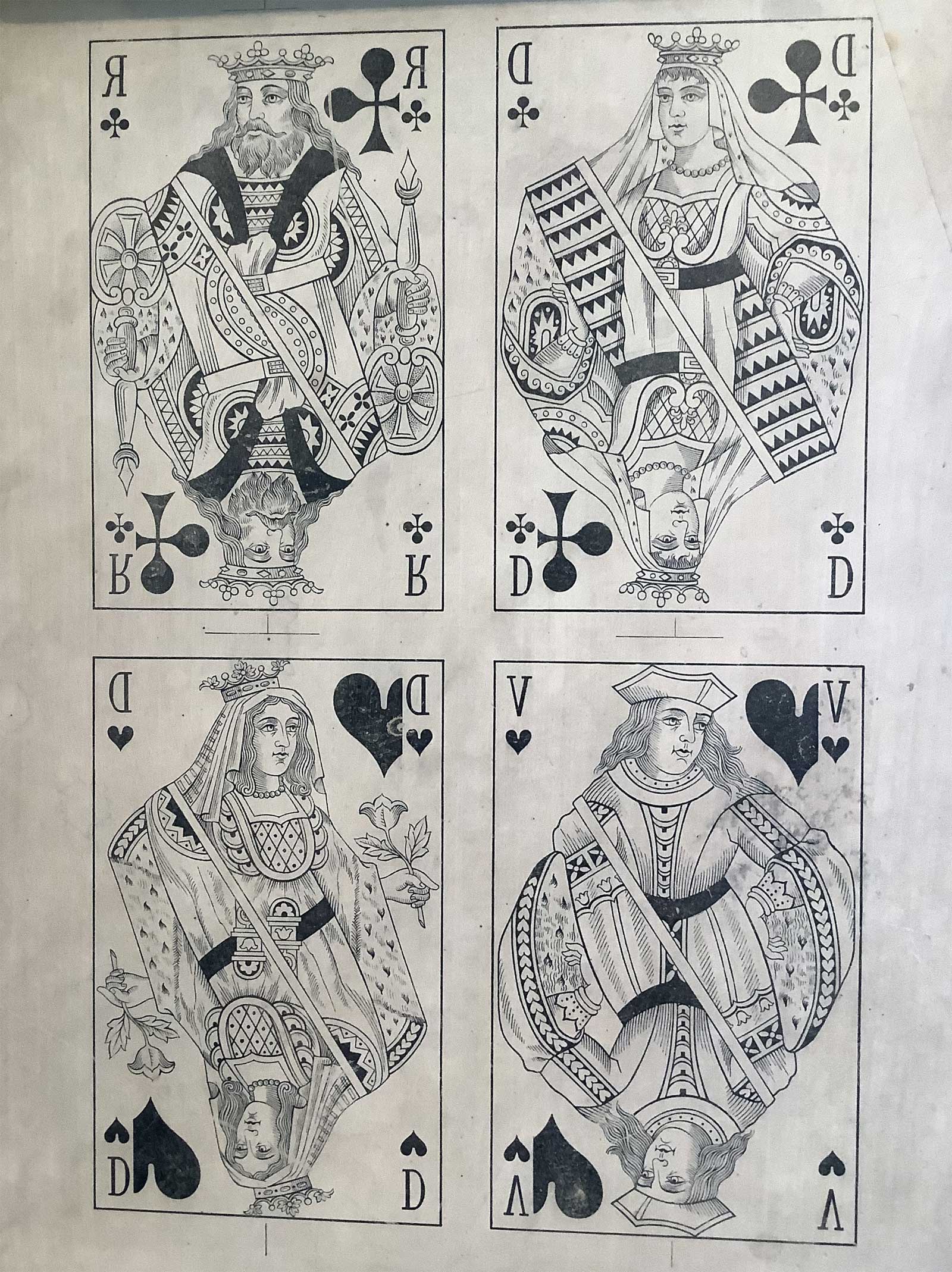
Above: close view of a limestone lithographic stone from the Turnhout Playing Card Museum showing four cards of the Genoese pattern (in reverse) alongside fully printed cards by Brepols (top) and Mesmaekers (below), c.1920s.
See also: Printing Presses from the Turnhout Playing Card Museum Amos Whitney's Factory Inventory Letterpress Printing Manufacture of Cardboard Manufacture of Playing Cards, 1825 Queen Victoria Diamond Jubilee, 1897 The Art of Stencilling.
Further reading: https://en.wikipedia.org/wiki/Chromolithography►

By Simon Wintle
Spain • Member since February 01, 1996
I am the founder of The World of Playing Cards (est. 1996), a website dedicated to the history, artistry and cultural significance of playing cards and tarot. Over the years I have researched various areas of the subject, acquired and traded collections and contributed as a committee member of the IPCS and graphics editor of The Playing-Card journal. Having lived in Chile, England, Wales, and now Spain, these experiences have shaped my work and passion for playing cards. Amongst my achievements is producing a limited-edition replica of a 17th-century English pack using woodblocks and stencils—a labour of love. Today, the World of Playing Cards is a global collaborative project, with my son Adam serving as the technical driving force behind its development. His innovative efforts have helped shape the site into the thriving hub it is today. You are warmly invited to become a contributor and share your enthusiasm.

Activity for Chromolithography
Sign in to comment or save this article.

Related Articles
Tarock Nr. 71 by Ferd. Piatnik & Söhne
Special tarock deck for the Tyrolean game Droggn.
Braulio Fournier
Baraja Nº 1 produced by Braulio Fournier, Burgos, c.1868.
Printing Presses
Antique printing presses from the Turnhout Playing Card Museum collection.
Lo Stampatore
‘Lo Stampatore’ linocut images created by Sergio Favret, published as a deck of cards by Editions So...
Imperial Club playing cards
Large index broad size cards by AGMüller using a special red ink suitable for casinos.
H.P. Doebele
Artist-designed playing cards produced to demonstrate the quality of a printing technique.
Lithographic Stone
Historic lithographic stone from the Fournier playing card factory, c.1888.
Geschichte des Buchgewerbes
Geschichte des Buchgewerbes illustrated by Ludwig Winkler, published by Verlag für Lehrmittel Pößnec...
Fleet Street
“Fleet Street” card game published by Chad Valley Games, c.1923.
41: A Guide to Dating Playing Cards
Dating is a particularly tricky but very interesting problem to tackle and there are many pitfalls. ...
Carte per Signora
“Carte per Signora” patience pack was produced by Fratelli Armanino, Genova, in c.1897.
33: Functional Changes to Playing Cards
The emphasis throughout my collecting has been on the design of the courts cards, and it should be p...
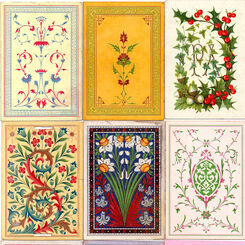
14: Back Designs
A few examples of the many interesting back designs.
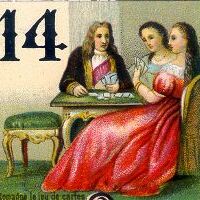
Dondorf Tarot
Dondorf's “Microscopique Tarock“ was first published in c.1870. The scenes portrayed at each end of ...
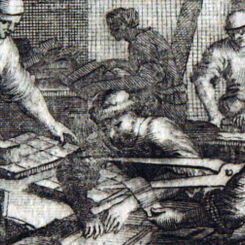
Manufacture of Playing Cards
Traditionally cardmakers worked in guilds with long apprenticeships under master craftsmen.
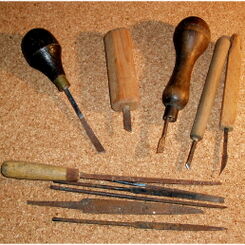
Printing of Playing Cards: Stencilling
Printing of Playing Cards :: Stencilling can usually be detected by observing the outlines of the co...
Printing of Playing Cards: Letterpress
Some notes on the manufacture of playing cards taken from Thomas De la Rue's patent, 1831.
Pneumatic Playing Cards
The surface of the cards was slightly grooved by being rolled on prepared plates, so that there were...
Regarding the designs of playing cards
The quality of playing card designs often deteriorates with time…
Most Popular
Our top articles from the past 60 days


