


Baraja Mitológica
“Baraja Mitológica” was first published in Madrid in c.1815 by Josef Monjardín from engravings by José Martínez de Castro.
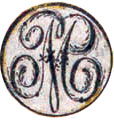
The “Baraja Mitológica” was first published in Madrid in c.1815 by Josef Monjardín from engravings by José Martínez de Castro, whose monogram appears on the ace of swords. The original drawings were probably by José de Rojas. In those days engravers might arrange for a local printer to produce their work and then sell the finished products themselves; alternatively they might sell the engravings to an established publisher. Consequently many editions appeared either anonymously, self-published or by different publishers. The printer’s details may or may not have appeared on the wrapper of a particular edition.
As can be seen in the images below, José Martínez de Castro’s engavings exhibit superb draughtmanship, clean and precise lines without any unnecessary ornamentation or fussiness. José de Rojas would have availed himself of the countless dictionaries of mythology and emblematic material available in 19th century Spain.
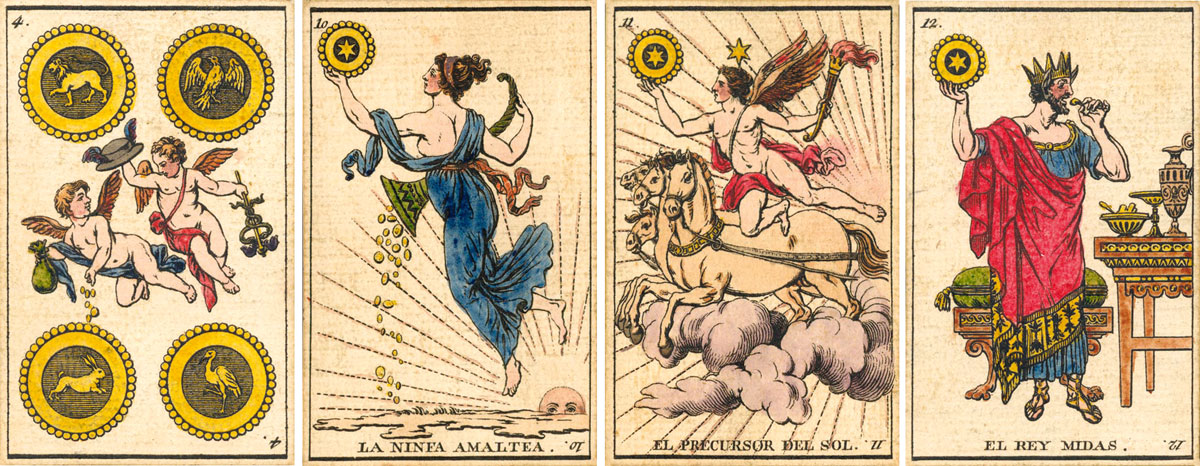
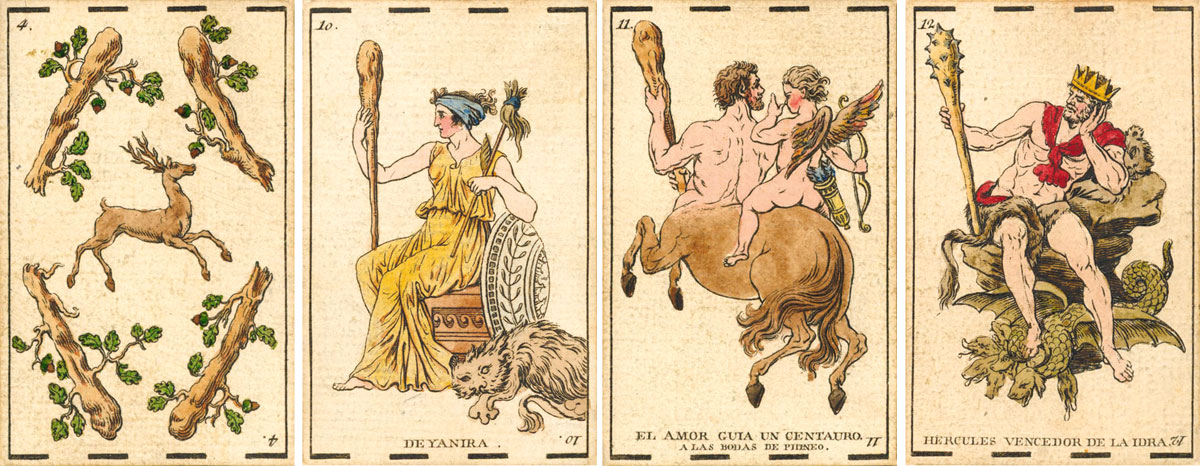
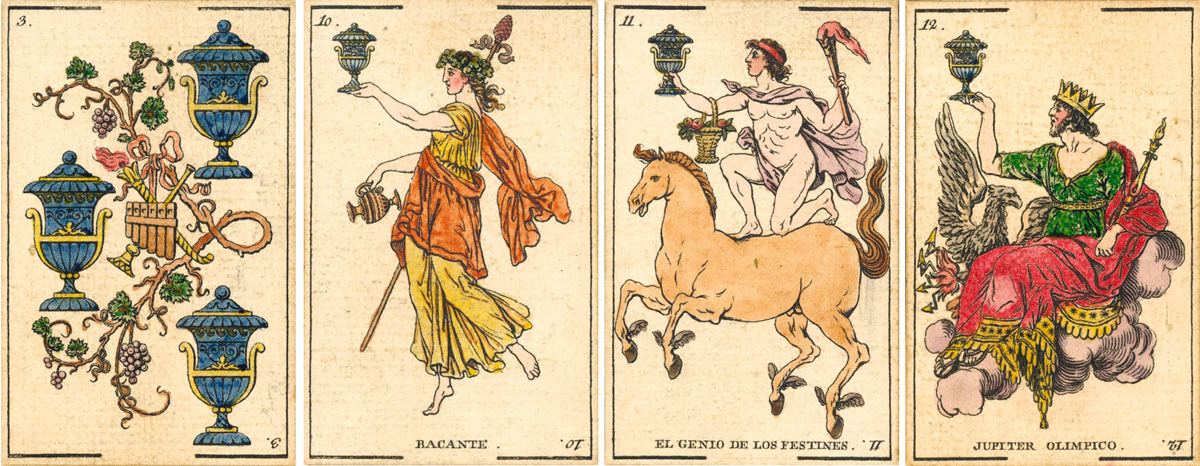
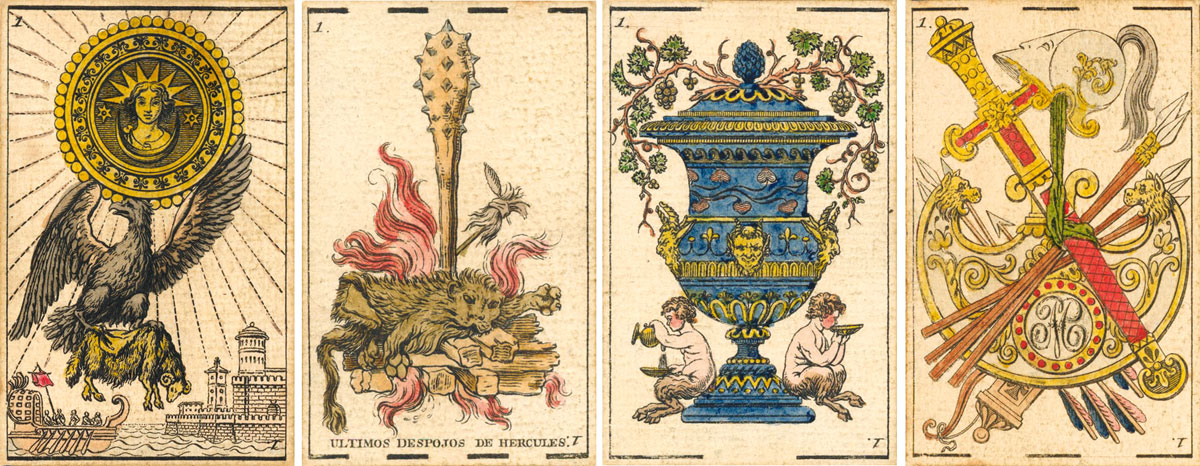
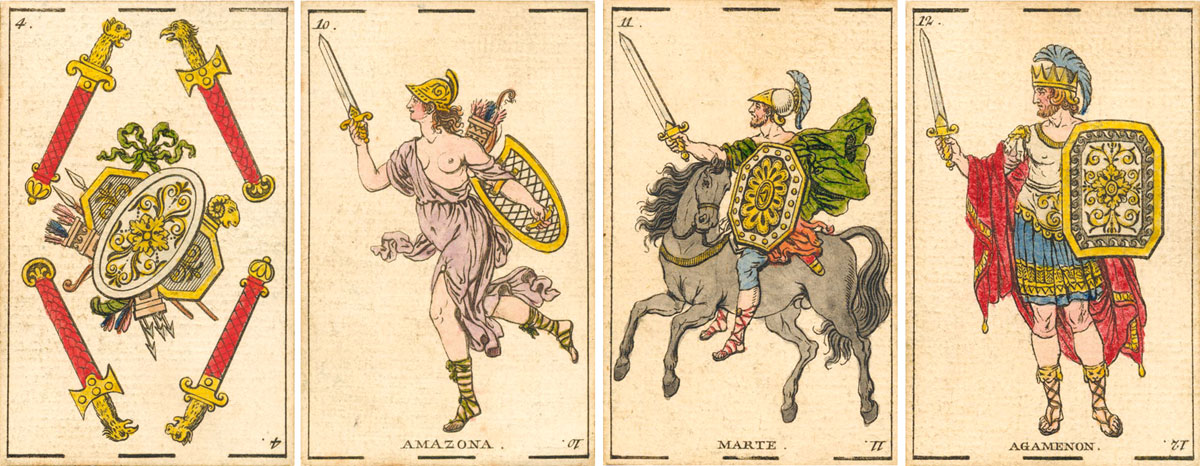
Above: cards from a hand-coloured edition of “Baraja Mitológica” by an unknown publisher from copper plate engravings by José Martínez de Castro, Madrid, 1817. The court cards depict classical heroes and deities. Images courtesy Alberto Pérez González.
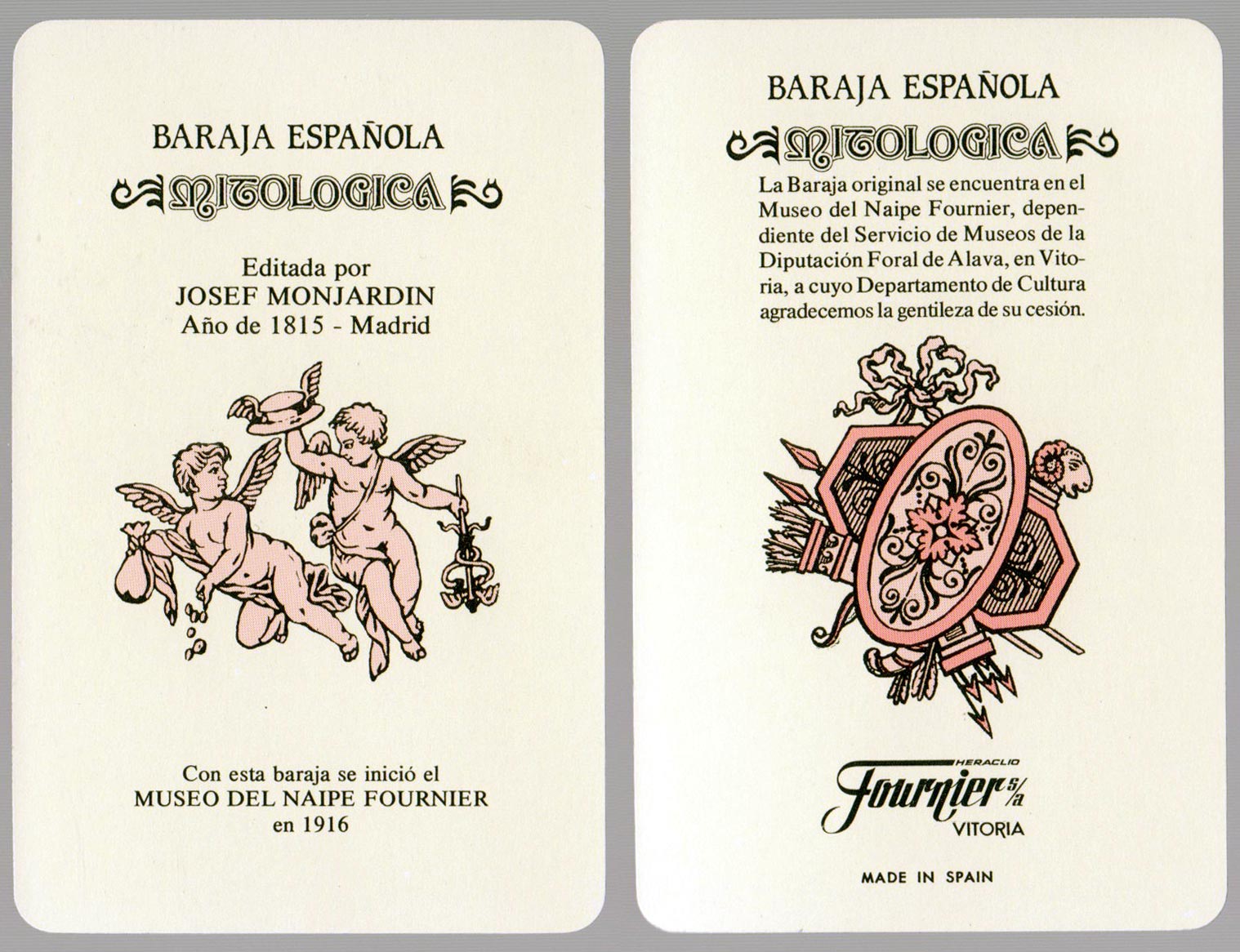
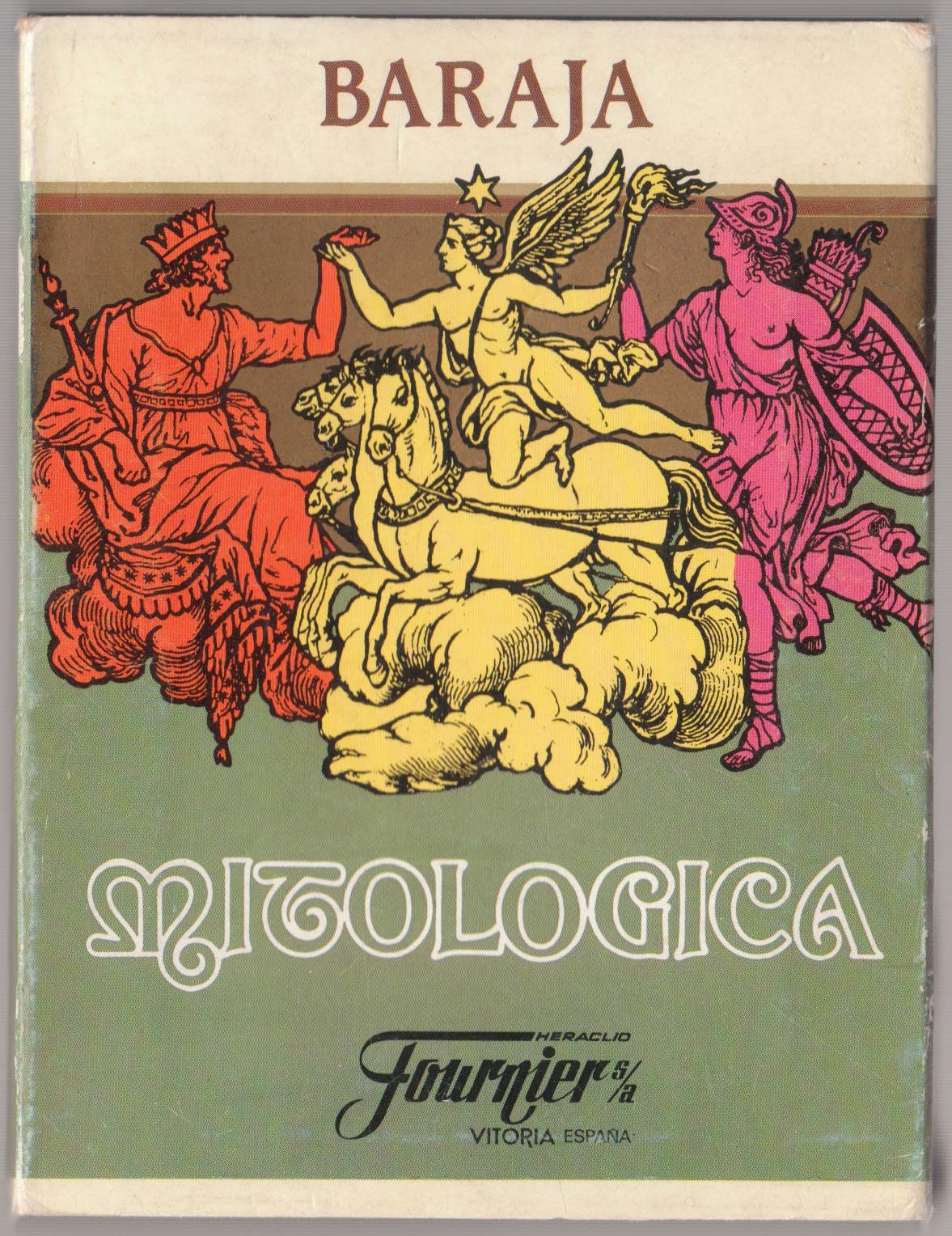
A facsimile edition of the cards was published by Heraclio Fournier in 1989, based on an original copy published in Madrid in 1815 by Josef Monjardín, now in the Fournier Playing Card Museum, Álava. Each suit is coloured in monochrome, and there are differences of detail in some numeral cards from the edition shown above, suggesting that the plates had been re-touched or repaired. See the information cards► See the Box►
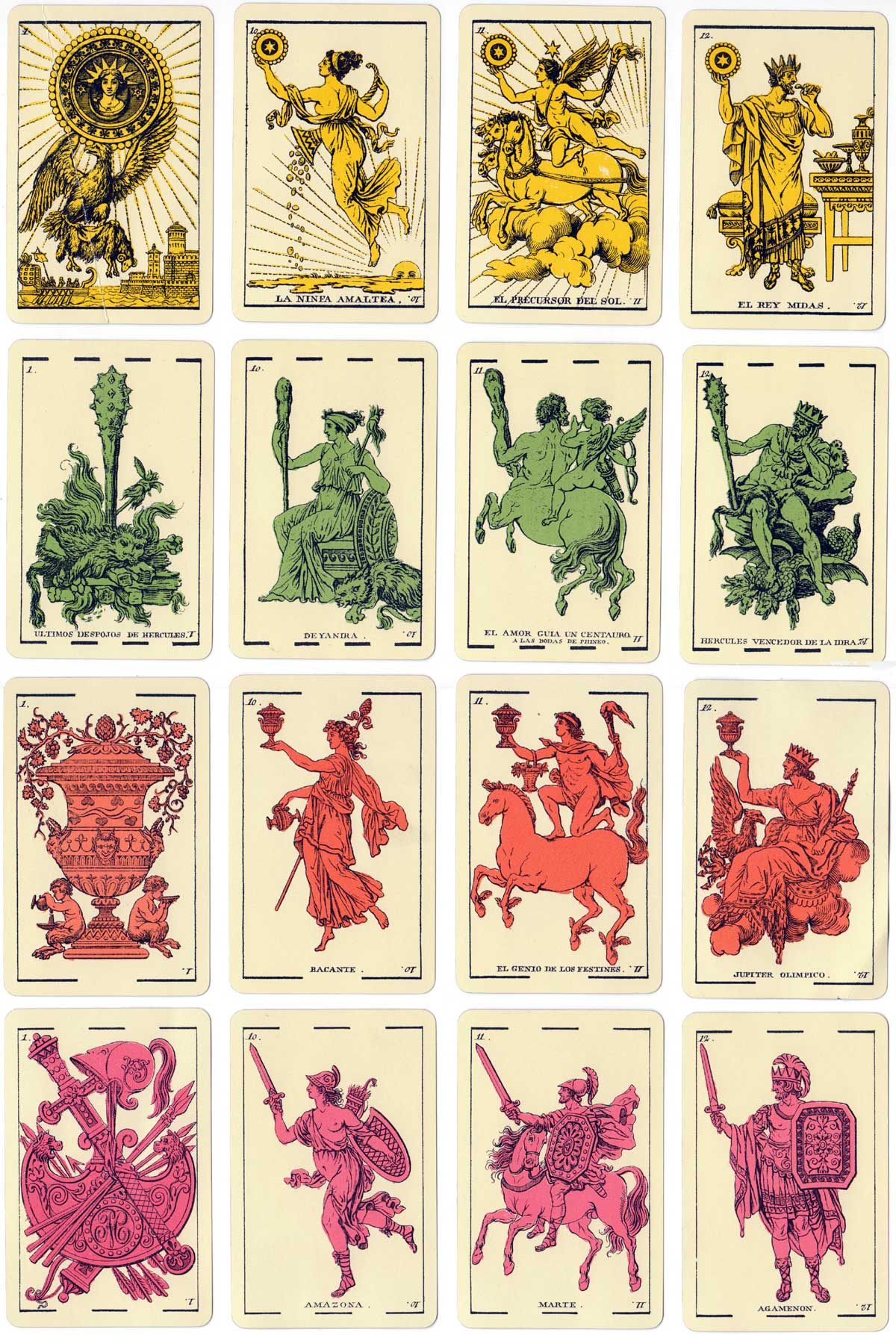
Above: cards from facsimile edition published by Heraclio Fournier in 1989, based on an original copy published in 1815 by Josef Monjardín.
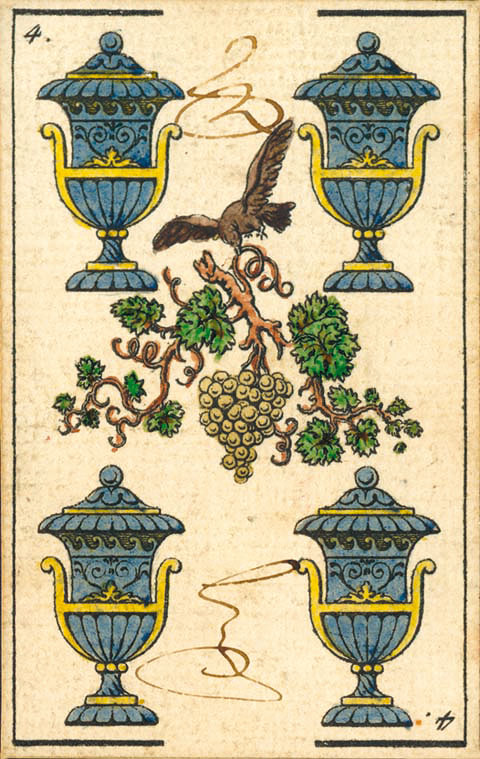
Right: the four of cups with the signatures of the tax accountant and administrator. (click to zoom) →
REFERENCES and CREDITS
Denning, Trevor: Catalogue of Trevor Denning’s Collection of Spanish Playing Cards, Birmingham, privately published.
Pérez González, Alberto & Ferro Torrelles, Víctor: El Archivo Desconocido de la Baraja Española, in LA SOTA no.21, Asescoin, Madrid, October 1999
Thanks to Alberto Pérez and Samten de Wet for additional research and to Rex Pitts for scans of the facsimile edition by Heraclio Fournier.

By Simon Wintle
Spain • Member since February 01, 1996
I am the founder of The World of Playing Cards (est. 1996), a website dedicated to the history, artistry and cultural significance of playing cards and tarot. Over the years I have researched various areas of the subject, acquired and traded collections and contributed as a committee member of the IPCS and graphics editor of The Playing-Card journal. Having lived in Chile, England, Wales, and now Spain, these experiences have shaped my work and passion for playing cards. Amongst my achievements is producing a limited-edition replica of a 17th-century English pack using woodblocks and stencils—a labour of love. Today, the World of Playing Cards is a global collaborative project, with my son Adam serving as the technical driving force behind its development. His innovative efforts have helped shape the site into the thriving hub it is today. You are warmly invited to become a contributor and share your enthusiasm.

Activity for Baraja Mitológica
Sign in to comment or save this article.

Related Articles
Balearic Souvenir Cards
Mediterranean Souvenir deck by Rioba Studio, Pollença, Mallorca.
Calligraphy Card Game
Military figures executed in calligraphic flourishes by Johann Christoph Albrecht.
Allegories and Myths
Semi-transformation playing cards from artist Violeta Monreal.
Mythological Zoo
An extraordinary collection of fabulous beasts.
Heathen Divinities
Handmade playing cards from the British Museum depicting classical Greek and Roman gods and goddesse...
Euskal Herriko Mitologia
Important figures from Basque mythology, named in four languages.

El Niño de las Pinturas
Forty-nine distinctive works by Spanish graffiti artist Raúl Ruiz.
Baraja Española de Pintores Murcianos
A Spanish-suited pack as conceived by 48 different artists from the region of Murcia.
Ases de la pintura / Masters of painting
Ases de la pintura / Masters of painting playing cards made by Naipes Comas, Spain, c.1990.
Crystal Time
Colourful and attractive designs by Violeta Monreal, inspired by stained glass through the ages.
Gods of Egypt
Gods of Egypt playing cards dedicated to the culture of Ancient Egypt.
Les Grandes Figures de L’Histoire Bretonne
Les Grandes Figures de L’Histoire Bretonne
Baraja “Neoclásica”, Madrid, 1810
Baraja “Neoclásica” engraved by José Martínez de Castro, first published by Clemente Roxas, Madrid, ...
Classic
“Classic” playing cards designed by Paul Mathison inspired by classical mythology, 1959.
Ancient Civilisations
Ancient Civilisations playing cards designed by Celedonio Perellón, produced by Heraclio Fournier, ...
Pathfinder Playing Cards
The Pathfinder deck of cards has been inspired by Odin, the Norse god of wisdom, war and death.
Suicide King
The King of Hearts, holding a sword behind his head, is sometimes nicknamed the “Suicide King”. He c...
Baraja Marinera
‘Baraja Marinera’ designed by Francisco Javier San Juan, published by Asescoin (Madrid), 1995
José Martínez de Castro, page 2
The most noteworthy feature of its history is that this design has since been adopted for use in Sar...
The History of Playing Cards
Playing cards appear in European records in the late 14th century, but their earlier history lies fu...
Most Popular
Our top articles from the past 60 days


Peter Burnett
19 November 2025, 09:47SavedSaved this article to Peter's Collection