

Moorish playing cards
These two uncoloured, uncut sheets of early Moorish playing cards were formerly preserved in the Instituto Municipal de Historia in Barcelona.
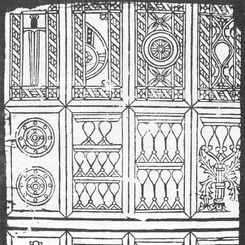
Moorish playing cards, two uncut sheets, early fifteenth century. These two uncoloured, uncut sheets of early Moorish playing cards were formerly preserved in the Instituto Municipal de Historia in Barcelona. They were first brought to light by Simon Wintle in 1987 and described by him in: A 'Moorish' Sheet of Playing Cards, in "The Playing Card" Vol.15 no.4, 1987, IPCS, England. (The original article can be downloaded here.) The cards are printed from woodblocks as bold black outlines. No court cards are present and the numerals evidently ran from 1-10. The four aces (top row, left) illustrate the suit symbols: a downward-pointing sword, complete with hilt; an ambiguous, curved shape which might be seen as a curved club (on what is probably the two of 'clubs' we see two curved strips not crossing but juxtopposed); a simple disc or coin decorated with concentric circles; and a stemmed cup or goblet resting on a triangular base. Unlike the remainder of the pack, these four aces also have geometrically patterned borders.
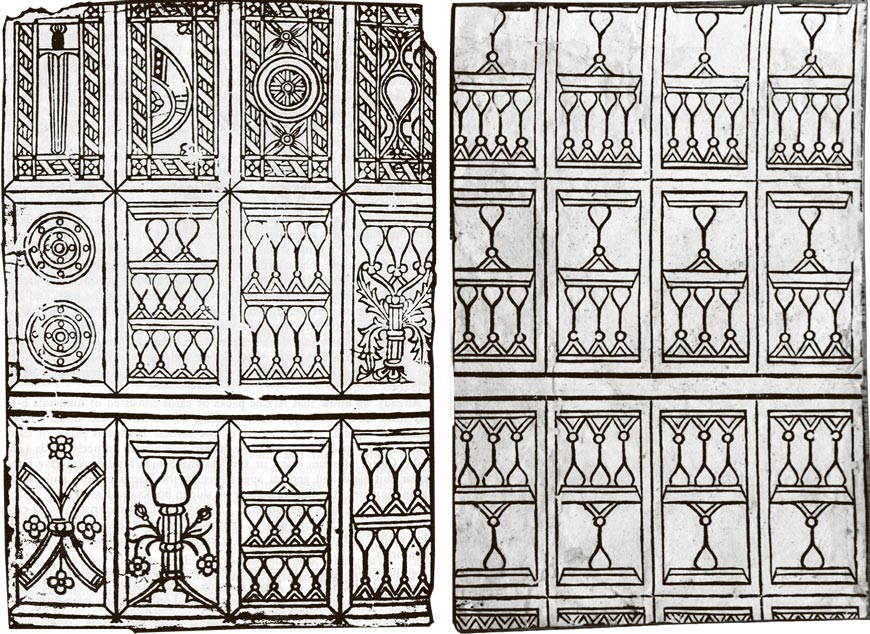
The earliest historical reference to specifically moorish designs in Barcelona is dated 1414, and subsequent discussions have led to the conclusion that these cards are possibly the earliest set of European playing cards that have come down to us. The pack was made before the 10s had been suppressed, and are possibly of Christian manufacture in imitation of some Muslim prototype. From the ambiguous form of the 'baton' suit sign one gets the impression that the card-maker was not sure what the corresponding symbol in his prototype was supposed to represent. In addition they have a striking stylistic similarity with the Islamic Mamluk cards preserved in Istanbul. Indeed, they look like a plainer and more rudimentary version of the same thing, which suggests that there may already have been an established style of 'Moorish' playing cards being produced in Spain since the earliest times after their introduction.
Finally, we can note that in the left-hand specimen the borders of each card suggest that the backs of the cards were folded around to make a margin around the fronts of the cards, as in Italian cards and some other 15th century Spanish cards. Was this method of production inherited from Moorish cards? The outwardly curved two of 'batons' also resembles the arrangement of swords in the archaic 15th century Italian suit system.

By Simon Wintle
Spain • Member since February 01, 1996 • Contact
I am the founder of The World of Playing Cards (est. 1996), a website dedicated to the history, artistry and cultural significance of playing cards and tarot. Over the years I have researched various areas of the subject, acquired and traded collections and contributed as a committee member of the IPCS and graphics editor of The Playing-Card journal. Having lived in Chile, England, Wales, and now Spain, these experiences have shaped my work and passion for playing cards. Amongst my achievements is producing a limited-edition replica of a 17th-century English pack using woodblocks and stencils—a labour of love. Today, the World of Playing Cards is a global collaborative project, with my son Adam serving as the technical driving force behind its development. His innovative efforts have helped shape the site into the thriving hub it is today. You are warmly invited to become a contributor and share your enthusiasm.

Leave a Reply

Your Name
Just now Your comment here. Your comment here. Your comment here. Your comment here. Your comment here. Your comment here. Your comment here. Your comment here. Your comment here. Your comment here. Your comment here. Your comment here. Your comment here. Your comment here. Your comment here. Your comment here. Your comment here. Your comment here. Your comment here. Your comment here. Your comment here. Your comment here. Your comment here. Your comment here. Your comment here. Your comment here. Your comment here. Your comment here. Your comment here. Your comment here. Your comment here. Your comment here.
Related Articles

Moorish Deck
Review of “Trzes’ Moorish Deck” facsimile published by Ulrich Kaltenborn, Berlin, 2023.
XV Century Spanish-suited playing cards
XV Century Spanish-suited playing cards with moorish influences
Juego de Naipes Andalusí
Andalusian playing cards designed by Marifé Montoya Carrillo with booklet by Jorge Lirola Delgado, 2...
Antoine de Logiriera
Archaic Spanish-suited playing cards published in Toulouse by Antoine de Logiriera (1495-1518).
J. Deluy c.1490s
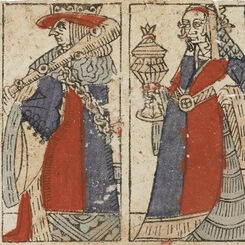
Archaic Spanish-suited cards produced by J. Deluy c.1490s.
Toledo, 1584
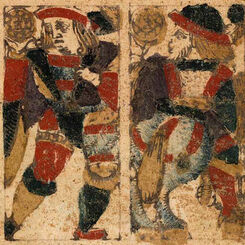
Archaic Spanish-suited deck with 48 cards made in Toledo in 1584.
Navarra Pattern, 1682
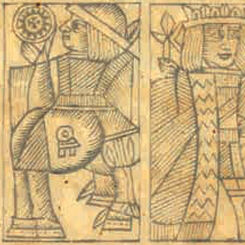
Navarra pattern produced for the Pamplona General Hospital Monopoly in 1682.
Navarra Pattern
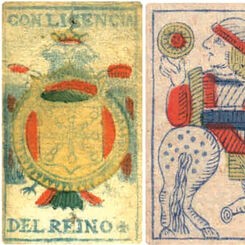
Navarra Pattern produced for the Pamplona General Hospital Monopoly.
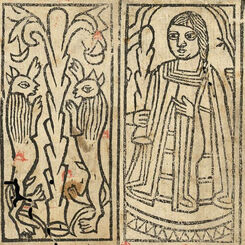
XV Century Catalan playing cards
XV Century Catalan Playing Cards, featuring four female Sotas, four Aces and four cards from the sui...
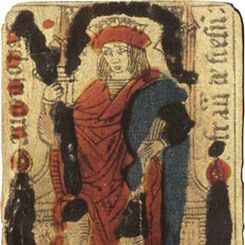
The Combination of Images and Text on early playing cards
When playing cards have titles or legends these reference a written/literary tradition of some form....
Joan Barbot
Joan Barbot, San Sebastian c.1765-1810.

Navarra, XVII Century
Facsimile of 17th century Spanish-suited playing cards produced by Erregeak, Sormen S.A., Vitoria-Ga...

Gothic Spanish-suited cards
These cards may be a typical example of early 'standard' Spanish playing cards, maybe from before Co...
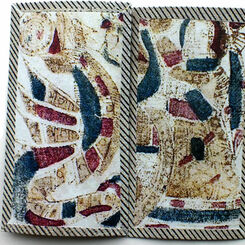
Francisco Flores
Playing cards in this style have been discovered in various parts of the world, suggesting that they...
Mamluk Playing Cards
Nã'ib, the game of lieutenants... these cards are amongst the earliest Arabic playing cards ext...
Phelippe Ayet, c.1574
Archaic, late medieval Spanish-suited playing cards printed by Phelippe Ayet, c.1574.
Baraja Morisca — Early XV century playing cards
Primitive Latin suited pack, dated by paper analysis as early XV century, which makes this one of th...

Hand-made Spanish Suited Playing Cards
Decks are made on two-ply pasteboard which reproduces the tactile quality of antique cards.
Silver Cards from Peru
Spanish-suited silver cards, richly embellished and enamelled, from a former Spanish Viceroy in Peru...
A Moorish Sheet of Playing Cards
This article was originally published in “The Playing-Card”, the Journal of the International Playin...
Most Popular
Our top articles from the past 60 days


