


Anonymous Spanish Suited pack, c.1760
Anonymous archaic Spanish suited pack, c.1760.
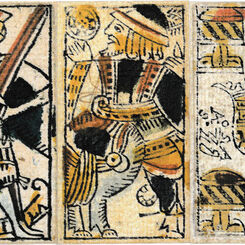
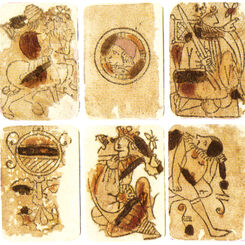
Fantasy “Felipe V” Spanish Suited pack based on popular models, anonymous manufacturer, c.1760. The pack contains 52 cards; unusual in that it has numeral cards up to 10, plus ‘Sotas’, ‘Caballos’ and ‘Reyes’. The original version of this deck, dedicated to Philip V on the ace of coins, is the work of the Sarton Bros & Sisters of Brussels (active 1745-67), whose name appeared on the banner of the ace and five of swords. Obviously destined for Spanish markets, the deck consists of a strange mixture of models where the presence of a lion stands out in all the figures, and the king of clubs holds the classic pharmaceutical symbol. The absence of ‘pintas’ (border breaks) and the unusual number of 52 cards underscore the rarity of a deck of obvious Nordic iconography; while the mock Latin inscriptions on the ace and five of coins are amusing nonsense.
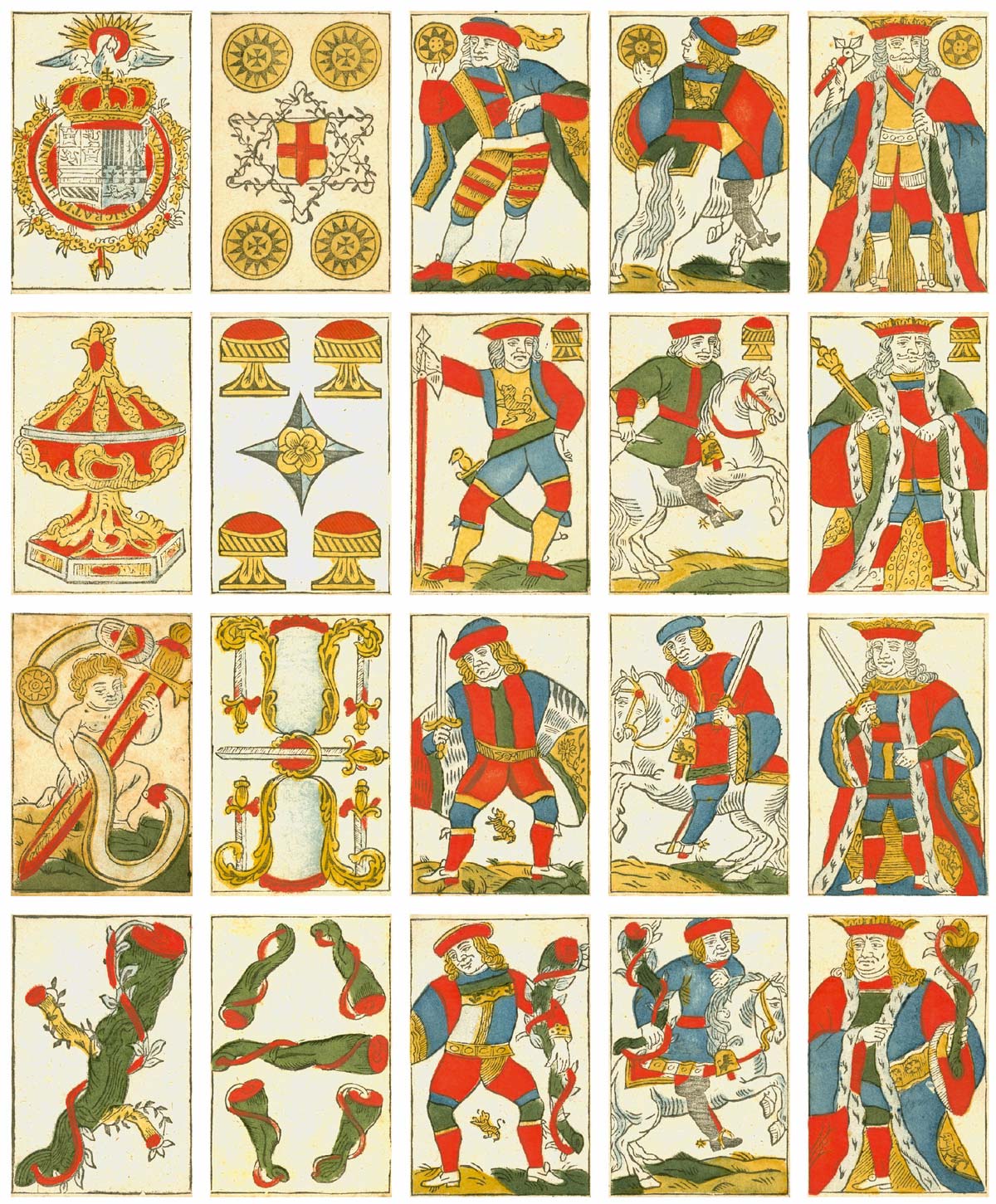
Above: Fantasy “Felipe V” deck, based on popular models, of 52 cards. Engraved in woodcut and coloured by stenciling, c. 1760. Unknown manufacturer.
In Europe, especially in Belgium, decks were manufactured with Spanish design for export to the immense Spanish-speaking overseas market, or even by order of the Spanish manufacturers themselves.
REFERENCES and CREDITS
Thanks to Alberto Pérez González for images and additional research.
Cary Collection (BEL 33).
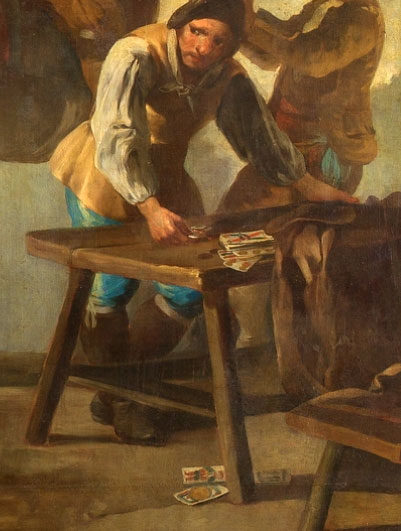
Above: detail from La Riña en la Venta Nueva by Francisco de Goya, 1777. Museo del Prado, Madrid.

By Alberto Pérez González
Spain • Member since December 21, 2016
I am a researcher and my primary interest lies in playing cards manufactured in Cádiz (not the 'Cádiz' type in general). I have authored several articles in the annual Asescoin magazine 'La Sota'. Among them are: “Madrid’s Playing Cards from the 17th to the 20th Century”; “New Contributions to the Study of Playing Cards in the Valencian Country”; “The Fouquets: 'Navarra pattern' in the Netherlands”; “Divided Playing Cards: Combining Ingenuity with Skill”; “Here Be Dragons: Speculations on the Evolution of the so-called 'Portuguese' Pattern”; “Playing Cards in Chile: News and Chronicles from the Viceroyalty Era”...
I have written and designed the book “Los Naipes de Cádiz” (296 pp). Additionally, I have contributed to the design, layout, and collaboration in Enrique García Martín’s book “Naipes, Arte y Fantasía” (444 pp).

Activity for Anonymous Spanish Suited pack, c.1760
Sign in to comment or save this article.

Related Articles
The archaic “Classic Madrid” Pattern
Centralisation, standardisation and consolidation of the Spanish card tradition.
La baraja de Almagro
De la chimenea al monumento nacional: la baraja de Almagro y el renacer del corral de comedias.
Sevilla 1647 reproduction
Facsimile of Spanish-suited pack produced in Sevilla, Spain, 1647.
Dubois
Dubois card makers from Liège in the Walloon Region of Belgium.
Toledo, 1584
Archaic Spanish-suited deck with 48 cards made in Toledo in 1584.
Navarra Pattern, 1682
Navarra pattern produced for the Pamplona General Hospital Monopoly in 1682.
Navarra Pattern
Navarra Pattern produced for the Pamplona General Hospital Monopoly.
Navarra Pattern, 1793
Navarra pattern by an unknown cardmaker with initials I. I., 1793.
XV Century Catalan playing cards
XV Century Catalan Playing Cards, featuring four female Sotas, four Aces and four cards from the sui...
Navarra, XVII Century
Facsimile of 17th century Spanish-suited playing cards produced by Erregeak, Sormen S.A., Vitoria-Ga...
Fournier No. 55
Naipes Intransparentes de Una Hoja No.55 made by Hijos de Heraclio Fournier (Vitoria) for exportatio...
Giuseppe Cattino
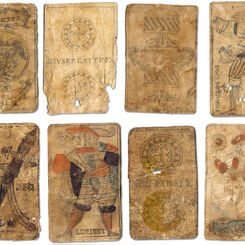
Playing cards manufactured in Italy by Giuseppe Cattino and Paolo Montanar for Spanish markets.
Mesmaekers Spanish Pack, c.1875
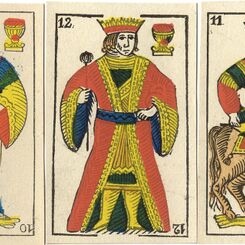
Mesmaekers Spanish Pack for export to Spanish colonies and South American countries, c.1875
Spanish Cards c.1920
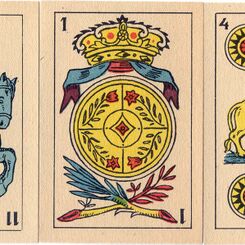
Spanish-suited Playing Cards manufactured by Van Genechten, c.1920.
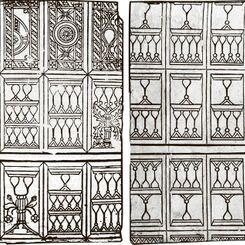
Moorish playing cards
These two uncoloured, uncut sheets of early Moorish playing cards were formerly preserved in the Ins...
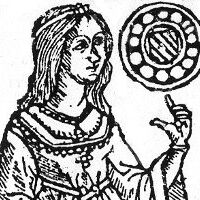
Gothic Spanish-suited cards
These cards may be a typical example of early 'standard' Spanish playing cards, maybe from before Co...
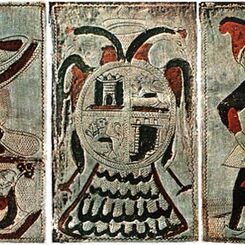
Silver Cards from Peru
Spanish-suited silver cards, richly embellished and enamelled, from a former Spanish Viceroy in Peru...
The History of Playing Cards
Playing cards appear in European records in the late 14th century, but their earlier history lies fu...

Real Fábrica de Macharaviaya
Production was controlled from Madrid as a source of national or regional revenue and, as a rule, th...
Baraja Morisca — Early XV century playing cards
Primitive Latin suited pack, dated by paper analysis as early XV century, which makes this one of th...
Most Popular
Our top articles from the past 60 days


