


Tarot de las Coscojas
Historical playing card design, tarot symbolism and an almost psychedelic medieval surrealism.
This is the second (of two) Tarot decks designed by Claudio Favier Orendáin (1931-2008) a Mexican philosopher, writer and artist who at the time was living near Peraleda de la Mata in Extremadura, Spain. Both sets were produced in his studio at «Las Coscojas». The leaflet explains that since antiquity mankind has tried to predict the future by examining prophetic omens or secret signs of various types, and that the symbols in the tarot have very ancient origins in the distant past, long before they were incorporated into a pack of cards.
The Major Arcana
The 22 Major Arcana are large-sized cards (89 x 144 mm) with Roman numerals at the top and titles in Spanish at the bottom. They have been very elegantly designed and engraved by Claudio Favier and follow the standard sequence found in most tarot packs, but with refinements added by the artist that distinguish them from traditional Marseille or Rider-Waite decks. The figures have a slightly cubist or expressionist quality and the designs include a lot of clearly defined detail. The contrast between bright colours and black outlines makes them stand out clearly within the grey borders.
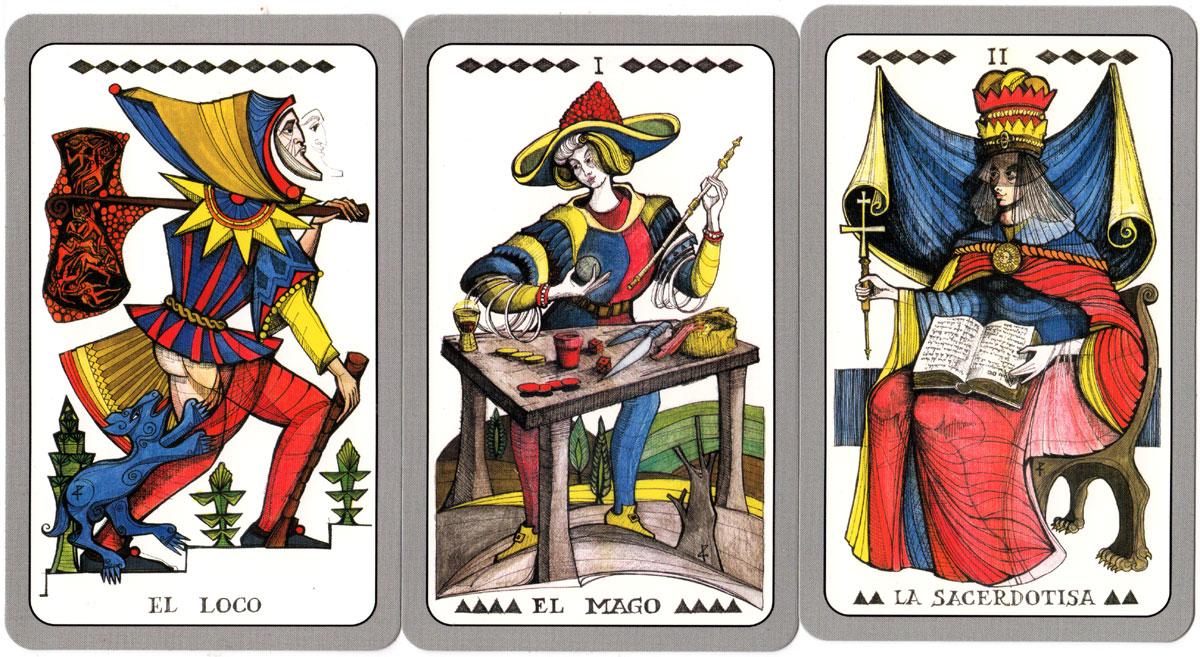
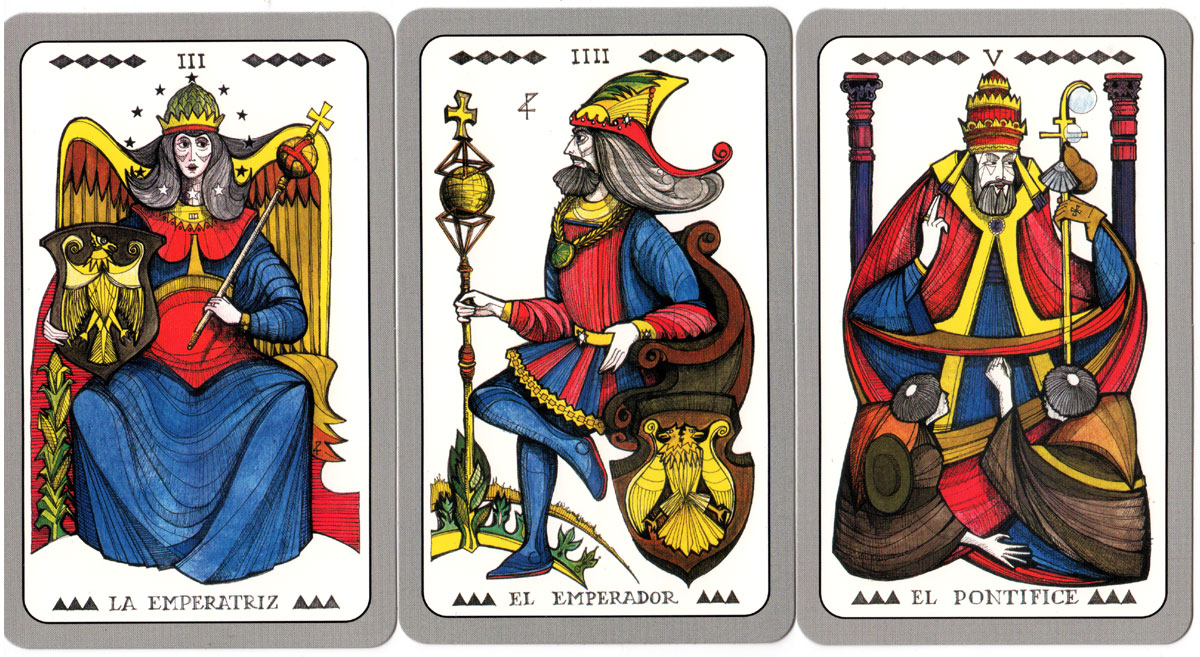
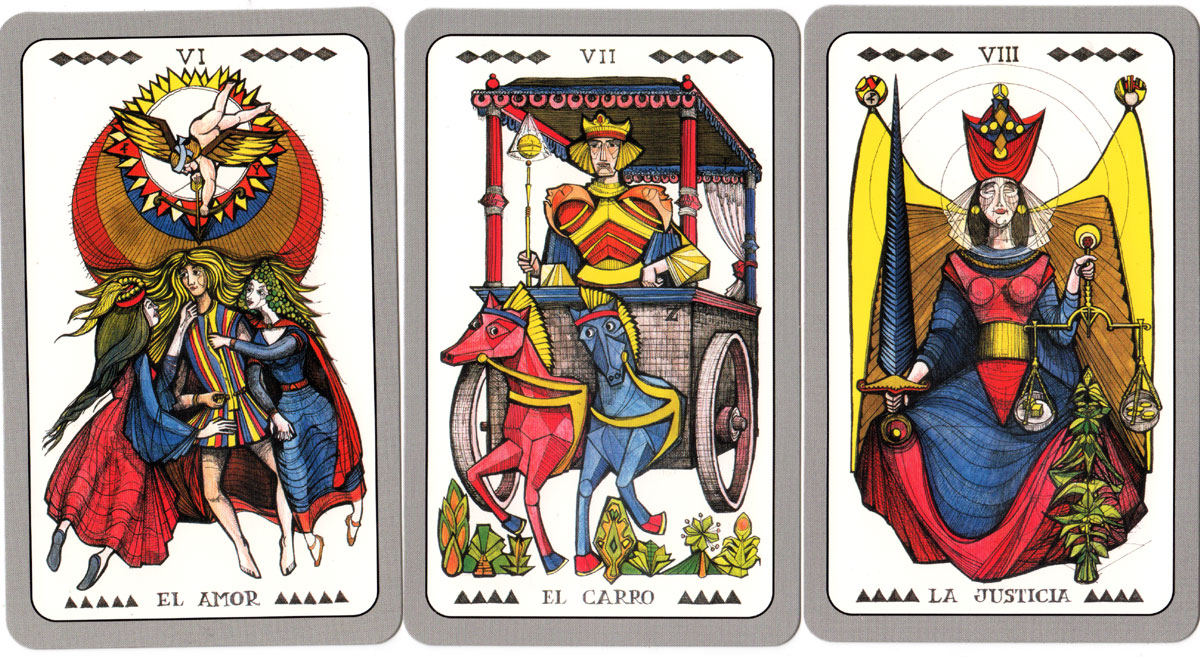
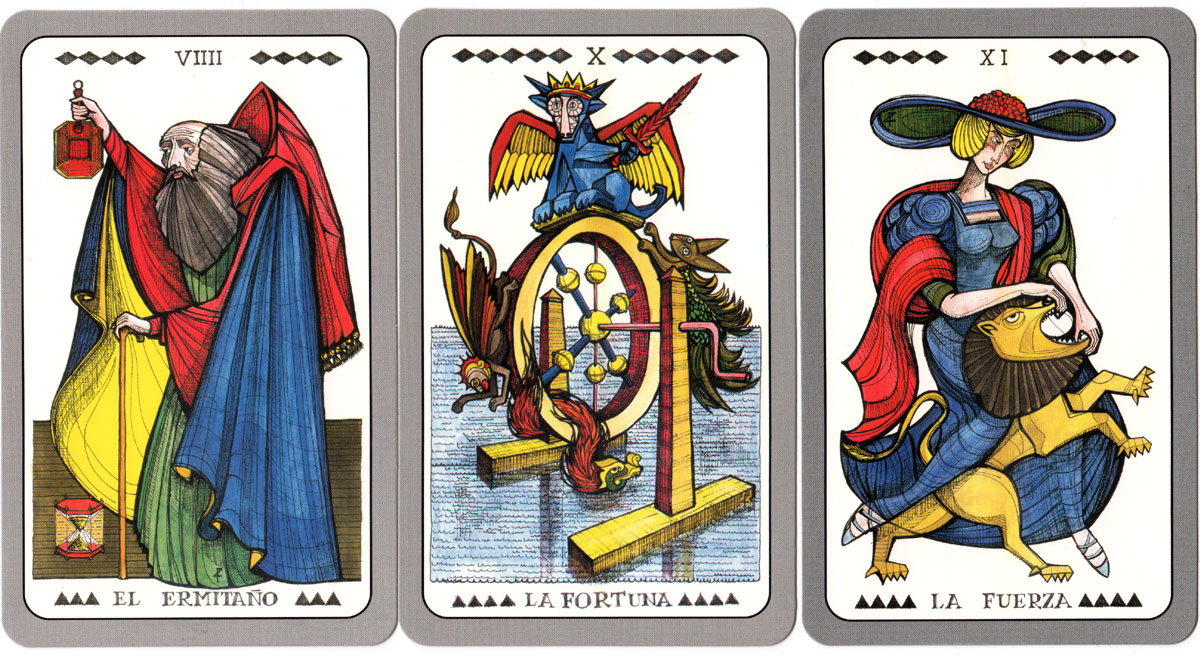
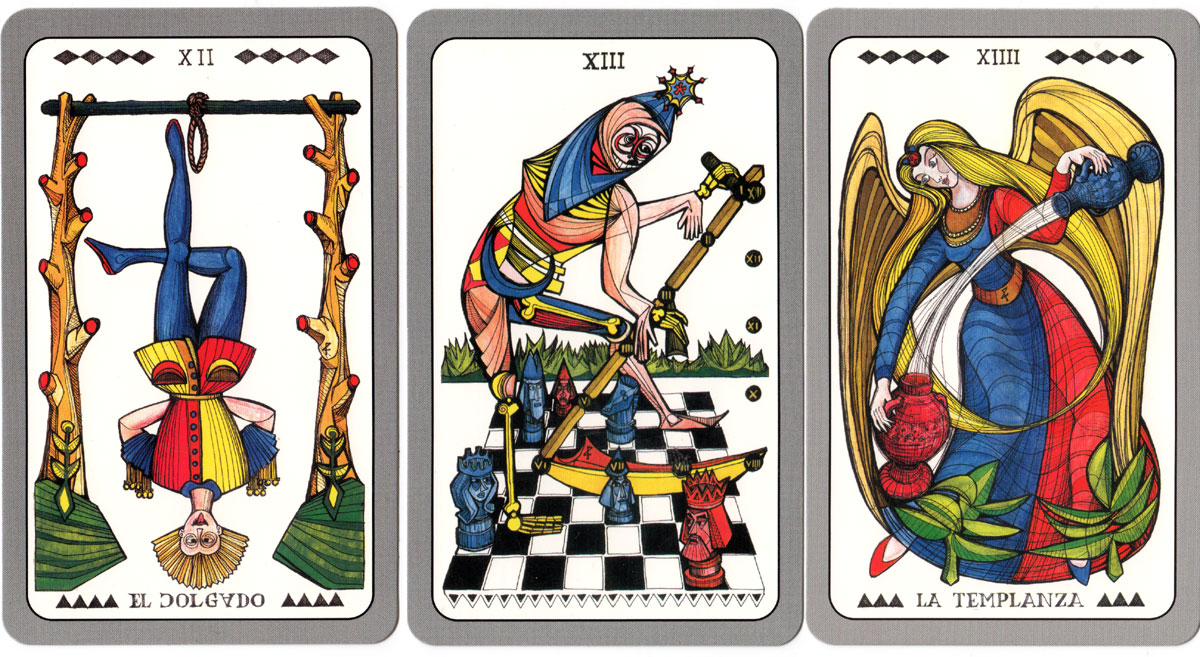
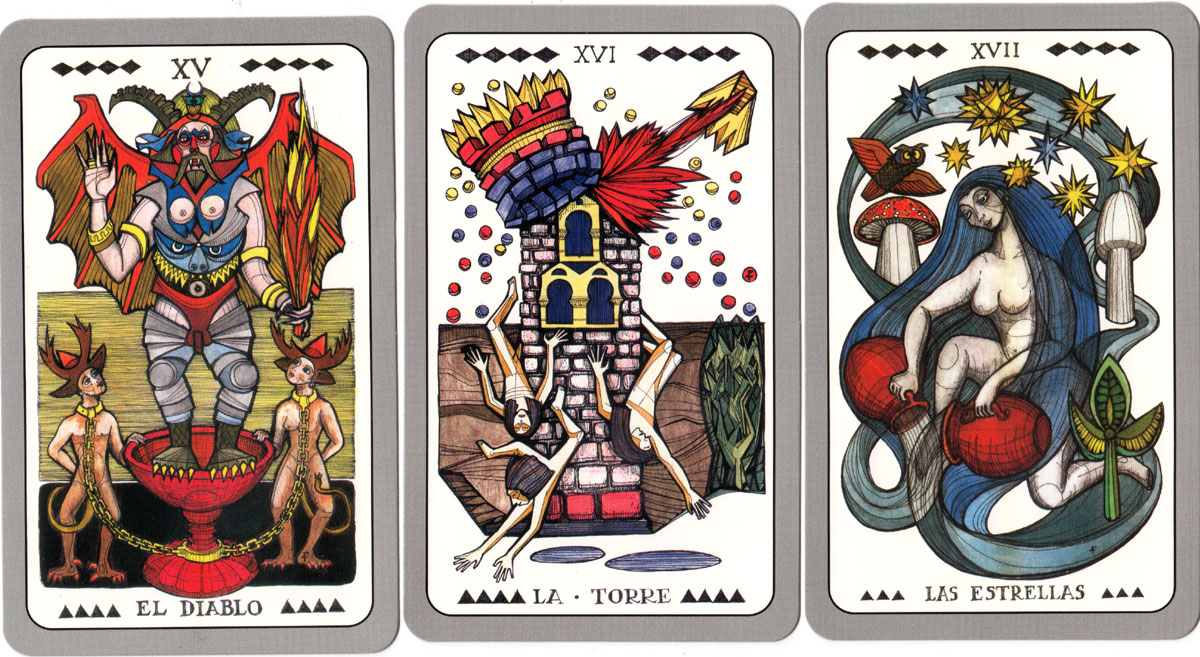
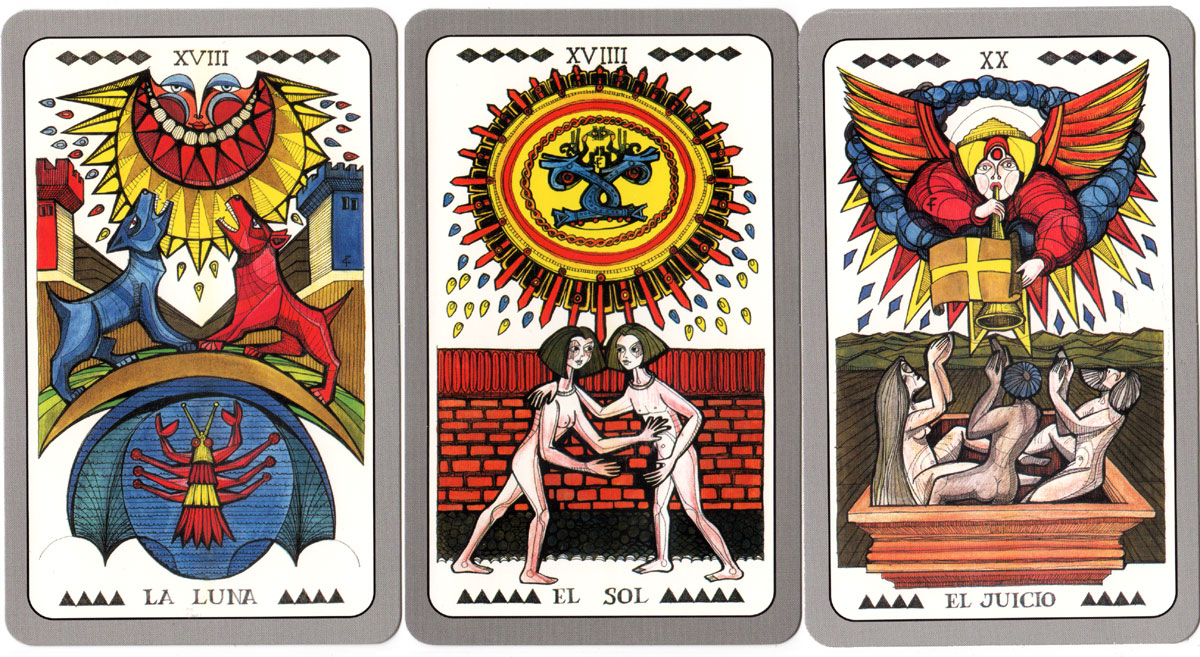
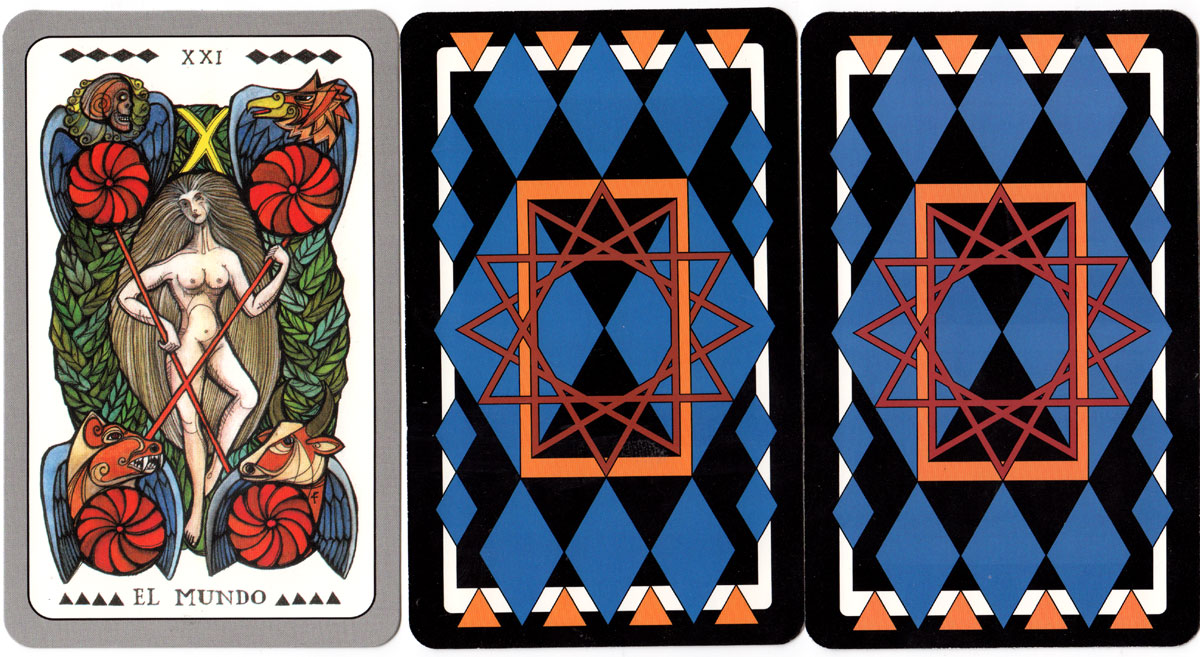
There are also some interpretative shifts, for example, the High Priestess' book openly displays a text, suggesting revealed knowledge rather than hidden mysteries. The skeletal Death figure plays on a chessboard, suggesting strategy or calculated transformation rather than mere destruction. Temperance (La Templanza), the water-pouring angel, has a beautiful flowing motion, emphasizing fluidity and harmony. Many other figures display a similarly harmonious design. The Star contains mushroom imagery alluding to psychedelic or visionary experiences. Traditional Tarot interpretations are given in the leaflet
The Playing Cards
The set also contains two 56-card packs of playing cards, with four court cards per suit (Jack, Queen, Cavalier and King) plus 2 jokers for playing normal card games. The suit symbols are simultaneously French/English and Spanish/Italian by design. These cards are not intended to be used in conjunction with the Trump cards as they as of a smaller size (61x88 mm).
The artist’s style in these playing cards is a fusion of historical European playing cards, particularly from the 15th-17th centuries, with figures wearing elaborate, period attire. The stylized halos or decorative frames around the heads of some figures suggest sanctity or mysticism rather than mere playing card royalty, thereby blending historical playing card design, tarot symbolism and an almost psychedelic medieval surrealism to create a uniquely evocative deck.


Above: Tarot de las Coscojas designed by Claudio Favier, 2005. 22 large-size major arcana cards, 89x144 mm, plus two 56-card packs of ordinary playing cards, 61x88 mm, with 2 jokers and an extra card in each pack, inside a presentation box with an instruction leaflet.
• See also Tarot de Valverde de la Vera►

By Simon Wintle
Spain • Member since February 01, 1996
I am the founder of The World of Playing Cards (est. 1996), a website dedicated to the history, artistry and cultural significance of playing cards and tarot. Over the years I have researched various areas of the subject, acquired and traded collections and contributed as a committee member of the IPCS and graphics editor of The Playing-Card journal. Having lived in Chile, England, Wales, and now Spain, these experiences have shaped my work and passion for playing cards. Amongst my achievements is producing a limited-edition replica of a 17th-century English pack using woodblocks and stencils—a labour of love. Today, the World of Playing Cards is a global collaborative project, with my son Adam serving as the technical driving force behind its development. His innovative efforts have helped shape the site into the thriving hub it is today. You are warmly invited to become a contributor and share your enthusiasm.

Activity for Tarot de las Coscojas
Sign in to comment or save this article.

Related Articles
Tarot del Toro
Tomás Hijo makes Tarot del Toro from hand-painted linocut prints of characters and settings from Gui...
Oxygène
Armenian miniatures were Stepan Kiourktchian’s inspiration for this pack for a Franco-Armenian assoc...
Buffy the Vampire Slayer Tarot
A Buffy the Vampire Slayer tarot pack that replaces Swords with scythes and Wands with stakes.
Tarot Familiars
Lisa Parker’s Tarot Familiars gives the traditional 78-card tarot a distinctly gothic world of cats,...
Tarot de los Angeles
Tarot de los Angeles is a 78-card pack featuring angels and other celestial beings, which works more...
History of Tarot and Playing Cards: Timeline & Origins
An alternative history of tarot and playing cards – from Mamluk Egypt to the invention of tarot in R...
The Sola-Busca Tarot
Humanist Iconography, Alchemical Metaphor, and the Origins of the Illustrated Minor Arcana.
Tarot de Valverde de la Vera
A series of 24 surrealist engravings by Mexican artist Claudio Favier in which archetypal Tarot alle...
Medieval Heraldry
53 cards of original hand painted prints taken from medieval manuscripts.
Tarot de Madrid
Black-and-white photographs of models whose faces are made up using elements found on the major arca...
Morgan-Greer Tarot
Based on the knowledge, wisdom and interpretation of Paul Foster Case and Arthur Edward Waite.
Medieval Life playing cards
‘Medium Aevum’ (Medieval Life) playing cards designed by Violeta Monreal, published by Heraclio Four...
Dungeons and Dragons Tarot
This 78-card officially licensed Dungeons & Dragons (D&D) tarot deck offers a visually appealing var...
Gambling and Vice in the Middle Ages
Gambling and Vice in the Hours of Charles V: card-playing in the local tavern
Romance Español
“Romance Español” designed by Carlos Sáenz de Tejada and published by Heraclio Fournier in various e...
Europe
“Europe” designed by Teodoro N. Miciano and printed by Heraclio Fournier in 1962, portraying XIV cen...
Rider Waite Tarot early editions
Rider Waite Tarot early editions
Rider-Waite Tarot
The Rider Waite Tarot was created at the beginning of the 20th century by Arthur Edward Waite and Pa...
The History of Playing Cards
Playing cards appear in European records in the late 14th century, but their earlier history lies fu...
Phelippe Ayet, c.1574
Archaic, late medieval Spanish-suited playing cards printed by Phelippe Ayet, c.1574.
Most Popular
Our top articles from the past 60 days


