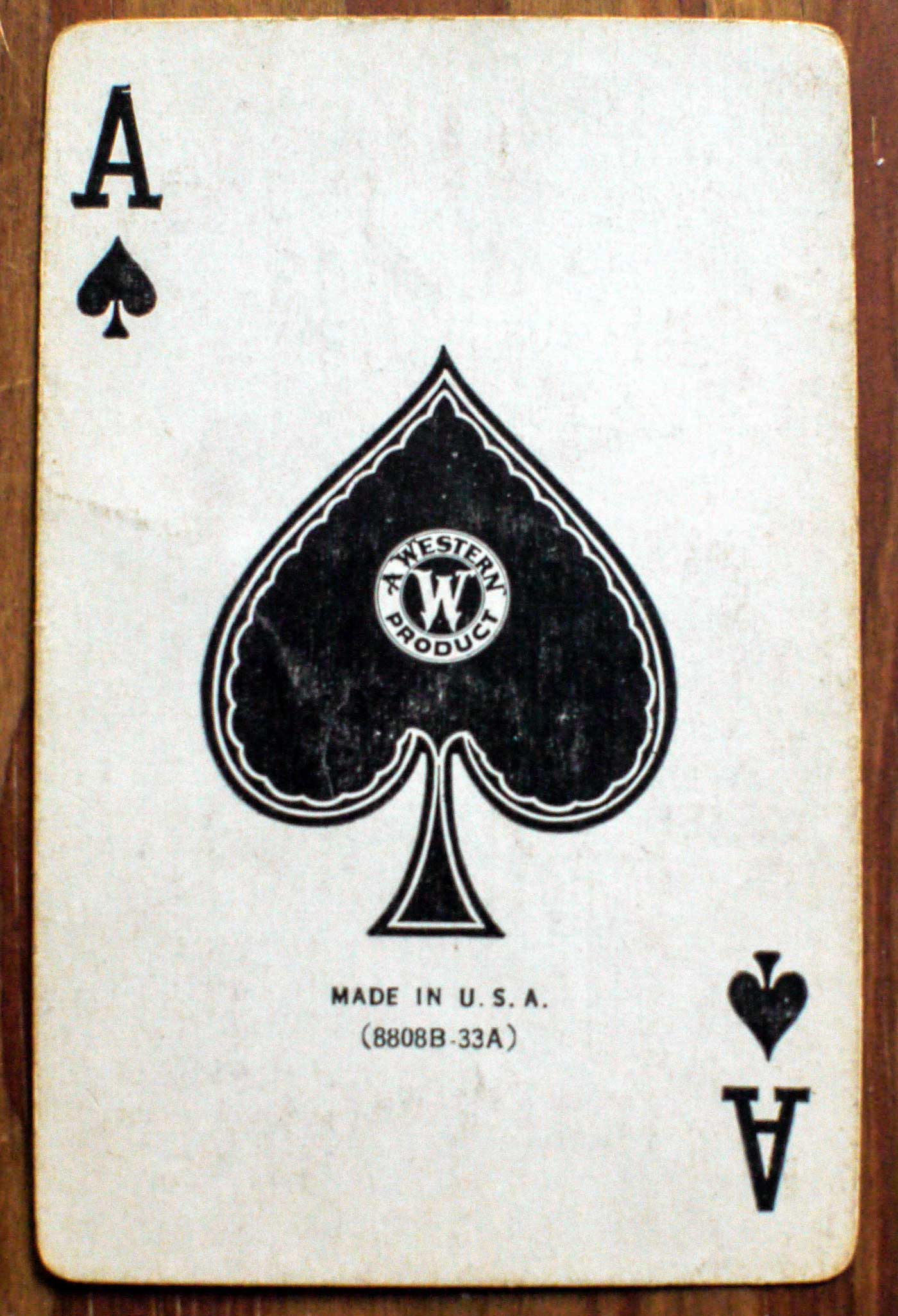
Western PCC
The Western Playing Card Company was formed in 1927. The exact history and origins are not clear.
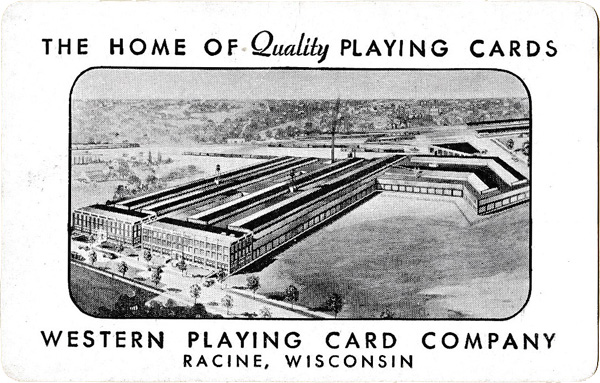
Above: extra card from “Century of Progress” pack produced by Western Playing Card Company, 1933.
Western PCC, Racine, Wisconsin
The Western Playing Card Company was formed in 1927. The exact history and origins are not clear. Following some kind of merger or change of name on the part of the M.B. Sheffer Card Co (1924-26), brands belonging to several former playing card manufacturers (possibly including The Western Press) were now produced by Western P.C.C. The double-ended Joker, for example, had formerly been used by Midland Playing Card Co., Chicago. Many pictorial back designs were issued, which were usually unnamed, in several popular categories of art which may appeal to the single card collector.
Note: Whitman Publishing Co was formed in 1916 as a subsidiary of Western Printing & Lithographing Company of Racine, Wisconsin. Whitman specialised in children’s books, puzzles and board games until the 1970s, and also became a leading numismatic publisher.
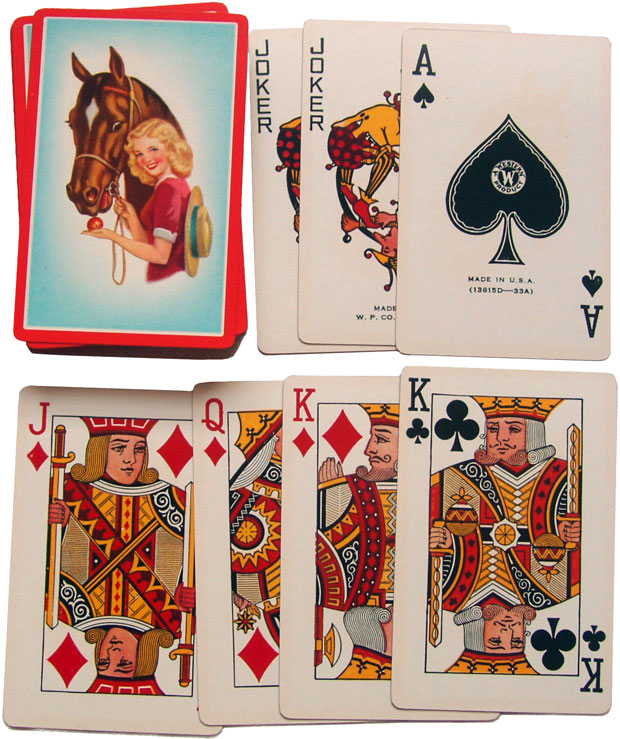
Above: cards from deck of No.149 Champions standard playing cards, with gold edges and pictorial back design, produced by Western Playing Card Co., c.1930s.
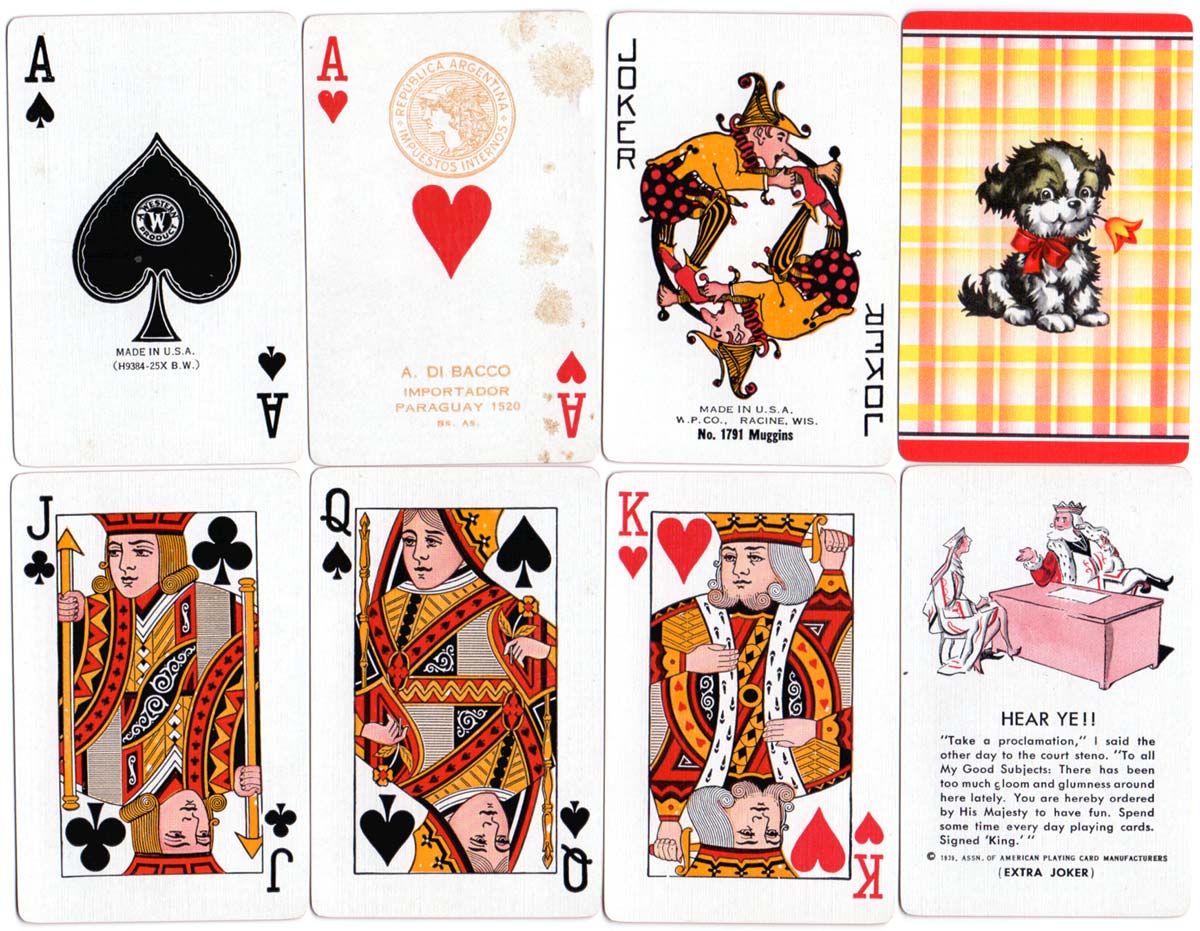
Above: cards from standard deck with gold edges and cute 'Puppy' back design, c.1940. This particular deck was imported into Argentina by the importing agent A. di Bacco, Paraguay 1520, Buenos Aires, whose details are overprinted on the Ace of Hearts along with the Argentinean importation tax stamp. The deck contains 52 cards + 1 double-ended Joker with the legend "No. 1791 Muggins" + 1 Extra Joker, with the legend "© 1939, Assn of American Playing Card Manufacturers".
Salesman’s Sample Cards
These sample cards are mostly blank on the faces but with various back designs giving an idea of the range of styles available. The complete packs would probably resemble the one shown above. An ace of spades is also present which has the production code 8808B-33A which suggests the year 1940.
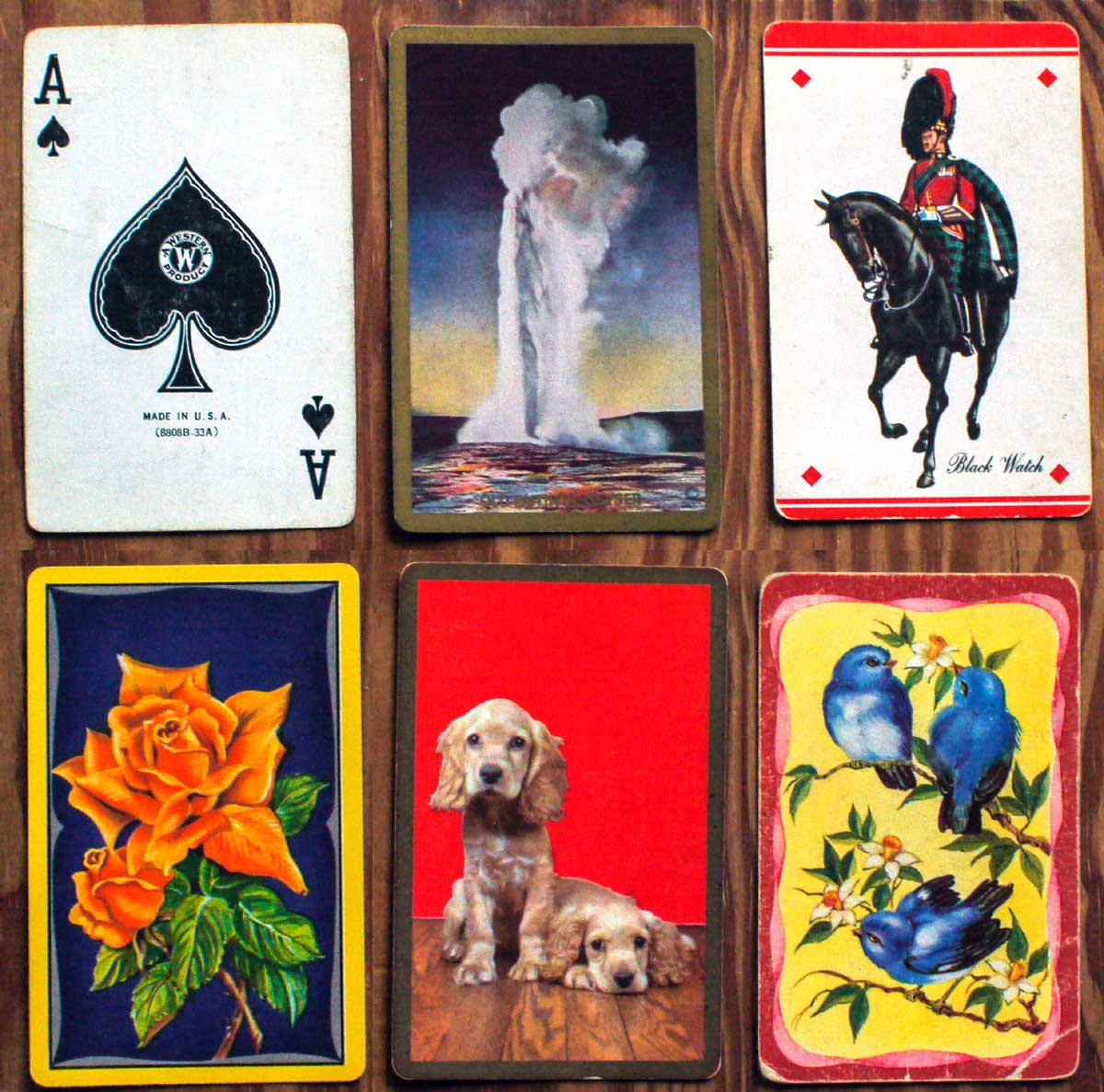
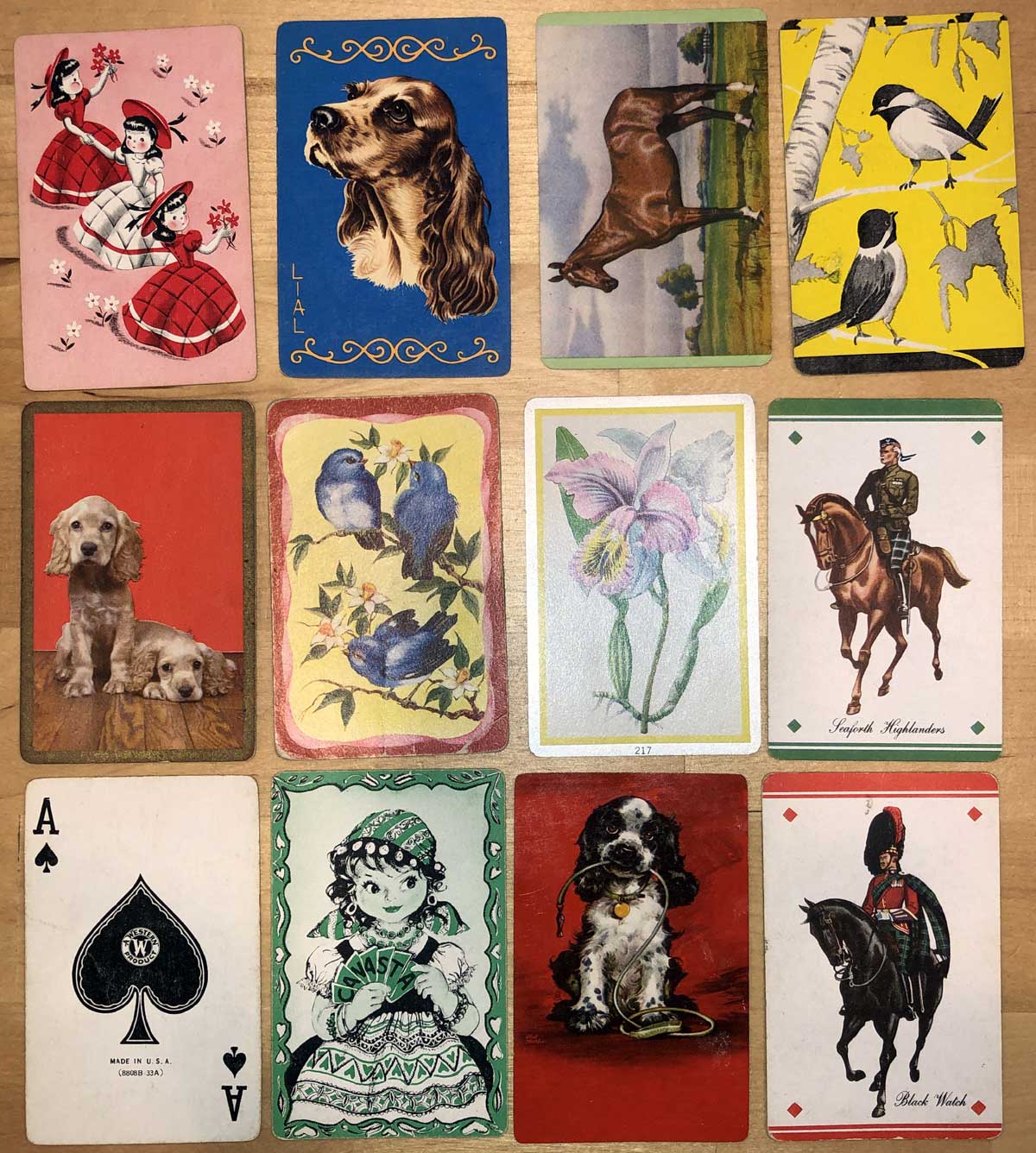
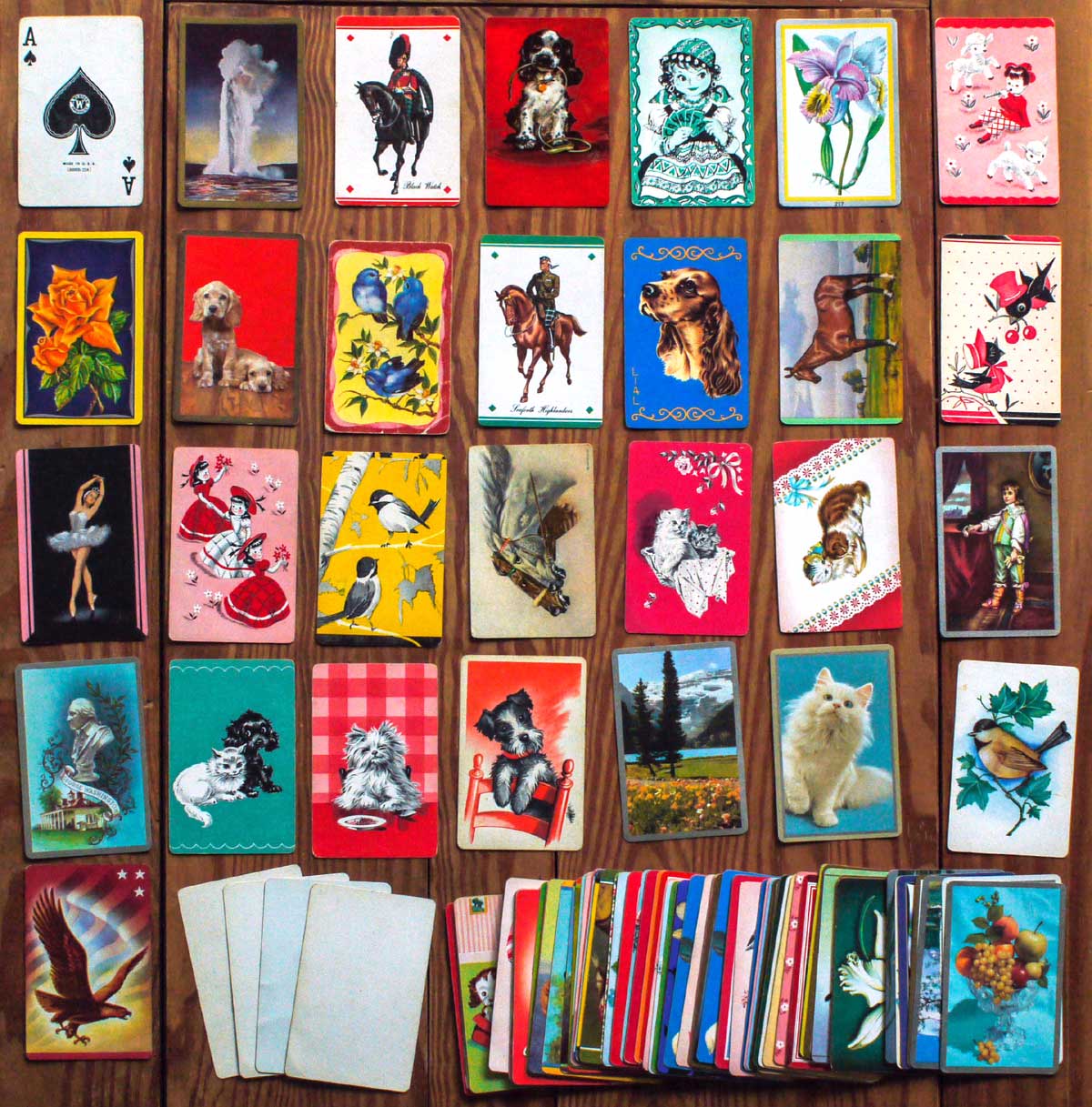
Above: a selection of Salesman’s sample cards, c.1940. Images courtesy David Fiorito.
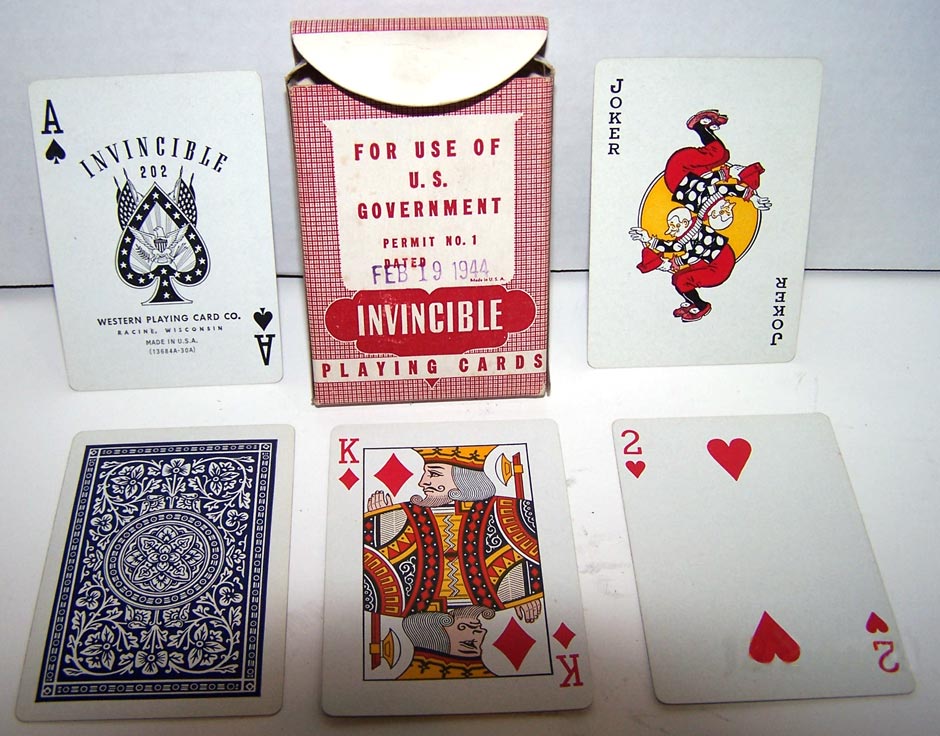
Above: deck of 'Invincible 202' playing cards issued as a gift of the American Red Cross (Not to be sold), for use of U.S. Government, linen finish, manufactured by Western Playing Card Co. during times of economic constraint, with over-stamp: "Feb 19 1944" on the box. The Ace of Spades seems to be based on a design inherited from The Western Press prior to 1927. A newer version of the Joker is used. Image courtesy Scott Blue.
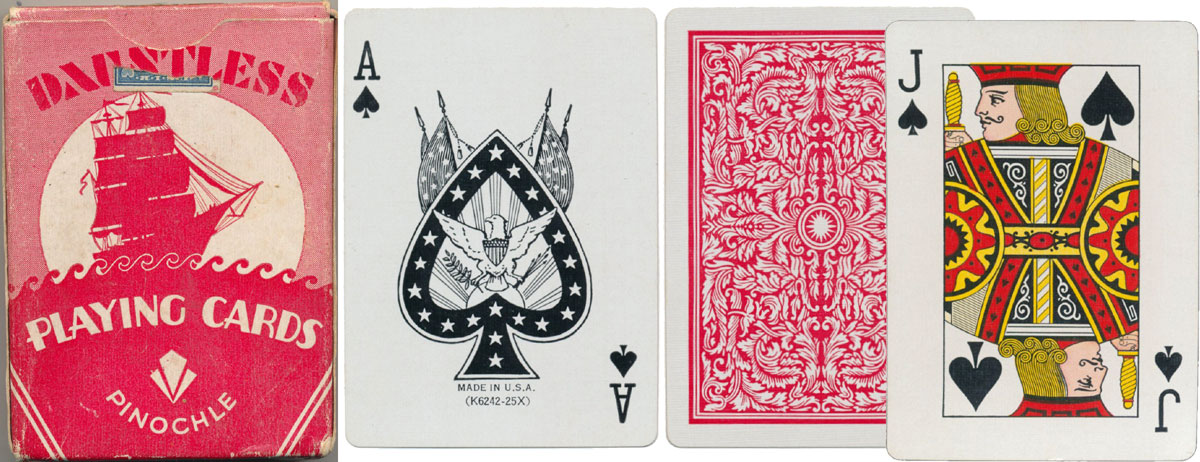
Above: Dauntless Pinochle deck, 1948. 48 cards in box. Image courtesy Matt Probert.
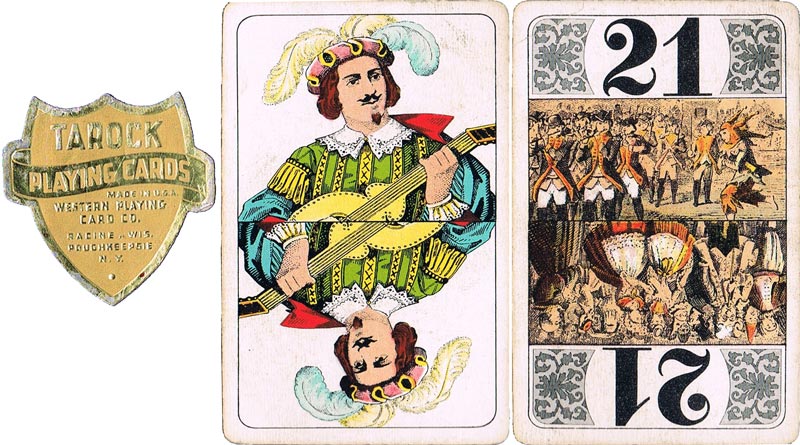
Right: Tarock pack published by Western Playing Card Co. Although the box label states 'Made in USA', the ace of diamonds has a Vereinigte Altenburger-Stralsunder logo, suggesting German manufacture. The trump cards show scenes of bourgeois life, and the minor cards have French suit marks. The cards are closer in size to "poker" decks (85x55 mm) than the size generally adopted by European makers. The back is a plain crisscross pattern of blue & brown. Image courtesy Anthony Lee.

By Simon Wintle
Spain • Member since February 01, 1996 • Contact
I am the founder of The World of Playing Cards (est. 1996), a website dedicated to the history, artistry and cultural significance of playing cards and tarot. Over the years I have researched various areas of the subject, acquired and traded collections and contributed as a committee member of the IPCS and graphics editor of The Playing-Card journal. Having lived in Chile, England, Wales, and now Spain, these experiences have shaped my work and passion for playing cards. Amongst my achievements is producing a limited-edition replica of a 17th-century English pack using woodblocks and stencils—a labour of love. Today, the World of Playing Cards is a global collaborative project, with my son Adam serving as the technical driving force behind its development. His innovative efforts have helped shape the site into the thriving hub it is today. You are warmly invited to become a contributor and share your enthusiasm.

Leave a Reply

Your Name
Just now Your comment here. Your comment here. Your comment here. Your comment here. Your comment here. Your comment here. Your comment here. Your comment here. Your comment here. Your comment here. Your comment here. Your comment here. Your comment here. Your comment here. Your comment here. Your comment here. Your comment here. Your comment here. Your comment here. Your comment here. Your comment here. Your comment here. Your comment here. Your comment here. Your comment here. Your comment here. Your comment here. Your comment here. Your comment here. Your comment here. Your comment here. Your comment here.
Related Articles
Romeo and Juliet
Unbranded ‘Romeo and Juliet’ backs by Russell Playing Card Company, c.1911.
Fortune Telling
Fortune Telling cards by Whitman Publishing Co., 1940.
Crazy Eights
Crazy Eights by Whitman Publishing Co., 1951.
Whitman 8 Game Box
Whitman 8 Card Games boxed set, 1951.

The Lumberjacks
2nd edition of Lumberjacks designed by Vadim Smolenskiy and manufactured by U.S.P.C.C.
Animal Tarot
Woodblock and stencil Animal Tarot cards, probably of Swiss origin, 2nd half 18th century.
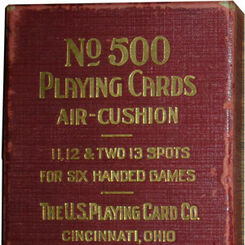
No.500 Playing Cards
No.500 Playing Cards published by U.S.P.C.C., c.1910

Bourgeois Tarot
Bourgeois Tarot by Vereinigte Altenburger und Stralsunder Spielkarten-Fabriken.
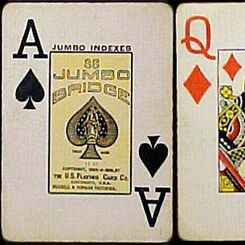
Jumbo Bridge 88
Cards with jumbo indices were introduced in 1895, and were given the subtitle '88'.
The United States Playing Card Company
Over the years the pressures of competition and other market forces have led to many smaller manufac...
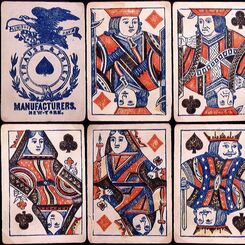
Strauss & Trier, c.1860
Strauss & Trier, New York, c.1860.
Thomas Crehore copy, c.1850
Thomas Crehore copy, c.1850.
U. S. A.
The manufacture of playing cards in America only began during the second half of the 18th century, a...

Ian Roth’s Unique playing cards
Ian Roth’s Unique playing cards

Pippoglyph
Pippoglyph Playing Cards by Ben Crenshaw © 2004
Bonnie Blue’s Rummy Cards
Bonnie Blue’s Rummy Cards.
Adametz, Vienna
Cards from a 54-card "Austrian Tarock" or "Industrie und Glück Tarock" pack made by Franz Adametz of...
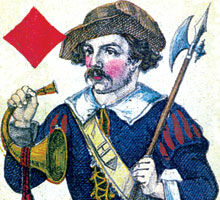
Danish Tarok Cards - Holmblad, c.1850
The traditional animal images on tarok decks are here substituted by images of buildings from Copenh...

Danish playing cards - Tarock trumps
Two versions of trump no.15 depicting the Thorvaldsen Museum.
4 Seasons Playing Cards
Colours of the Four Seasons - Playing Card Art Deck
Most Popular
Our top articles from the past 60 days