


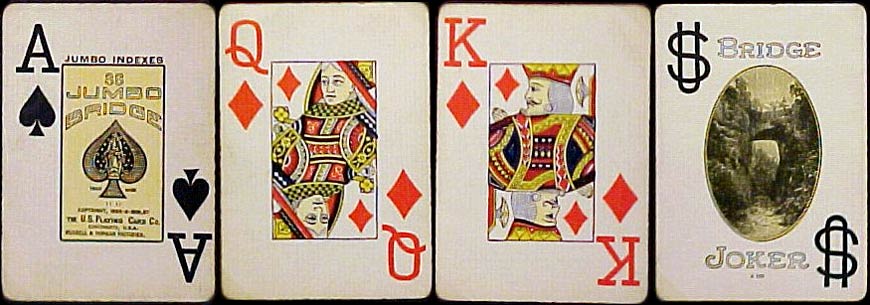
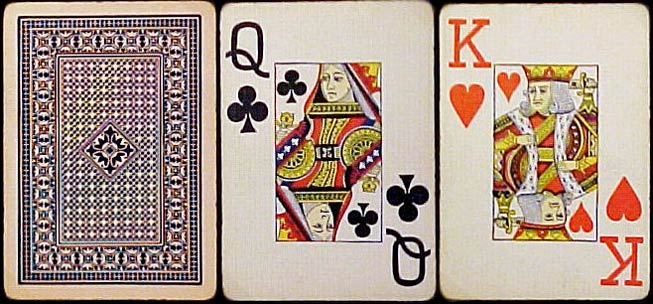
Jumbo Bridge 88
Cards with jumbo indices were introduced in 1895, and were given the subtitle '88'.
Jumbo Bridge 88
The United States Playing Card Company, 1917
Cards with jumbo indexes were first introduced by USPCC in 1895, and were given the subtitle '88'. Over the years wide and narrow-sized cards were issued, and a variety of Jokers were used, often taken from other brands.

By Simon Wintle
Spain • Member since February 01, 1996
I am the founder of The World of Playing Cards (est. 1996), a website dedicated to the history, artistry and cultural significance of playing cards and tarot. Over the years I have researched various areas of the subject, acquired and traded collections and contributed as a committee member of the IPCS and graphics editor of The Playing-Card journal. Having lived in Chile, England, Wales, and now Spain, these experiences have shaped my work and passion for playing cards. Amongst my achievements is producing a limited-edition replica of a 17th-century English pack using woodblocks and stencils—a labour of love. Today, the World of Playing Cards is a global collaborative project, with my son Adam serving as the technical driving force behind its development. His innovative efforts have helped shape the site into the thriving hub it is today. You are warmly invited to become a contributor and share your enthusiasm.

Activity for Jumbo Bridge 88
Sign in to comment or save this article.

Related Articles
Two consecutive 7 No Trumps contracts!
What are the odds?
Cheating at Whist and Bridge
The Blackleg in the Drawing-Room: Cheating and the Victorian Gentleman.
The Molassine Company and its link to Whist and Bridge
A savvy marketing strategy blending Victorian decorative design with Edwardian practicality.
Waddington’s faux books
Waddington’s faux book set containing four packs of playing cards and bridge markers.
Agatha Christie and Playing Cards revisited
Agatha Christie uses card-play as a primary focus of a story, and as a way of creating plots and mot...
Bourbon Bridge
Attractive, woodcut-style courts adapted for modern play.
The making of a Bridge or Bézique marker
This post-mortem was carried out on a Bezique marker which was already falling apart.
Sextet: 6 handed bridge
6 handed bridge playing cards designed by Ralph E. Peterson, 1966.
The Personalities and Books which shaped the game of Whist, 1860-1900
All the books described here are from Tony Hall's own collection, put together over years because of...
TDC Inc.
TDC Inc.: a 20th Century American Playing Card Maker.
Dal Negro Bridge set
Dal Negro Bridge set featuring old Vienna pattern courts.
Bridge Challenger®
“Bridge Challenger®” by Fidelity Electronics, 1975 - better living through science.
Progressive Whist Cards - page 2
Wireless Whist itself, in many forms...
Atlantic Playing Card Co
Atlantic Playing Card Co., Inc. promoted Bridge Ensemble boxes and companion accessories.
Canasta
Canasta is a card game of the Rummy family which originated in Uruguay probably about 1947.
Cribbage Board Collection part 4
A collection of antique and vintage Cribbage Boards by Tony Hall, part 4.
The Invention of Bridge
“The Invention of Bridge” - a humorous story by Larry Lefkowitz.
Club Bridge
Modiano’s ‘Club Bridge’ is a new edition of a stylish deck originally published in c.1895.
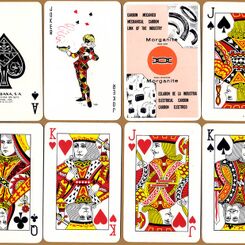
Bridge advertising playing cards by La Cubana
Bridge advertising playing cards for Morganite Carbon, manufactured by La Cubana, S.A., Tulipan 108,...
History and Evolution of Spades
History and Evolution of Spades
Most Popular
Our top articles from the past 60 days


