

Impuestos Internos Sobre Naipes
Duty was first introduced on playing cards in Argentina in 1892, as part of the Internal Duties law, and in 1896 the first duty labels were printed to be used on packets of 1 gross packs.
TAX - IMPUESTOS INTERNOS sobre NAIPES
In 1816 imported, foreign playing cards were taxed at 30 reales per dozen packs. As a precaution, locally produced packs were stamped on the two of swords, and imported ones on the two of coins. On June 27, 1842 tax was imposed on playing cards by General Antonio López de Santa Anna. The treasury would control the manufacture and sale of playing cards through the tobacconists. Auditable accounts were required.
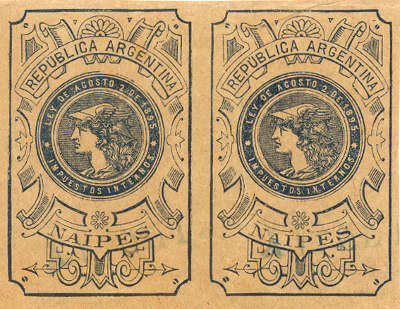
In 1892 the Internal Duties law was passed (no.2856) introducing the use of a tax stamp to be affixed around each gross of playing cards. The example shown (left) refers to a law of 2nd August 1895. In 1899 these were replaced by bands, initially for a dozen packs and then for single packs. There were several laws and decrees enacted which varied the details of the tax bands and stamps over the years.
The 'Boletín Oficial' dated 26th January 1899 (Official Government Bulletin) states that the inland revenue tax bands on playing cards shall be black for home-produced packs, and red for imported packs. It appears that the colour of these tax bands varied in the course of time, as well as the colour of the tax stamps themselves (below). Furthermore, the bulletin also states that the manufacturer must print his name and address on each outer wrapper, and also submit the four of cups (in Spanish-suited packs) or the ace of hearts (in Anglo-American style decks) for a control stamp to be applied, and that this card, once stamped, must be left outside the wrapper for inspection. Similar regulations governed the supplies of cardboard which also were officially controlled. Offenders were fined.
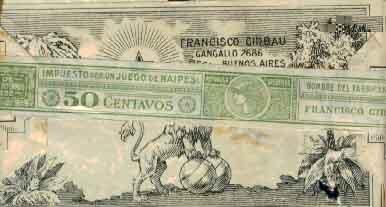
Left: green tax band (50 centavos) on outer wrapper of a standard pack made by Francisco Girbau, Buenos Aires, c.1925. "Ley de Impuestos Internos No.11252" of 1923. There was also a family of Girbaus manufacturing playing cards in Igualada (Spain) during the 1880s. The trade mark of a lion standing on two hemispheres beneath a radiant sun was used by several Spanish manufacturers of this time, referring to Spain and Hispano-American colonisation. (Image courtesy of Jose Luiz G Pagliari.)
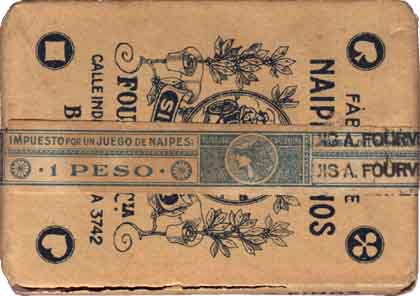
Left: blue tax band (one peso) on outer wrapper of a standard 'Side-Car' pack made by Luis A. Fourvel & Cia., Buenos Aires, c.1945. The manufacturer was also required to print his name and address on the tax band, as shown here. The tax band refers to "Decreto No. 18,235" which was used between 1944-64.

Above: a 50 centavos green tax band from a pack imported from Spain c.1930, referring to "Ley de Impuestos Internos No. 11,252" which was used between 1924-43. The box at the right-hand end contains the name of the importing agent: Casa Bertrand Domec de F. Fernández y J. Fagoaga.

Above: a rare 50 centavos blue tax band from a pack manufactured in Buenos Aires for Apeles S.A., referring to "Decreto No. 18,235" which was used between 1944-64. The box at the right-hand end contains a stamp which reads: C. A. 14 which must have been the code for the manufacturer.

Above: tax band from a pack manufactured in Buenos Aires by Igor L. M. Domicelj, referring to "Decreto No. 18,235" which was used between 1944-64.

Above: tax band from pack manufactured by Justo Rodero e Hijos S.R.L. in around 1950, also referring to "Decreto No. 18,235" which was used between 1944-64, although the image of Mercury has been changed to Marianne.

Above: tax band from a pack manufactured in Buenos Aires by Cappellano S.A. c.1960, referring to "Decreto No. 18,235" which was used between 1944-64.

Above: tax band from a pack manufactured in Buenos Aires by Paisanito S.R.L. c.1953, referring to "Decreto No. 18,235" which was used between 1944-64. The amount of tax can be 50 centavos or 1 peso.
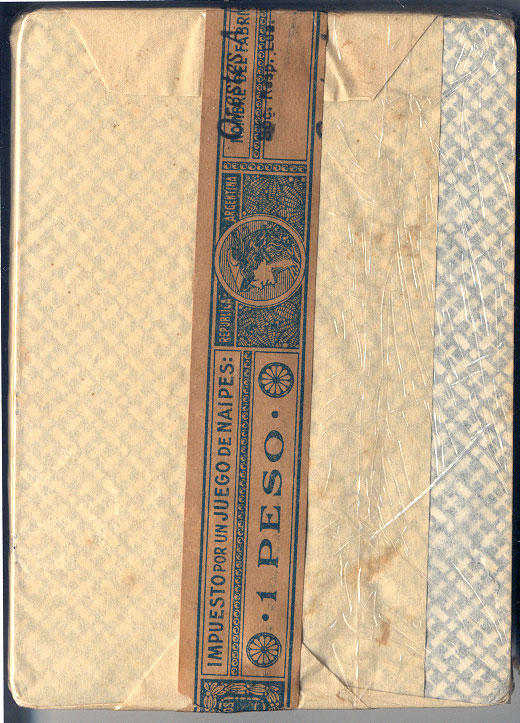
Above: 1 Peso blue tax band, normally used on imported decks, but occasionally used on home-manufactured ones, as in this case from a pack manufactured in Buenos Aires by Orestes A. Cappellano, c.1944, referring to "Decreto No. 18,235" which was used between 1944-64.

Above: tax band from a pack manufactured in Buenos Aires by Paisanito S.R.L. c.1953, referring to "Decreto No. 18,235" which was used between 1944-64. The amount of tax can be 50 centavos or 1 peso.

Above: 2 peso yellow tax band from an imported pack, referring to "Decreto 18,235" used between 1944-64.

Above: tax band from an imported pack, referring to "Ley No. 16,656/64" used between 1965-7. The amount of tax can be 5 or 10 pesos.
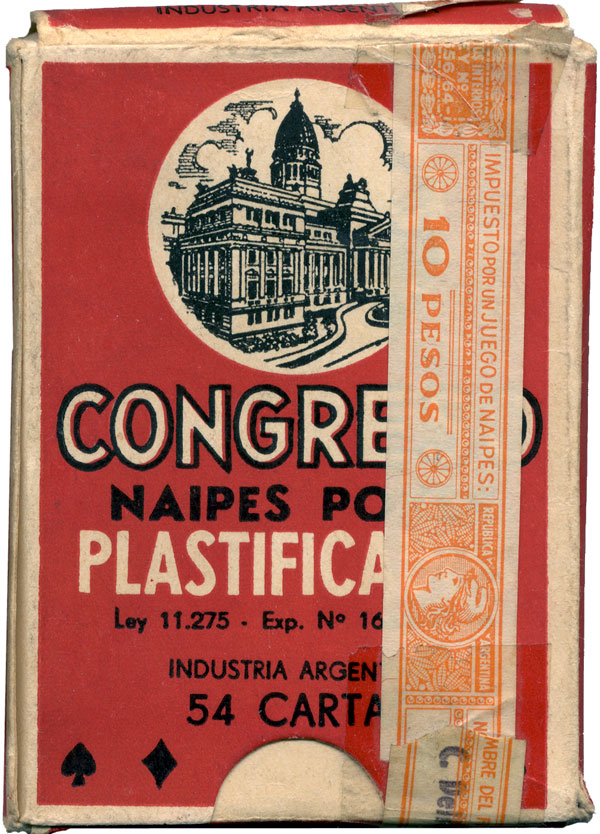
Above: tax band from a pack manufactured in Buenos Aires by Carlos della Penna, referring to "Ley No. 16,656/64" (1965-7). The amount of tax can be 5 or 10 pesos.

Above: tax band from a children's card game manufactured in Buenos Aires by Juegos Victoria, referring to "Ley No. 17,196" (used between 1965-7). The amount of tax can be 10, 20 or 40 pesos.


Above: 3½ Peso tax bands for 12 imported packs, c.1900-1915.

Click image to see more
The tax stamp was printed onto the four of cups for Spanish-suited packs, or the ace of hearts for Anglo-american decks. The earliest examples appear after 1892, in black. A pale brown version was used on imported cards. There are at least three versions of the "Mercury" stamp, with slight differences in the engraving or lettering. The last type ("Marianne") appeared in 1953. Tax on playing cards was abolished in 1968.
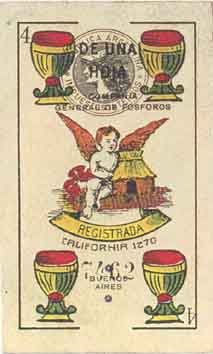
Black tax stamp on a pack made by Compañia General de Fosforos, Buenos Aires in c.1915. (Image courtesy Enrique García Martín).
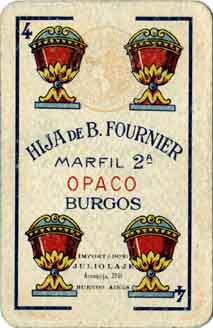
Pale brown 'import' tax stamp on a pack made by Hija de B. Fournier, Burgos (Spain) in c.1930 for export to Argentina. The name of the Argentinean importer, Julio Laje, Buenos Aires can be read at the bottom of the card. (The five of swords has the normal Spanish 'Exportación' tax stamp on it).
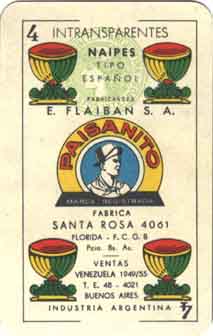
Green domestic production tax stamp on a 'Paisanito' Spanish-suited pack manufactured by E. Flaiban, Buenos Aires, c.1955.
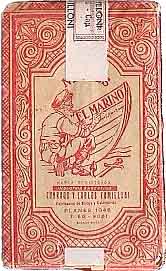
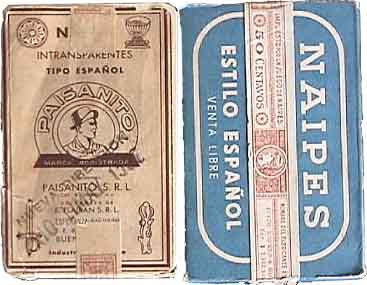
Above: three packs in wrappers with tax bands. (Images courtesy Andrea Pollett.)

By Simon Wintle
Spain • Member since February 01, 1996 • Contact
I am the founder of The World of Playing Cards (est. 1996), a website dedicated to the history, artistry and cultural significance of playing cards and tarot. Over the years I have researched various areas of the subject, acquired and traded collections and contributed as a committee member of the IPCS and graphics editor of The Playing-Card journal. Having lived in Chile, England, Wales, and now Spain, these experiences have shaped my work and passion for playing cards. Amongst my achievements is producing a limited-edition replica of a 17th-century English pack using woodblocks and stencils—a labour of love. Today, the World of Playing Cards is a global collaborative project, with my son Adam serving as the technical driving force behind its development. His innovative efforts have helped shape the site into the thriving hub it is today. You are warmly invited to become a contributor and share your enthusiasm.

Leave a Reply

Your Name
Just now Your comment here. Your comment here. Your comment here. Your comment here. Your comment here. Your comment here. Your comment here. Your comment here. Your comment here. Your comment here. Your comment here. Your comment here. Your comment here. Your comment here. Your comment here. Your comment here. Your comment here. Your comment here. Your comment here. Your comment here. Your comment here. Your comment here. Your comment here. Your comment here. Your comment here. Your comment here. Your comment here. Your comment here. Your comment here. Your comment here. Your comment here. Your comment here.
Related Articles

Naipes Gauchescos Argentinos
“Naipes Gauchescos Argentinos” with re-styled Spanish suit-symbols reflecting Argentinean culture, 2...
La Cumparsita Tango deck
Tango playing cards manufactured in Argentina, 2001.
G. Berger, Buenos Aires, c.1935-50
Berger also produced a Hungarian-type "Seasons" pack with the brand name "La Estrella" and a six-poi...

Fours of Cups
Over the years the company evolved, and changes in the company's name and address can be seen reflec...
Anonymous manufacturers 1
Argentina has produced a series of anonymous decks, both Spanish-suited and Anglo-American type and ...
Anonymous manufacturers 2
Argentina has produced a series of anonymous decks, both Spanish-suited and Anglo-American type and ...

Standard playing cards manufactured by Joker S.A.
Standard playing cards manufactured by Joker S.A.

Alvarez Holmberg y Cia,
Alvarez Holmberg y Cia, playing card manufacturer, Buenos Aires, Argentina, c.1950-70

Argentinian Playing Cards - Naipes Argentinos
Playing cards were introduced to the Americas by Spanish explorers in the 16th century.

Naipes La Banca
Naipes La Banca, Argentina c.1970-85.

Imported Argentinean Playing Cards
There has been a number of importing agents, as well as manufacturers from other countries, who have...

Cía General Fabril Financiera S.A.
Founded in 1889 as Compañía General de Fósforos, and favoured by certain economic factors, the firm ...
List of Argentinian Playing Card Manufacturers
List of Argentinian Playing Card Manufacturers from the 19th and 20th centuries.
La Primitiva, Victoria 3179, Buenos Aires
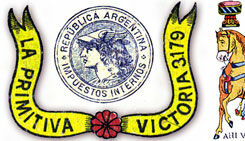
La Primitiva, Victoria 3179, Buenos Aires c.1878-1920, manufacturers of paper and playing cards.
Ricardo Sopena
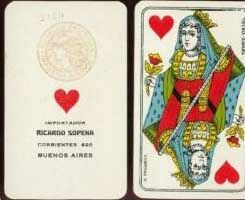
Argentina importing agent Ricardo Sopena, Corrientes 920, Buenos Aires
Ernesto Flaiban - Quality Control
Sr. Ernesto Flaiban, founder and president of E. Flaiban S.A., is seen here checking the quality of ...
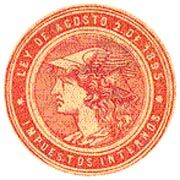
Argentina Tax Stamps on playing cards 1895-1968
Argentina Tax Stamps on playing cards 1895-1968
Nascal S.R.L., Buenos Aires, 1960-80
Nascal S.R.L., Paisandu 760, Buenos Aires c.1960-80, manufacturers of plastic playing cards.

Souvenir Playing Cards
Argentina publishes many tourist souvenir packs, usually with colour pictures on each card, and with...

Uruguay playing card tax
In 1806 the Council of Concepción del Uruguay imposed an 8 Peso tax on card and billiard tables on a...
Most Popular
Our top articles from the past 60 days


