


Austrian Tarock by S.D. Modiano
Modiano’s Austrian Tarock with country scenes has been in production for over 100 years.
In 1868, the young Saul David Modiano (1834-1922) founded a company in Trieste to import and export cigarette papers. The cosmopolitan environment of the then 4th largest city in Austria-Hungary offered business opportunities even for immigrants from Macedonia (at that time part of the Ottoman Empire), which he was. His dynamic company flourished and adopted the new lithographic printing process which facilitated diversification into production of postcards. In addition, the acquisitions of competing companies also benefitted the playing card department. Today, Modiano is one of the two (main) remaining manufacturers of traditional Italian card designs.
As this deck demonstrates, at the beginning of the 20th century, one of S.D. Modiano’s products was a deck of Austrian tarot cards. The trumps contain a set of genre scenes that correspond to the Type B typology according to Sylvia Mann. This classification is also used by the International Playing-Card Society.
The tax stamp visible on the ace of hearts dates the deck to the period 1900-1920. The old company trademark with a centaur can also be seen there. Further identification of the manufacturer is given on the jacks of diamonds and clubs - quite in keeping with the traditional Austrian tarot design.
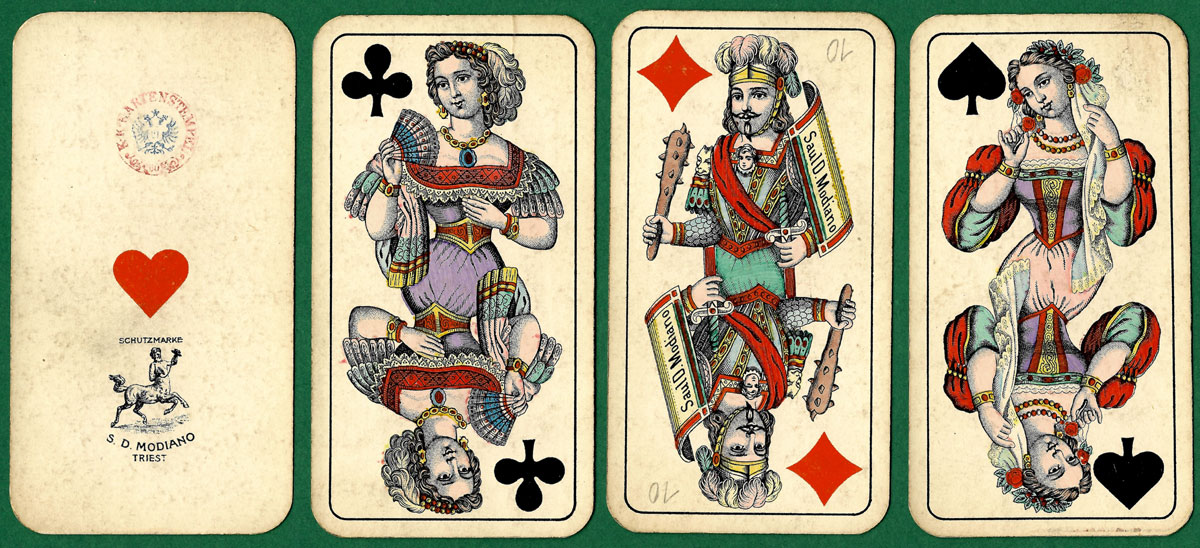
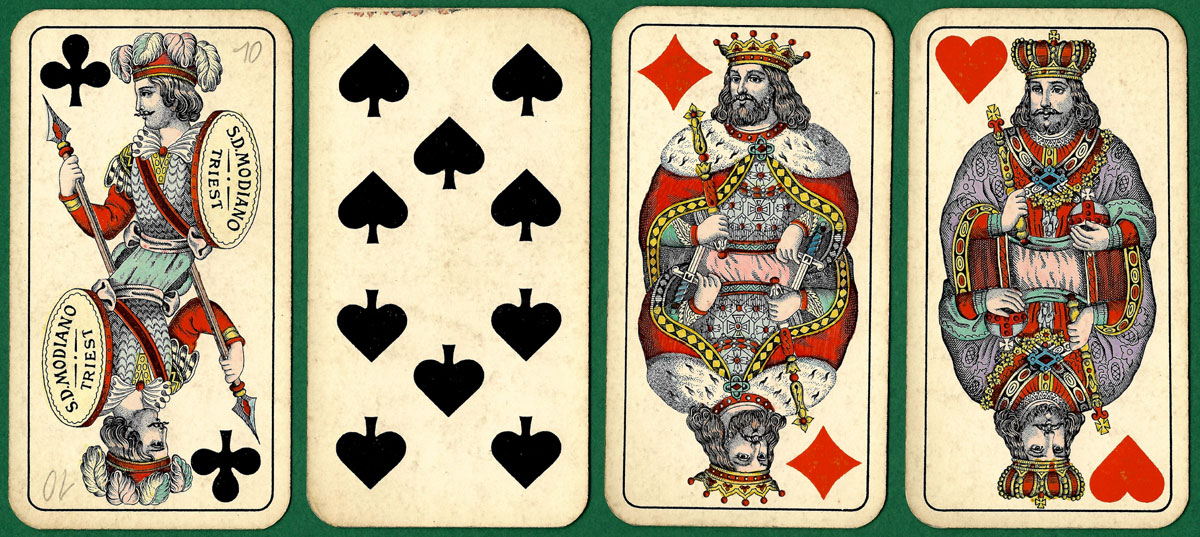
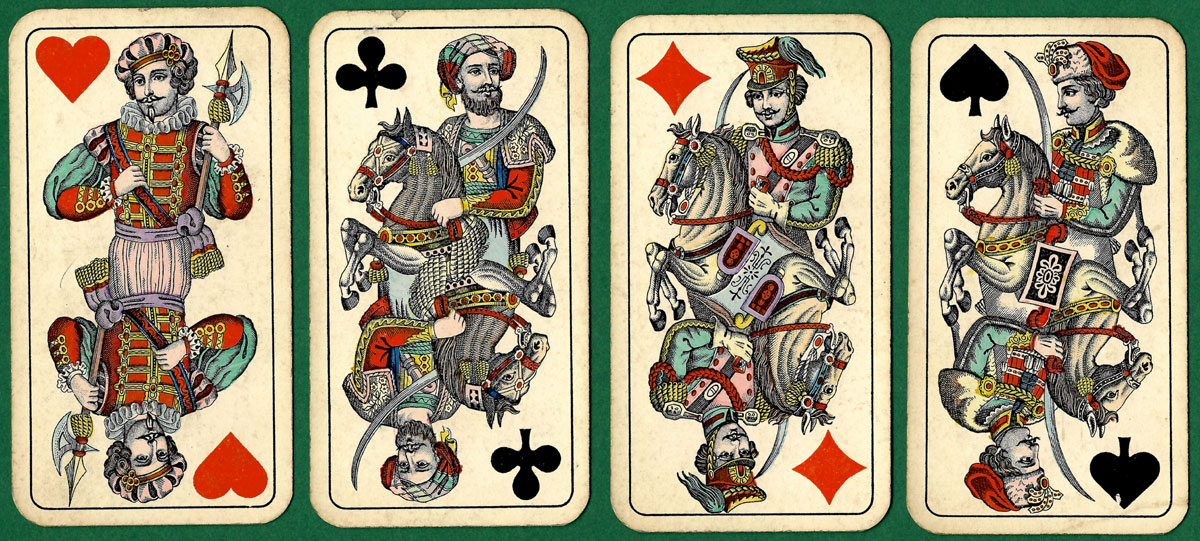
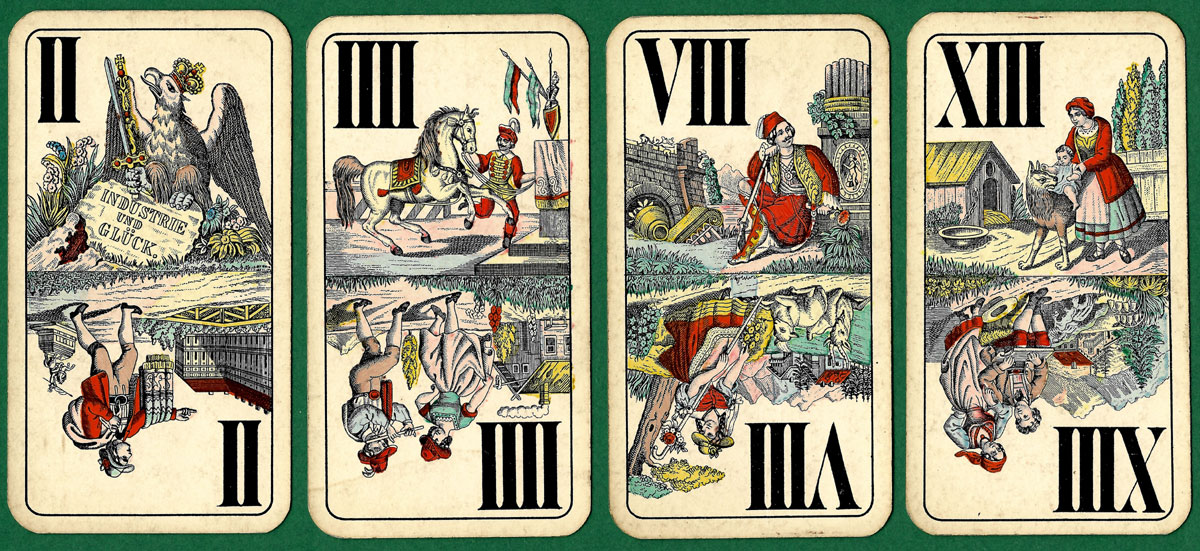
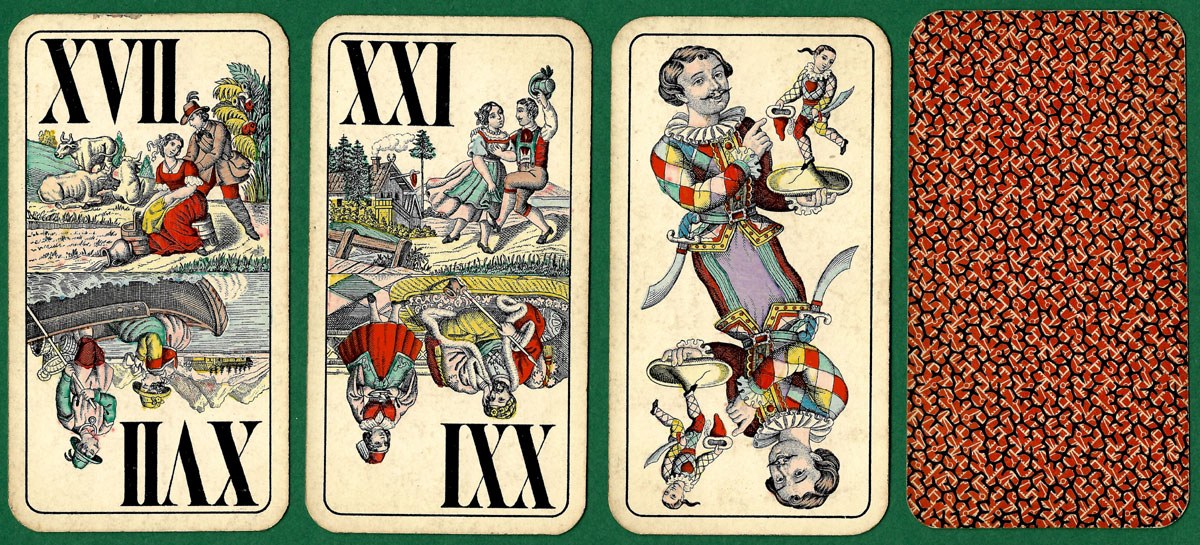
Above: Austrian Tarock type 'B', produced by S.D. Modiano, Trieste, 1914.
The reverse side with a pattern called wienerbitz (Viennese lightning) in a more recent production is shown below. During this period, Modiano used black lines on the reverse side that were much thinner than is common with other manufacturers.
Even today, after a hundred years, a Modiano deck can be purchased under the name Tarocco Nr. 500 with the same set of genre scenes typical of Austrian Tarock Type B. This pattern is now a minority; the majority of production contains scenes corresponding to Austrian Tarock Type C.
After the Second World War, the manufacturer’s trademark and the name was changed. Today, Modiano’s production is associated with the typical jumping deer motif.
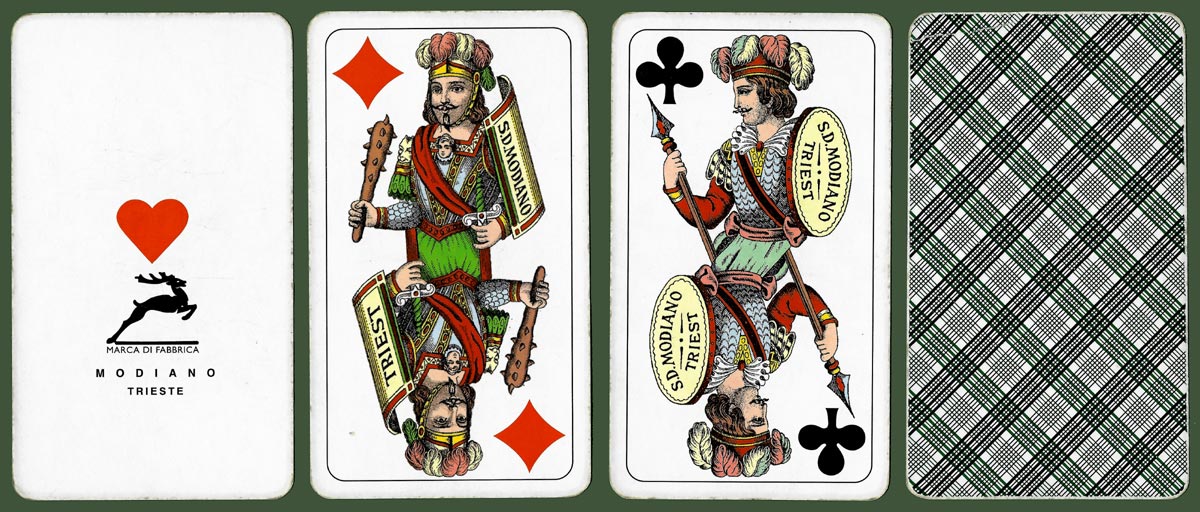
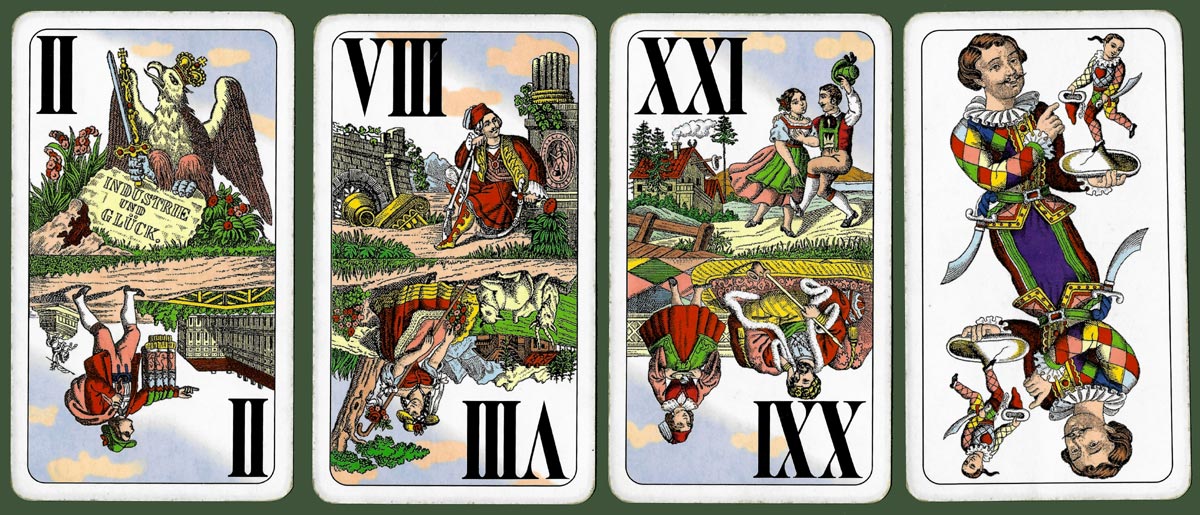
Above: modern Austrian Tarock, produced by Modiano, Trieste.
When comparing these two products, I have doubts whether the digitization of the printing process can be described as progress.
References
History of Modiano www.modiano.it/en/our-history►
Peter Endebrock’s tax stamp database►
I.P.C.S. pattern sheet specification: Austrian Tarock Type B►
By Marek Brejcha
Czech Republic • Member since June 13, 2024
My relationship with cards grew from playing to collecting and transformed into publishing as well. I am part of the team at Counter Clockwise, a small company that publishes traditional card games.

Activity for Austrian Tarock by S.D. Modiano
Sign in to comment or save this article.

Related Articles
Modiano Napoletane Cards
From Trieste with Pride – a 150th Anniversary Edition of the Neapolitan Pattern.
Czech National Patterns by S.D. Modiano
Modiano produced cards with the Prague and Trappola patterns in the early 20th century.
Emilio Tadini playing cards
Beautiful dreamlike playing card designs by Emilio Tadini.
Alan Tarot Deck
Reprint of a Tarock pack originally designed by Argio Orell for the Austrian Lloyd shipping company....
Oriental Scenes tarock
Trumps have oriental scenes on one end of the card, and mermaids, mermen, assorted sea serpents and ...
Venetian Tarot
Scenes from the history of Venice on a set of the major arcana.
Il Quinto Seme
An Italian pack with a fifth suit of “amici” (“friends”).
Triestine Pattern
The Triestine pattern is derived from the Venetian (Trevisane) pattern but with its own characterist...
Primiera Bolognese
Primiera Bolognese by Modiano, c.1975
Bergamasche Pattern
Bergamasche Pattern by Modiano, 1970s.
V. F. Solesio Tarot
V. F. Solesio Tarot, Genoa, mid-late 19th century.
Tarocco Siciliano
The highly individual Sicilian Tarot has the Italo-Portuguese suit system with straight, interlockin...
Club Bridge
Modiano’s ‘Club Bridge’ is a new edition of a stylish deck originally published in c.1895.
Piacentine Pattern
Piacentine Pattern, several double-ended versions.
Tarocco Piemontese | Piedmontese tarot
The double ended version of the Piedmontese Tarot evolved during the second half of the nineteenth c...
XV Century Italian Playing Cards
Cards from a pack of an early form of north Italian playing cards, with the swords back-to-back and ...
Tarocco Milanesi by Lamperti (Milan) c.1850
Tarocco Milanesi by Lamperti (Milan) c.1850
Sicilian Pattern
The Sicilian pack has a similar composition to the Neapolitan pack, and is small and squat in appear...
Neapolitan Pattern
Cartine da Gioco Vesuvio miniature Neapolitan pattern.
Hand-Painted Tarocchi Cards
Hand-painted Tarocchi cards sometimes known as ‘Charles VI tarot’, North Italy, 1475-1500.
Most Popular
Our top articles from the past 60 days


