


Feine Quitli Karten
A living fossil - typographic minimalism from Vienna, c.1900.
Last November, I received an email from a stranger in my inbox. It is the story of a collector, and I would like to share it. Stefan R. lives in Vienna. He has a favourite store where he likes to go and check out what's new in card games. The store offers a wide range of products from the local company Ferd. Piatnik & Söhne, and you can also order something from the catalog that is not currently in stock. (I think Stefan prefers the William Tell design, but that's not important). On the shelf among the others, Stefan noticed a box with special card decks. The covers are completely white, without any description, and are sealed in foil.
Even the salesperson doesn't know what they are, but you definitely have to buy them first and then unwrap them! Stefan is willing to pay the few euros for the surprise.
The card decks he found contain Feine Quitli Karten from Piatnik. A touch of history that is known to exist, but I think many people have never held it in their hands. Bold, high-contrast numerals provide the sole visual focus — the cards dispense entirely with pictorial or suit imagery apart from a cartouche on the 2 and 11. Several articles about these cards have appeared in The Playing-Card magazine in the past, but today there are also e-shops that offer the cards. However, the card manufacturer's product catalog does not normally display them.


Above: Feine Quitli Karten published by Piatnik, Vienna, undated.
It is clear that the second half of the 20th century had no influence on the design of these traditional cards. However, the number of cards in the deck is new information. One box contains 48 cards, i.e., 4 sets of cards numbered 1 to 12. Existing sources always mention the use of only two sets, i.e., 24 cards. I considered the limited number of cards in the deck to be an advantage that shifts the random gambling principle of the game (a variant of Blackjack) closer to conscious play, which I consider more suitable for "family" use. (The cards can also be used to play a simple game of Pairs or to teach children arithmetic.) The 48-card design suggests use in a professional gaming room.
While searching the internet, Stefan came across my activities related to this game and contacted me with a request for more information. One thing led to another, and today I also have my own deck of Feine Quitli Karten. When purchasing them for me, he also managed to take a photo of the box containing the decks of cards. Note: the spelling on the box reads "Quittli" which will probably be Yiddish and related to the delivery to Tel Aviv.
By Marek Brejcha
Czech Republic • Member since June 13, 2024
My relationship with cards grew from playing to collecting and transformed into publishing as well. I am part of the team at Counter Clockwise, a small company that publishes traditional card games.

Activity for Feine Quitli Karten
Sign in to comment or save this article.

Related Articles
Luxury No. 2167
A Piatnik classic that lives up to its title.
Art pack I
Art pack featuring Old Masters, including Bruegel, Vermeer, Titian, Raphael, Caravaggio, Canaletto, ...
Lenormand Wahrsage-Karten No. 55
Conventional Lenormand designs on a pack from Piatnik but with unconventional numbering.
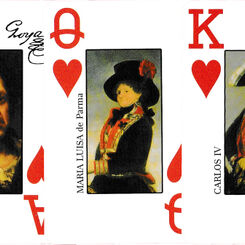
Museo del Prado
Museo del Prado: Pintores y familias reales / Painters and royal families playing cards.
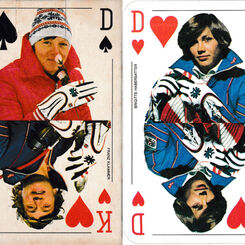
Rika playing cards
Playing cards depicting famous Austrian skiers of the 1970s.
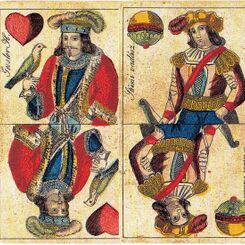
Tell Wilmoś
Facsimile of ‘Wilhelm Tell’ Hungarian deck by Salamon Antal, Keczkemét, 1860.
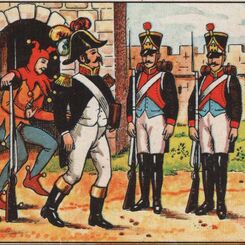
Bourgeois Tarot by Piatnik 1987
Piatnik’s ‘Bourgeois Tarot’ in a version published in 1987 with nice quality images, especially the ...
Piatnik No.97
Non-standard French-suited cards published by Ferd Piatnik & Sõhne, Vienna, c.1940s.
Vienna (ex-Lyon) pattern
‘Vienna pattern’ derived from archaic Lyon pattern by Ferd Piatnik & Söhne A.G., c.1926-1934.
48: Ferdinand Piatnik & Sons
Ferd. Piatnik produced a very large range of cards with many different standard and non-standard pat...
Popular No.257
Piatnik’s “Popular Playing Cards” No.257
Salzburger Pattern
Salzburger pattern by Ferd. Piatnik & Söhne, Vienna
Die Neue ÖVP
Promotional deck for the Austrian People’s Party (ÖVP) printed by Piatnik, 1996.
Blue Playing Cards
“Blue Playing Cards” by Piatnik, 1960s, inspired by the Cubism art movement in which objects are ana...
El Jokey by Piatnik, 1990s
‘El Jokey’ Spanish-suited pack by Piatnik & Sons, Vienna, 1990s
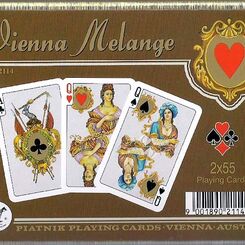
Vienna Melange
“Vienna Melange” Playing Cards by Piatnik with a historical feel representing the four races that ma...
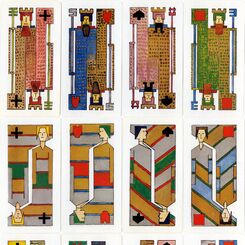
Arnold Schönberg
In around 1909 he created three sets of playing cards. His inventiveness was driven by a passion for...
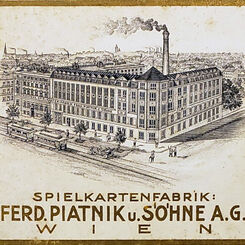
Ferd. Piatnik & Söhne
Ferdinand Piatnik was born in Ofen on October 14, 1819.
Piatnik Tarock
Deck of "Industrie und Glück" or "Rural Scenes" tarock cards manufactured by Ferd Piatnik & Söhne, V...
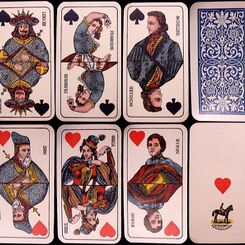
Literary Figures
Non-Standard Literary Figures playing cards manufactured by Ferd. Piatnik & Söhne A.G., Vienna, 1924...
Most Popular
Our top articles from the past 60 days


