


Zdeněk Mézl's Fortune Telling cards
A thematic deck from Czechoslovakia.
The post-war socialist regime in Czechoslovakia aimed to organize society on a "rational, scientific basis," but this was primarily a matter of ideological rhetoric, not practical reality. Such a society, in theory, had no need for fortune-telling cards. However, in 1967 the state publishing house Mladá Fronta managed to remedy the situation by issuing this cartomancy deck as a special New Year publication. In the product description, the word ‘card’ is hidden behind the word "cedulka" with a meaning closer to ‘sign’ or ‘label’.
The cards were designed by L. Salačová and the graphics were handled by Zdeněk Mézl, a master of woodcut technique. The overall theme is based around the subject matter of the client : i.e. book publishing and its associated professions and situations. The imagery reflects the aesthetics of early 20th century Austria-Hungary. An unambiguous reference is the stamp shown on the card Bureau (Úřad) with the initials C.K., the original meaning of Emperor and King is associated with the monarchy.
The deck contains 32 cards measuring 58 x 88 mm + one extra card with a short description and publisher's information. The cards present the usual Fortune Telling Cards format. The image is supplemented with a title in Czech. Recommended interpretations of a specific situation are placed under the card title, excepting only the figures of the Lord (Pán) and the Lady (Dáma). However, the interpretations often contain sarcastic humour that undermines the seriousness of the game.
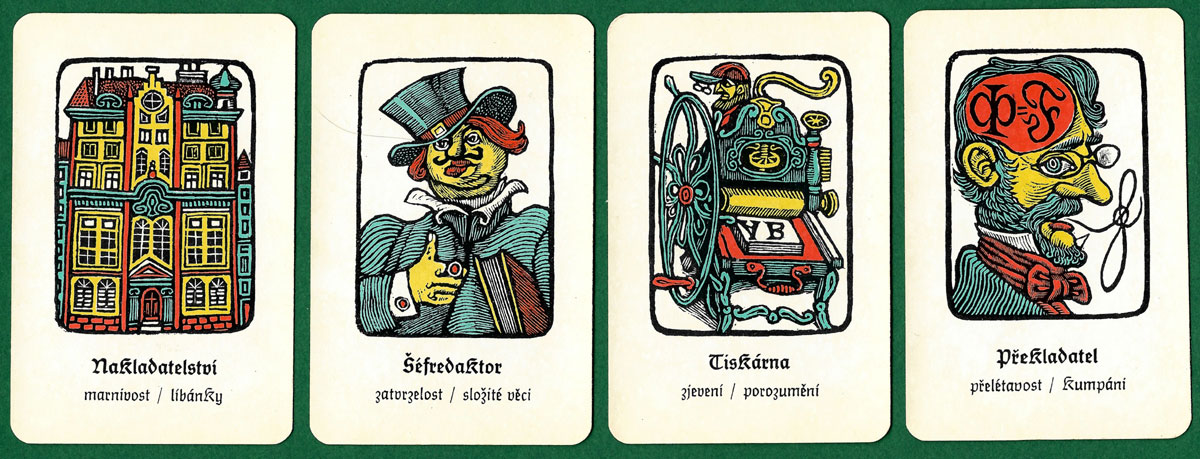
Above: Nakladatelství = Publisher; vanity/honeymoon • Šéfredaktor = Editor-in-chief; stubbornness/complicated matters • Tiskárna = Printer; revelation/understanding • Překladatel = Translator; flightiness/cronies.
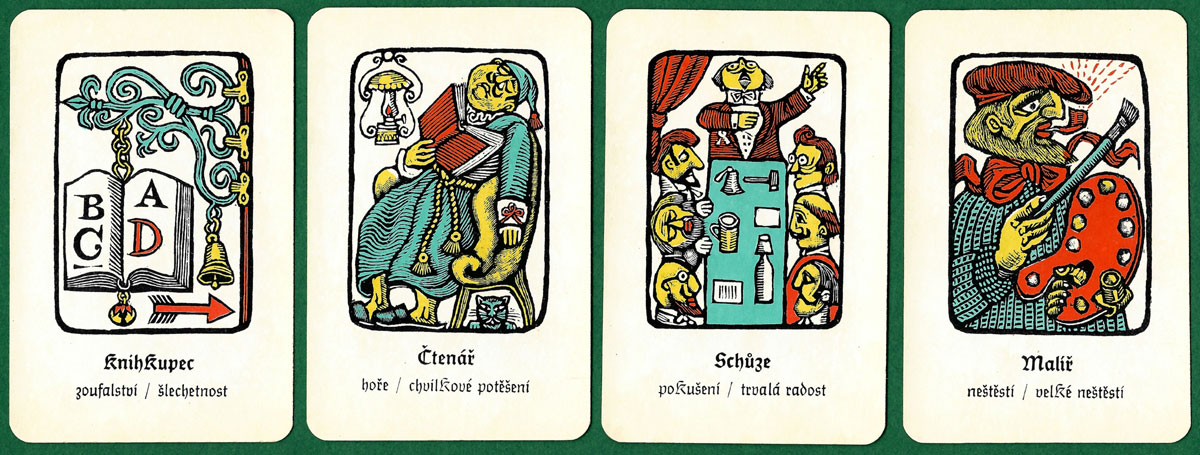
Above: Knihkupec = Bookseller; despair/nobility • Čtenář = Reader; grief/momentary pleasure • Schůze = Meeting; temptation/lasting joy • Malíř = Painter; misfortune/great misfortune.
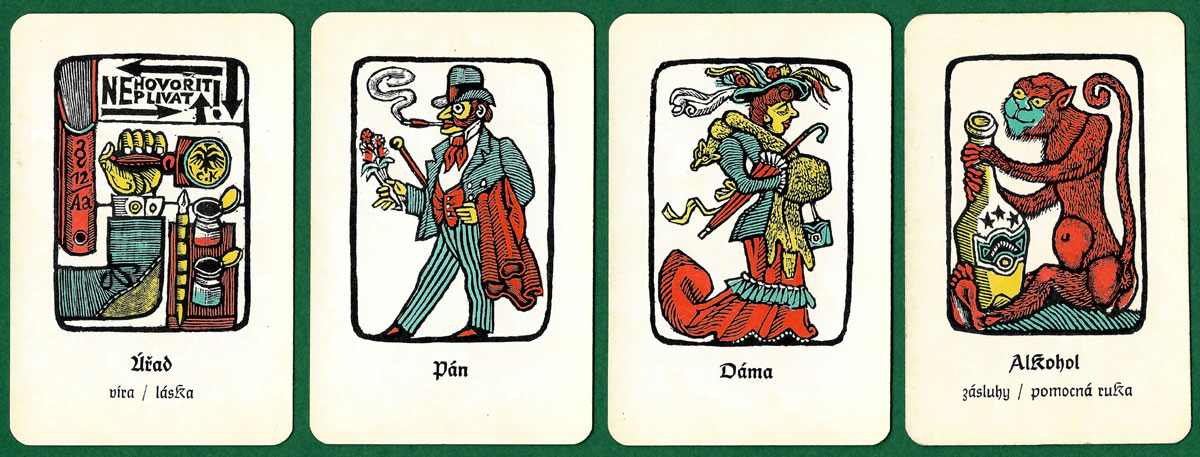
Above: Úřad = Bureau; faith/love • Pán = Gentleman • Dáma = Lady • Alkohol = Alcohol; merit/helping hand.
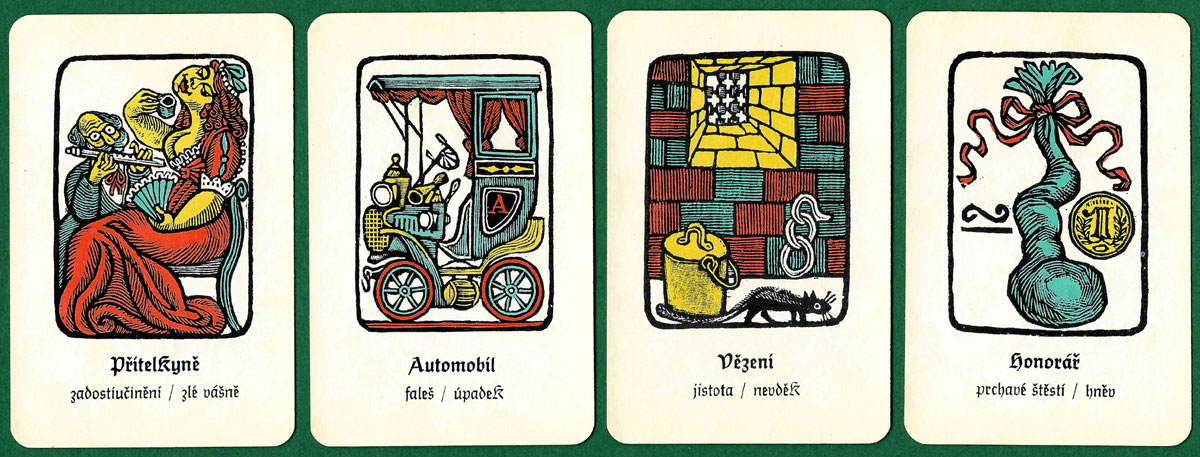
Above: Přítelkyně = Girlfriend; satisfaction/evil passions • Automobil = Car; falsehood/decay • Vězení = Prison; certainty/ingratitude • Honorář = Fee; fleeting happiness/anger.
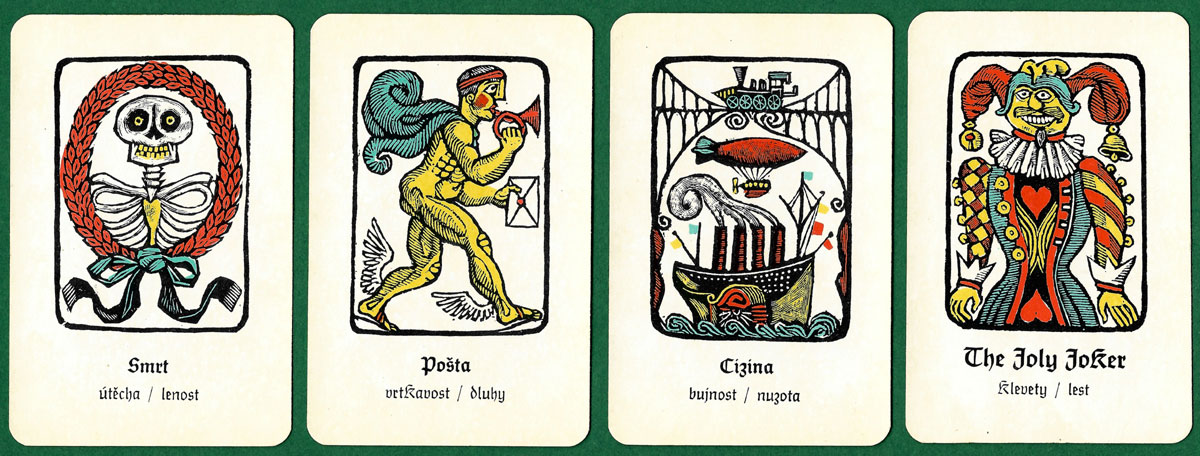
Above: Smrt = Death; consolation/laziness • Pošta = Mail; fickleness/debt • Cizina = Abroad; exuberance/poverty • The Joly Joker; gossip/cunning.
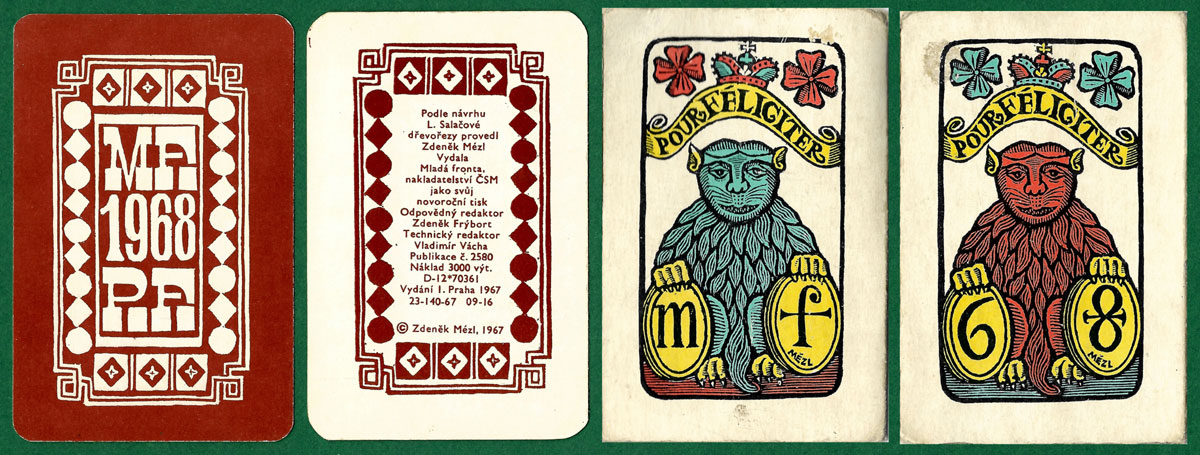
Above: Zdeněk Mézl's Fortune Telling cards published by Mladá Fronta in 1967. The backs of the cards contain the letters MF, abbreviation of the publisher's name. The letters PF are an abbreviation of the French ‘Pour Féliciter’, and the reference to the following year: 1968. History has shown that it was not at all lucky for Czechoslovakia. The illustration on the sleeve (similar on both sides) is Mézl's quotation of the acorn ace from the Prague pattern and thus anticipates the master's further work in the card genre. In 2004, Zdeněk Mézl released a limited edition of the entire deck of his version of the Prague cards, even in two variants: ordinary and erotic (court cards and aces are common in these decks).
Zdeněk Mézl (1934-2016) studied fine arts at various institutions from 1949 to 1960. After his studies he began working with the woodcut technique, which engaged him throughout his professional career. His unmistakable style and fame spread far beyond the borders of the country. In addition to freelance work, he illustrated over 100 books and designed 3 postage stamps.
References
Petr Bílý - Karty Zdeňka Mézla in Yearbook of Club sběratelů hracích karet 2018
Wikipedia (Czech) : Zdeněk Mézl►
By Marek Brejcha
Czech Republic • Member since June 13, 2024
My relationship with cards grew from playing to collecting and transformed into publishing as well. I am part of the team at Counter Clockwise, a small company that publishes traditional card games.

Activity for Zdeněk Mézl's Fortune Telling cards
Sign in to comment or save this article.

Related Articles
Cartes Oracle or La Voyante
Comparing three editions of a French cartomantic pack by Héron.
Karty Do Wróżb
Fortune Telling Cards from Poland by Ewa Hadydoń.
Oracle Rock
Cartomantic set depicting rock and pop stars, designed by La Rata, with a book by Virginie Despentes...
Le Petit Oracle des Dames
Le Petit Oracle des Dames ou Récréation des Curieux, Paris, 1807.
Cartomancy, Oracle and Divination Cards
Playing cards are used for fortune-telling - turning another card illumines the moment and a new per...
El Oráculo de la Bruja
“El Oráculo de la Bruja” fortune-telling cards, 2003.
Georgian Fortune Telling Cards
Georgian Fortune Telling Cards, c.1800.
Le Grand Tarot Belline
“Le Grand Tarot Belline” after drawings by Edmond Billaudot (1829-1881).
The Playing Card Oracles
The Picture Book of Ana Cortez is an original work of art designed to facilitate Divination.
Playing Card Oracles - Alchemy Edition
Playing Card Oracles - Alchemy Edition - by Charles J. Freeman and Ana Cortez
Art Deco Gypsy Oracle
Art Deco fortune telling deck published by Piatnik, 1936.
Grand Jeu Lenormand
Chaotic Grandeur in a collage of astrology, folklore and mythology from Parisian salons.

Cartomancia Astrología Quirologia Tests
A set of rather unusual and non-standard cartomancy cards from Argentina with religious connotations...
The Fortune Teller's Deck
The Fortune Teller’s Deck was published in 1995 in conjunction with a book written by Jane Lyle. The...
Ye Witches’ No.62 Fortune Cards
Ye Witches Fortune Telling Cards published by the United States Playing Card Co., 1896. 52 cards + J...
Wahrsage-Karten
In this version an explanatory verse is printed at the top of each card.
Fortune Telling Deck, c.1818
Fortune Telling Deck by Industrie Comptoir, Leipzig c.1818.
Livre du Destin
Livre du Destin / The Book of Fate, c.1900, entire deck (32 cards)
Geistliche Karten
Geistliche Karten, Augsburg, 1718. Each card carries a text in Gothic typeface giving advice regardi...
Significado de los Naipes Españoles
Cartomantic meanings of Spanish playing cards by Benita the Witch (XVI century), published by Chocol...
Most Popular
Our top articles from the past 60 days


