


25: More Standard European Cards
A further selection of European standard patterns including various redrawings.
Here is a further selection of European standard patterns including various redrawings. The first page on this topic is page 16. The variation of design within one pattern can be remarkable. This has been my focus with regard to the standard English pattern, but it applies to most other standard patterns as well.
The form of the Paris pattern was strictly regulated in France, so that hardly any variation can be found throughout the 19th century, except in small packs and in packs destined for export. The following are mostly not from France and are quite elaborate versions of the Paris pattern. The first two are French exceptions.

A decorative version with gold in a patience pack by Grimaud, late 19th century

A slightly less conventional version by Willeb, c.1950 (sorry for the poor quality of the original slide)
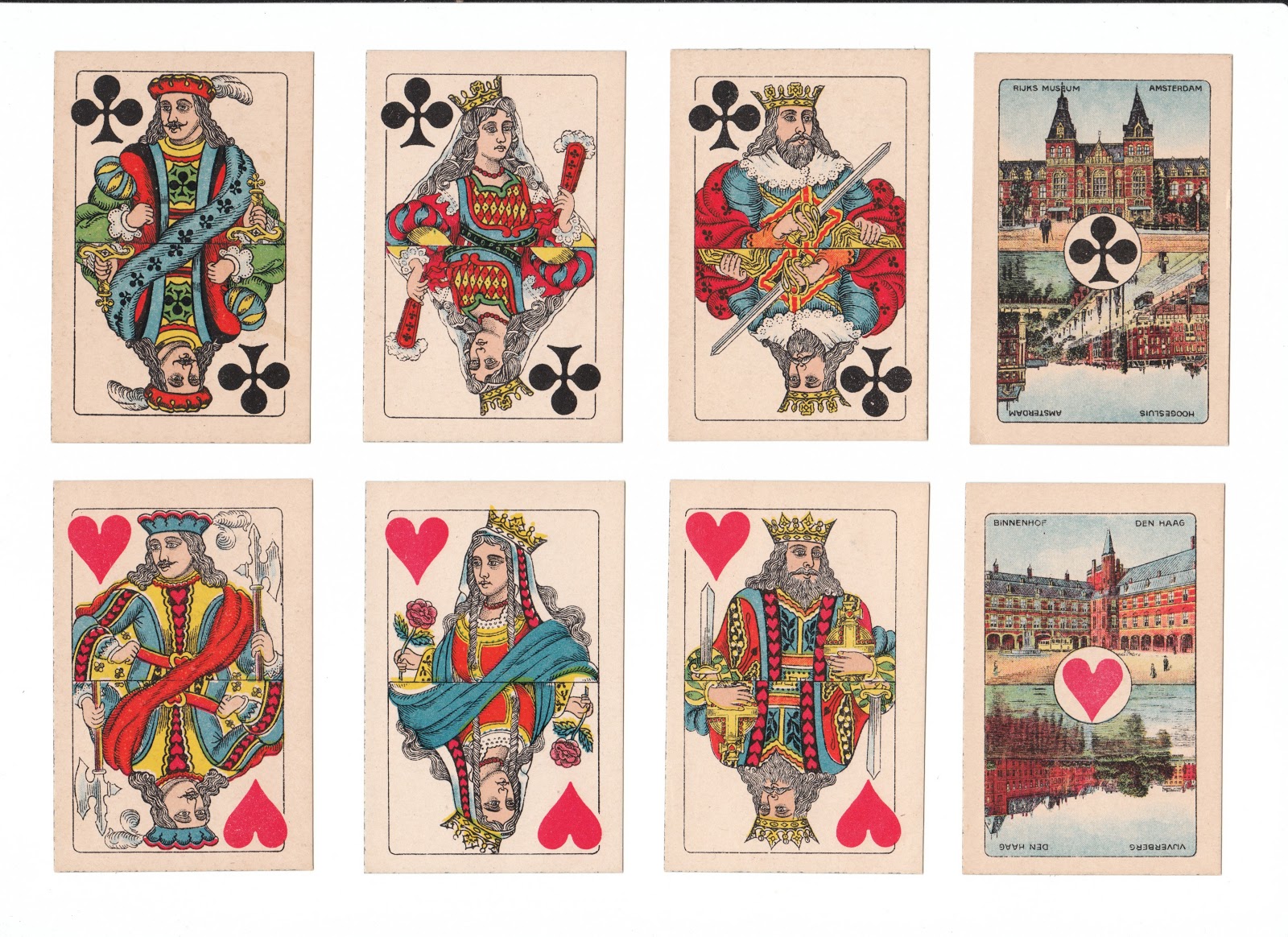

Another elaborate version with some features redrawn for the Dutch market, probably made in Belgium
The earlier version of the Paris pattern, as used in the 17th century, gave rise to a lot of local variants that have become standards in their own right. Here is a selection; local idiosyncrasies, such as which way the KD and JD face, abound. Other examples are illustrated on pages 11 and 16.


Cartes marbrées, so-called because of the back design (marbled), by a Turnhout maker, possibly Brepols

The Russian version of the pattern
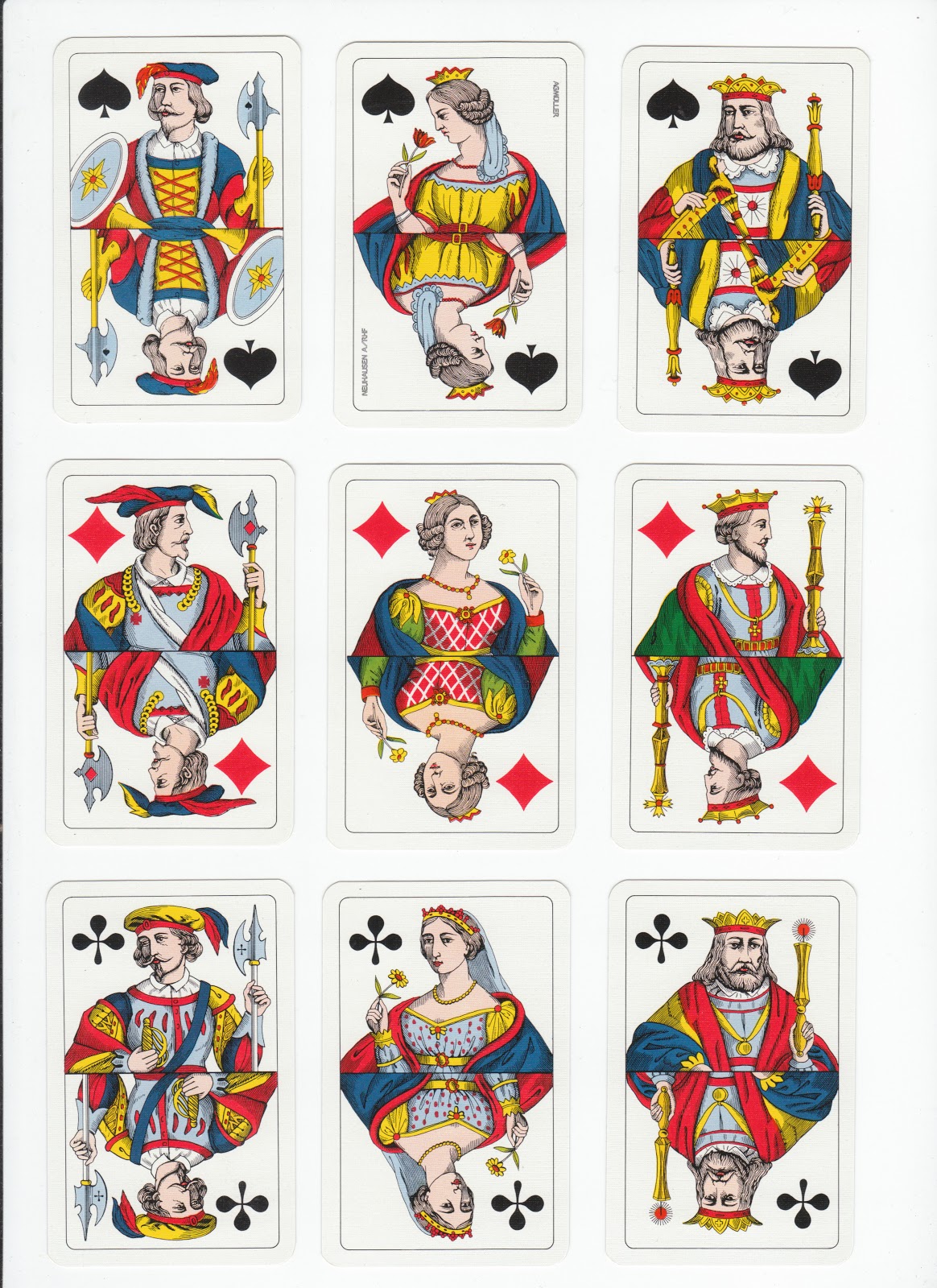
And the Swiss version by Müller; here the figures of the black jacks have been switched

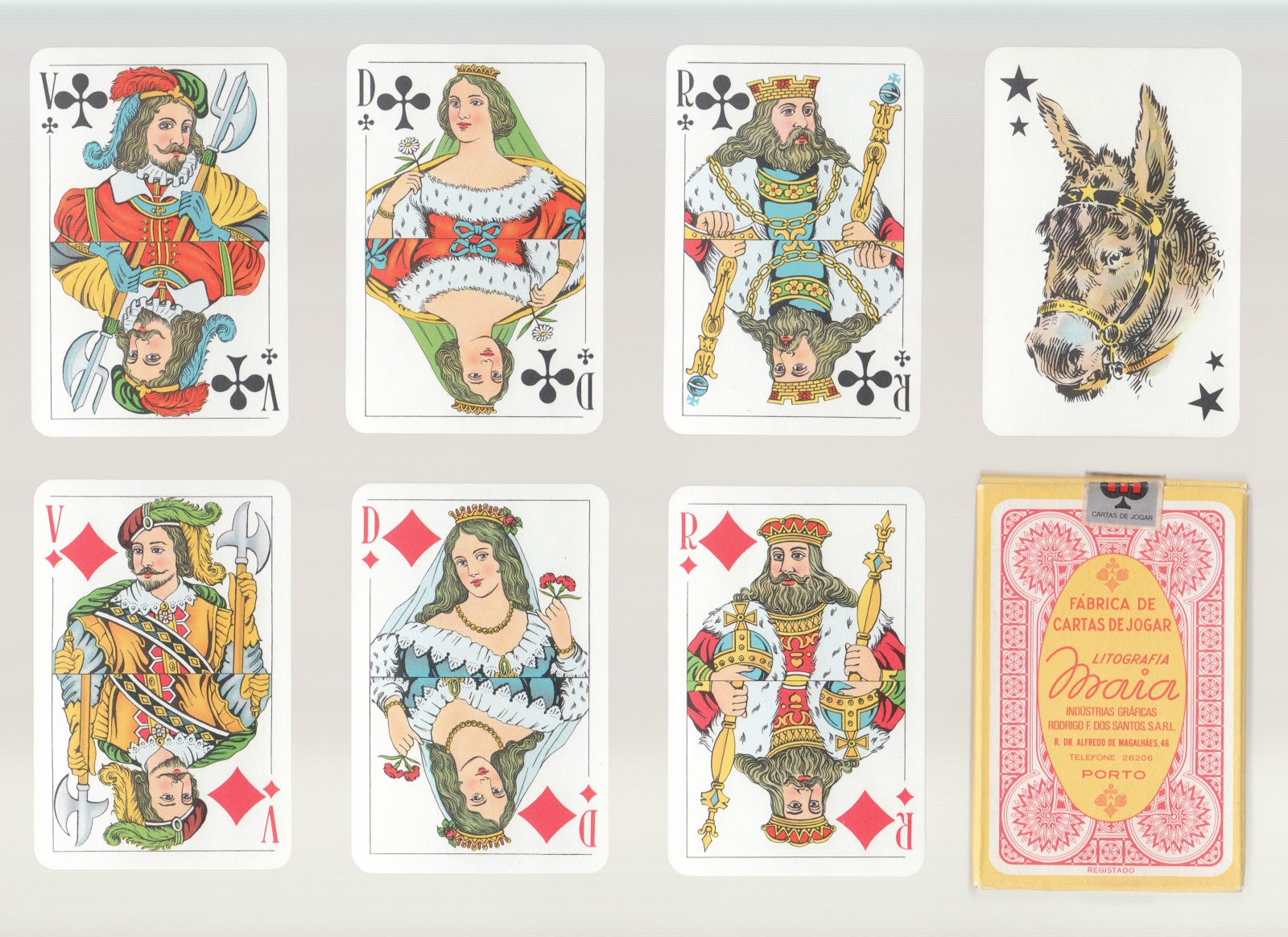
A version by Litografia Maia, Portugal, resembling the German and Dutch versions (see page 16)
A number of European designs, most of which date to the latter part of the 19th century, have a semi-standard status in that they became established as more than a one-off non-standard design for a specific purpose. Bon Goût made in Belgium was one such: it bears a strong resemblance to the contemporary Paris-derived patterns, even though some of the figures are not in their traditional suits. For example, the KD holds a harp rather than the KS (originally representing David).

Another widely established and copied design is Dondorf's Rhineland pattern. As far as I can tell, this was an in-house design (I stand to be corrected by Dondorf collectors), but was used in several different packs of different grades and was copied by other makers.

Dondorf's original design, here from a pack with scenes from the Napoleonic Wars on the aces

A Belgian version redrawn with some changes: e.g. KS holding a sword, KD holding a sword over his shoulder rather than a sceptre
The pattern originally had the courts of each suit facing the same way, but Piatnik's version, which was available until very recently, has changed the head of the JD to three-quarters left.

Piatnik, c.1970
A good example of an invented standard is furnished by Öberg's standard Swedish pattern. From some time in the early 20th century it took over from the Scandinavian version of the Old Paris pattern, which had been used until then.

Öberg, 1943
Piatnik has also produced a version; as with the Rhineland pattern a few changes have been made, so, for example, all the kings hold orbs.

Piatnik, modern
For further examples, see the wopc website.
One of the regional French patterns has provided at least some of the figures of the Lombard or Milanese pattern, such as the bird-carrying king, the king with his sceptre over his shoulder and the profile jack.
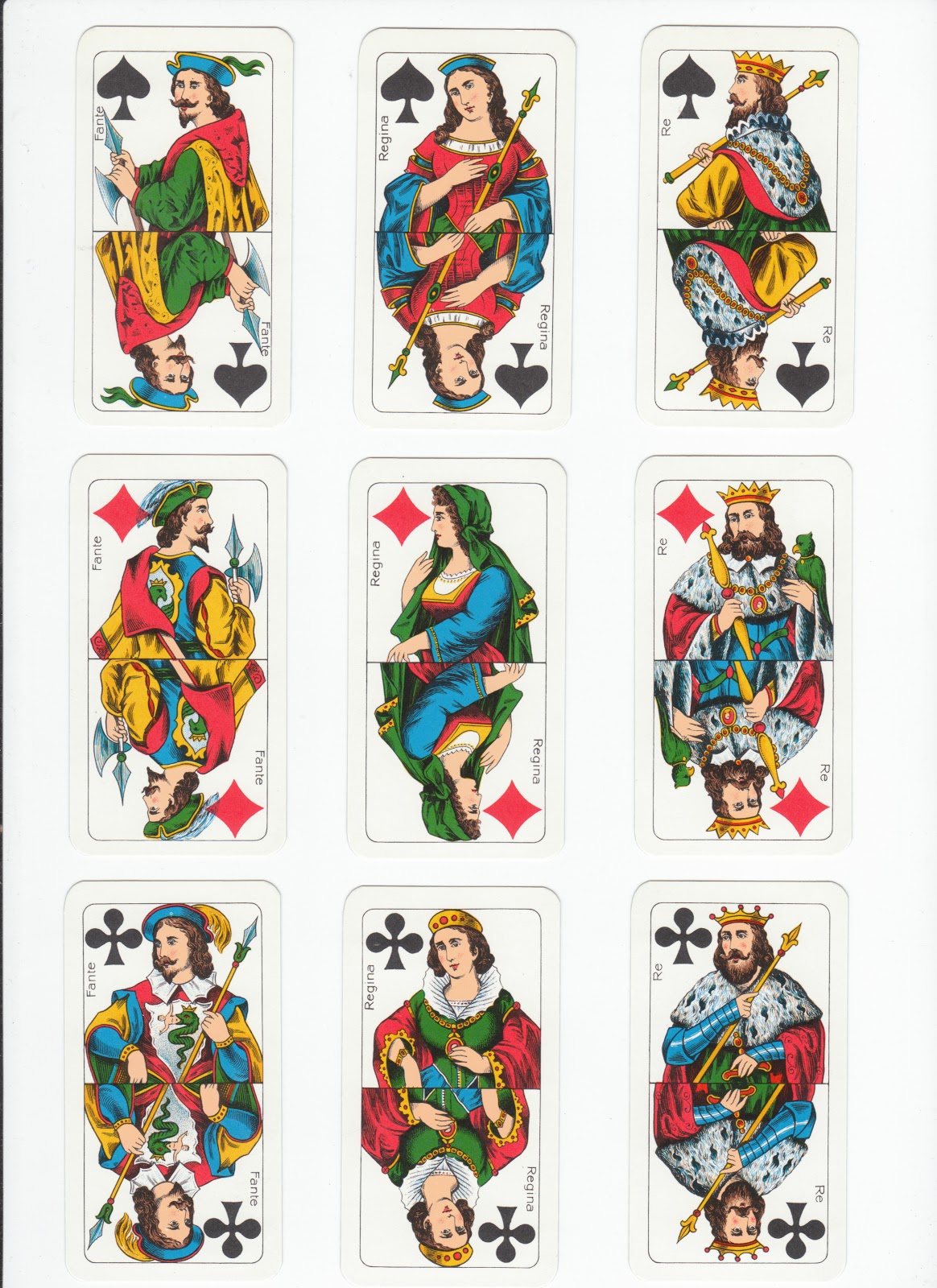
The Milanese pattern
And finally, two more patterns which do not have French suit-signs.
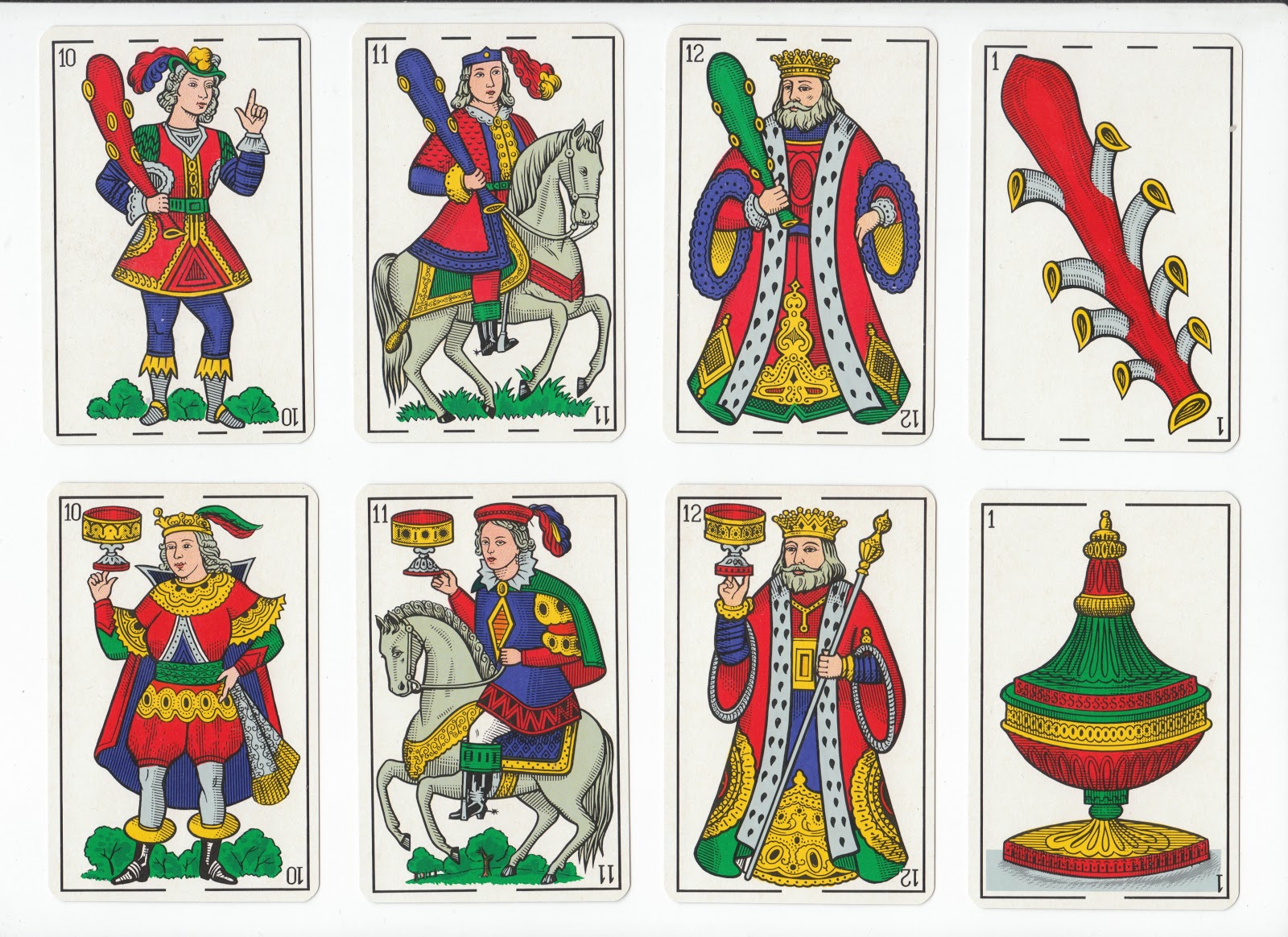

The Catalan pattern by La Ducale of France


The suits of leaves and bells from the Prussian pattern by ASS; the female figure is on the two (Daus) of the suits

By Ken Lodge
United Kingdom • Member since May 14, 2012
I'm Ken Lodge and have been collecting playing cards since I was about eighteen months old (1945). I am also a trained academic, so I can observe and analyze reasonably well. I've applied these analytical techniques over a long period of time to the study of playing cards and have managed to assemble a large amount of information about them, especially those of the standard English pattern. About Ken Lodge →

Activity for 25: More Standard European Cards
Sign in to comment or save this article.

Related Articles
Arab No. 2141
Piatnik ventures into Orientalism.
NS Reizigers Promotion
A Dutch Railways pack with an unusually elongated format.
Zodiac No. 1182
Constellations captured on cards.
La Provence
A Piatnik pack drawing on Provençal heraldry and local legend.
Arik Brauer
An artist-led pack from Vienna’s Hilger Edition, with Arik Brauer’s fantasy imagery turned into card...
Heritage Preservation Cards : Afghanistan and Iraq
Twin decks with a noble purpose.
The ACA Liège Game
A curious art-game from the Royal Academy of Fine Arts of Liège, issued in 2000.
Japan
Piatnik’s tribute to Japanese history.
EFFEGIEFFE
Corporate gift: a non-standard "Venice Carnival" deck by Dal Negro.
Summer Solstice
Jackson Robinson’s Summer Solstice is a minimalist seasonal pack built around solar colours and geom...
Baraja Mexicana Calendárica
Scholarly Mexican playing cards with Aztec and Maya calendar motifs.
Spiderweb by Strateg
A Simple Update to the Card Deck’s Design.
Romeo & Juliet
A Shakespearean-themed pack, with Spanish-suited and standard editions.
Grateful Dead playing cards no. 3
A pack celebrating the long strange trip it’s been.
Peter Pan
A Peter Pan-themed deck developed through live-streamed drawing sessions, with members invited to su...
Saga aka King Arthur
Capturing the spirit of medieval legend on playing cards.
Arn de Gothia
A Swedish tale of the Crusades gets the Piatnik treatment.
The archaic “Classic Madrid” Pattern
Centralisation, standardisation and consolidation of the Spanish card tradition.
Misc. Goods Co. Playing Cards
One of the early custom playing-card projects funded through Kickstarter, and the starting point for...
Glorious America No.2174
Major figures in US history enshrined in the courts.
Most Popular
Our top articles from the past 60 days


Glo Lexa
28 April 2026, 00:46SavedSaved this article to Suit systems