


Birma Karte or Englische Karten
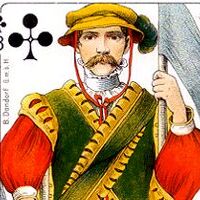
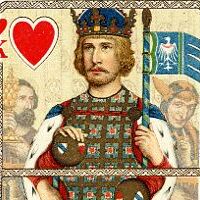
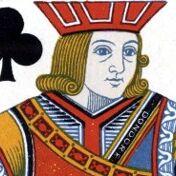
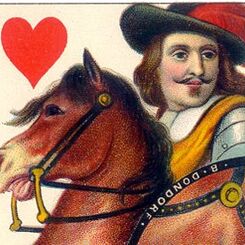
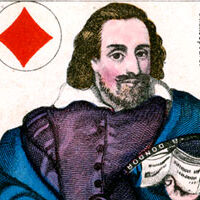
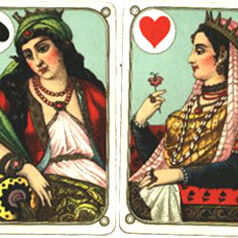
Based upon older ‘standard’ patterns, the Kings and Queens are three-quarter length figures whilst the Jacks are full-length with legs giving the impression that they are walking about!
B. Dondorf: ‘Birma Karte No.194’ - for export to British colonies (1867-1920)
Single-ended (full-length) courts were common in the early 19th century, but were gradually replaced by double-ended courts. Both forms coexisted during this period. Single-ended English cards by Dondorf were primarily intended for export to England and its colonies, especially to Burma. For this reason they do not appear in regular price lists. All the costumes are elaborately decorated.
Whilst several manufacturers were experimenting with decorated versions of the standard International pattern*, this is definitely the most remarkable example designed by Dondorf. Examples are known with wrappers printed for Hegt & Co. Trading Company, Rangoon (Burma).
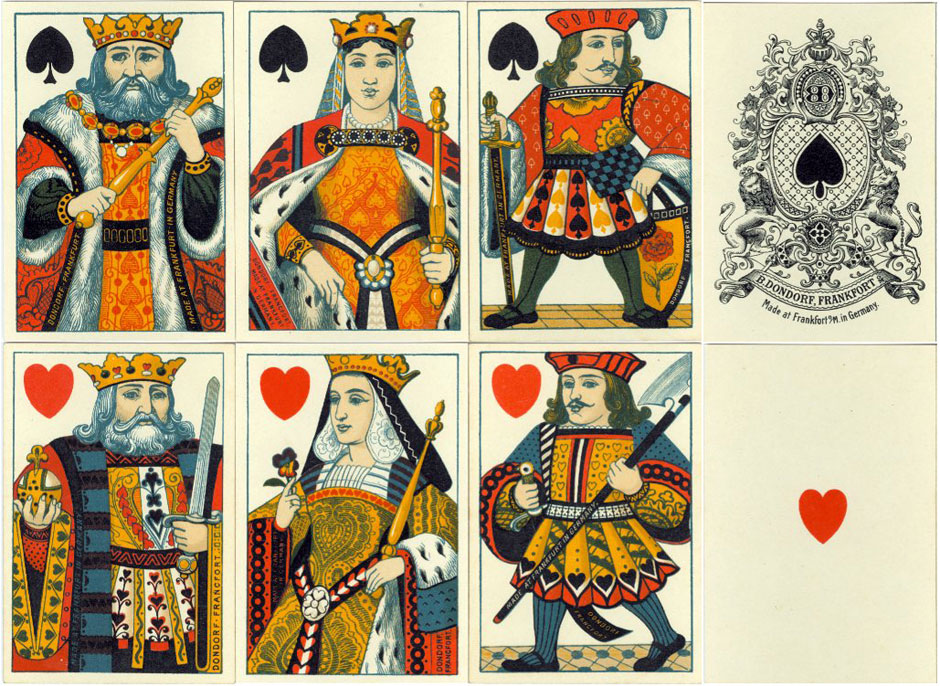
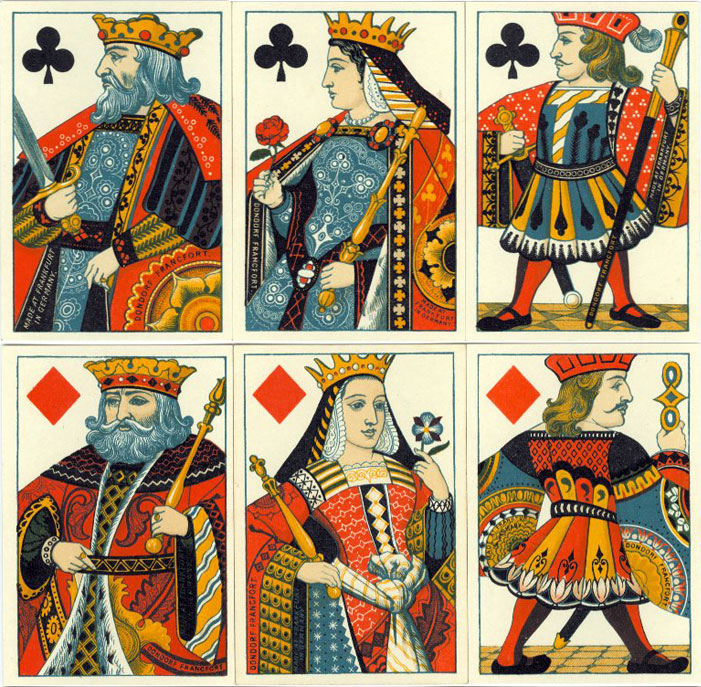
Above: Dondorf's “Birma Karte No.194” printed by chromolithography for exportation to British and other colonies, 1867-1920. 52 cards, square corners, no indices, the reverse is blank but could also be a tartan pattern of green and pink lines. Size: 64x94 mms. The name of the manufacturer appears somewhere on each court card as well as the Ace of Spades. Single-ended (full-length) courts were common in the early 19th century, but were gradually replaced by double-ended courts. For a time the two forms were used side by side.
* Note: playing cards from northern France reached England in the 15th century and became the English ‘International’ pattern. These cards have some similarities but are not really copies of the 'English' pattern, although the Ace of Spades has a lion and unicorn.
In an article published in ‘The Playing Card’ (Volume 45.2, 2016: pp.82-84) Ken Lodge notes:
I was somewhat surprised, however, to see that Hoffmann & Dietrich (1981: 150-53) describe the pack known as Birma-Karte (B) and a similar double-ended pack made for Portugal (D) as being derived from the standard English pattern (or “internationales Bild”). I have known these packs for some time and never considered them to be serious candidates for the label “English pattern”. They are both drawn in the same style, very ornate and stylized, but in a very different way from the standard English stylization, making the figures look much more realistic. The kings and queens of the single-figure court set are drawn three-quarter-length within the frame, whereas the jacks, having legs, are foreshortened, squat and look deformed. True, there are nods in the direction of the English pattern, for example, the strange object held by the English JS is held by the JD in (B) and the JC in (D), the patterns on the hats of some of the jacks resemble those of the English pattern, and the KS of (D) has a sword behind his head (note, not the KH). But if we take a proper look at the details, we’ll see that, in fact, the figures are mostly those of the French regional patterns that I dealt with in Lodge (2015 & 2016). I am not claiming that the model for these cards is one particular French regional pattern, but that it is made up of versions of the figures found in various French packs from the late mediaeval period to the late 17th century. To take just one example to start with, the single-figure JS is the Paris 1 JC (J7 in my system of classification), also found in an earlier JH by Valéry F(aucil?).

By Barney Townshend
United Kingdom • Member since October 06, 2015
Retired Airline Pilot, interested in: Transformation Playing Cards, Karl Gerich and Elaine Lewis. Secretary of the EPCS. Treasurer of the IPCS.

Activity for Birma Karte or Englische Karten
Sign in to comment or save this article.

Related Articles
Englische Karten nr.190
Dondorf Nr.190“Englische Karten”, 1867-1895.
Vues et Caractères Suisses No.228
A Swiss souvenir pack by Dondorf
Rococo Whist-Bridge Nr.53
printed by Flemming-Wiskott A.G. of Glogau
Dondorf Patience playing cards No.26
Patience playing cards with children in historical costumes
Figures Amusantes
French language edition of a children's quartet game published by B. Dondorf, c.1900, consisting of ...
Pierre l’Ebouriffé
Heinrich Hoffmann (1809-1894) wrote the Struwwelpeter stories in 1847 for his son Carl. The stories ...
La Zoologie
Dondorf's “La Zoologie” card game no.335 features a collection of 40 chromolithographic prints of sp...
Wappen-Quartett
A coat-of-arms quartet game published by B. Dondorf, c.1900
Hauptstadte Spiel
Each Ace shows views of two European capital cities.
Hundertjahrkarte
A new ‘medieval look’ is intended to suggest the power and virtue of the German character.
Whist No.178 ‘Stuart Zeit’
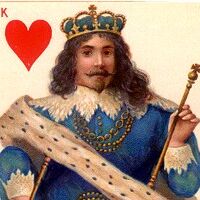
Although not historically accurate this example is subtitled “Stuart period”, with rich costumes cre...
Einköpfige Deutsche Spielkarte No.303
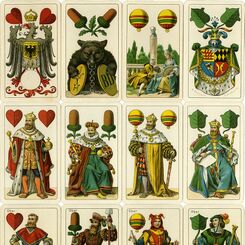
Dondorf's ‘Einköpfige Deutsche Spielkarte No.303’ (‘Single-ended German Playing Cards’) were produce...
Cartes Comiques, 1870-1888
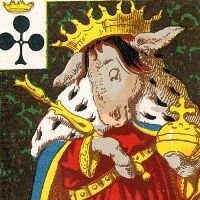
“Cartes Comiques”, published by B. Dondorf, printed by chromolithography, c.1870-1888.

Deutsches Luxusbild
The court cards in this well designed double-ended pack are realistically dressed in 16th century co...

Club Karte
There have been many variations in the design of “Club Karte” including the introduction of borders,...
10: Playing Cards in Germany
The playing card manufacturers of Germany from 1900 until 1939 provide a complicated set of relation...
Poker No. 140
Dondorf Poker-Karte No. 195, re-issued as Poker No. 140 for the "Argentina Compañia General de Naveg...
Dondorf
The luxury playing card factory founded in Frankfurt am Main by Bernhard Dondorf in 1833 existed for...
Tarot Microscopique
French-suited tarot cards made by B. Dondorf, c.1870.
Most Popular
Our top articles from the past 60 days


Glo Lexa
28 April 2026, 01:01SavedSaved this article to Suit systems