


Tarocco Gumppenberg
Neoclassical Empire-style Tarocchi cards by Ferdinando Gumppenberg, Milan, c.1810.
Complete pack of 78 playing-cards for Tarocchi from the British Museum. The artwork on the court cards reflects Neoclassical and imperial tastes of the time, with antiquarian and pseudo-Roman iconography, in the popular engraved tradition of Lombard playing cards. All the cards have refined, elegant detailing, and narrow ornamental borders. This aligns with Gumppenberg’s wider output, which frequently adopted an “imperial antiquity” aesthetic influenced by contemporary Austrian and German graphic fashions, of stylish and modern recreational cards for a trick-taking game, not esoteric.
The standard allegorical imagery on the trumps was not mystical secrets but the familiar and much-admired "Trionfi" that had been part of Italian card-playing culture for over four centuries. The transformation of the Tarot into a mystical artifact happened not in Italy, but in France, beginning in the late 18th century (driven by figures such as Antoine Court de Gébelin and Jean-Baptiste Alliette or 'Etteilla'). Gumppenberg was not operating in that world. He was a card manufacturer and an "innovative master of Italian paper art," not an occult publisher.


The presence of a tax stamp on the ace of swords helps date the deck. This stamp was in use in the 'Kingdom of Italy' under Napoleonic reign from 1807 to 1814. The text is 'REGNO D'ITALIA', and the value is '25 CEN.' (25 centesimi).


Cards from a pack of 78 playing-cards for Tarocchi, the suit-marks being of the Spanish type, by Ferdinando Gumppenberg, Milan, c.1810. Hand-coloured etching and index numbers in top left-hand corner on pip cards. The court cards have titles in Italian in the lower border. Backs printed with a pattern of red stars. © The Trustees of the British Museum number 1896,0501.14 ►
Producing a Spanish-suited deck allowed Gumppenberg to market his products not only to local Milanese players accustomed to French or Italian-suited Tarocchi, but also to merchants, travellers, and migrants from other Italian regions (e.g., Naples, Sicily, Romagna) who were familiar with the Spanish suit system. He was known for producing a variety of distinct patterns to cater to different tastes.

By Simon Wintle
Spain • Member since February 01, 1996
I am the founder of The World of Playing Cards (est. 1996), a website dedicated to the history, artistry and cultural significance of playing cards and tarot. Over the years I have researched various areas of the subject, acquired and traded collections and contributed as a committee member of the IPCS and graphics editor of The Playing-Card journal. Having lived in Chile, England, Wales, and now Spain, these experiences have shaped my work and passion for playing cards. Amongst my achievements is producing a limited-edition replica of a 17th-century English pack using woodblocks and stencils—a labour of love. Today, the World of Playing Cards is a global collaborative project, with my son Adam serving as the technical driving force behind its development. His innovative efforts have helped shape the site into the thriving hub it is today. You are warmly invited to become a contributor and share your enthusiasm.

Activity for Tarocco Gumppenberg
Sign in to comment or save this article.

Related Articles
The Sola-Busca Tarot
Humanist Iconography, Alchemical Metaphor, and the Origins of the Illustrated Minor Arcana.
Austrian Tarock by S.D. Modiano
Modiano’s Austrian Tarock with country scenes has been in production for over 100 years.
Il Tarocco del Mondo Nuovo
Imaginative Tarot card designs by Amerigo Folchi relating to Columbus and the New World.
Il Tarocco Mitologico
Fully pictorial Tarot designed by Amerigo Folchi with figures mainly from Greek mythology.
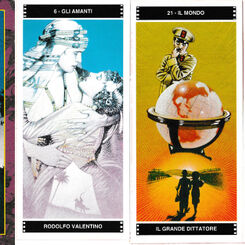
I Tarocchi del Cinema (di Sesar)
A set of Tarot trumps on the subject of the cinema, with designs by Sergio Sarri.
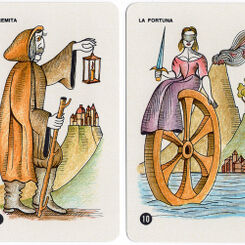
Tarocco Indovino
Sergio Ruffolo’s “Tarocco Indovino” is an expanded version of his “Lo Zodiaco” cartomancy deck.
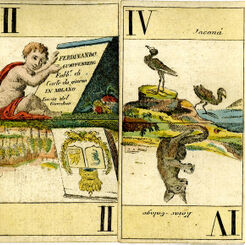
Natural History Tarocchi
Natural History Tarocchi by Ferdinando Gumppenberg, Milan.
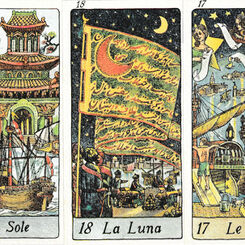
Venetian Tarot
Scenes from the history of Venice on a set of the major arcana.
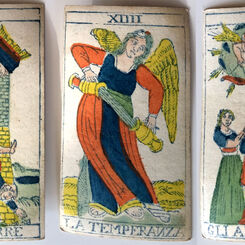
V. F. Solesio Tarot
V. F. Solesio Tarot, Genoa, mid-late 19th century.
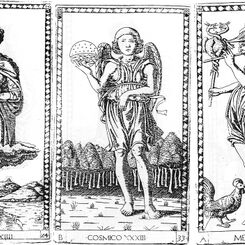
Tarocchi di Mantegna, c.1465
The so-called Tarocchi di Mantegna (c.1465) reflect an ideological structure bringing to mind the so...
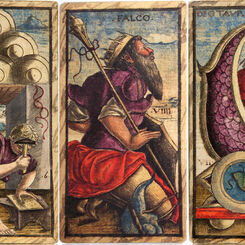
Sola-Busca Tarocchi
The Sola-Busca Tarocchi, c.1491
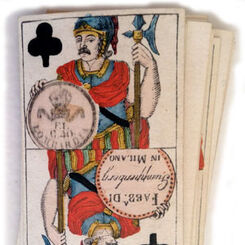
Gumppenberg of Milan
Fine playing cards made by Gumppenberg of Milan evoking the style of antiquity, c.1830
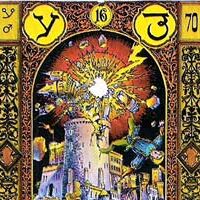
Stairs of Gold Tarot
Whilst the titles of the cards are in Italian, the Hebrew and Sanskrit letters on the Trump cards de...
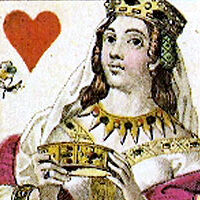
Corona Ferrea
Trumps depict historical scenes primarily of the political period known as the Holy Roman Empire fro...
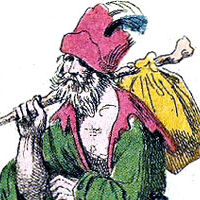
Tarocco Neoclassico
Gumppenberg published several new decks by artists or engravers of the day. The designs are clear an...
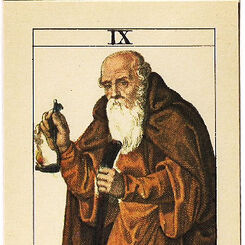
Tarocchino Lombardo, c.1835
“Tarocchino Lombardo c.1835”, a facsimile edition of 2500 by Edizione del Solleone, Italy, 1981.
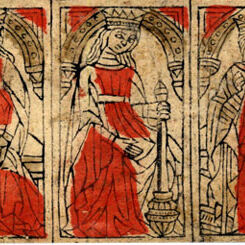
XV Century Italian Playing Cards
Cards from a pack of an early form of north Italian playing cards, with the swords back-to-back and ...
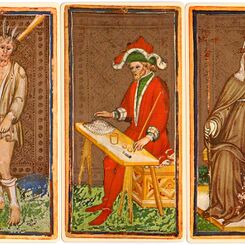
The Visconti-Sforza Tarot, c.1460
This pack of tarot cards appears to have have been made in the Bembo workshop in Cremona for Bianca ...
Tarocco Bolognese
Tarocco Bolognese
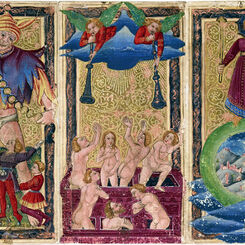
Hand-Painted Tarocchi Cards
Hand-painted Tarocchi cards sometimes known as ‘Charles VI tarot’, North Italy, 1475-1500.
Most Popular
Our top articles from the past 60 days


