


Lyon pattern made in Italy by Pietro de Santi
The Lyon pattern was initially developed in France during the 16th century. As Lyon was a trading hub, cross-cultural exchange between Italy and France naturally occurred.
The Lyon pattern was initially developed in Lyon, France, during the 16th century. As Lyon was a trading hub, cross-cultural exchange with Italy and other neighbouring countries occurred. The designs spread abroad, undergoing adaptations and surviving even after they became obsolete in France. Italian manufacturers produced their own versions, retaining the French suit symbols but simplifying the designs to make them easier to mass-produce. However, the Italian artisanal method of folding the back paper around the edges to form a border at the front, creating a more durable product, can be seen here. When lithography replaced woodblock printing this method was dropped.
On the knaves of spades, diamonds and clubs are scrolls lettered respectively “Carte Fine”, “Pietro de Santi”, and “Del Moro”. The knaves of hearts and clubs bear excise marks. The knave of spades has no pipe and the knave of clubs has a lion on his chest. The king of hearts has a falcon on his wrist.
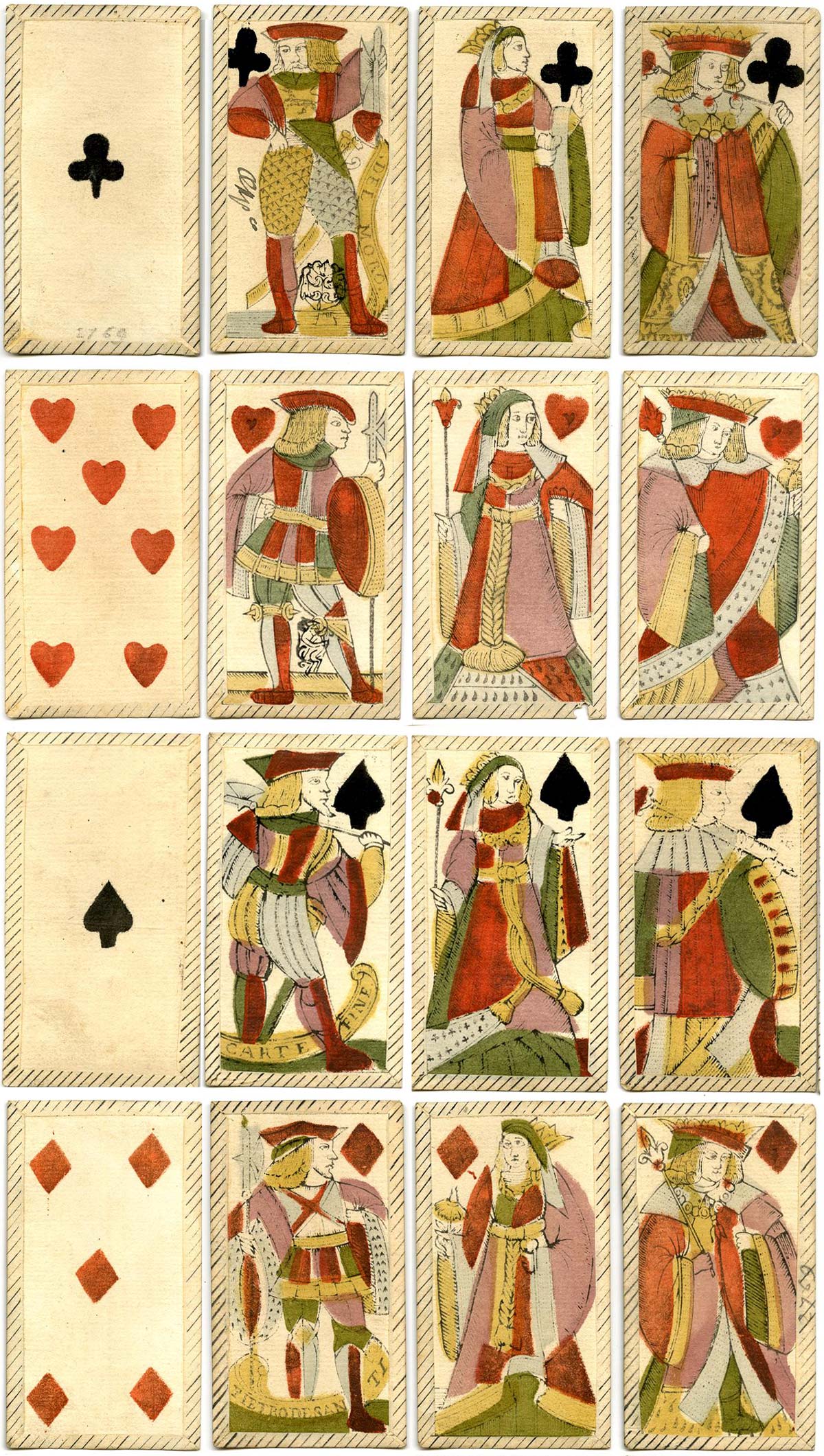
Above: Lyon pattern made in Italy by Pietro de Santi, mid-18th century (?). Deck of 40 cards, hand-coloured woodcut printing. The hand-colouring gives each card a slightly unique look, even within the same deck, as small variations occur depending on the artisan’s skill and technique. © The Trustees of the British Museum.
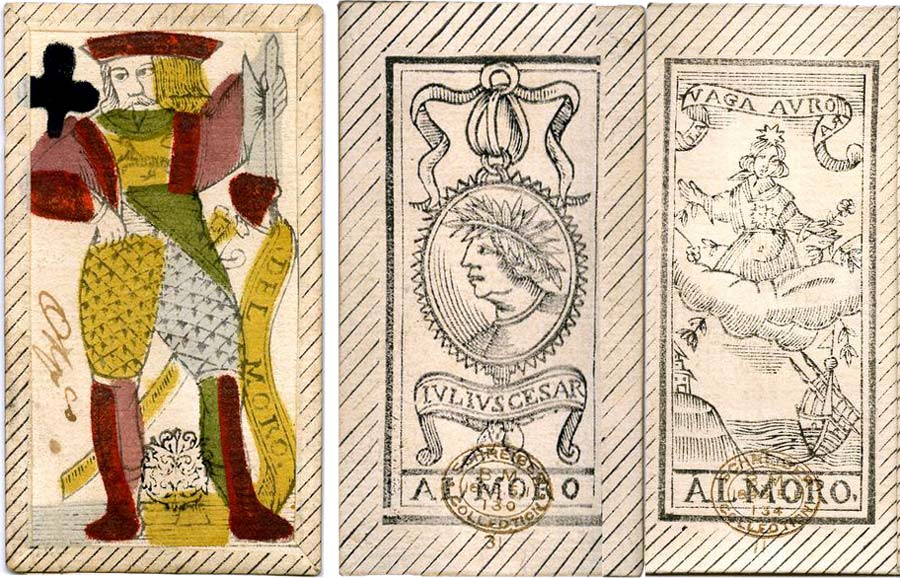
The British Museum has two copies of this pack with different back designs. 1) a medallion of Julius Caesar and the legend “Al Moro” and 2) an image of Aurora in the clouds with the same legend “Al Moro”. Aurora is the Roman goddess of the dawn, believed to renew herself each morning, rising from the ocean to bring light to the world. In both cases the backpaper can be seen folded around to the fronts.
References
O’Donoghue, Freeman M: Catalogue of the collection of playing cards bequeathed by Lady Charlotte Schreiber (Italian 84 & 85), Trustees of the British Museum, London, 1901 [digital version here]
British Museum

By Simon Wintle
Spain • Member since February 01, 1996
I am the founder of The World of Playing Cards (est. 1996), a website dedicated to the history, artistry and cultural significance of playing cards and tarot. Over the years I have researched various areas of the subject, acquired and traded collections and contributed as a committee member of the IPCS and graphics editor of The Playing-Card journal. Having lived in Chile, England, Wales, and now Spain, these experiences have shaped my work and passion for playing cards. Amongst my achievements is producing a limited-edition replica of a 17th-century English pack using woodblocks and stencils—a labour of love. Today, the World of Playing Cards is a global collaborative project, with my son Adam serving as the technical driving force behind its development. His innovative efforts have helped shape the site into the thriving hub it is today. You are warmly invited to become a contributor and share your enthusiasm.

Activity for Lyon pattern made in Italy by Pietro de Santi
Sign in to comment or save this article.

Related Articles
Most Popular
Our top articles from the past 60 days


