

Reynolds c.1809-1885
Joseph Reynolds had been producing playing cards in the traditional method since c.1809.

Reynolds & Sons, like several other UK manufacturers of the time, modernised the traditional court card designs in around 1840 with an overlay of decorative engraved patterns. Joseph Reynolds had been producing playing cards in the traditional method since c.1809 (click here to see) but new technologies facilitated a move away from woodblocks and in turn prompted changes in fashion and taste so that manufacturers began experimenting with new, 'modernised' designs (see also: Hunt and Sons, Bancks Brothers, De La Rue, Goodall & Son). The trend was subsequently imitated by foreign manufacturers (e.g. Boisse). Reynolds also produced a double-ended version of their new designs (shown below) as double-ended playing cards were becoming accepted at this time.
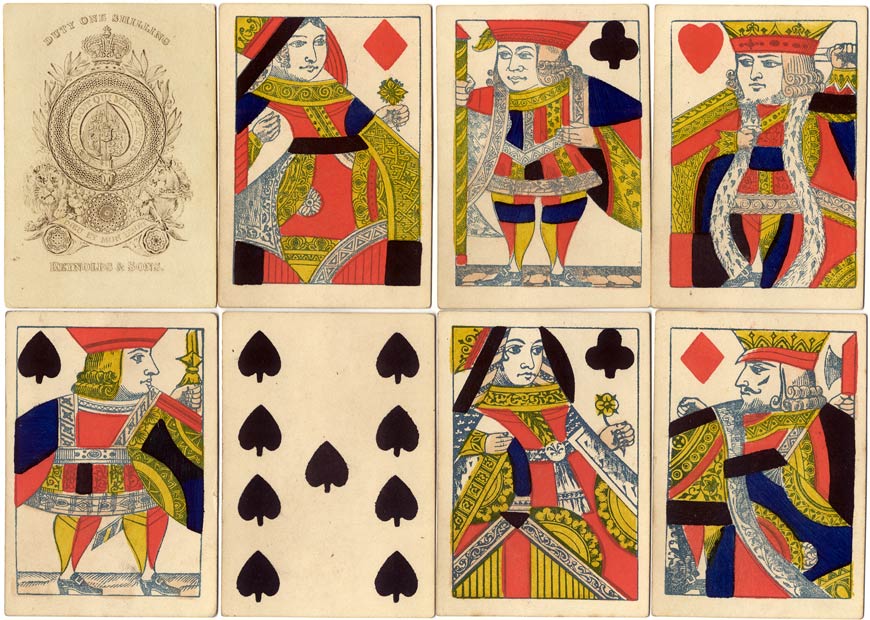
In the double-ended version, although more convenient, many charming features of the designs are lost.
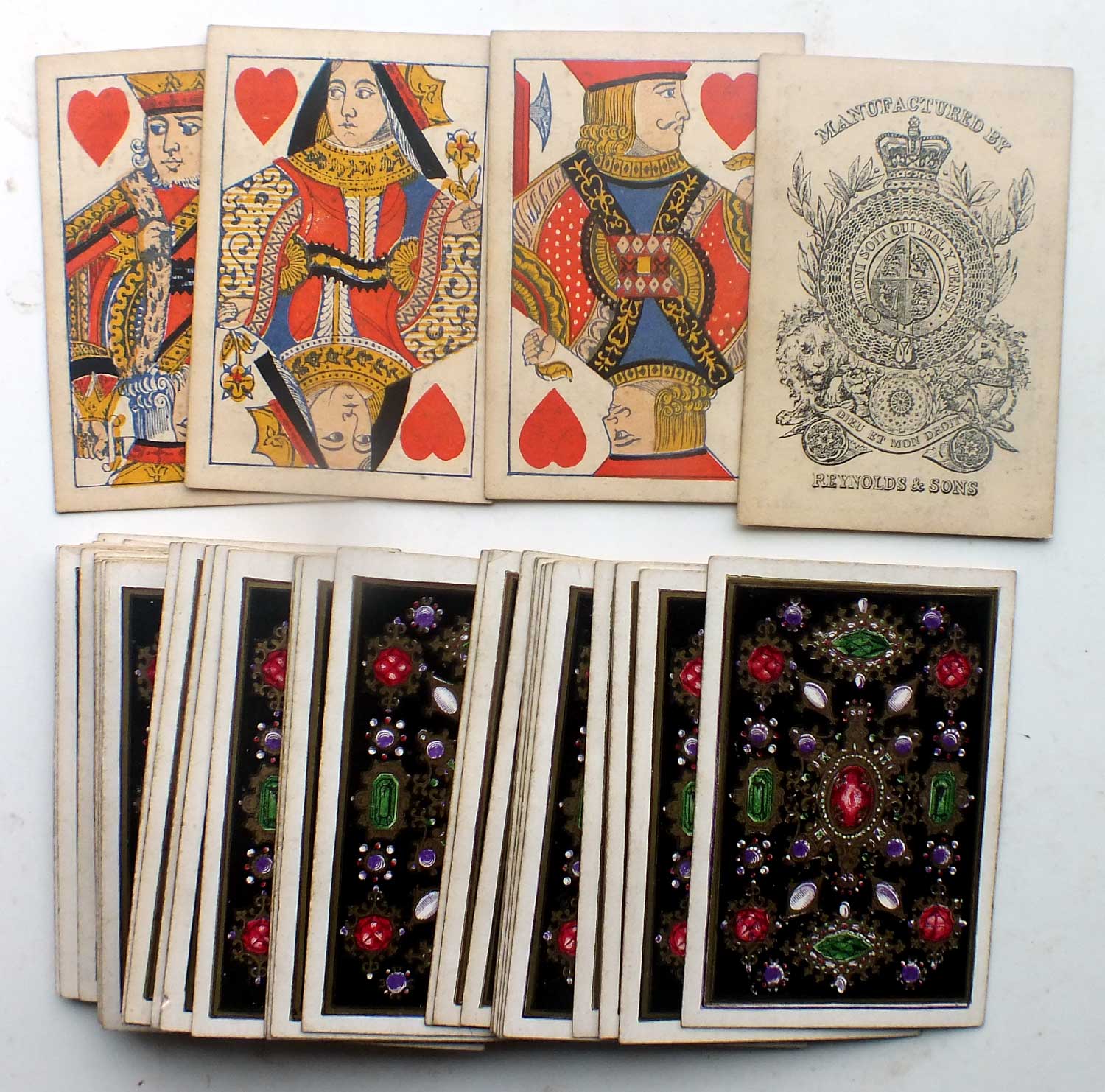
Above: Redrawn versions of the traditional English courts, both full-length (top two rows) and double-ended versions (bottom two rows). In the top version, the old method of colouring with brush and stencils has been used, but this was replaced as technology advanced with letterpress printing. In 1862 the 'Old Frizzle' Ace of Spades was discontinued, and manufacturers designed their own aces which became a sort of badge or manufacturer's identity device. Note that in both the above examples, the numeral cards are always full-length, or one-way with no index numbers.
Reynolds & Sons produced a variety of non-standard or variant designs, as well as Transformation packs with designs by T.S. Chapman and Crowquill, and fortune-telling cards. In around 1885 the firm appears to have been acquired by Charles Goodall & Son.
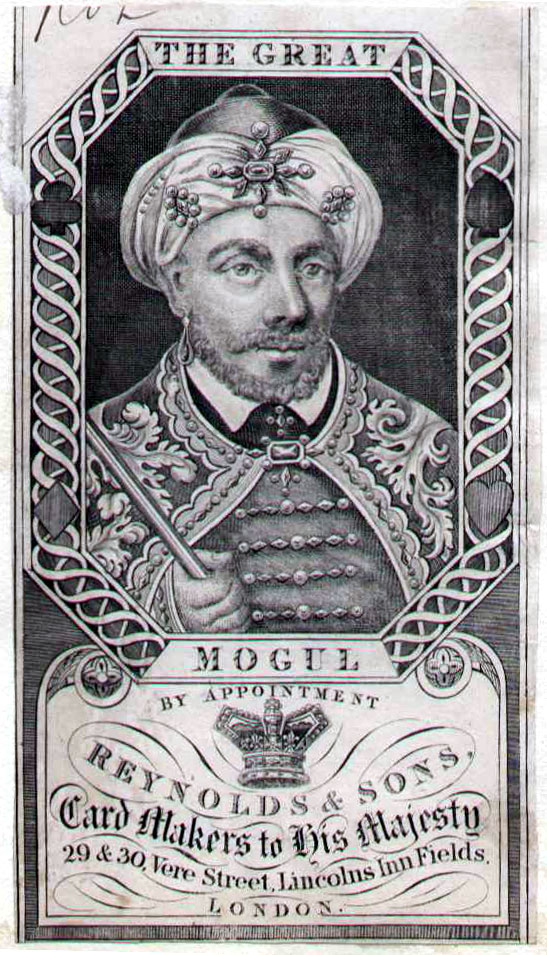
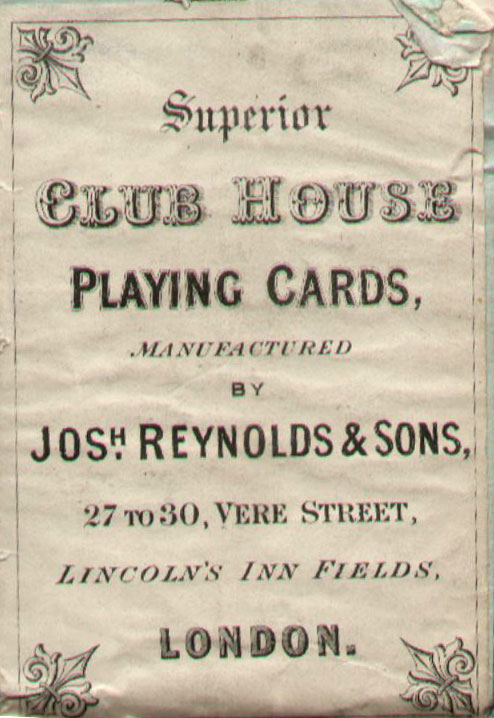
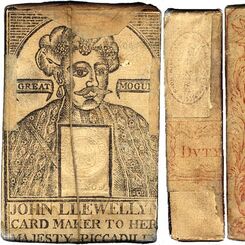
Left & below: cut out wrapper fronts advertising "THE GREAT MOGUL" (c.1830) and "Superior Club House" playing cards (c.1870s) by Reynolds and Sons, 29 & 30 Vere Street, Lincoln's Inn Fields, London. Images courtesy John Sings.
Note: information regarding the classification and relatedness of the variants of the standard English pattern comes mostly from Ken Lodge's work (see bibliography).

By Simon Wintle
Spain • Member since February 01, 1996 • Contact
I am the founder of The World of Playing Cards (est. 1996), a website dedicated to the history, artistry and cultural significance of playing cards and tarot. Over the years I have researched various areas of the subject, acquired and traded collections and contributed as a committee member of the IPCS and graphics editor of The Playing-Card journal. Having lived in Chile, England, Wales, and now Spain, these experiences have shaped my work and passion for playing cards. Amongst my achievements is producing a limited-edition replica of a 17th-century English pack using woodblocks and stencils—a labour of love. Today, the World of Playing Cards is a global collaborative project, with my son Adam serving as the technical driving force behind its development. His innovative efforts have helped shape the site into the thriving hub it is today. You are warmly invited to become a contributor and share your enthusiasm.

Leave a Reply

Your Name
Just now Your comment here. Your comment here. Your comment here. Your comment here. Your comment here. Your comment here. Your comment here. Your comment here. Your comment here. Your comment here. Your comment here. Your comment here. Your comment here. Your comment here. Your comment here. Your comment here. Your comment here. Your comment here. Your comment here. Your comment here. Your comment here. Your comment here. Your comment here. Your comment here. Your comment here. Your comment here. Your comment here. Your comment here. Your comment here. Your comment here. Your comment here. Your comment here.
Related Articles
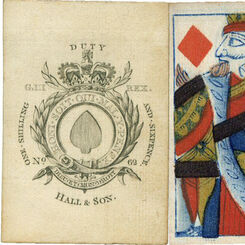
Hall & Son
Hall & Son
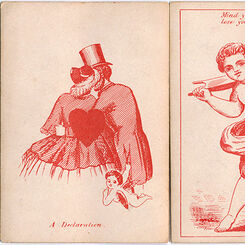
Fortune-Telling Cards
Comic Fortune-Telling Cards published by Reynolds & Sons, c.1850.
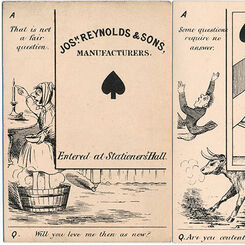
Comic Question & Answer cards
Comic Question & Answer cards by Josh. Reynolds & Sons, circa 1850.
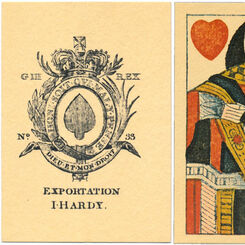
I. Hardy facsimile
Facsimile edition of 19th century I. Hardy Exportation deck complete with reproduction tax wrapper, ...
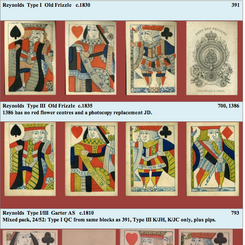
50: Joseph Reynolds
A presentation of my database of Reynolds cards.

32: The Not-So-Minor Cardmakers of the 19th Century - Part 3
A survey of the cards made by Creswick and Hardy, with a brief mention of De La Rue, Goodall and Rey...
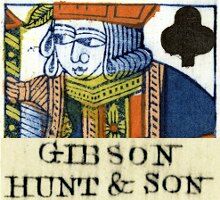
Gibson, Hunt & Son
Gibson originally took over the business of Blanchard in 1769. Gibson & Hunt operated briefly and we...
John Llewellyn, playing card manufacturer, London, 1778-1785
John Llewellyn, playing card manufacturer, London, 1778-1785
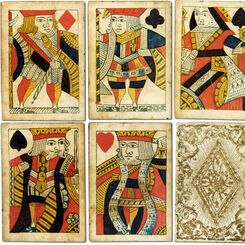
Reynolds c.1830
Woodblock and stencil playing cards, produced by Reynolds & Sons c.1830-1850.

Reynolds non-standard
Sometime around c.1850 Reynolds & Sons produced this non-standard or variant pack with courts inspir...

Games & Print Services
Games & Print Services Limited, of Canvey Island, now part of Cartamundi.
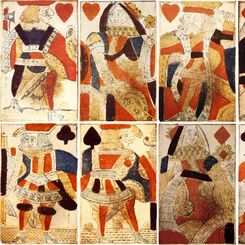
Hunt, c.1800
Standard English pattern playing cards manufactured by Hunt, c.1800.
Playing cards in Wales - Welsh playing cards
Whereas the distinctiveness of Wales is an important resource contributing to the rich texture of va...
J & W Mitchell, Birmingham
This rare Victorian manufacturer made standard English playing cards for a short period during the l...
James English & Co.
Victorian Playing Cards manufactured by James English & Co., London, c.1875
History of English Playing Cards & Games
The History of English Playing Cards dates probably from the mid 15th century
Waddington’s “Envoy“ Series
Waddington’s “Envoy“ Series.
Waddington’s Classic and Wildlife Series, 1933
Waddington’s Classic and Wildlife Series, 1933.
Waddington’s Varsity Series
Waddington’s Varsity Series.

W. H. Willis & Co
Willis & Company was formed in 1869, having been preceded by Charles Steer at the same address (80 L...
Most Popular
Our top articles from the past 60 days


