


Sextet: 6 handed bridge
6 handed bridge playing cards designed by Ralph E. Peterson, 1966.
Published by Secobra of Dallas Texas, and printed by the USPCC in 1966, this pack was designed by Ralph E. Peterson. In addition to the four standard suits there are two new suits, both coloured blue: tennis racquets and a ship’s wheel or helm. All six aces are specially designed to provide a better representation of their suit. The cards were originally issued as a double set, with the rules for sextet contract bridge given on the inside of the box lid. My copy of this pack contains one joker.
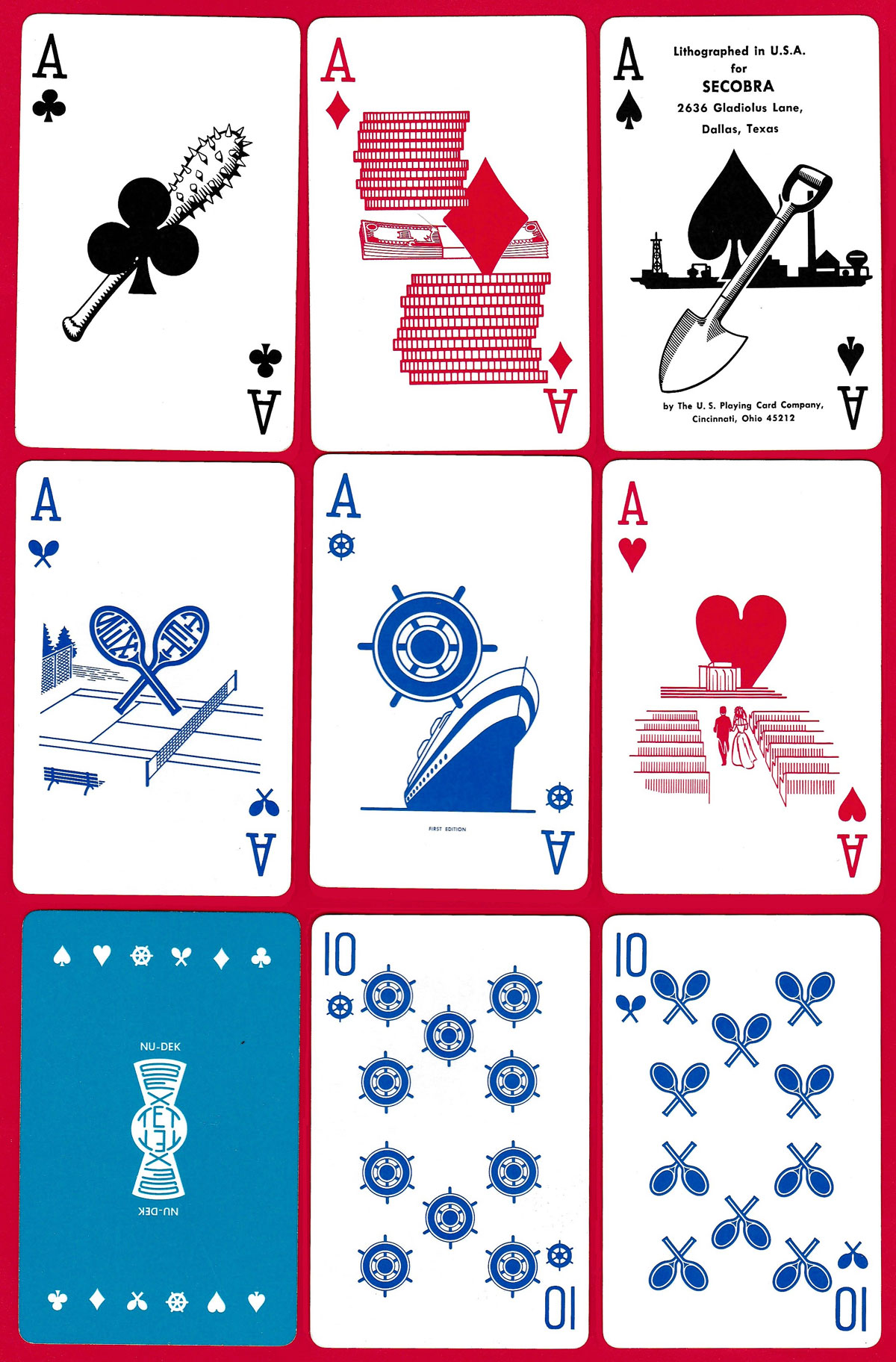

Above: Sextet: 6 handed bridge designed by Ralph E. Peterson, published by Secobra of Dallas Texas, and printed by the USPCC, 1966.

By Peter Burnett
United Kingdom • Member since July 27, 2022
I graduated in Russian and East European Studies from Birmingham University in 1969. It was as an undergraduate in Moscow in 1968 that I stumbled upon my first 3 packs of “unusual” playing cards which fired my curiosity and thence my life-long interest. I began researching and collecting cards in the early 1970s, since when I’ve acquired over 3,330 packs of non-standard cards, mainly from North America, UK and Western Europe, and of course from Russia and the former communist countries.
Following my retirement from the Bodleian Library in Dec. 2007 I took up a new role as Head of Library Development at the International Network for the Availability of Scientific Publications (INASP) to support library development in low-income countries. This work necessitated regular training visits to many sub-Saharan African countries and also further afield, to Vietnam, Nepal and Bangladesh – all of which provided rich opportunities to further expand my playing card collection.
Since 2019 I’ve been working part-time in the Bodleian Library where I’ve been cataloguing the bequest of the late Donald Welsh, founder of the English Playing Card Society.

Activity for Sextet: 6 handed bridge
Sign in to comment or save this article.

Related Articles
Junior Playing Cards
Child-friendly versions of standard English pattern cards designed by Louie Mantia, Jr.
New York City souvenir
New York City souvenir playing cards with 53 different views of interest, USA, 1915.
Nile Fortune cards
Nile Fortune cards no.68x published by the United States Playing Card Company, USA, 1904.
Foster’s Self-Playing Whist Cards
In 1890 R. F. Foster published the first edition of “Foster’s Whist Manual” which was to become the ...
Playboy playing cards
52 different magazine covers from the first 50 years of Playboy.
Hawaiian Souvenir playing cards
Hawaiian Souvenir playing cards, 1901.
TDC Inc.
TDC Inc.: a 20th Century American Playing Card Maker.
Bridge Challenger®
“Bridge Challenger®” by Fidelity Electronics, 1975 - better living through science.
Bicycle Heritage
Bicycle Heritage playing cards by the United States Playing Card Company, 2012
Hesslers Enhanced
Matt Hessler’s “Enhanced” four-colour playing cards, 2015.
Atlantic Playing Card Co
Atlantic Playing Card Co., Inc. promoted Bridge Ensemble boxes and companion accessories.
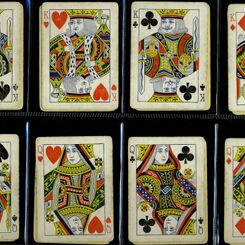
35: More Design Copies
Here I want to take another widely copied design and see how individual variation by the copier can ...
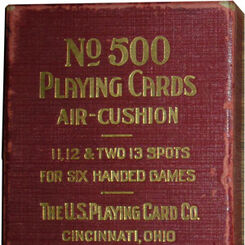
No.500 Playing Cards
No.500 Playing Cards published by U.S.P.C.C., c.1910
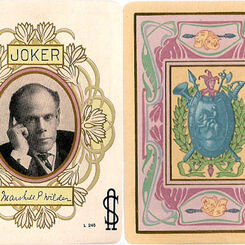
Stage Playing Cards, 1908
This beautiful deck features an oval half-tone photo of a theatre star on each card, many of them le...

Norwood #85, c.1909
The deck features a colourful Ace of Spades and Joker, decorated Aces, unique courts and two beautif...
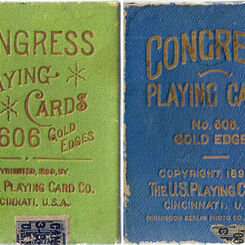
Congress No.606
Congress Playing Cards were first produced by the Russell & Morgan Company in 1881 as the finest and...
Bicycle No.808
The famous Bicycle playing cards were first introduced by Russell & Morgan Printing Co in 1885. More...
Jumbo Bridge 88
Cards with jumbo indices were introduced in 1895, and were given the subtitle '88'.
The United States Playing Card Company
Over the years the pressures of competition and other market forces have led to many smaller manufac...
Naipes No. 71 Los Leones
Naipes No. 71 Los Leones by The United States Playing Card Co., c.1900.
Most Popular
Our top articles from the past 60 days


