


Heathen Wars
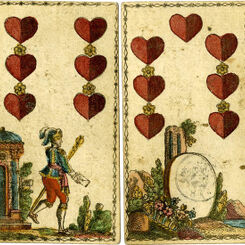
German-suited ‘Heathen War’ playing cards published by Joseph Fetscher, Munich, c.1820.
The imagery of pre-Christian divinities in chariots on the deuces with German military on other cards in this pack is not necessarily historically accurate. In 19th-century Germany the image of heathens was shaped by the Romantic idealization of pre-Christian cultures as noble and in harmony with nature. This period also witnessed a nationalist resurgence that looked to Germanic folklore for a distinct national identity, emphasizing Germany’s historical mission: a European community based on religious, cultural, and racial traits set against a pagan non-European world.
On the king of bells is a plaque which reads “Joseph Fetscher Kartenfabricant”. Some of the numeral cards depict country folks in harmony with nature whilst other cards depict military artillery. The 7 of hearts has a figure of Fame supporting a tablet on which is an 8 Kreuzer excise stamp used in Bayern (Bavaria) from c. 1816 to 1826.
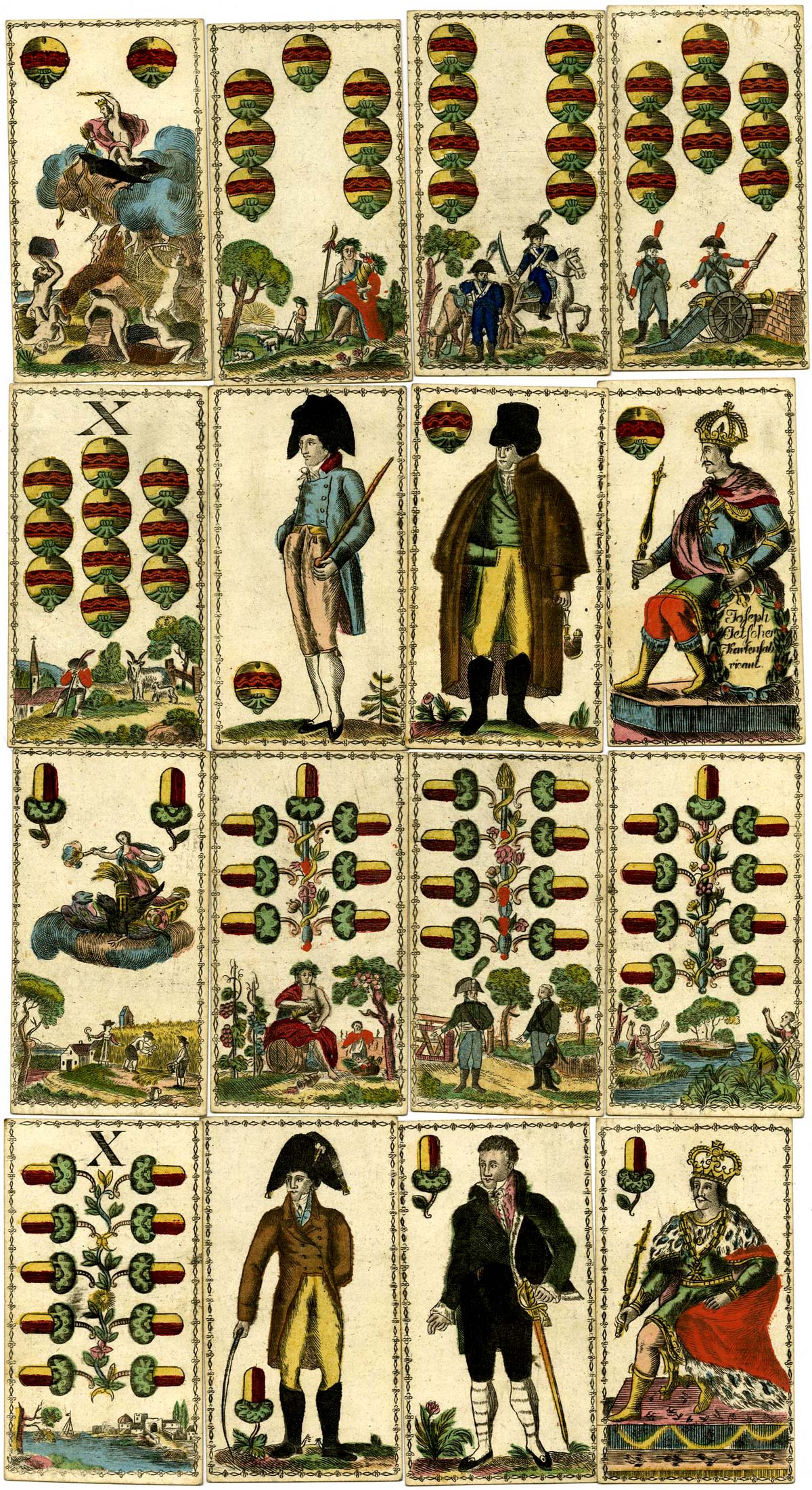
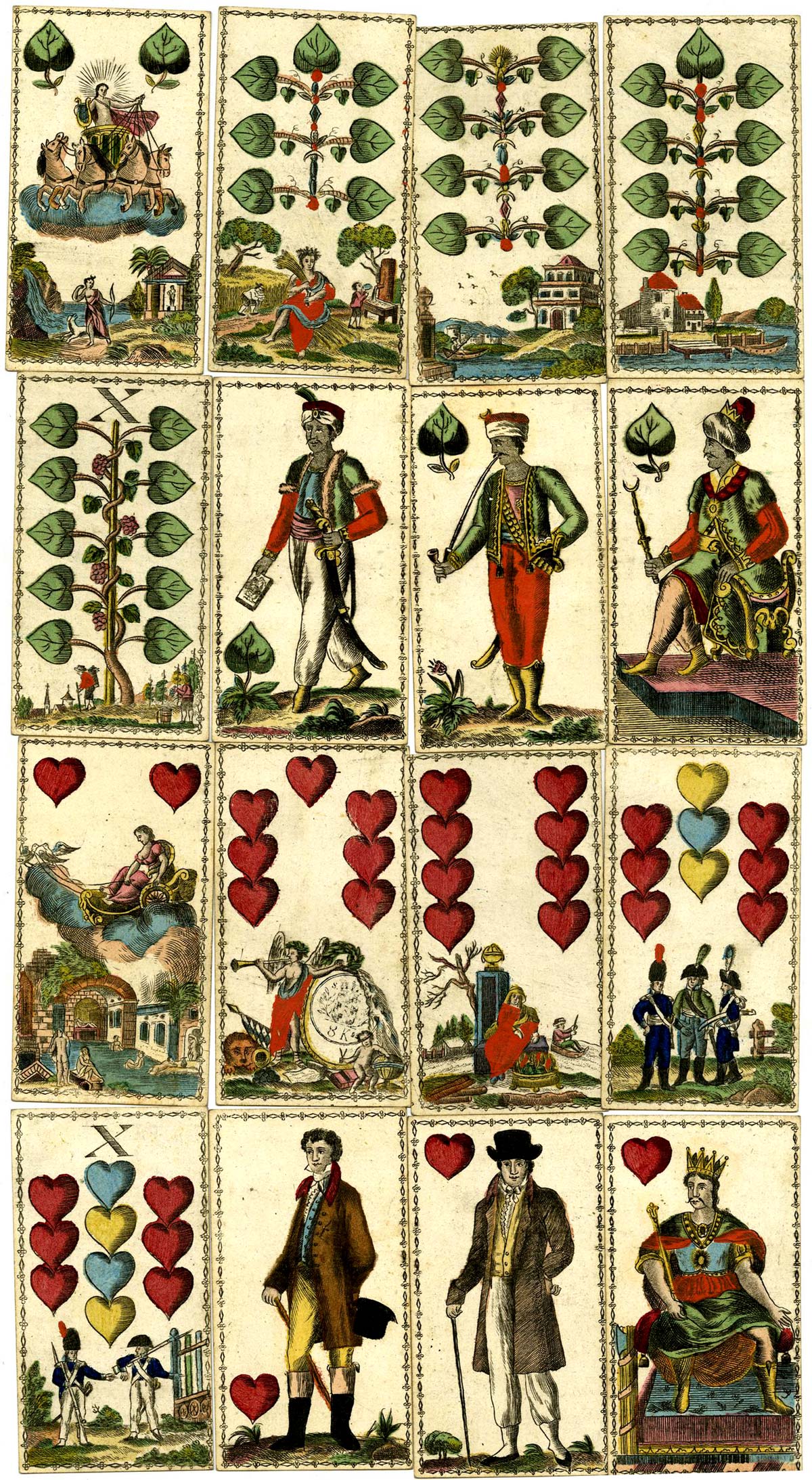
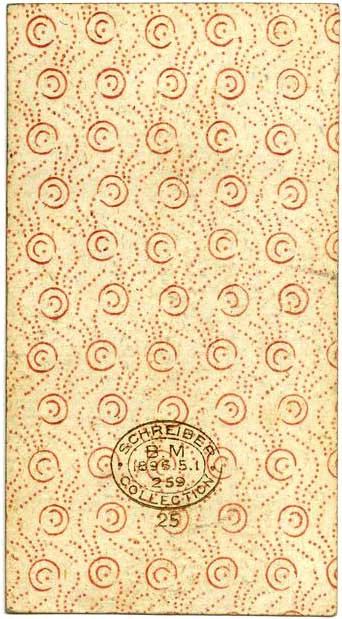
Above: Heathen War playing cards published by Joseph Fetscher, Munich. 32 playing-cards with ornamental borders, hand-coloured etching, backs printed with a pattern of circles and dots in red, early 19th Century. © The Trustees of the British Museum • Museum number 1896,0501.259►
Overall, the 19th-century image of heathens in Germany was complex, influenced by a range of cultural, intellectual, and political factors.
Further References
Endebrock, Peter: playing-card pages: Tax Stamps from German States►
O’Donoghue, Freeman M: Catalogue of the collection of playing cards bequeathed by Lady Charlotte Schreiber (German 76), Trustees of the British Museum, London, 1901 [digital version here]
Another French suited tarot pack by Joseph Fetscher contains views and incidents connected with a naval battle, ships shelling a town, a balloon ascent, etc. British Museum number 1896,0501.171►

By Simon Wintle
Spain • Member since February 01, 1996
I am the founder of The World of Playing Cards (est. 1996), a website dedicated to the history, artistry and cultural significance of playing cards and tarot. Over the years I have researched various areas of the subject, acquired and traded collections and contributed as a committee member of the IPCS and graphics editor of The Playing-Card journal. Having lived in Chile, England, Wales, and now Spain, these experiences have shaped my work and passion for playing cards. Amongst my achievements is producing a limited-edition replica of a 17th-century English pack using woodblocks and stencils—a labour of love. Today, the World of Playing Cards is a global collaborative project, with my son Adam serving as the technical driving force behind its development. His innovative efforts have helped shape the site into the thriving hub it is today. You are warmly invited to become a contributor and share your enthusiasm.

Activity for Heathen Wars
Sign in to comment or save this article.

Related Articles
Ethnological Tarot by Joseph Fetscher
Joseph Fetscher's inventive, ethnographic tarot from Munich c.1820.
Ubo cards
Traditional Ubo cards from the Philippines made from tree bark.
Colonial Art
A collection of 53 pieces of art showcasing detailed scenes from early American colonial life.
Trappola pack by Joseph Fetscher
Trappola pack published by Joseph Fetscher, Graz, 1739.
Animal Tarot by Joseph Fetscher
French-suited Natural History Tarot deck by Joseph Fetscher, Munich, c.1820.
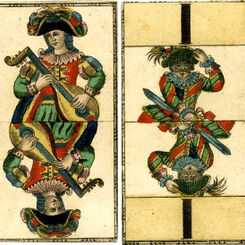
Mythological and Allegorical tarot
Mythological and Allegorical tarot produced by Peter Paul Fetscher junior, Munich.
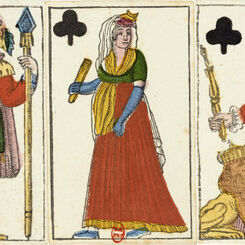
Fantasy deck by Joseph Fetscher
Fantasy French-suited pack produced by Joseph Fetscher, Munich, c.1825.
Miniature playing cards by Joseph Fetscher
Uncut sheet of miniature Bavarian playing cards by Joseph Fetscher.
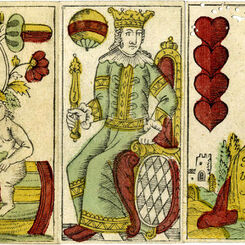
Bavaria pattern
Classic German-suited Bavarian pattern by Joseph Fetscher, Munich, early 19th century.
Historical playing cards by Joseph Fetscher
Historical playing cards by Joseph Fetscher, Munich, c.1820.
Traditional Nomadic Life of Mongolia
Playing cards depicting paintings of Traditional Nomadic Life of Mongolia.
Habesha playing cards
Habesha playing cards published by “Ethiopian Reflection”
Happy Playing Cards
Cheerful, colourful designs on handmade paper from Nepal.
Tonalamatl
Baraja Tonalamatl Mexican Aztec playing cards based on the prehispanic Codex Borgia manuscript.
National Misfitz
National Misfitz published by C.W. Faulkner & Co c.1900.
Neue Deutsche Spielkarte
Neue Deutsche Spielkarte (Reformkarte) conceived by Dr. Timon Schroeter, 1883.
Banana Leaf Cards
English Standard pack hand drawn & coloured on banana leaf, c.1820.
Ainu culture
A terrific deck of cards made by Nintendo c.1979 with original designs on every card showing the Ain...
Iceland Mythological Playing Cards
Iceland Mythological Playing Cards designed by Sigurlinna Pétursson, 1958
Maori
Maori themed playing cards from New Zealand depicting Maori Kings, Queens and Chiefs
Most Popular
Our top articles from the past 60 days


