


Verkehrte-Welt-Tarock
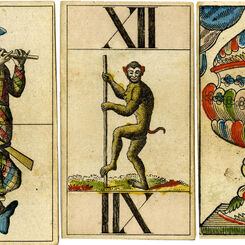
"Verkehrte-Welt-Tarock” (reverse world ?) manufactured by Christian Theodor Sutor (fl. 1823-1854), Naumburg, around 1850.
“Verkehrte Welt Tarock” manufactured by Christian Theodor Sutor, Naumburg, c.1850.
Lithography, stencil coloured, later tax stamp: Deutsches Reich No. 9, 78 cards. The first version of this deck was made by C. A. Müller in Berlin. Sutor produced a military deck “Russische Trachten und Soldatenkarte” in c.1825.
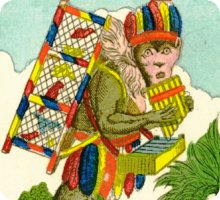
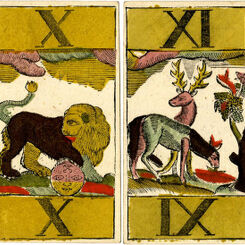
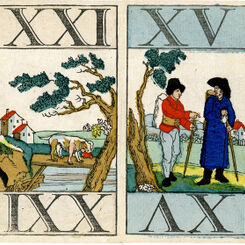
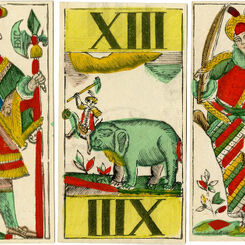
The images on Animal Tarots usually derive from fables or songs and often have a symbolic meaning, although no sayings or moral aphorisms are normally printed on the cards. In some cases the theme of the illustrations wanders and new motifs can appear. The ‘Fool’ card (third card in top row below) might be a flute or oboe player, a fiddler or a lute player. In this case he is a buffoon, whilst Trump No.1 is a monkey ‘Papageno’. The court cards are double-ended whilst the trumps have single-ended images with Roman numerals at each end.
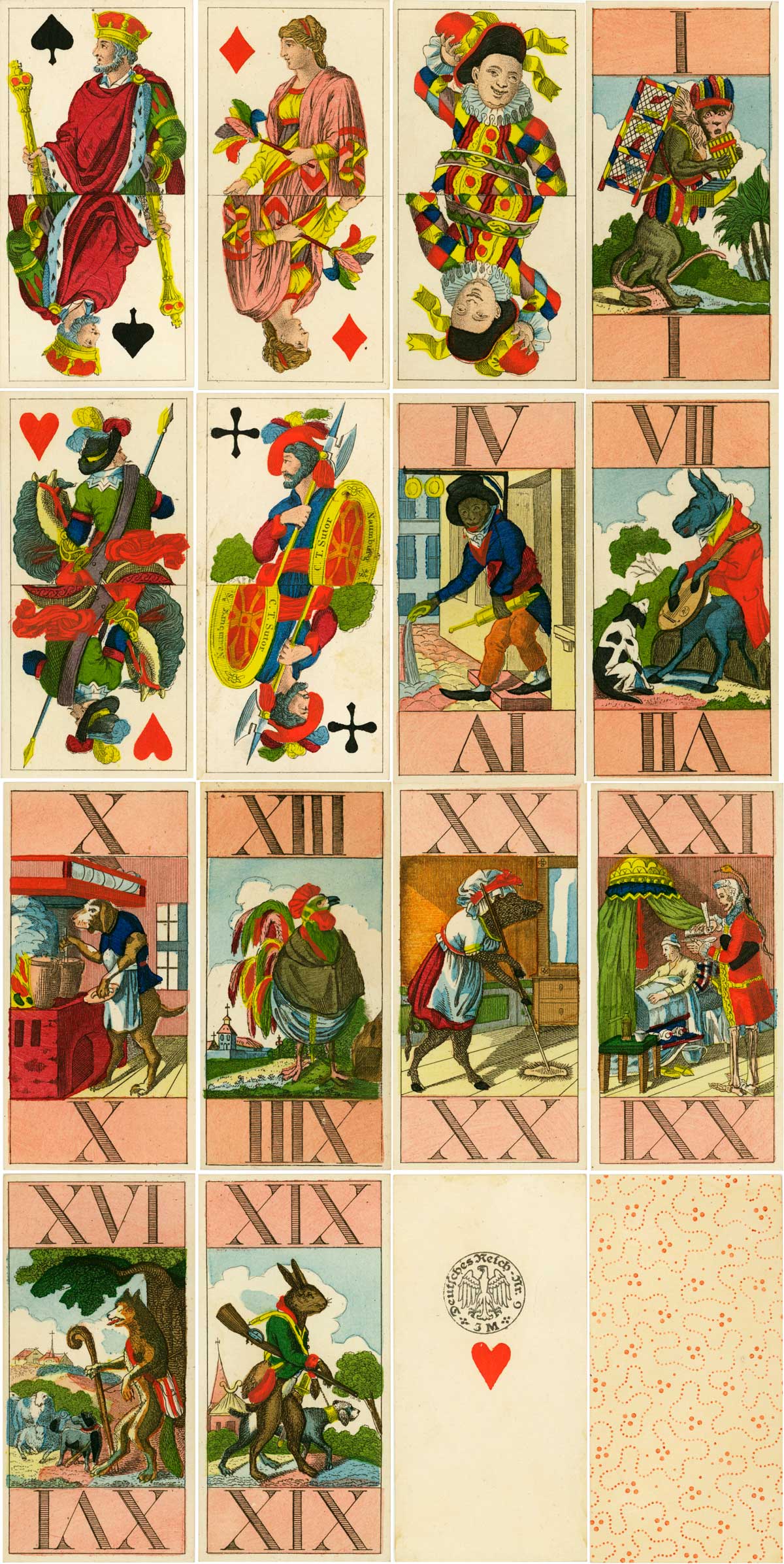
Above: cards from "Verkehrte-Welt-Tarock” (reverse world ?) manufactured by Christian Theodor Sutor (fl. 1823-1854), Naumburg, around 1850. Later tax stamp: Deutsches Reich No. 9.
An earlier edition of "Verkehrte Welt" was published by C. A. Müller in Berlin, c.1840. The trumps feature scenes involving animals occupying different positions, roles and performing human tasks that justify its title of “world turned upside down”.
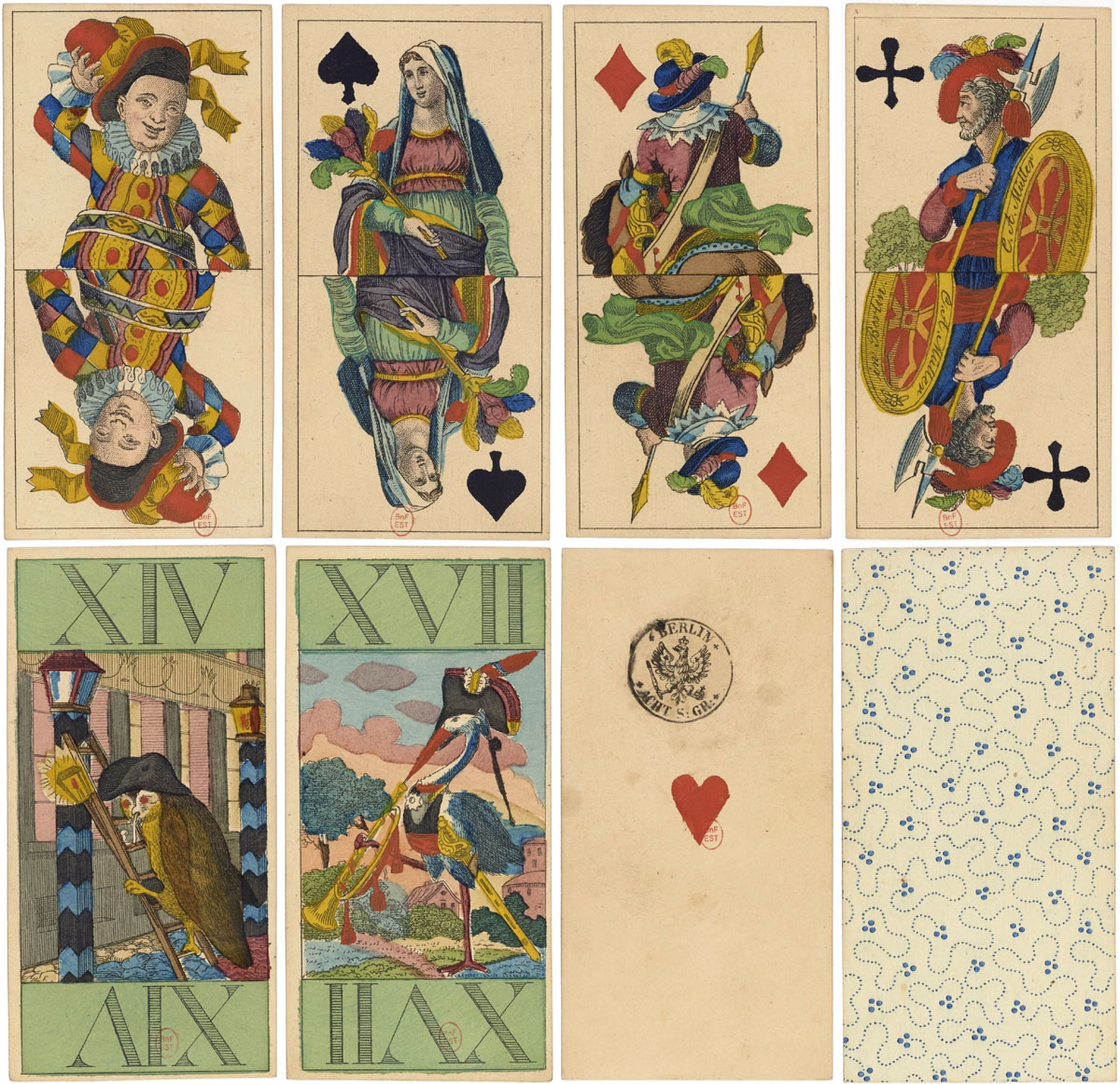
Above: fantasy tarot deck known as "Verkehrte Welt" published by C. A. Müller in Berlin, c.1840. 78 cards, stencil coloured etching; 10,5 x 5.3 cm. The tax stamp on the Ace of Hearts reads : “Berlin // Acht S. Gr.” The backs have a trefoil and wavy lines design dotted in blue. Source gallica.bnf.fr / Bibliothèque nationale de France • “Verkehrte Welt” tarot published by C. A. Müller, Berlin, c.1840►

By Klaus-Juergen Schultz (1948-2025)
Germany • Member since February 03, 2024
From the collection of Klaus-Jürgen Schultz.

Activity for Verkehrte-Welt-Tarock
Sign in to comment or save this article.

Related Articles
Ethnological Tarot by Joseph Fetscher
Joseph Fetscher's inventive, ethnographic tarot from Munich c.1820.
Austrian Tarock by S.D. Modiano
Modiano’s Austrian Tarock with country scenes has been in production for over 100 years.
Engel-Tarot
Set of major arcana designed by Alois Hanslian depicting angels throughout.
Animal Tarot by Johann Jobst Forster
French-suited 78-card animal tarot deck of the Bavarian type.
Mythological tarot by Michael Schatzberger
Mythological tarot by Michael Schatzberger, Passau, Bavaria, early 19th century.
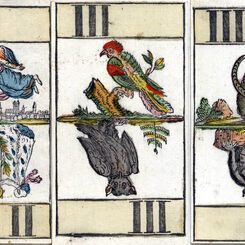
Animal Tarot by Joseph Fetscher
French-suited Natural History Tarot deck by Joseph Fetscher, Munich, c.1820.
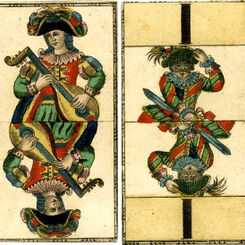
Mythological and Allegorical tarot
Mythological and Allegorical tarot produced by Peter Paul Fetscher junior, Munich.
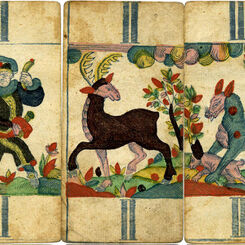
Animal Tarot by Andreas Benedict Göbl
French-suited Animal Tarot deck produced by Andreas Benedict Göbl, Munich.
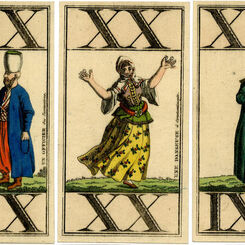
Costumes of Turkey Tarot
‘National Costumes of Turkey’ tarot by Industrie Comptoir, Leipzig, c.1800-1825.
Natural History Tarot
Natural History Tarot published by G M, Germany, early 19th C.
Animal Tarot by J. B Dubois
French-suited Bavarian Animal Tarot by J B Dubois, Liège, Belgium, late 18th C.
Æsop’s Fables tarot
French-suited Æsop’s fables tarot produced by Leipzig Industrie Comptoir, c.1800-1825.
Animal Tarot by J. T Dubois
Early 19th century Animal Tarot pack produced by J T Dubois, Liège, Belgium.
Animal Tarot by G. Larmoyer
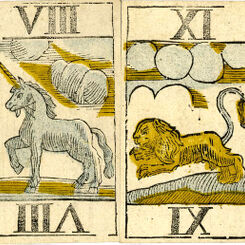
Flemish Animal Tarot deck by G. Larmoyer, Liège, 1753.
Bilder zum Tarot
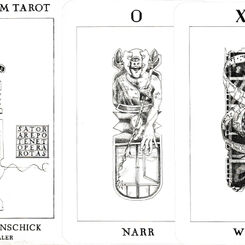
Detailed pen and ink drawings of the major arcana by the German artist Helmut Wonschick.
Animal Tarot by Johann M Backofen
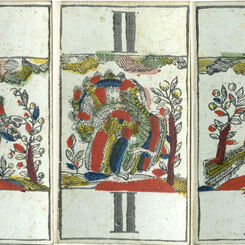
French-suited ‘Bavarian Animal Tarot’ by Johann Matheus Backofen, Nürnberg, late 18th C.
Wüst “Encyclopedic Tarot”
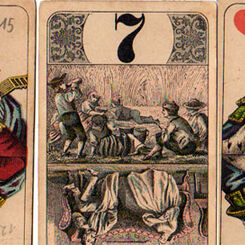
“Encyclopedic Tarot” by C. L. Wüst with “bourgeois” views of life on the Trumps.
Dondorf Tarot Aces
The four suits are associated with four countries: Clubs = Germany, Diamonds = UK, Spades = Russia a...
Bourgeois Tarot
Bourgeois Tarot by Vereinigte Altenburger und Stralsunder Spielkarten-Fabriken.
Animal Tarok by Jean Friedrich Mayer (1752-1783)
Animal Tarok by Jean Friedrich Mayer (1752-1783).
Most Popular
Our top articles from the past 60 days


