


Fantasy Italian style
Fantasy latin-suited pack with court figures in pseudo-medieval style, Fratelli Armanino, Genova, c.1890s.
This full-figure, latin-suited pack made by Fratelli Armanino, Genova, has some resemblances to Romagnole, Piacentine and Sicilian patterns but the court figures have been re-designed in fantasy, medieval style costumes. (The cards are reminiscent of Fournier’s Castilian pattern from the 1880s which had been conceived as a new definitive national pattern). The Armanino brothers’ firm was based in Genova until the 1920s when it moved to Rome and operated until c.1960. The name has more recently been revamped as a brand by Modiano.
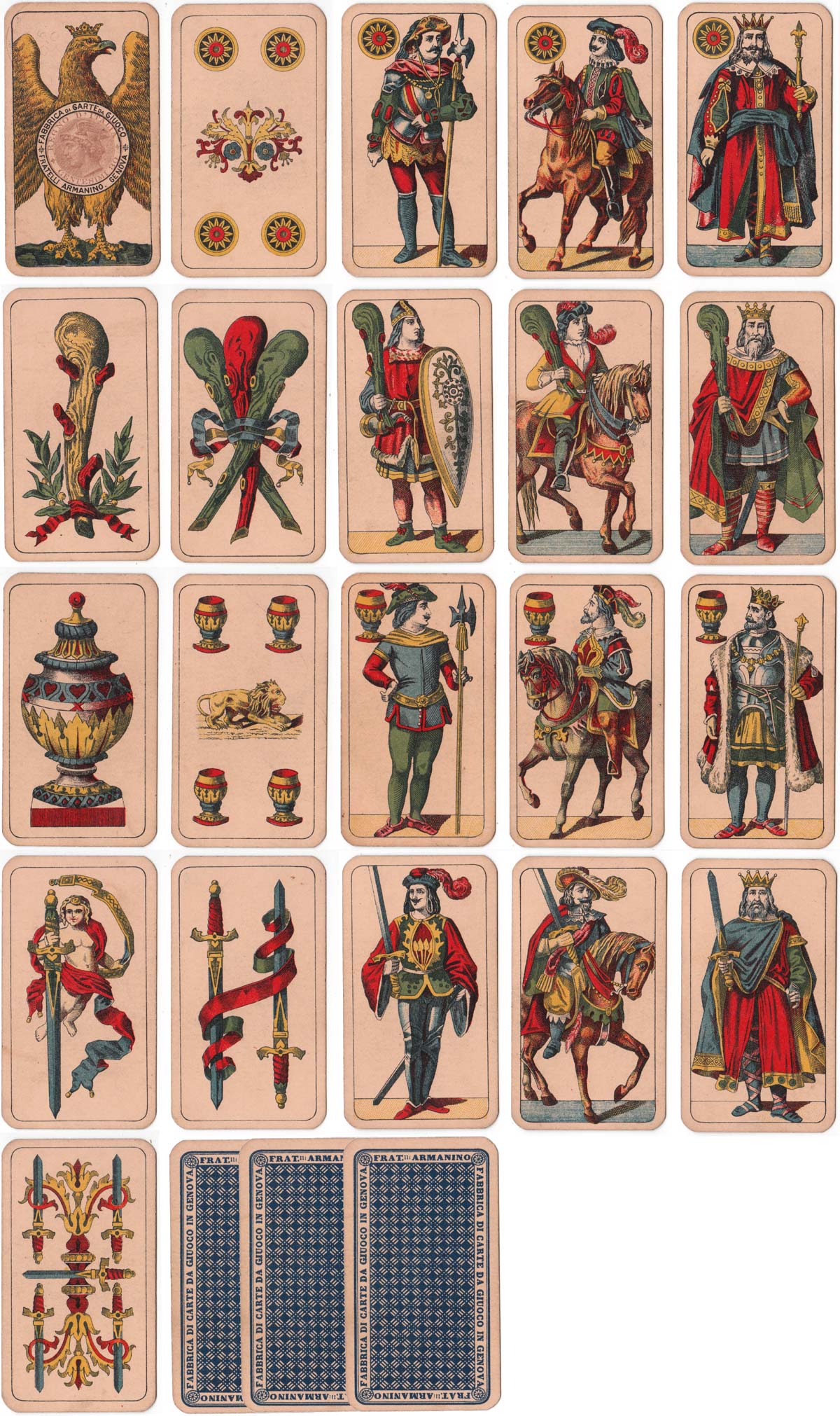
Above: non-standard Latin-suited pack with court figures re-designed in pseudo-medieval style, 40 cards, no indices, rounded corners, Fratelli Armanino, Genova, c.1890s.

By Rex Pitts (1940-2021)
United Kingdom • Member since January 30, 2009
Rex's main interest was in card games, because, he said, they were cheap and easy to get hold of in his early days of collecting. He is well known for his extensive knowledge of Pepys games and his book is on the bookshelves of many. His other interest was non-standard playing cards. He also had collections of sheet music, music CDs, models of London buses, London Transport timetables and maps and other objects that intrigued him.
Rex had a chequered career at school. He was expelled twice, on one occasion for smoking! Despite this he trained as a radio engineer and worked for the BBC in the World Service. Later he moved into sales and worked for a firm that made all kinds of packaging, a job he enjoyed until his retirement. He became an expert on boxes and would always investigate those that held his cards. He could always recognize a box made for Pepys, which were the same as those of Alf Cooke’s Universal Playing Card Company, who printed the card games. This interest changed into an ability to make and mend boxes, which he did with great dexterity. He loved this kind of handicraft work.
His dexterity of hand and eye soon led to his making card games of his own design. He spent hours and hours carefully cutting them out and colouring them by hand.

Activity for Fantasy Italian style
Sign in to comment or save this article.

Related Articles
Art Nouveau playing cards from Italy
from the Armanino factory in Genoa
Carte per Signora
“Carte per Signora” patience pack was produced by Fratelli Armanino, Genova, in c.1897.

Piacentine Pattern
Piacentine Pattern, several double-ended versions.
Piedmont Pattern
The Piedmont pattern is a very close relative to the French 'Paris' pattern. The courts are not name...
Tarocco Piemontese | Piedmontese tarot
The double ended version of the Piedmontese Tarot evolved during the second half of the nineteenth c...
Most Popular
Our top articles from the past 60 days


