


Sicilian Playing Cards
Sicilian Playing Cards by Dal Negro (Carte da Gioco).
The Sicilian Playing Cards (Carte da Gioco), produced by the historic manufacturer Dal Negro, is the traditional 40-card deck widely used throughout Sicily for games like Scopa, Briscola, and Tressette. Following the Italian pattern, the deck consists of four suits: Denari (Coins), Coppe (Cups), Spade (Swords), and Bastoni (Clubs). A very noticeable feature of these cards is their size: they are significantly smaller than most international decks, measuring only 51x82 mm.
The artwork is a refreshed version of the historic Sicilian pattern by Dal Negro. The Ace of Denari serves as the primary informational card, displaying the "Made in Italy" origin and the edition code "99E" around a central drawing of a joker. The 4 of Denari functions as the company signature card, showcasing the classic Dal Negro crown logo. A unique charm of the Sicilian pattern is the playful personality found on the low-numbered cards; these are decorated with small, supplementary vignettes of little humans, ships, houses, and dogs.

Above: Sicilian Playing Cards (Carte da Gioco) produced by Dal Negro, Treviso, Italy, 2000.
Most notably, the court cards consist of the Re (King), Cavallo (Knight on horseback), and the so-called Donna (a feminine Knave). While most Italian regional decks, such as the Neapolitan or Piacentine, feature an all-male court and refer to this lowest face card as a Fante (soldier), the Sicilian tradition identifies this card as a woman. This feminine presence is an archaic trait that predates the widespread adoption of the Queen in French-suited playing cards.
Author’s Note:
A good friend of mine traveled around Sicily while remote working during summer and saw the locals playing with these little cards. She immediately thought of me, so she went on a search to find a deck to bring back for me. Her personal favorite card is the 2 of Spade, purely because of the little dog depicted there!

By Konrad Hämmerle
Austria • Member since December 04, 2024
Konrad Hämmerle is a student and card artist from Vorarlberg, the westernmost region of Austria. He founded his own company with his deck Vorarlberger Büschel: a unique reinterpretation of traditional Jass cards. His deck showcases Vorarlberg’s rich cultural heritage, featuring detailed illustrations of traditional clothing, mythical creatures, and real historical figures from the region. Through this project, Konrad has become a true card enthusiast, particularly fascinated by playing cards that represent countries, regions, or historical themes. His passion lies in blending storytelling with design to keep cultural heritage and identity alive in the world of playing cards.

Activity for Sicilian Playing Cards
Sign in to comment or save this article.

Related Articles
EFFEGIEFFE
Corporate gift: a non-standard "Venice Carnival" deck by Dal Negro.
79: Goodall in Italy
A survey of the influence Goodall's courts had on Italian cards.
Le carte da gioco Arcimboldo
Courts and suit-signs inspired by the works of the Italian Renaissance painter, Giuseppe Arcimboldo....
Tarocco Indovino
Sergio Ruffolo’s “Tarocco Indovino” is an expanded version of his “Lo Zodiaco” cartomancy deck.
Carte Bolognesi
New designs reinforcing Bologna’s reputation as the gastronomic capital of Italy.
Lo Zodiaco
French-suited fortune-telling pack with distinctive designs by Italian artist Sergio Ruffolo.
Modet Sardegna
Costumes, masks and symbols from the island of Sardinia, with designs by Luciano Dettori and Tonino ...
Fernando Valenti
Designs by Italian artist Fernando Valenti issued to coincide with an exhibition of his work in 1986...
Baracca & Burattini
Baracca & Burattini puppetry deck printed by Dal Negro, 1998.
Le Avventure di Pinocchio
Avventure di Pinocchio by Dal Negro, based on Carlo Collodi’s famous 1883 novel “The Adventures of P...
Dal Negro Bridge set
Dal Negro Bridge set featuring old Vienna pattern courts.
Cities of Art - Naples
Striking views of Naples, photography by Cesare Gerolimetto, produced by Dal Negro.
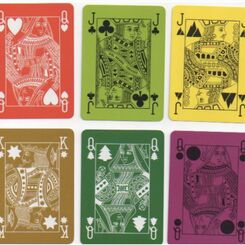
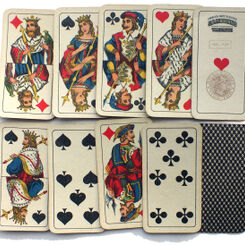
Lombardy (or Milanesi) pattern
The origins of the Lombardy pattern probably lie in the early 19th century when it was a full-length...
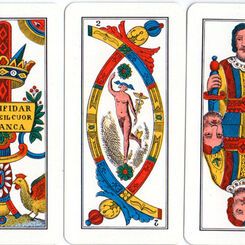
Trevisane pattern
The double-ended version of the ‘Trevisane’ pattern originated in the early 19th century.
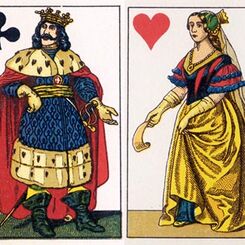
Florentine Pattern
Originally one of several designs which emerged during the nineteenth century, the Florentine patter...
Brescia pattern
The Brescia pattern contains elements which come from a past age.
Most Popular
Our top articles from the past 60 days


Adam Wintle
16 April 2026, 07:47SavedSaved this article to Researching & Reading
Jason Somers
10 June 2026, 06:25SavedSaved this article to Jason Somers's Collection